Choosing an MBA admissions consultant can be one of the most important decisions you will make in the business school application process. But in an industry where anyone can claim expertise, how can you distinguish consultants who offer truly effective guidance based on a depth of experience from ones who provide merely surface-level advice?
In this episode of The mbaMission Podcast, Host Harold Simansky sits down with mbaMission Founder Jeremy Shinewald and Senior MBA Admissions Consultant Nisha Trivedi to explore what actually makes a great MBA admissions consultant. Drawing on decades of combined experience helping thousands of applicants gain admission to top business schools, these three experts highlight the importance of institutional knowledge, rigorous training, collaboration among consultants, and the ability to guide applicants through every stage of the process—from school selection to storytelling. Together, they explain why applicants need to carefully evaluate a consultant’s experience, approach, and track record before seeking guidance.
New episodes of The mbaMission Podcast are released every Tuesday on all major streaming platforms, with full video episodes available on its YouTube channel. Sign up for a free 30-minute consultation with Harold, Jeremy, Nisha, or another member of mbaMission’s admissions team.


Table of Contents
- Who MBA Admissions Consultants Are
- mbaMission’s Rigorous Hiring and Screening Process
- Consultant Collaboration, Institutional Knowledge, and Applicant Resources
- How Admissions Consulting Is More Than Essay Editing
- Profile Evaluation and School Selection Strategy
- Track Record, Reviews, and Proven Expertise
- Admissions Officers versus Admissions Consultants
- The “Chef versus Food Critic” Analogy
- Avoiding the Formulaic MBA Application
- Red Flags When Choosing a Consultant
- Final Advice for MBA Applicants
Who MBA Admissions Consultants Are
Jeremy Shinewald: I’m so thrilled to be here with my co-host and friend Harold Simansky and my non-co-host but also friend, our guest, Nisha Trivedi, veteran consultant, longtime member of the team. Certainly one—I would say seriously, at the risk of flattering Nisha—one of those conscientious people, someone who just takes her clients so seriously and her own practice seriously. Anyone who works with Nisha is extremely lucky to be working with her. So thanks for joining us today. We’re here to talk about something that really sticks in my craw as someone who has built a firm in this space, which is the relative differences. We’re going to focus on us. We don’t want to talk too much about others, but I find that there’s a growing industry of overnight consultants who graduate from Wharton and declare themselves to be a Wharton consultant or go on a platform and claim that they’re an expert now because they’re at Harvard or something like that. And it’s just so different. You know, Harold has been a decade in this field, you’re [gestures to Nisha] almost a decade. I mean, [gestures to himself] 22 years! The institutional knowledge at our firm and across all of our consultants is just so significant.
And it’s like—there are so many examples I’ve given over the years—but it’s like, “I cooked a really good meal. I’m a chef now.” It’s like, “No, I’m not. I’m not prepared. I did really well. I followed the instructions. I am not prepared to make your family a very important dinner.” There are all sorts of reasons why people get into business school. It doesn’t necessarily make them qualified to be a consultant, even if they got into a top school. So I think it’s really, really important to focus on what separates us [mbaMission] in a positive way. I think it’s really, really important to talk about the commitment we’ve all made to this field. So at the highest level, can you just talk about how rigorous not just our hiring process is, but also our most basicscreening process is?

mbaMission’s Rigorous Hiring and Screening Process
Nisha Trivedi: Yeah, absolutely. So when we are hiring a consultant, the company, as I understand, gets many, many, many resumes.
Jeremy Shinewald: Kate Richardson, who leads our hiring committee, is inundated with requests all the time from other firms, from students—just inbound, before we’re even doing outbound.
Nisha Trivedi: Yeah, absolutely. We’re constantly getting resumes and cover letters and expressed interest in working with mbaMission. And so, first of all, there’s just getting through that screening process and being selected for an interview, which in and of itself is incredibly selective. And then I remember going through the interview process, I had to critique essays, I had to do a mock free consultation, the 30-minute meeting that we offer candidates who are applying to business school, with somebody listening in, I think a mock interview. And really, there were at least a few rounds of this. I talked to a few members of the staff to get a sense of their day-to-day experiences, and they asked me questions about parts of my previous work experience, even outside of admissions consulting, that would be applicable to this role. And in the end, I believe it’s like a 1% to 2% acceptance rate for consulting.
Jeremy Shinewald: One of the things I love about our process, first of all, is that I’m not even involved in it. It’s pure run, which is great. At the very end, I get to meet someone at the very end of that process. But one thing that I love about it is everyone has to agree every step of the way. So you can’t get through our recruiting process unless every person who’s part of that process—the four to five consultants who are doing the evaluation—all agree that you’re our quality before you can get that offer. And we’ve had amazing people, like, we’ve had so many admissions officers apply and just haven’t had the skills that we’re looking for, haven’t had the demeanor we’re looking for, haven’t had the writing skills. So we’re testing for everything. It’s so rigorous. It is not, “Hey, join our platform. If you can get five clients, we’re happy.” It’s “Hey, this is a calling for you. We want you to be committed.”
Consultant Collaboration, Institutional Knowledge, and Applicant Resources
Harold Simansky: Jeremy, let me just pause here. It also speaks to the infrastructure that we have as a firm. And what I mean by that is all of us are going to be interviewed by I forgot how many people—many, many people interviewed me, and I spent time with many people. But when I was finally hired, suddenly, I had a network of people I can just start bouncing ideas off of. And it’s not just can you become a consultant overnight, an mbaMission admissions consultant overnight? The reality is do you have an infrastructure around you? And if you’ve just become it overnight, it’s like the answer is no, you don’t, you simply do not.
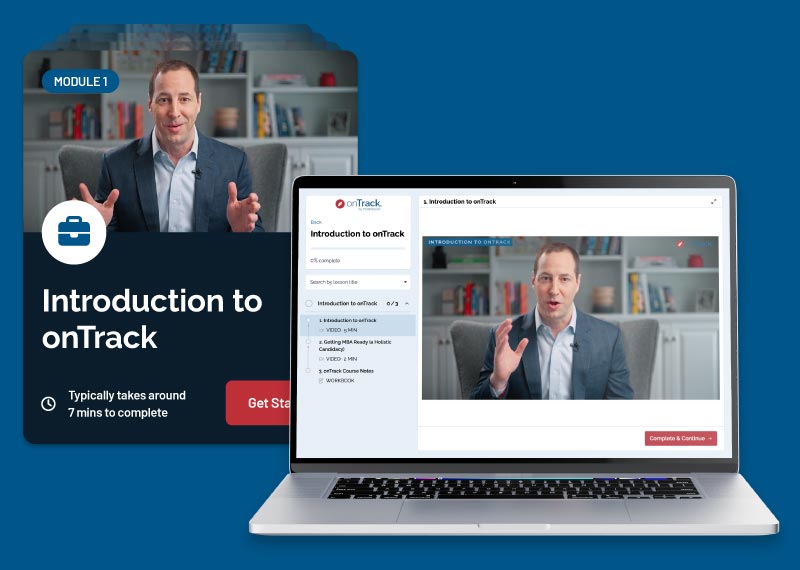
Jeremy Shinewald: At mbaMission, we have onTrack [by mbaMission], for example, which is a free resource. Well, you can sign up for a free version of it. You can upgrade to a paid version. We have put our collective wisdom into creating resources. This is a huge curriculum that supports our clients that you can use as a self-study curriculum. We have our own Insider’s Guides. We have our own Career Guides. I mean, I can go on and on. There are so many resources free or paid on our website that you can access. You just don’t have those things as a, “Hey, today, I’m a consultant!” You don’t have resume templates; you don’t have all the things that allow us to help people. You don’t have reference points for their colleagues.

Harold Simansky: I mean that’s the thing. The funny thing to me is Nisha is my colleague. When I have a question or an issue, I send her an essay to take a look at. I ask her questions, because at the end of the day, this is a profession that benefits from experience—not just your own experience, but the experience of the people you rely on.
Jeremy Shinewald: I have a client right now who I’m working with. I love the guy. He’s such a great, great applicant. I’m too biased now. I need to step away from him in the interviews because I just love what he does. I asked another consultant on our team, I asked a few, and two people stepped up to give him a mock interview. You can’t do that if you’re like, “Today I’m a consultant.” You don’t have the colleagues to call on to do the great work.
Just in general, also, before you’re actually an official consultant at mbaMission, you do a self-study program that’s very vast. We don’t hire you until you’ve completed a self-study program. There’s a capstone process where you have to prove yourself. Like, it’s rigorous. There’s mentorship before you become a consultant. There’s mentorship, there is reading, there are exercises before we can even say you meet the level that we need. I feel like everyone is obsessed with [the TV show] The Bear—I don’t know, placing spoons or something like that. Maybe we’re not quite that level, but you have to do a lot of work before we’ll even consider you to be part of our team. I remember years ago—this is so funny, I haven’t thought about this—years ago, someone called us and said, “I really would like to join your firm, but I’ve got another firm out there that’s willing to hire me now, and they don’t have all these requirements.” And I was like, “So you want to join the firm that is less strenuous so you can get to work now and deliver less than your best?” Like, great, go work for that firm. So I’m glad that person didn’t sign up with us. I get carried away with this because I’m pretty passionate about it. But let’s talk about the intensity of the work that we do.
How Admissions Consulting Is More Than Essay Editing
Harold Simansky: I think our work really covers everything. Frequently, particularly for folks who are just trying to do it [consulting] on the shoestring or overnight, they think that it’s just about essays. And at the end of the day, so much work has to happen before the essays. I frequently tell my clients that writing the essays is the easy part if you’ve done everything else well. And again, you sort of have to know something, and experience really shows this to you.
Jeremy Shinewald: If you’re going to assess the profile of a candidate, it’s like “So I just started yesterday, and I’m ready to go.” Or “I’m Nisha, I’ve done thousands of free consultations, I’ve worked with hundreds of clients. I know what the ins and outs of your profile are.”
Nisha Trivedi: Absolutely. Because that’s the thing, exactly what Harold said. A lot of times people think, “Oh, I need an admissions consultant because I need help with my essays and my resume and a mock interview later on.” Sure, we work on that, but it’s so much more than that, right? When I first meet a candidate, I help them assess their profile. What are their strengths? What are some watch-out points? And based on their goals and some other preferences, what is a good list of target schools? And there have been times where a candidate has told me, “I hadn’t thought about those schools. Let me look into it.” They end up applying, and sometimes they end up going there. And it’s because of that institutional knowledge that my colleagues and I have built up that we’re able to see certain patterns or make judgment calls in terms of a person’s profile or what direction they should go in. And so again, it’s very, very holistic.
Profile Evaluation and School Selection Strategy
Jeremy Shinewald: Assessing your profile or guiding school selection is something you just need the reps to do it properly. And then on top of that, the whole point of hiring a consultant is that we understand nuance, right? There isn’t some sort of easily understood path to getting there. “I was just laid off. What do I do?” [Or] “My recommender is being difficult. I’m not sure he’s going to make his deadline.” I mean, it goes on and on.
Harold Simansky: So frequently, it’s not just about what the client should end up writing about. Frequently, it’s also what the client should end up not writing about.
Nisha Trivedi: Exactly.
Harold Simansky: And that is really reflected in the experience we have. We’ve seen other people like them. We’ve actually had the opportunity to talk to other colleagues. Honestly, we do a lot of ding reviews as a firm. We do a lot of ding reviews, and sometimes, I’ll look at a ding review, look at their application, look at everything, and I think to myself, you know what? The consultant just went wrong. The applicant did a great job. They did everything they were supposed to do, but the nuance was missing there. And frequently, I hate to say it, but sometimes, the reason for that—there’s no escaping it—is they simply got wrong information [from the consultant] because the seasoning wasn’t there.
Jeremy Shinewald: Right. There’s an amateur consultant out there who’s just taking a few clients to pay off their ski trip or something like that. And it just doesn’t work. Is there any industry out there—I’m trying to think of—where a lack of experience is rewarded? You wouldn’t want the part-time doctor, the part-time attorney. Like “I’ve got to go to court. I’m going to go find someone who takes one client every two years.” [Or] “I’ve got to go to court. It’s making me anxious. I’m going to go find someone who’s on a platform who’s relatively inexpensive, and I’m going to have this person represent me.” Or “I’m going to go find an expert who has a lot of seasoning and nuance, and that person is going to do a great job.”
Track Record, Reviews, and Proven Expertise
Harold Simansky: I hate to necessarily put it this way, but go to Poets&Quants, go to GMAT Club. I think at the end of the day, sort of the proof is in the pudding. Nisha, I believe at this point, you have over 100 five-star reviews.
Jeremy Shinewald: That’s more than several firms. Seriously. More than most firms that are listed there, actually, because most firms are small, what I call “zombie” firms, that if they get a client, great. And the majority of the firms listed there have a very small number of reviews. They don’t have the kind of enduring success.
Harold Simansky: No, that’s right. Experience matters. As with everything, experience matters.
Nisha Trivedi: It does. I feel like I built up almost this Rolodex—to use a very vintage word—of experience, of having seen certain types of client profiles. And that’s what gives me the confidence to advise those I work with in terms of their application elements. And of course, as you mentioned earlier, Harold, we’re a group of full-time consultants. So, sometimes, if I feel like I need another opinion, I’ve bounced ideas off of you or one of our other colleagues, and that just gives me all the more conviction in the advice that I’m giving to my clients.
Admissions Officers versus Admissions Consultants
Jeremy Shinewald: Another format that we’ve sort of shied away from is the “we’re admissions officers” type of format. And we have several people on our team who have been admissions officers. It’s not necessarily a bad thing, but I can’t tell you how many admissions officers have not made it at our firm, have not made it through that screening or pre-training period and mentorship period. It’s because it’s a totally different skill. Helping someone be creative is not necessarily inherent. There are some admissions officers who can do it, but it’s not the same as having a creative side where you’re an extremely strong writer, you have a very high EQ. The ability to evaluate applicants is great for an admissions officer. It’s just not terribly helpful as an admissions consultant.
The “Chef versus Food Critic” Analogy
Harold Simansky: Listen, I’m going to get to the punchline that invariably all of us get to: Would you rather have Steven Spielberg making your movie, or do you want to have the top movie critic for the New York Times making your movie? And it’s sort of obvious at that point. The reality is that you want the person who knows how to create the great product, not the person who knows how to critique the great product.
Nisha Trivedi: Exactly. And it’s also, we actually have a blog post about this, what’s the difference between a food critic—so kind of like what you just said, a food critic—and a chef, right? It’s one thing to critique an application, to recognize a good application, but to work with somebody on actually constructing the elements, that’s what we do as admissions consultants. And that is a different skill set from being an admissions officer.
Jeremy Shinewald: And as I said before, what’s the difference between a chef and someone who just pulled off a really good meal? Just because you got into a program, there are so many different ways [to do that].
Harold Simansky: That’s absolutely true. Or your brother got into a good program.
Jeremy Shinewald: Yeah. Or “My boss went to Harvard in 2001. And he’s going to read my essays.” Okay, that’s fine.
Avoiding the Formulaic MBA Application
Harold Simansky: And again, just to be clear here, the issue with that is they’re trying to take you and make you sound like somebody else. And I think that that’s the biggest problem with inexperienced consultants, this notion of there’s only one formula, there’s only one type of person who gets into these programs, and I’m going to make you look like that as opposed to figuring out what you look like and what about you is going to be most important.
Nisha Trivedi: Exactly. And so that’s the thing. I get to know my clients deeply so that I can make sure their voice, not mine, not anyone else’s, comes through in their application elements, and it’s really recognizing the unique strengths that they bring to the program.
Red Flags When Choosing a Consultant
Jeremy Shinewald: Anyone who says to you, “I’m going to help you discover your personal brand” or “I went there, I know the way, I understand how to do it,” run for the hills. It is so much more nuanced and complicated. It requires judgment.
Harold Simansky: I personally see it every day. And what I mean by that is I look at essays that were written by some of Nisha’s clients, and the beautiful thing about them, and I don’t want to embarrass Nisha, is one essay does not seem to be like another essay. This idea that Nisha takes the time, and all of us do, to get to know that person and how that person communicates most effectively that’s right for them, that is not right for somebody else. And a commercial here for Nisha. If you want to, by all means, sign up for a free 30-minute consultation with Nisha. She’ll help you think through some of those things. Sign up for a 30-minute conversation with me or with Jeremy.
Final Advice for MBA Applicants
Jeremy Shinewald: Because we all know what we’re doing. And we’re ready to help you from the moment you’re on that free consultation call. And we always say this is your first half an hour of paid time, only it’s free. The point is we’re not holding anything back. You’re going to experience what it’s like to talk to an expert like Nisha when you call for that free consultation. I don’t want to belabor the point. I think we’ve made our point. I think this has been really great. I hope that every applicant will watch this one and will sort of do the homework necessary to find the right consultant for them. Because, admittedly, we’re in an unregulated industry, and people can just pop up and say, “Okay, I’m a consultant,” and it’s super important to actually know what you’re getting and to really, really do that homework. So, thanks for having this discussion with me, guys. Thanks for being here, Nisha.
Harold Simansky: Thank you, Jeremy. Thanks for coming on to my podcast tonight.
Jeremy Shinewald: I always love being on your podcast, Harold. We’ll see you next time.