

Blog

Projected Impact of the U.S. Supreme Court Affirmative Action Decision on MBA Applications

What did the Supreme Court decide on affirmative action?

This past Thursday, the U.S. Supreme Court barred using race as a factor in college admissions, ending a decades-long struggle wherein successive courts have endeavored to square affirmative action with the Constitution’s guarantee that all races be treated equally.

The first test came in 1978, when racial quotas and minority set-asides led to court challenges to affirmative action as a form of “reverse discrimination.” In the Regents of the University of California v. Bakke case,  brought by a white man denied admission to the UC Davis School of Medicine, the Supreme Court banned colleges from setting racial quotas but allowed schools to consider race as a “factor” in the admissions process. In 2003, a divided court in the Grutter v. Bollinger case reluctantly allowed colleges to consider race, deeming attracting underrepresented minority groups a “compelling governmental interest,” but one that was subject to strict scrutiny. At the time, Justice Sandra Day O’Connor noted that affirmative action was a temporary corrective measure, however, stating the expectation that “25 years from now, the use of racial preferences will no longer be necessary.”

This week, the Supreme Court found that Harvard and the University of North Carolina had simply gone too far. The two schools’ race-conscious admissions programs failed to abide by the narrow restrictions the court had laid out in previous cases and “unavoidably employ race in a negative manner, involve racial stereotyping, and lack meaningful end points.” Chief Justice John Roberts concluded, “Many universities have for too long wrongly concluded that the touchstone of an individual’s identity is not challenges bested, skills built, or lessons learned, but the color of their skin. This Nation’s constitutional history does not tolerate that choice.” In short, eliminating racial discrimination means eliminating all of it.”

At the same time, Justice Roberts commented that “nothing in this opinion should be construed as prohibiting universities from considering an applicant’s discussion of how race affected his or her life, be it through discrimination, inspiration, or otherwise. But . . . universities may not simply establish through application essays or other means the regime we hold unlawful today.” He added, “What cannot be done directly cannot be done indirectly.”

How will this decision affect MBA applications?  

Probably not in any significant way.

Nine states already ban using race in admissions, including California, Washington, and Florida. Moreover, affirmative action is primarily a burning issue at the most selective colleges, where grades and scores are the dominant assessment criteria, so not all schools will see much change.

Unlike undergraduate or other more-academic graduate programs, top MBA programs are looking for leaders. In addition to evaluating more-mature candidates, typically with four to six years of experience, they assess a holistic set of factors, looking at the applicants’ professional background, career goals, and outside leadership experience, as well as their grades and test scores. Moreover, the schools are consciously trying to assemble a broadly distributed class of students who represent different jobs and industries, career goals, and socioeconomic and personal backgrounds. So, MBA applicants have ample opportunity to highlight their individuality and differentiate themselves in their essays, recommendations, and outside activities. 

Although schools can no longer use race as a factor in admissions, MBA applicants can still describe in their essays how race has affected their life. This means that even though underrepresented minorities no longer receive an automatic “plus,” they can nevertheless discuss their differentiating background in their essays. At the same time, students from overrepresented populations (e.g., Caucasian, Asian, South Asian American) can do the same and will now be on an equal footing.

Entrepreneurship at Northwestern Kellogg and Chicago Booth

How about a quick game of word association? We will start.

“Kellogg.”

Okay, go ahead. “Entrepreneurship,” right? No? Aspiring MBAs may be surprised to learn that Northwestern University’s Kellogg School of Management offers a number of courses in this discipline and that its Entrepreneurship and Innovation major is among its most popular areas of study—defying the stereotype that Kellogg produces only marketing MBAs.

Overseen by the Larry and Carol Levy Institute for Entrepreneurial Practice, the Kellogg Innovation & Entrepreneurship Initiative (KIEI) offers numerous opportunities for students to develop their entrepreneurial acumen and currently features a total of 50 professors in its faculty. In addition to business plan competitions, the Levy Institute manages the Kellogg Early-stage Entrepreneurial Internship Program Stipends and the Entrepreneur in Residence Program, an experiential learning option through which, for a day, an experienced entrepreneur hosts half-hour one-on-one sessions with students who aspire to careers in this field or are seeking advice on their already active projects.

The school’s Heizer Center for Private Equity and Venture Capital offers the Private Equity Lab, wherein rising second-year students intern with small businesses or private equity firms to facilitate career transitions that would otherwise be challenging for those without experience. MBA student entrepreneurs coming from or planning to enter a family business will likely be interested to learn that the Kellogg John L. Ward Center for Family Enterprises not only publishes research and cases on such businesses but also confidentially consults with family-run companies. Indeed, this is all just the tip of the iceberg.

Let us continue the guessing game: Chicago Booth is just a finance school, right? Not at all. We feel that not enough applicants are aware of Chicago Booth’s robust “hands-on” entrepreneurial offerings, which are available through its Polsky Center for Entrepreneurship and Innovation. Where to begin?

Chicago Booth’s practical academic programs extend into the field of entrepreneurship with the school’s “New Venture and Small Enterprise Lab.” Herein, students work within a host firm or take on a dedicated project in a class designed to train those who intend to ultimately join start-ups or provide consulting services to them. Other courses offered by the Polsky Center include “Lab to Launch,” “Building the New Venture,” and “Entrepreneurial Selling.” In addition, the Polsky Center sponsors the annual Edward L. Kaplan New Venture Challenge, a business plan competition that awarded more than $1.4M in funding to its 2023 winners.

Further, entrepreneurially minded Chicago Booth students can apply for funding from the Hyde Park Angels (HPA), a group of former Chicago Booth Executive MBA students who make investments in start-ups—in 2020, for example, the group invested nearly $14M. Although the HPA is an arms-length organization and does not source investments exclusively from Chicago Booth, it maintains a connection to the Polsky Center, which supports the HPA’s mission. So, students hoping to get in front of the HPA’s investment committee will have a built-in networking advantage. Also, the HPA offers students the opportunity to apply for the Hyde Park Angels Venture Capital Award, which is only available to Chicago Booth students.

Believe it or not, we are just scratching the surface here. Again, Chicago Booth is most definitely not “just a finance school.”

For more information on Northwestern Kellogg, Chicago Booth, and other leading MBA programs, check out our free mbaMission Insider’s Guides.

Harvard Business School Essay Tips for 2016-2023

Please note: Harvard Business School revised their application essay prompts for the 2024-2025 admissions season. An analysis of the latest essay prompts can be found on this page

How do you write a standout Harvard Business School (HBS) admissions essay? The answer might surprise you. Your goal is not to “wow” the admissions committee with fancy adjectives or to share spectacular achievements that admissions officers have never read or heard about before. Instead, your HBS admissions essay is your opportunity to share your values—to stand out on the basis of who you are and what you stand for.

Let us start with the basics. HBS actually has just one essay question, with no word limit: “As we review your application, what more would you like us to know as we consider your candidacy for the Harvard Business School MBA program?”

The first thing to note about this question is that it is totally open-ended. Because it is so open-ended, many applicants have no idea where to start. And without a word limit, many also have no idea where to stop! Let us address the end first. We recommend that applicants target 1,000 to 1,250 words, but some candidates’ essays might be as short as 800 words or as long as 1,500. However, anything longer than 1,500 words can start to seem like an imposition on the admissions reader, while anything shorter than 800 could mean that you are short-changing yourself and not giving the admissions committee as full a picture of who you are.

As for the open-ended nature of the question, the whole essay really hinges on the word more—“what more would you like us to know?” The admissions committee should already be able to learn a lot about the path you have taken via your resume and short answers, and they should also learn about your professional performance and character via your recommendations. But through your essay, they should truly learn more about you. As I noted earlier, the goal of your essay is to share more about your values—possibly even about your soul.

To help illustrate my point, I would like to review here a successful application essay from my book “What Matters?” and “What More?”: 50 Successful Essays for the Stanford GSB and HBS (and Why They Worked), titled “Shhh! Can You Hear Me Listening?” If you do not have a copy of the book, you can download the essay here. I want to start by highlighting a few key takeaways. First, this is not an essay about the kind of vocal leadership many people expect from an HBS MBA. In fact, it is the exact opposite; it is an essay about the often undervalued skill of listening and how it is reflective of the applicant Paul’s empathy. Those are the values Paul highlights throughout the essay: listening, empathy, better listening, more empathy. Rather than trying to hew to some perceived notion of who he thinks he “should” be for HBS, Paul discusses who he actually is! By doing so, he gets to a truly authentic place—he shares his soul. Second, this essay, like almost all essays should be, is a story of growth and change. We get a sense of both who Paul was and who he is now, and although he is not a radically different person, his growth and his ability to effectively wield his sense of empathy reveal themselves as very powerful, making his story compelling for the reader.

Common GMAT Concerns: Taking the Test Again and Dealing with a Low AWA Score

When candidates who have already taken the GMAT once ask us whether they should take the test again, we always reply with this key question: “Do you think you can do better?” If the individual does indeed believe that they can improve, the next question we inevitably get is “What do business schools think of multiple scores?”

Fortunately, most MBA admissions committees do not frown on candidates taking the GMAT more than once. Many applicants feel that they must be “perfect” the first time and that any subsequent test they take—particularly if they receive a lower score on it—might be damaging to their candidacy. This is not the case.

Accepting a candidate’s highest GMAT scores is actually in an MBA program’s best interest, because doing so can help raise the school’s GMAT average, which is then reported to rankings bodies such as Bloomberg Businessweek and U.S. News & World Report and could positively affect the school’s position in these surveys. So, do not be afraid to take the test two or even three times. It can only help.

Now, if you took the GMAT and feel like you finally “nailed” the exam but later learn that your score on the Analytical Writing Assessment (AWA), the essay portion, is low, should you panic?

In short, the answer is no. Although we have always encouraged business school candidates to do the best they can on the AWA, the truth is that we have never been told by an admissions officer—nor, as far as we know, has a candidate ever been told in a feedback session—that the AWA score is a factor in a school’s decisions. Generally, the AWA is not used to evaluate candidates but to detect fraud.

If, hypothetically, you had tremendous difficulty expressing yourself via the AWA essays but wrote like a Pulitzer Prize winner in your application essays, the school would get suspicious and begin to compare the two. Not to worry—the schools are not punitive and are not acting as fraud squads. Your AWA essays are expected to be unpolished, so no one will seek out your file if you did your best in both areas. However, if an enormous discrepancy arises between the two, the AWA serves a purpose.

So, if you did well on the GMAT and have a low AWA score, that is unfortunate, but it will not be the difference in a school’s decision about your candidacy. Rest easy—as long as you truly did write both!

Upskilling: Invest in Online Coursework 

During the COVID-19 quarantine days, career professionals wrote a lot of articles about using one’s available time to build up and learn new business skills, and many people did just that. But this is a valuable activity to consider anytime, not just during a global pandemic. 

So, where should you start? Although completing an internship is a great way to develop skills and gain exposure to new ideas, you can also expand your knowledge through online courses. 

Check out the low-cost—or in some cases, free—opportunities available through the following online learning platforms: 

Other platforms offer certifications that might be even more relevant for your industry or function but might require more of a commitment of time and money. Additionally, many universities offer access to their online courses, such as UCLA Extension.

To find the right course or program for you, reflect on your goals and do your research, then consider these criteria: 

Your objective

Why are you interested in enrolling? What do you want to learn? What skills do your target companies seek? Do you need a certificate of completion? Do you want to take one course or multiple courses? 

Industry or functional standards

Ask current and former colleagues, friends, mentors, and others for recommendations. Look at the LinkedIn profile of people in your target role to see what types of certificates and/or coursework they completed. 

Quality of content

What do the course reviews and ratings say? Who is the instructor, and what is their level of expertise? What are the learning outcomes? 

Logistics

Will you need to purchase any materials? What is the price of the course? What is the class size? What is the format of the course: asynchronistic or synchronistic? What is the duration of the class/required commitment (i.e., number of hours)? 

Finally, once you select and enroll in an online course, maximize your learning opportunity by approaching it in the following way:

  • Treat it like a “real” course. Show up! Have the discipline and dedication to listen to classes and complete your homework. 
  • Hold yourself accountable. Set goals at the beginning of the semester, and check in with yourself weekly. Allot sufficient time to complete the required work. 
  • Create a regular study space, stay organized, and avoid distractions. 
  • Figure out how you learn best, and actively participate. 
  • When completed, add the course/certification to your resume and LinkedIn profile. 

What is the best way to showcase your accomplishments or mitigate your weaknesses? Start getting answers to all your questions by taking advantage of a free 30-minute consultation with an expert from mbaMission’s team of consultants.


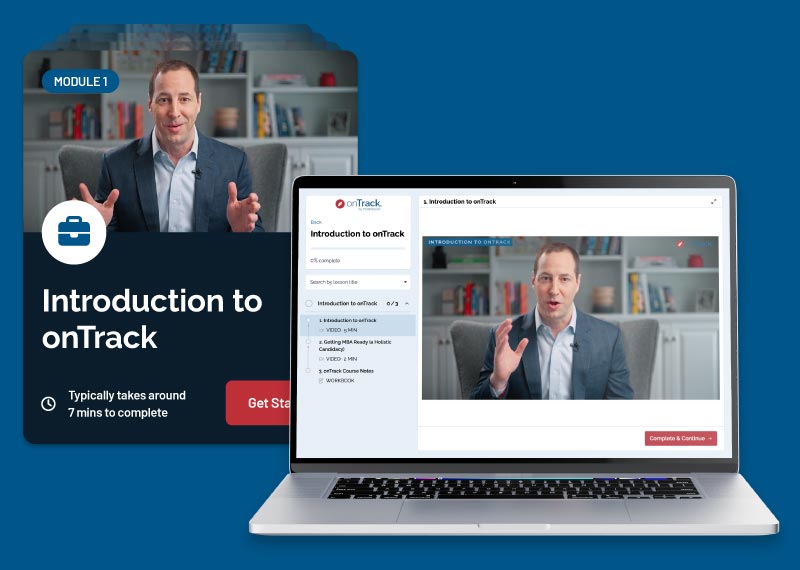
onTrack by mbaMission

A first-of-its-kind, on-demand MBA application experience that delivers a personalized curriculum for you and leverages interactive tools to guide you through the entire MBA application process.

Get Started!

2026–2027 MBA Essay Tips

Click here for the 2025–2026 MBA Essay Tips


MBA Program Updates

Explore onTrack — mbaMission’s newest offering allowing you to learn at your own pace through video. Learn more