
Blog

Round 1 vs. Round 2 vs. Round 3: When Should I Apply?

At most top business schools, aspiring MBAs apply in one of three application rounds: Round 1 in September or October, Round 2 in January, and Round 3 in March or April. As an applicant, you might be wondering, When is the ideal time for me to apply?

Round 1 is generally considered the best one in which to apply. The schools’ classes are wide open, and the admissions officers have fresh eyes—no application fatigue from reading thousands of applications just yet. Applying in the first round also emphasizes your interest in the program. You are showing the admissions committee that you are committed and really want to be admitted to their school. Round 1 is also particularly beneficial for candidates from overrepresented groups, such as consultants and private equity applicants. Because the programs can accept only a certain number of applicants from these crowded pools, anyone in these groups will want to grab their place in the class before the schools no longer have the flexibility to make them an admissions offer.

Does that mean you should throw in the towel after Round 1, then? Absolutely not. Most MBA programs actually admit the most applicants in Round 2. So, if you are a very strong applicant in Round 1, you should be just fine in Round 2, when the dynamic changes imperceptibly but not that substantially. And if you can use the time leading up to Round 2 to improve your profile in a meaningful way—such as by pushing your tests scores up significantly or earning a promotion—then waiting to submit until then can be very much worthwhile.

What about Round 3, or the last round for those MBA programs that have four rounds? This final round is what most schools refer to as a “shaping” round. The admissions committee has given out many offers by this point and is starting to see how the class is taking shape. So when Round 3 comes around, they might say, for example, “We need a few more countries represented. Be on the lookout for international candidates!” or “We usually have a higher number of women in our class. Let’s take steps to balance out the class in this round.” While an absolutely remarkable applicant can get accepted in any round, Round 3 is almost never the right time for an overrepresented candidate to apply. The final round is really for applicants who can help the admissions officers create a diverse class or who offer unique professional experience (e.g., an ER doctor) that might otherwise be lacking.

One last round to mention is Early Decision, which is not broadly used in MBA admissions but is available at a few top programs, including Duke Fuqua and UVA Darden. Early Decision is a way to get preferred consideration and to know your outcome much earlier in the process, but it comes with a nonrefundable financial commitment. Plus, if you are accepted, you must rescind all your applications to other schools. So, if your target school offers Early Decision, make sure that you are 100% certain you want to commit to that program before you decide to apply in that round.

To view the upcoming application deadlines for approximately 30 top domestic and international MBA programs, you can visit our deadlines page here. And if you have any questions about which round you should apply in, we encourage you take advantage of our free, 30-minute consultation to discuss your options with one of our experts.

Setting Yourself Apart on LinkedIn: The About Section

This post was written by our resident Career Coach, Elissa Harris. To sign up for a free 30-minute career consultation with Elissa, please click here.

An effective LinkedIn profile for job searching or increasing your professional visibility requires more than cutting and pasting information from your resume into the online platform. 

You can craft your About section in lots of different ways. To help you determine what is best for you and your profile, here are five questions that can help you create an About section that makes a positive first impression:

Does it tell your story? Does it clearly convey how you add value in a professional setting?

Use the About section to explain who you are as a professional (e.g., industry, function, and level of seniority), your skills and contributions, and your passions. The About section is basically the “pitch” (or introduction) you would give verbally during a networking conversation. Do not shy away from incorporating a bit of your personality. 

Does it appeal to your target audience? Does it adhere to your industry’s norms? 

Your About section should not be a summary of everything you have done but rather a forward-looking curation of the most relevant things you have done that you want to keep doing in the future. Who is your intended audience? What information is most compelling to that audience? 

Does it quickly grab the reader’s attention?

Although you have 2,000 characters in the About section, only 200 characters are visible to the reader without their clicking “see more” to read the rest. Write a catchy (not cheesy) first sentence that captures who you are and encourages the reader to continue engaging with your content. Maintain the reader’s attention by writing in short paragraphs or using bullets; limit the total length of your About section to no more than 300 words.

Are you using relevant keywords? 

Avoid overused words (e.g., “passionate,” “expert,” “experienced,” “leadership,” “creative”), which can become meaningless unless you demonstrate those attributes. Consider the terms a recruiter might plug into the search bar—perhaps job titles or industry-specific vocabulary—looking for somebody with your expertise. Use those words in your About section. 

Is it error free? 

Proofread! Ensure that the content is easy to digest quickly and has no grammatical mistakes or typos. Confirm that all the information is factually accurate and appropriate for a public platform. 

If you get stuck, try the following tips to identify appropriate content for your About section:

  • Reflect on your values and goals. What are your guiding principles? Why are you passionate about your current job or industry? Do you have any unique knowledge?  
  • Review the LinkedIn profiles of people in your industry and/or people who have your target job. Identify what you like and dislike about their About section. 
  • Read job descriptions that interest you, and take note of recurring hard skills and keywords—especially in the responsibilities/tasks section. 
  • Record your verbal introduction. Write down what you said, and then tweak the language to be appropriate for the written form. 
  • Ask friends and colleagues to describe you and how you contribute at work.

Five Things to Do During Your Pre-MBA Summer to Prepare for Your Internship

In this blog series, our mbaMission Career Coaches offer invaluable advice and industry-related news to help you actively manage your career. Topics include building your network, learning from mistakes and setbacks, perfecting your written communication, and mastering even the toughest interviews. To schedule a free half-hour consultation with one of our mbaMission Career Coaches, click here.

With the start of orientation less than two months away for many MBA programs, we know some of you are finishing up your jobs, planning cross-country (or international!) moves, and thinking about how to transform your career goals into reality. 

Business school will offer you tremendous opportunity for personal and professional growth, but preparation is key to taking full advantage of this opportunity. Here are five actionable steps you can take to lay the foundation for a successful internship search before you even set foot on campus:

1. Evaluate and narrow down your career goals. 

Write down each major job/role you have had to date, and for each one, record the following information: what you liked most/least about the role, what skills you developed in the role, and how the role related to and/or influenced your current career goals. Employers want to know why working at their organization makes sense for you; this exercise will help you identify information and examples you can use in your career narrative. 

2. Update your network. 

Send personalized emails to your contacts letting them know you are leaving your job and will be attending business school. Explain your career goals and thank them for their support. Change the headline in your LinkedIn profile to reflect your upcoming MBA experience (e.g., “MBA Candidate @ XXXX | Focused on XXXXX”), and in August, post about your arrival on campus on your LinkedIn news feed. 

3. Become an “insider” in your target industry. 

Identify and read trade publications and relevant industry news sources to understand the challenges facing your target industry (as well as recent hiring trends). Use the information you gather to develop a perspective on your target market. Learn how your intended industry hires MBAs. Via on-campus recruiting? Or will your job search need to be very networking driven ? 

4. Identify at least ten potential target companies. 

As you do your research, make a robust list of potential employers. Look beyond the obvious ones (e.g., Google, McKinsey & Company) and consider other firms. Which ones provide similar services? Which ones offer the opportunity to develop some of the same skills? Follow these companies on LinkedIn. See how they position themselves and what they are doing to address changing market dynamics. 

5. Write down any potential obstacles to your internship search. 

We know that the internship search can be overwhelming, and feeling apprehensive is totally normal, but discussing your concerns with a career advisor and/or your peers will help you discover actionable ways to overcome them. For example, many international students might realize that American-style networking is completely new to them. Finding ways to learn the nuances of this networking approach and gaining comfort with it will be critical for job search success.

Here is one final tip: read all emails from your MBA program—especially those from the career management office! Schedule an advising appointment with the career center as soon as such meetings are made available to incoming students. Given the tighter job market, getting an early start and incorporating job search best practices into your process will help you optimize your time and differentiate you as a candidate.  

We at mbaMission are so excited for your new journey and wish you the best of luck. And remember, we are always here to support you and can supplement offerings from your school’s career center, if needed. 

Have you been admitted to business school? If so, do you want to get a head start on defining your career goals? Do you need help preparing for job interviews or learning how to effectively network with your target employers? Or maybe you want to be a top performer in your current role but are unsure how to maximize your potential. Let an mbaMission Career Coach help via a free 30-minute consultation

When to Submit an Optional Essay

Luckily for business school candidates, MBA admissions teams recognize that behind every application is an actual human and that one’s story does not always fit neatly into designated boxes. This is where the optional essay (or “additional information” section) comes into play, allowing applicants to explain or clarify any potentially negative elements of their profile and provide additional perspective that should be considered in the admissions committee’s assessment of them.

Importantly, the optional essay is truly that—optional! If you do not have a good reason to submit one, do not feel that you need to; no points will be deducted for not taking advantage of the opportunity.

Here are some situations in which you might want to consider using the optional essay:

  • Unexplained gaps in your work history
  • Choice of recommenders, particularly if not following any explicit direction from the school
  • Unfavorable or questionable academic performance
  • Nonrepresentative GMAT/GRE scores
  • Academic disciplinary issue
  • Layoff/firing or significant professional or academic time off
  • Arrest, charges, and/or conviction

Given that the optional essay is typically used to provide further context around a blemish in one’s profile, you must take ownership of the situation you describe in your essay and show self-awareness. Openly acknowledge the element of your candidacy that warrants additional explanation. You might worry that doing so will draw attention to it, but we can assure you that the admissions committee will notice any such issues anyway! So rather than leaving the committee to make assumptions about the situation, proactively control the narrative and mitigate the issue by leveraging the optional essay in a constructive manner.

After providing brief, yet transparent, context for the situation, move on to how you addressed it, and share any positive change that resulted from it or highlight a “hidden” element of the situation that can be positioned in a positive light. For example, perhaps your undergraduate GPA is lower than your target school’s average, but you can show a trend of improvement over time and explain that you recognize the importance of taking academics seriously and regret that you did not focus more on your studies when you first arrived on campus. Ideally, you would also be able to highlight a strong test score to offset a weaker GPA. Or perhaps your quantitative test score is not as strong as you would like, so you took and excelled in supplemental coursework in such key business school topics as accounting, economics, and business analytics. You might also have successfully navigated a recent work project that called for significant quantitative prowess, driving positive results for your company. Leverage the optional essay to speak to these kinds of experiences, giving the admissions committee reason to feel confident in your ability to successfully manage the quantitative rigor the MBA curriculum demands.

Importantly, consider writing your optional essay as a final step in preparing your application submission. You want to ensure that it complements your essays and other sections of the application and is not duplicative. This is also an opportunity to assess your application in totality and confirm that all relevant elements of your candidacy are represented. If not, you can also use the optional essay/additional information field to share pertinent information that enhances your overall profile and that the admissions committee should take into consideration. Of course, any additional information you offer, even positive in nature, must be truly meaningful and not frivolous. Again, this opportunity is optional and misusing it could be a disservice to your efforts to submit the best possible application.  

The examples shared in this article represent only a few potential situations one might want to discuss in the optional essay and just some of the ways one could address them. Make sure to download your free copy of mbaMission’s Optional Essays Guide for additional guidance and specific examples of optimal wordings and level of detail to include. In addition, consider signing up for a free 30-minute consultation with an mbaMission Consultant to get an expert assessment of your specific situation and learn steps you can take to improve your applicant profile.

Professor Profiles: Vijay Govindarajan, Dartmouth College Tuck School of Business  

 width=

Many MBA applicants feel that they are purchasing a brand when they choose a business school. However, the educational experience you will have is what is crucial to your future, and no one will affect your education more than your professors. Today, we focus on Vijay Govindarajan from the Tuck School of Business at Dartmouth College.

Vijay Govindarajan, affectionately known by students as simply “VG,” is the Coxe Distinguished Professor at Tuck and has been cited by Bloomberg BusinessweekForbes, and The Times as a top-ten strategy professor. His research focus includes global strategy, strategic innovation, strategy execution, and strategic controls. Govindarajan has been a consultant to several well-known companies, including Walmart, FedEx, and Microsoft, and in 2008, he served as chief innovation consultant to General Electric. In addition to his residency at Tuck, Govindarajan was named a Marvin Bower Faculty Fellow at Harvard Business School in 2015 for a two-year period. He was also the 2015 recipient of the Association of Management Consulting Firms Award of Excellence.

One alumnus told mbaMission, “VG’s class is great, and the cases have been interesting. Most of the cases are about manufacturing companies; however, they are not boring at all. He’s a great speaker and great lecturer.” Another graduate described Govindarajan’s classroom style to mbaMission by saying, “VG maintains a balance between lecture and class participation. He never cold-calls because he believes that students will be prepared. He doesn’t want students to comment for the sake of commenting and wants people to say something meaningful, which might be different from the approach at other schools.” Another alumnus shared that Govindarajan often brings great speakers to class.

For more information about Dartmouth Tuck and 16 other top-ranked MBA schools, check out our free mbaMission Insider’s Guides.


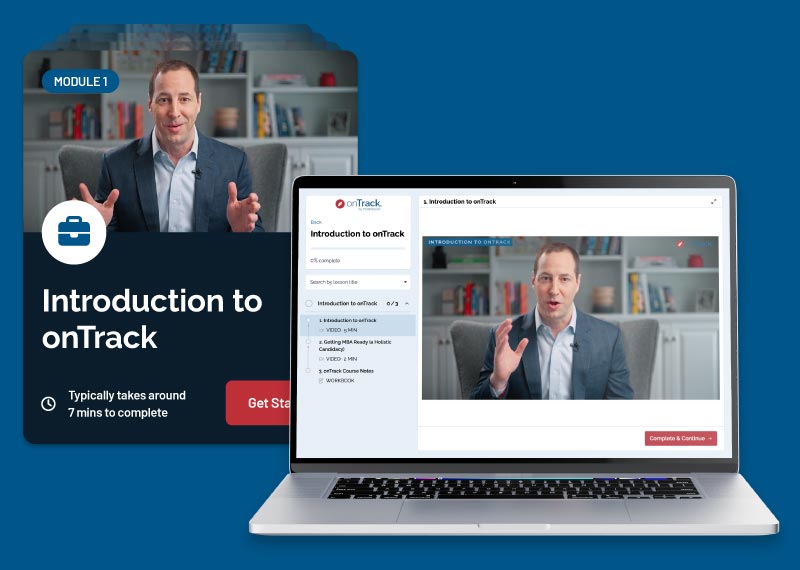
onTrack by mbaMission

A first-of-its-kind, on-demand MBA application experience that delivers a personalized curriculum for you and leverages interactive tools to guide you through the entire MBA application process.

Get Started!

2026–2027 MBA Essay Tips

Click here for the 2025–2026 MBA Essay Tips


MBA Program Updates

Explore onTrack — mbaMission’s newest offering allowing you to learn at your own pace through video. Learn more