
Blog

Five MBA Application Essay Mistakes and How to Avoid Them

Your MBA application essays give you the chance to distinguish yourself from the multitude of other business school applicants who also want a spot in your target program’s next incoming class. The essays allow you to show the admissions committee who you are. So, drawing on our experience of having read tens of thousands of MBA application essays, we want to help you avoid making any of these five common MBA essay mistakes.

1. Writing about Someone Else

Sometimes, applicants have difficulty knowing how to start their essays—particularly the Stanford Graduate School of Business’s “What matters most to you, and why?” and Harvard Business School’s “What more would you like us to know?” essays. Generally, we want to give our reader context for our stories, so candidates often begin by discussing their family history. Although that strategy can sometimes be effective, the key is to avoid having too much of your essay focused on someone else. If you want to give the admissions committee some background as to where your values come from, make sure that you keep the discussion of other people to a minimum and that you transition quickly back to yourself. You should always play the lead role in your application essays.

2. Starting with the Conclusion

At the beginning of your essay, always ensure that you truly start there—at the beginning—without rushing ahead to reveal the end of your story. So, when the Yale School of Management (SOM), for example, asks about the biggest commitment you have made in your life, you should not write something like “My biggest commitment was to my brother, whom I encouraged to return to college and helped get his first job, where he was just promoted.” You would give away the whole story, including the outcome, in your very first sentence! Nothing would be left to hold the reader’s attention for the rest of the essay. Instead, make sure that the opener for your essay simply opens. Consider this much more effective alternative: “When my brother dropped out of college, I knew we had only a short window of time in which to get him back on track.” This kind of opener makes the reader want to find out what happened next; they will feel compelled to continue reading.

3. Telling Rather than Showing

In the first sample opening sentence we offered in the previous tip, not only does the writer immediately reveal the outcome of their story but they are also “telling” what they did, rather than “showing” their actions in the form of a narrative. If you provide the admissions reader with the details of your story in such a way that you lead them to reach the conclusion themselves, you do something much more important—you reveal your actions, your decision-making capability, and your authenticity! By directly telling the reader the conclusion and discussing it at length without context, you risk sounding arrogant, but showing the reader creates an engaging and effective essay. For more examples of how to do this, read this helpful blog post.

4. Pandering to the Admissions Committee

After providing what a school has asked for in its essay prompt, applicants often feel the urge to add some measure of flattery to their essay or to tie their answer directly to the school in some way. For example, in the aforementioned Yale SOM essay prompt, the school asks applicants to discuss their biggest commitment, but it does not ask them to explain how that commitment relates to Yale. Yet a candidate might feel compelled to end their essay by writing, “Like I committed to my brother, I will commit to my brilliant and talented classmates at Yale, where together, we will benefit from the school’s unparalleled curriculum.” The admissions officers do not need to be convinced of the caliber of their MBA program, and you certainly do not want them to feel you are fawning or just plain overdoing it. Trust in the strength of your candidacy, rather than pleading or relying on compliments. Of course, if an MBA program does ask some version of “Why our school?,” you will need to do your research and provide that information, but refrain from addressing the topic otherwise. For more on this topic, check out this blog post.

5. Not Answering the Question

This tip might sound obvious, but experience has shown us that it needs to be said: always answer the question the school is asking. Many applicants start out by doing so but then keep tweaking their essay and getting input from others until they end up somewhere completely different. Some candidates will even cut and paste an essay from another school, trying to fit a square peg into a round hole to save themselves the time and effort necessary to create a whole new essay—but this strategy does not work. When you believe you are truly done writing your essay, step back and read the school’s question again and take a moment to reflect. Did you tell the admissions committee what you wanted to say, or did you give them the information they asked for in the essay prompt? Make sure you have done the latter.

If you would like to discuss your application essays and school selection in more detail with an expert MBA admissions consultant, sign up today for a free 30-minute consultation!
Convey a Confident Tone and Avoid Fawning in Your MBA Application Essays

In your MBA application essays, you must ensure that the tone you use allows the admissions committee to readily recognize your certainty and self-confidence. Being clear and direct about who you are and how you envision your future is vital. Consider these example statements:

Weak: “I now have adequate work experience and hope to pursue an MBA.”

Strong: “Through my work experience, I have gained both breadth and depth, providing me with a solid, practical foundation for pursuing my MBA.”

——

Weak: “I now want to pursue an MBA.”

Strong: “I am certain that now is the ideal time for me to pursue my MBA.”

——

Weak: “I have good quantitative skills and will succeed academically.”

Strong: “I have already mastered the quantitative skills necessary to thrive in my MBA studies.”

——

Weak: “With my MBA, I hope to establish myself as a leader.”

Strong: “I am certain that with my MBA, I will propel myself to the next levels of leadership.”

The key in all these examples is the use of language that clearly projects self-confidence. Instead of “hope,” use “will”; rather than saying you have “good” skills, show “mastery.” Although you should avoid sounding arrogant, of course, by being assertive and direct, you will inspire confidence in your reader and make a more positive impression.

Your target MBA programs certainly want to know that you identify with them. However, this does not need to be a running theme throughout your essays or application. Unless a business school explicitly requests this kind of information—for example, by asking what you are most passionate about and how that passion will positively affect the school—we generally recommend that candidates only discuss their connection with their target MBA program via their personal statements (“What are your short- and long-term goals, and how will [our school] allow you to achieve them?”).

For example, in response to a school’s question about leadership or putting knowledge into action, you would not need to discuss how the school will help you further develop your leadership skills or how you will continue to be an active learner when you are a member of the next incoming class, even though these topics reflect core values that each school embraces. Although we cannot assert this as an absolute, we find that in most cases, such statements come across as insincere or fawning—the very opposite of the effect you want.

​​Best Business Schools for Entrepreneurship

Stanford, Stanford, Stanford. 

Stanford seems to be the only name on anyone’s mind when the topic turns to entrepreneurship. Sure, the school has a long-standing culture of entrepreneurship, dozens of courses on innovation, its “Startup Garage” class and Venture Studio, and a stacked roster of famed practitioners as professors! But guess what? A lot of other top MBA programs also focus on entrepreneurship and innovation, and do so with great results.

Some 85% of MBA students say they want to be entrepreneurs. Of course, entrepreneurship has many flavors, from creating that tech company of the future to founding a decidedly low-tech company, to buying an established business, but no matter which route you are considering, business schools are ready to help you get started.

The way each MBA program provides future entrepreneurs with the tools they need can be quite different, though. Entrepreneurship can be studied in a host of ways, including in the classroom, on campus, and in the broader community.

Some places start with coursework, seeing it as the “foundation” of entrepreneurship. Harvard Business School, for example, begins with the core course “The Entrepreneurial Manager” and continues with some hugely popular electives, such as “Entrepreneurial Finance.” At Harvard, the curriculum will drive a lot of your study of start-ups.

Other schools systematize this process even more by offering majors or concentrations focused specifically on building new businesses. This generally includes a series of courses, combined with an internship at a local start-up, that tightly focuses on entrepreneurship. For example, at Duke Fuqua, you can pursue an Entrepreneurship & Innovation concentration, allowing you to do a deeper dive in the classroom.

On campuses where every other person seems to be walking around with a business plan in their pocket, the MBA program works to integrate its students with the broader university community. Some schools have programs specifically designed to get math majors in the same room as engineering PhDs and business students. Stanford, for instance, offers its Lean LaunchPad program, which brings together students from every part of the university. Its results have been almost legendary, producing such well-known ventures as DoorDash and Impact Food.

Some business schools accomplish the same thing through campus-wide business plan competitions, in which student teams compete for seed funding to get their company going. One of the earliest and most well-known is the MIT $100K Entrepreneurship Competition at MIT Sloan, which awards $100,000 to a range of start-ups. Past winners include Akamai Technologies and HubSpot.

One campus is not always enough to provide the entrepreneurship curriculum that students demand. For example, in addition to Wharton’s Philadelphia campus, where its entrepreneurship mother ship Tangen Hall is located, the program has a San Francisco campus committed to producing the next Silicon Valley success. Classroom teaching is still front and center, however, and being in San Francisco gives Wharton the ability to find professors and lecturers who have their own entrepreneurial roots in the region. Students get out of the classroom by engaging with founders and participating in local events. Beyond this, approximately one-third of the program’s students do an internship at a San Francisco–based start-up or a growing company in Silicon Valley.

As for in-semester internships, the leader in this space is Columbia Business School. Columbia gives its students Fridays off to allow them to get out of the classroom and into the local economy. The companies involved frequently include start-ups, particularly those in Silicon Alley, New York’s smaller, but growing, version of Silicon Valley.

Chicago Booth achieves the same effect of students being part of a start-up but follows a different formula. Booth students can spend the summer before they begin their studies finding out what being an entrepreneur is like. The school’s Startup Summer is a seven-week program in which Booth first years can intern at a start-up in any one of ten countries or eight U.S. cities (not just Chicago). Participants even receive a stipend. And all this before classes even start!

Chicago also has some unique things happening with respect to the other flavors of entrepreneurship, such as the Booth-Kellogg Entrepreneurship Through Acquisition Conference. Although many people think about entrepreneurship as some tech business being built out of someone’s garage, another way to do a start-up is by buying a venture that already exists. Following this well-trodden path, a would-be entrepreneur purchases an already established business with an eye toward making it run better, cheaper, or faster. With their unique joint conference, Booth and Kellogg bring students, entrepreneurs, funders, and others in the entrepreneurship space together to explore possible opportunities to buy a business rather than found one from scratch. As part of this process, students learn how to create their own “search fund”—a special financial vehicle used just to buy companies—and even find funders. 

For some industries, such as investment banking and consulting, attending a top-tier business school is critical to getting the job you want, but entrepreneurship is somewhat of a different animal. Great ideas have turned into big companies on practically every business school campus. With this in mind, I want to call out a couple of other schools.

For their capstone projects, second-year students at UCLA Anderson can build their own business via the Business Creation Project pathway. When most people think about entrepreneurship in California, Silicon Valley comes to mind, but if they look 400 miles south, they will realize that Los Angeles has become quite the entrepreneurial hub, as well.

Talking about entrepreneurial cities, one of the most significant that frequently flies under the radar is Pittsburgh. Meta, Amazon, Duolingo, and other tech giants have a presence in Pittsburgh, anchoring a start-up universe that includes Carnegie Mellon Tepper. Pittsburgh is a city teaming with entrepreneurial life, and Tepper helps entrepreneurs plug right into that ecosystem.

Voted number one for entrepreneurship year after year by U.S. News & World Report is the Olin Graduate School of Business at Babson College. Though small and somewhat removed from a big city, it nevertheless has transformed into a true entrepreneurial power. It has built a comprehensive pathway for taking a business from seed to IPO. Babson lives and breathes entrepreneurship and is fully integrated into the entrepreneurial world of the Northeast.

Go across the country, and you get to Boise State University, which has very deliberately tried to instill entrepreneurship into every element of its DNA. Driving this thinking is that Boise is now the new Boulder, which was once the new Seattle, which was once the new San Francisco. As each city became too expensive, tech remained one step ahead and has now landed in Idaho—not a bad place to be if you love the outdoors, mountains, and skiing.

Business students want to learn entrepreneurship, and business schools are ready to teach it—in the classroom, on campus, and in the community, and frequently with great success. Billions of dollars of value are created each year, as ideas go from PowerPoint slides to start-ups to mature companies, catalyzed by the learnings each MBA gains. The nice thing is that you can elect to follow this pathway at any number of business schools, across the country and around the world. 

For aspiring entrepreneurs, now might be the time to start diving deeply into this topic. Become the entrepreneur you want to be at a business school that fits you best.

If you wonder which schools you would be competitive at or have questions about your application essays, sign up for a free 30-minute consultation with an mbaMission consultant.

Which MBA Application Round Should I Apply In?

At most top business schools, aspiring MBAs apply in one of three application rounds: Round 1 in September, Round 2 in January, or Round 3 in March or April. As an applicant, you might be wondering when the ideal time to apply is. In this video, we explain the differences among the MBA application rounds:

Round 1 is generally considered the best time to apply for several key reasons:

  • The class is wide open, and the MBA admissions officers have fresh eyes.
  • Applying early indicates your interest in your target MBA program.
  • If you are an overrepresented applicant (e.g., consultant, private equity analyst), or if you have a weak point in your application (e.g., a low GPA or GMAT/GRE score), getting your application in front of the admissions committee as early as possible can help you stand out.

We recommend that you apply in Round 1 if you are ready to submit your best possible application by your target school’s deadline. However, if you believe you can significantly improve your application in some way, such as boosting your test score or earning a promotion, if you had a little extra time, then applying in Round 2 is also a solid option. Similarly, if you got a bit of a late start on your application and do not want to rush, opting for Round 2 would be a prudent decision. If you would be a strong applicant in Round 1, you should still be a strong applicant in Round 2.

Round 3—or the last round at MBA programs that have more than three application rounds—is what most schools refer to as a “shaping” round. This is when the admissions committees are more targeted in their evaluations because they are looking to fill certain “holes” in the class. For example, they might say, “We need a few more countries represented” or “We usually have a higher number of women in the class, so let’s be thoughtful about balancing things in this final round.” Because most spots in the MBA class have been filled by Round 3, we generally advise against waiting until this round to submit your application. However, if you are a truly exceptional candidate or can offer a unique professional experience to the class, you could find success in Round 3.

We asked Bruce DelMonico, the assistant dean and director of admissions at the Yale School of Management, for his thoughts on applying in the different application rounds. Here is what he had to say:

“We really don’t [recommend that candidates apply in any specific round]. We model to admit the same quality of students in each round, so it’s not as though there’s an advantage to applying in one round versus another. We have three rounds, and we’re also part of the Consortium for Graduate Study in Management, so we do receive applications that come in through the consortium and that are referred to us. But in terms of our three direct application rounds, like a lot of schools, we counsel people that if they can avoid the third round, they should try to do that. That’s not because it’s inherently any more difficult, but just because it’s more variable. It depends on how many people have already been accepted into the class in the first two rounds, so you just don’t know. It could be more than we were expecting, or it could be less. It’s that uncertainty that can make it more challenging. The main piece of advice we give everybody is to apply when you have your strongest application ready. Don’t rush to get it in earlier if it’s going to be less strong. And especially between Rounds 1 and 2, as I said, we model so that the quality of people we’re admitting stays constant throughout, so there’s no advantage in applying in one round versus another.”

If you have questions about your candidacy or the timing of your applications, book your FREE 30-minute MBA admissions consultation with one of our experienced MBA admissions consultants.

Should I Work with an MBA Admissions Consultant?

Each year, thousands of people apply to the top business schools. Although many of them opt to work with an MBA admissions consultant, many others do not. We at mbaMission find that this decision greatly depends on each candidate’s personal, professional, and financial circumstances. In this post, we address several common questions from applicants related to hiring an MBA admissions consultant.

What kinds of applicants typically work with MBA admissions consultants?

Applicants seek the guidance of an MBA admissions consultant for different reasons. Here at mbaMission, we commonly interact with applicants who fit at least one of the following descriptions:

  •     Struggle to identify and tell their strongest story
  •     Want any edge they can get
  •     Would benefit from some help bringing efficiency and organization to this complex and time-consuming process
  •     Need assistance in overcoming cultural or language barriers that can complicate the application process

If you find yourself relating to one (or more) of these scenarios, you might benefit from the informed guidance of a professional MBA admissions consultant.

I am confident in my MBA application, but getting the opinion of an elite professional would not hurt. Is that possible?

Although not every business school applicant will find themselves in one of the aforementioned situations, we at mbaMission believe that everyone can benefit from objective feedback and informed guidance in the competitive world of MBA admissions. Quite frankly, no one should submit a business school application that has not first been reviewed by a second set of eyes.

Are you an applicant who requires support in the following areas?

  •     Compatibility and assessment advisory
  •     Brainstorming for essay ideas
  •     Individual essay editing
  •     Resume or short answer preparation
  •     Letter of recommendation advisory
  •     Interview preparation
  •     Waitlist guidance
  •     Post-acceptance counseling

For all these topics, a professional MBA admissions consultant might be able to give you the insight to build your most compelling MBA application.

In this blog post, we break down the tasks and goals of an MBA admissions consultant so you can better understand what working with one looks like on a day-to-day basis—and ultimately determine whether hiring a consultant is the right choice for you.


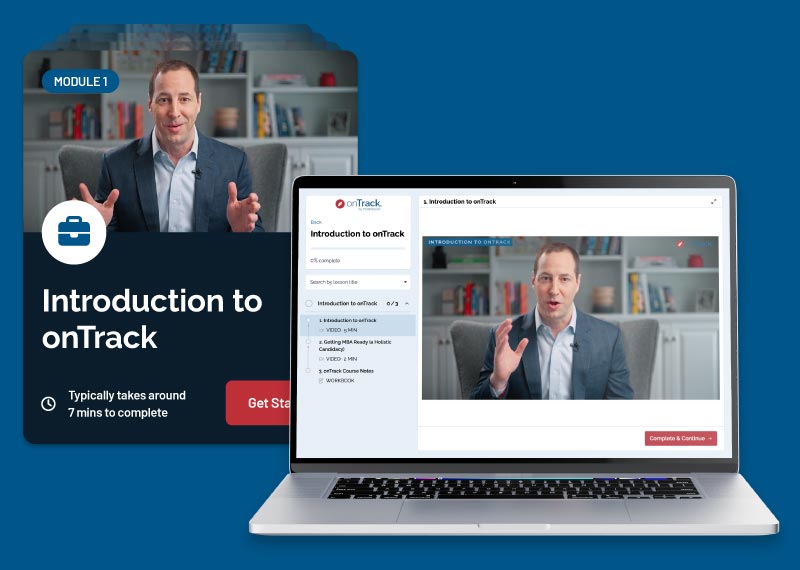
onTrack by mbaMission

A first-of-its-kind, on-demand MBA application experience that delivers a personalized curriculum for you and leverages interactive tools to guide you through the entire MBA application process.

Get Started!

2026–2027 MBA Essay Tips

Click here for the 2025–2026 MBA Essay Tips


MBA Program Updates

Explore onTrack — mbaMission’s newest offering allowing you to learn at your own pace through video. Learn more