

Blog

The Best MBA Programs for Social Impact

Over the last few years, we at mbaMission have seen growing interest in social impact careers among aspiring MBAs. Amid this increasing desire to make significant, positive change that solves critical social issues, business schools have responded by introducing new coursework and resources in social impact; environmental, social, and governance (ESG); and related topics. If you are seeking a purpose-driven career in sustainability, impact investing, or nonprofit management, which MBA programs are best? 

At mbaMission, I have helped countless business school candidates thoughtfully choose their target MBA programs. In this post, I share some “must consider” programs if you are interested in social impact as well as other programs that should be on your radar if you want to pursue a social impact career. 

Berkeley Haas, the Yale School of Management (SOM), Duke Fuqua, and Oxford Saïd offer robust resources that have consistently attracted socially minded applicants.  

Berkeley Haas 

Berkeley Haas has four defining principles, including “Beyond Yourself. The school strives to not only teach management skills but also achieve societal progress through innovation, inclusion, and sustainability. Haas has some of the most robust social impact resources, all within a wider university and city known for its progressive values. 

Perusing the course catalog, you will find such courses as “Social Investing” and “Strategy and Leadership for Social Impact.” The Institute for Business & Social Impact is a leading research center offering hands-on activities including the Berkeley Board Fellows, as well as fellowships for students focused on social impact. In addition, you can build practical social impact career experience at Haas through such clubs as Net Impact and competitions including the Patagonia Case Competition, while connecting with a network of students, alumni, and faculty who are equally passionate about social impact. 

Yale School of Management

With a long-standing mission “to educate leaders for business and society,” Yale SOM is a top choice for those interested in social impact. The school’s past admits tell us it is a place where students genuinely want to make a difference. Even the first-year MBA core curriculum at Yale SOM includes content related to social and environmental issues. The school’s website presents an impressive list of elective courses related to social impact: “Financing Green Technologies,” “Inequality and Social Mobility,” and “Global Social Entrepreneurship,” to name a few. Yale SOM’s Program on Social Enterprise is the hub for social impact activities at the school. Outside the classroom, Social Impact Week is full of mission-driven programming, all led by students, and the Social Impact Consulting Club offers pro-bono consulting services to the nonprofit and public sectors. 

Duke Fuqua

The tight-knit community at or “Team Fuqua,” as Fuquans call itprofoundly cares about using business to serve society. The school offers four concentrations related to social impact: Diversity, Equity, and Inclusion; Energy & Environment; Leadership & Ethics; and Social Entrepreneurship. Beyond these focus areas, one of the top reasons to consider Fuqua for social impact is the school’s Center for the Advancement of Social Entrepreneurship (CASE). Through CASE, students can engage with social sector leaders at such events as the Executive Speaker Series and the Sustainable Business and Social Impact Conference. Students can also gain hands-on opportunities via such clubs as Fuqua on Board and the CASE Initiative on Impact Investing. Fuqua’s Career Management Center even has team members dedicated to social impact career development.

Oxford Saïd

Oxford Saïd is the only European school on this list. The hub of social impact at Oxford Saïd is the Skoll Centre for Social Entrepreneurship, which hosts the Skoll World Forum on Social Entrepreneurship and a fully funded scholarship for selected Skoll Scholars who are pursuing social entrepreneurship. A popular program within the Skoll Centre is the Impact Lab, a co-curricular opportunity that includes workshops and mentoring from alumni in impact careers.

Other MBA Programs to Consider

As mentioned earlier, many MBA programs have expanded their offerings related to social impact. So, this list would not be complete without mentioning a few more business schools to consider:

  •  GSB has a Center for Social Innovation, offers personalized learning that can encompass social impact, and conducts leading research on social and environmental problems.
  • HBS hosts a Social Enterprise Initiative and the Social Impact Fellowship Fund.
  • Kellogg offers a Social Impact pathway for its socially minded students and fosters a community-centered mindset.
  • Booth features the Rustandy Center for Social Sector Innovation as well as one of the country’s first social venture competitions, the Social New Venture Challenge.
  • MIT Sloan’s well-regarded Sustainability Initiative manages the Sloan Social Impact Fund.
  •  Michigan Ross offers a concentration in Business and Sustainability in addition to a student-run Social Venture Fund.
  • Boston University’s full-time Social Impact MBA program aims to develop responsible leaders who will address social challenges.

If you would like help identifying which schools would be the best fit for you, or if you have questions about your competitiveness at any of these programs, we invite you to sign up for a free 30-minute consultation with one of our mbaMission admissions experts.

Multidimensional Brainstorming for Your MBA Application Essays

We at mbaMission often tell candidates, “You cannot turn a bad idea into a good essay.” We insist on taking our clients through a lengthy brainstorming process—starting with a thorough questionnaire—to discover the stories that make them distinct. As you uncover your stories, consider each one from as many different angles as possible. Doing so will not only help ensure you understand the various “weapons in your arsenal” but also provide you with maximum flexibility, considering that MBA admissions committees ask questions that vary dramatically from school to school.

For example, an experience coaching a baseball team at an underfunded high school may have multiple dimensions, such as the following:

  • Creatively motivating an underachieving team and changing attitudes, despite losses
  • Initiating and leading fund-raising efforts so that each player could afford proper equipment
  • Mentoring struggling players and seeing an improvement in their on-field performance
  • Helping a player deal with a family issue off the field
  • Recruiting other coaches and then working to improve a team’s on-field performance

These are just a few of the stories that could be gleaned through brainstorming, proving that considering your experiences from various angles can help you discover multiple unique approaches to your essays.

In addition, many MBA candidates—whether they work as bankers or lawyers, in internal corporate finance or corporate strategy—feel they must tell a “deal story” in their application essays. Although discussing a deal can be a good idea, what is vital is showing your distinct impact on the deal in question. You are the central character, not the deal. A straightforward story about how you dutifully completed your work and steadily supported others as a deal became a reality will not likely be very compelling. Further, the important thing is that the admissions committee gain insight into your personality, not your spreadsheets.

Ask yourself the following questions to ensure your story is truly about you:

  • What did you do that was beyond expectations for your role? Did you grow into additional responsibilities at a crucial time?
  • Did any particular interactions take place in which you used your personality to change the dynamic, thereby ensuring the deal’s progress or success?
  • Did you need to take a principled stand at any moment or speak out on behalf of a needful party?
  • Did you help others overcome any corporate or international cultural barriers?

These questions can get you started, but the point remains: do not simply offer any deal; instead, provide insight into your deal.

If you have questions about your application essays or wonder which schools you would be competitive at, sign up for a free 30-minute consultation with an mbaMission consultant.

MBA Admissions Myths Destroyed: You Need a 750 GMAT to Get into Business School

We often hear MBA applicants ask some form of the following question: “Do I need a 750 GMAT score to get into a top MBA program?” Although a 750 can certainly be helpful, it is not a prerequisite. We wanted to dispel this myth and put some who believe it at ease. Here are a few simple reasons why this is just not true:

  1. The average is lower. Average GMAT scores at the top MBA programs range from approximately 700 to 730. Clearly, if the high end of the GMAT average range is 730, the schools cannot expect applicants to have a 750. That would mean that every applicant would be above average, which is not possible. Still, if a candidate’s score falls below the average, this generally places a greater burden on the other components of the individual’s application—so, for example, maybe their work experience would need to be stronger than that of other applicants, or maybe their extracurriculars would need to stand out even more. The bottom line is that mathematically speaking, many people have a GMAT score below 750.
  2. Too few applicants have a 750 or higher. The top MBA programs accept thousands of applicants each application season. Only approximately 2% of GMAT test takers earn scores of 750 or higher, and some are earned by people who do not ultimately apply to business school at all, do not apply to any of the leading schools, take the test only to become GMAT instructors, pursue an EMBA or part-time MBA instead, are rejected because other aspects of their profile render them uncompetitive… and the list goes on. Basically, the top MBA programs do not receive applications from enough applicants with 750s to entirely populate their incoming class, as evidenced by the schools’ mid-80% GMAT ranges, which are typically 660–760.
  3. All schools accept the GRE. Applicants do not really even need to take the GMAT anymore. Of course, if you do take the GMAT, you should strive to achieve the highest score possible. However, if the GMAT is not even required, you obviously would not need to score a 750 to be accepted.

We want to be unequivocal: 750 is a great GMAT score, and anyone who earns that score should be delighted. However, if you do not fare as well on the exam, you should still be quite hopeful and keep a positive mindset, because the admissions process is holistic.

MBA Admissions Myths Destroyed: I Need to Tell It All! (Part 2)

Recently, we discussed observing limits with your resume. This time, we take a similar approach with your essays—in particular, your goals essay. Some business schools ask applicants to discuss their career progress first in a classic goals essay:

Briefly assess your career progress to date. Elaborate on your future career plans and your motivation for pursuing an MBA.

Whereas other schools do not request any professional context:

What are your short-term and long-term post-MBA goals? How will our school help you achieve these goals?

Applicants tend to seize on these broad, open-ended questions as opportunities to discuss their entire career history in depth, offering far more than mere context for their goals. In response to a question like the first one here, some candidates will mistakenly use 75% or more of the word space provided just discussing their career progression to date. Although this may seem “brief” to you, the truth is that focusing so extensively on your past minimizes your opportunity to discuss other crucial aspects of your candidacy.

If you devote too much of your essay to detailing your past career progress, you will be unable to thoroughly address your reasons for wanting an MBA and your interest in the school. Providing context for your goals by giving an overview of your professional life to date is unquestionably important, but you must be sure to balance the different sections of your essay. Clearly conveying your goals and your reasons for choosing a particular school is crucial so that you connect with your target, rather than miss it entirely.

MBA Admissions Myths Destroyed: I Need to Tell It All! (Part 1)

In your pursuit of acceptance to business school, you are competing against thousands of other applicants. Because you do not actually know these individuals, you may naturally assume that you need any and every edge available to stand out. As a result, you may feel compelled to provide every single detail of your life, exploiting your resume in particular to do so. We want you to maximize your opportunities, of course, but we also want to be sure you do not jeopardize your application by offering too much information.

Our experience has shown that many resumes—especially those in which every margin is narrowed and every font is made smaller—provide a detrimental surplus of detail. Some become so dense with text that rather than being easily scannable, which is the ideal, they are entirely impenetrable and therefore easy to ignore. We often tell clients that “less is more,” explaining that a brief resume that will be read in full is more beneficial than a dense resume that will not get read at all. At an Association of International Graduate Admissions Consultants Conference, eight leading admissions officers were asked whether they would prefer a one-page or two-page resume, and one person led all the others in declaring, “Everyone together… one page!”

Even with a one-page resume, however, you need to understand what is useful to include and what should be excluded. The answer to this riddle is different for everyone. You may consider jettisoning internships from years gone by, for example, or reducing the number of bullet points offered for past jobs. Eliminating entries for community involvements from long ago could be helpful. The agenda for your resume should be to create maximum impact, and sometimes that is achieved by using fewer words and bullet points. You may need to make tough choices, but the time and effort will be well spent if you ultimately submit a stronger resume and thereby make a more compelling statement about yourself.


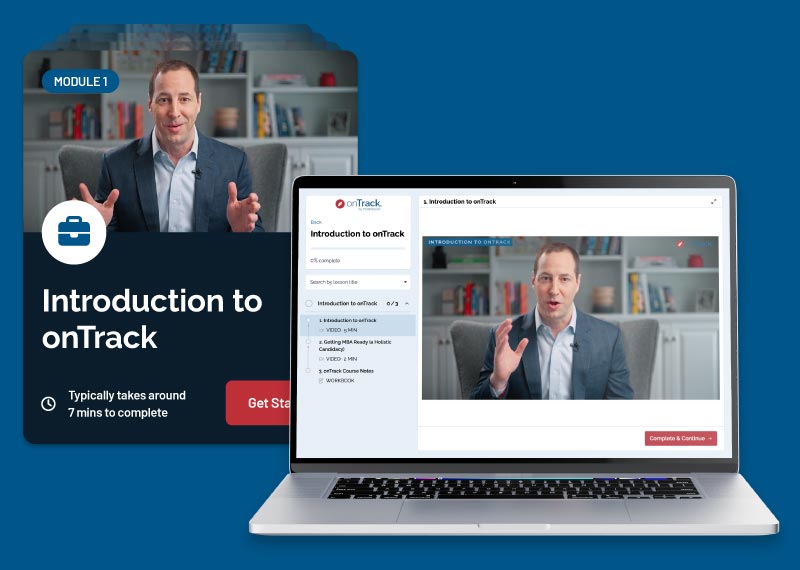
onTrack by mbaMission

A first-of-its-kind, on-demand MBA application experience that delivers a personalized curriculum for you and leverages interactive tools to guide you through the entire MBA application process.

Get Started!

2026–2027 MBA Essay Tips

Click here for the 2025–2026 MBA Essay Tips


MBA Program Updates

Explore onTrack — mbaMission’s newest offering allowing you to learn at your own pace through video. Learn more