

Blog

A Successful Stanford GSB Essay Example

“What matters most to you, and why?”

This is a huge question and one that requires a great deal of thought before answering. How do you approach this essay prompt that the (GSB) poses in its application? To help you, we have recorded a video offering guidance on this topic! Be sure to subscribe to mbaMission’s YouTube channel for the most up-to-date content. Today, we are going to take you through an actual successful GSB essay and discuss its strengths. 

The essay we will review in this post is showcased in the book “What Matters?” and “What More?”: 50 Successful Essays for the Stanford GSB and HBS (and Why They Worked), co-authored by mbaMission Founder Jeremy Shinewald. To read more of our analysis of this essay, and that of 49 other examples, be sure to download your copy today. Note that this essay is not meant to be a template—it is one applicant’s personal answer. At mbaMission, we encourage you to reflect on and write about what is meaningful to you! The first paragraph of our highlighted GSB example follows;

In Lithuania, one of the most Catholic countries in the world, it is almost inconceivable for anyone to leave the church. Yet, as I grew older, I increasingly felt that as a person of science, I couldn’t reconcile being committed to an organization founded broadly on beliefs. Despite a rich tradition and the good guidance the church provides, I still felt that to be true to myself I should file for apostasy—a challenging process! Several of my friends refused to be my witnesses and vouch for my sanity—in our society one is “insane” to leave the church—because they feared I would be ostracized. Finally, finding two people who confirmed the thoughtfulness of my choice, I met with the priest only to hear him reject my deed of will. I had to find his superior to finally get my act stamped and my name removed from the baptismal book. Although I would no longer gain entry to sacred grounds and could not be married in my country, making my life marginally more difficult socially, I was nonetheless at peace with myself because I know that there is no price for living by the truth.

This is an aggressive opening. Three sentences in, and the reader learns that the applicant filed for apostasy. Note that our writer is not trying to tell us about the church. Rather, he is sharing a lot about himself. In fact, he is even deferential to the church to ensure that the admissions committee understands that can be diplomatic. Nonetheless, he very forcefully asserts that he is an independent thinker, taking a symbolic step that will disadvantage him, just to be true to himself and his conscience. That said, the next paragraph is really critical:

To me, this is emblematic of my approach to work and life: I have always had strong opinions, unwavering whether they are aligned with the majority or not.From a young age, my teachers joked that one day I would start a revolution setting Lithuania straight. By the end of high school, my educator asked me if he could resign from applying for highest distinction on my behalf, rather than start a storm by presenting my candidacy, as not all teachers appreciated my independence as he did. (I actually agreed to his request because grades and titles were confirmations rather than goals.) Later, while at Vilnius University, I made my approach of a thesis advisor very carefully, seeking an individual who would strenuously challenge me, because truths must withstand scrutiny. I found that advisor in Professor Sarkinas, our former chairman of the central bank. He was known to intimidate, but I just accepted that he pushed students to reconsider their thoughts and reveled in his constant challenges. Over my four years with him as an advisor, he expanded my view of economics and my perspective on learning. His most important lesson was not a theorem, but was about debate and seeking truth: to oppose, one must understand his opponent, at times, better than one understands himself.

The reader understands that the applicant’s theme is independent thought, but what is important to a business school is that an independent thinker is still productive and does not yield to dogma or consider themselves an expert on everything. In this paragraph, our author talks about how he specifically chose an advisor who would challenge his opinions. In doing so, the writer shows that he seeks understanding before asserting himself. Again, this is a strong theme, but he thoughtfully balances it out.

Equipped with my professor’s wisdom, I have embarked on my career in investment management by building my brand on independence and truth. When the biggest mobile telecom provider in the Baltics was going public, I gave an interview about its prospects, wherein I stated that the IPO was a “smoke screen” to force a higher bid in a parallel private process with a competitor (as synergies in a unified company were far more compelling). Furious, the company excluded me from the IPO, canceled its road show for me and even resigned on group insurance offered by our parent company.In the end, after its IPO, news surfaced that it in fact was in negotiations with its competitor throughout the IPO process, which was intended to inflate its price. Later, in an offering by eight brokerages, an overhyped, fast-growing, Lithuanian financial institution launched its IPO. Listening attentively, I understood that its CEO had admitted to two minor fraudulent practices during its road show and found its business model simply did not add up. I was certain the firm was a deceit that the market did not want to see. At the time, I was on a road show and was repetitively asked about that IPO. I answered honestly that the company was a swindle and that management would end up in jail—not a popular thing to say! As I write this essay, the company is being liquidated and management is in custody, in one of the biggest financial scandals in my country’s history.

In this paragraph, the reader sees the payoff—all the author’s independent thought comes in service of others. The applicant is recognizing frauds that others cannot spot. He is not blinded by a good story. He digs deeper and sees that something is fishy. Something does not add up, and this is to the benefit of his firm, investors, and society at large. His independence is a superpower, not a crutch or a problem. Further, throughout this essay, we are not just learning about a character trait but are also gaining a picture of an individual who has had distinct experiences and will add a unique voice to his class, through his background, knowledge of the capital markets in an emerging region, and other aspects of his character. His message is complete—the applicant has an authentic voice and has led an interesting life. He concludes his essay with the following paragraph:  

Recently, I visited one of the distributors who asked me for another market presentation. When I was about to start my talk, the regional director stood up and said to his colleagues, “Quiet, let’s now listen to the truth.” Maybe just a brief utterance, but also the most rewarding moment of my career, when it became clear to me that truth is not a liability, but a way to help and shape reality.

This is a nice closing to a well-constructed essay. Of course, writing somewhat aggressively can be risky, but readers clearly understand what this applicant stands for, and his principles certainly manifest in this essay, as they no doubt did when he was on the GSB campus!

If you found this post helpful, consider downloading the, “What Matters?” and “What More?”: 50 Successful Essays for the Stanford GSB and HBS (and Why They Worked). Also, sign up for a  and speak with an mbaMission consultant about any questions you might have about your GSB application—or really about anything related to MBA applications. mbaMission is here to give you our expert opinion and help you on your journey.

Finally, be sure to subscribe to our YouTube channel for even more MBA application tips and advice. Thanks so much for reading, and good luck with your applications!

Get an Early Start on Your Resume and Personal Goals

We at mbaMission try to encourage business school candidates to get as much “noise” out of the way as possible before they begin working on their official application(s) and essays, even several months in advance. We want applicants to have the freedom to reflect on their experiences, formally and thoroughly brainstorm, choose ideas, prepare outlines, and then focus on crafting powerful essays. Essentially, we want them to be unfettered as they engage in what is, for many, one of the most significant creative challenges they will ever face.

If you are targeting Round 1 deadlines this fall, using this time to address a task such as preparing your resume—a process that often requires several rounds of revisions—will allow you to focus better on the other elements of your application later. By revising your resume now, you can dedicate the time needed to do so at a more leisurely pace, before “crunch time” hits. Further, you will lay the foundation for brainstorming for your essays by reminding yourself of your most significant accomplishments.

If you prepare your resume now, you will definitely thank yourself later for having completed this task early. Note: We recognize that you may achieve additional accomplishments before applying. We nonetheless suggest that you update your resume now and then revisit and amend it as necessary one to two weeks before your application deadlines.

A similar message applies to personal leadership—you always have time to take steps to bolster your chances of admission. Many candidates completely ignore the personal side of their candidacy. But if you have, for example, completed a triathlon, learned a language, published an article, or simply been an inordinately dedicated neighbor/sibling/mentor in an unofficial capacity, your story can provide an interesting point of differentiation.

So, if you have an activity or adventure in mind that you would otherwise complete later anyway, we recommend pursuing it now. We are not suggesting that you start writing poetry tomorrow in hopes of getting something published, for instance, but if you are a dedicated poet and have verses that you have long intended to submit, do so now. If you can run 20 miles and have always planned to run a marathon, do it now. These kinds of personal stories can help set you apart from your fellow applicants.

MBA Admissions Myths Destroyed: Reapplicants Should Not Reapply

You applied to business school(s) once and did not get in. It took a lot of effort and caused a lot of heartache. Now what do you do? You cannot apply to those schools again, can you? What would be the point? They already rejected you once, so they will definitely do the same thing next time, right? Not necessarily!

Remember, MBA admissions committees are governed by self-interest. Simply put, the schools want the best candidates out there. If you are among the best candidates, why would any admissions director think, “Well, this is an outstanding candidate who can add something special to our school and has unique potential going forward, but they applied last year, so we’ll just forget about them.” Indeed, the reapplication process is not a practical joke or a disingenuous olive branch to those permanently on the outside. If the schools were not willing to admit reapplicants, they would not waste time and resources processing and reviewing their applications.

Although many candidates fret about being reapplicants, some admissions officers actually see a reapplication as a positive—a new opportunity. The Yale School of Management’s assistant dean and director of admissions, Bruce DelMonico, noted, “I can certainly bust [that] myth. Our admit rate for reapplicants is actually the same as it is for first-time applicants. It’s important, though, for reapplicants to explain to us how their candidacy has improved from the previous time they applied. Reapplicants need to make sure they enhance their application, rather than just resubmitting the same application.”

In short, reapplicants, you have no reason to believe that you only have one chance. Like any competitive MBA applicant, continue to strive and achieve; if things do not work out this time, they just might the next time.

The GMAT Is Changing for 2024

The GMAT exam is changing.

And I do not mean in the computerized adaptive way that informs your score!

The Graduate Management Admission Council™ (GMAC™) announced this week that major changes are coming to the GMAT exam’s format and structure, likely in later 2023. (The current GMAT is expected to be offered through early 2024.) 

What changes are planned?

1. The exam will be shorter!

The new GMAT Focus Edition will consist of three 45-minute sessions. This new testing experience will require approximately one hour less than the current GMAT, for an improved test-taker experience.

2. It will no longer include written essays!

The updated GMAT will no longer include the Analytical Writing Assessment (essay) section. All questions will be multiple choice.

This might remove the additional anxiety some test takers feel when tasked with writing lengthy timed essays during the same sitting in which they must contend with quant, verbal, and critical thinking exam topics.

3. You will have the flexibility to return to prior questions.

GMAC notes that the new GMAT Focus Edition will allow test takers to mark specific questions within a section and return to them later—similar to options candidates currently have with the GRE exam—and to change up to three question responses per section.

This is in stark contrast to the GMAT’s current structure, which does not allow test takers to return to earlier questions.

You will also be able to choose which section you would like to begin with, which will hopefully help you perform your absolute best on the exam.

What Do MBA Admissions Consultants Do? And Do You Need One?

Often, we hear from candidates who are just beginning their business school research and have questions about the MBA experience, application components, and submitting their applications. Many applicants who are entirely new to the process of MBA admissions might be wondering, What do MBA admissions consultants do? And do I need one? 

If this sounds like you, we want to provide an explanation of the kinds of services MBA admissions consultants offer their clients. Hopefully, this information will facilitate your decision on whether hiring such a consultant would be right for you.

What is the general idea behind MBA admissions consulting?

Let us provide some context. Imagine you are interested in a high-level position at a prestigious, top-tier company you know very little about. While doing your preliminary research on the company, you find that its application process is very rigorous and includes several components that are completely new to you, such as writing about yourself and your past experiences in depth, demonstrating your professional mastery, and detailing what has led you to want this job in particular. You surmise that given the demands of your busy schedule, you might need several weeks (or even months) to put together an application that properly captures who you are and gives you the best chance of being considered for the job. And to complicate matters further, you realize that you are competing for this coveted position against thousands of other applicants—many of whom seem to be more qualified than you.

What would you do?

A. Quickly submit an application sight unseen by anyone other than you
or
B. Thoughtfully prepare an application with the help of a trusted advisor, mentor, or former leader at the company

Option B seems far more likely to yield a favorable outcome, right? We think so, too.

With any important decision or move in your life, we believe that getting a second opinion (ideally from a trusted advisor or mentor) is generally always a good idea to help inform your decision-making process and fine-tune the execution of your next steps.

For applicants to the world’s top-15 MBA programs, the stakes are high. Gaining admission to a premier business school will lay the foundation for the rest of an applicant’s life, ensure a quick return on investment, and foster future business success. Each year, thousands of candidates compete for just a few hundred spots in each MBA program’s incoming class, and they all know they need to stand out among the applicant pool. If you think this sounds like an uber-competitive process, it is.

MBA admissions consultants exist for this very reason: to advise MBA hopefuls through the application process and help ensure that the application they ultimately submit is the most compelling version possible.

But what does that process look like? We will explain that next.

What do MBA admissions consultants actually do for their clients?

On a day-to-day basis, MBA admissions consultants collaborate with their clients on the various components of the MBA application process, helping them brainstorm, execute, and polish their application materials. These tasks include the following:


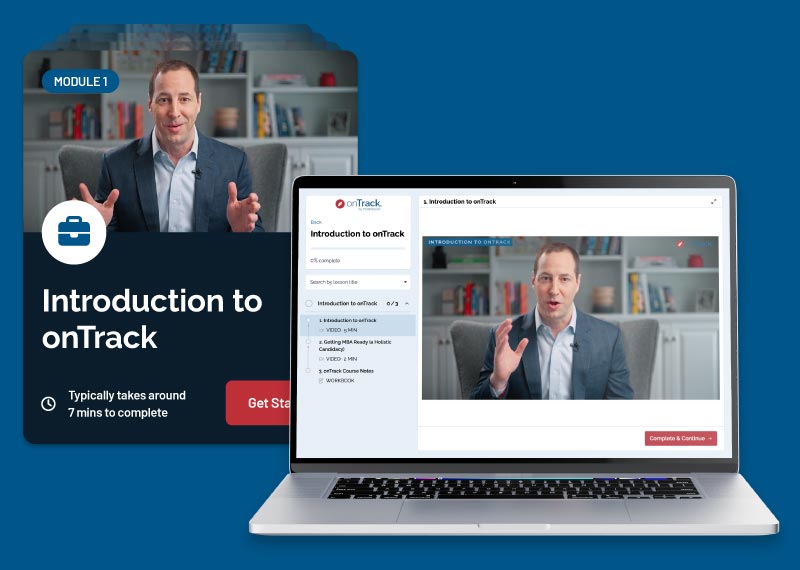
onTrack by mbaMission

A first-of-its-kind, on-demand MBA application experience that delivers a personalized curriculum for you and leverages interactive tools to guide you through the entire MBA application process.

Get Started!

2026–2027 MBA Essay Tips

Click here for the 2025–2026 MBA Essay Tips


MBA Program Updates

Explore onTrack — mbaMission’s newest offering allowing you to learn at your own pace through video. Learn more