Blog

Long-Term MBA Application Planning with onTrack

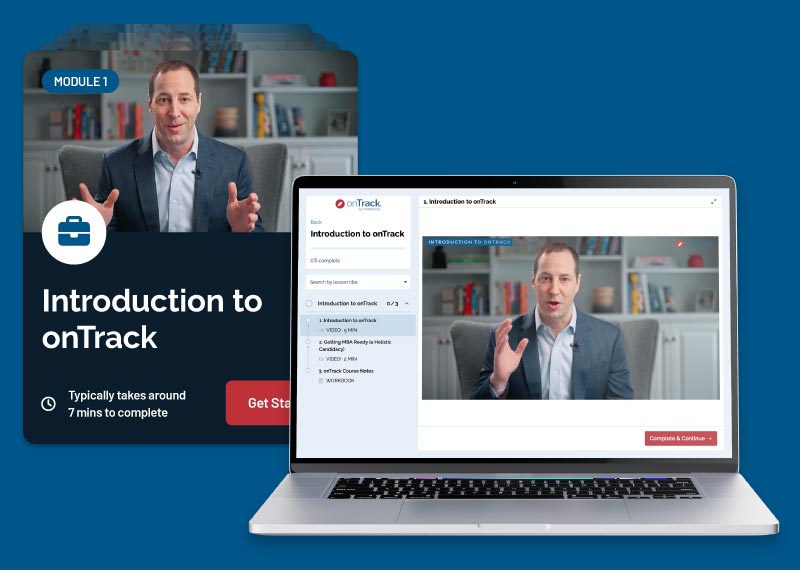
If you are applying to business school in the fall, you might be wondering when you should begin preparing your MBA candidacy. The answer is now! Although applications will not open for a few more months, you can—and should—still do a lot in this pre-application stage to begin building your strongest possible profile. Our in-depth, on-demand MBA admissions course, onTrack by mbaMission, is a fantastic resource to support you on your MBA application long-term planning journey. Here is how onTrack can help you master some of the important things you need to be working on in the coming months.

Standardized Testing

If you have not yet taken the GMAT, GRE, or Executive Assessment, you should start creating your study plan now. Successful applicants typically spend months preparing for these exams, and taking a test more than once is very common. onTrack’s Testing 101 module explains everything you need to know about your exam options, helps you determine which test is the best one for you, and guides you in creating a personalized study plan and timeline. If you use this valuable time before applications open to prepare for and take your exam of choice, you will thank yourself later!

Profile Evaluation

If you are wondering how your test score, GPA, and professional experiences compare to those of other business school applicants, the MBA Stats module of onTrack evaluates each component of your applicant profile to help you determine your competitiveness. More than six months remain before the Round 1 deadlines, so you still have time to address any weaknesses in your candidacy, but only if you identify those weaknesses now! onTrack’s Mitigating Weaknesses module presents ways you can offset a suboptimal test score, a low GPA, or other potential red flag in your profile.

Professional and Community Impact

MBA admissions committees evaluate applications holistically. This means that in addition to evaluating your quantifiable stats (e.g., undergraduate GPA, GMAT/GRE score), they will look for evidence of your work ethic and leadership skills. onTrack’s Professional Background module breaks down the steps you can take at work over the next six (or more) months to optimize the professional impact element of your candidacy. If you give yourself enough lead time, you can strengthen this part of your profile in a truly substantial way. Similarly, your community involvement can be a fantastic way to showcase not just your interests and passions outside of work but also your leadership abilities. But again, to impress the admissions committees, you need to start enhancing your efforts in this area as soon as possible so you can show a track record of involvement and leadership by the time you submit your applications. Our Community and Personal Leadership module helps you determine which kinds of community activities to pursue and—just as importantly—how to demonstrate real engagement in those activities. 

School Research

In your business school applications, you need to convince each school’s admissions committee that you are a good fit for their particular MBA program. And to be able to effectively communicate this fit in your essays, short answers, and interviews, you must truly understand the ins and outs of your target programs, after first making sure that the schools on your list are well suited to help you achieve your post-MBA career goals. In addition to a dedicated School Selection module (with over a dozen lessons), onTrack offers in-depth, standalone modules on more than 15 of the top MBA programs. These modules break down each school’s pros and cons, curriculum, pedagogy, career paths, and other key features. Using onTrack to research schools will save you an incredible amount of time and ensure that you are always able to craft a standout response when one of your chosen programs asks, “Why our school?”

The winter and spring months are an incredibly important time with respect to building your MBA applicant profile. This is your opportunity to make some valuable progress, but you need to start now! Fortunately, onTrack can guide you smoothly through every step of the pre-application stage, and when the time comes to craft your applications, you will have access to extensive content on essay writing, resumes, recommendations, interviews, and every other element of the application process. onTrack’s more than 80 modules include several hundred video lessons, along with templates, sample essays and resumes, workbooks, checklists, and even an interactive interview tool. To get started, complete a brief, two-minute questionnaire, and a personal onTrack learning path will be customized just for you, based on your background, goals, and target programs. Use the code MBAMBLOG to save 30% on any length onTrack subscription. We wish you the best of luck with your MBA application long-term planning and look forward to seeing you in onTrack!

How to Approach Quantitative Comparison Questions in the GRE

If you are taking the GRE instead of the GMAT, you will have to deal with the GRE’s “weird” question type: Quantitative Comparison (QC). What are these questions, and how do we handle them?

What is Quantitative Comparison?

The GRE and the GMAT really are not math tests, all evidence to the contrary. These tests are actually trying to test us on our “executive reasoning” skills—that is, how well we make decisions and prioritize when faced with too many things to do in too little time.

So, QC questions are really about quickly analyzing some information and figuring out a relationship between two quantities. If we label the two quantities A and B, we have four possibilities:

(A) Quantity A is always bigger than Quantity B.

(B) Quantity B is always bigger than Quantity A.

(C) The two quantities are always equal.

(D) I cannot tell, or there is not an “always” relationship; maybe sometimes A is bigger and sometimes B is bigger, or sometimes A is bigger and sometimes they are equal.

We do, of course, have to do some math—and sometimes that math is quite annoying. We usually do not, however, have to do as much as we usually do on regular “problem solving” questions (the normal Quant questions).

How does Quantitative Comparison work?

First, the question is always the same: figure out the “always” relationship, if there is one (in which case the answer is A, B, or C), or figure out that there is not an “always” relationship, in which case the answer is D.

Some QC questions will provide us with “givens”—information that must be true and that we will need to use when answering the question. For example, a problem might read as follows:

x > 0

So, now I know that x is positive. Is it an integer? Maybe. But it could also be a fraction or decimal, as long as that value is positive.

Next, the problem will give us two columns with their own pieces of information. For example:

Quantity A                                          Quantity B

x = 3                                                      x2-9 = 0

We do not have to do anything with Quantity A; it already tells us what x is. What about Quantity B? Solve:

(x+3)(x-3) = 0

x = -3, x = 3

It seems like the answer should be D, right? Sometimes Quantity A is bigger and sometimes they are the same. Do not forget about our “given,” though! We are only supposed to use positive values for x, so we can ignore x = -3 for Quantity B. Both quantities are always equal, so the answer is C.

Okay, these are weird. How do I get better?

These are going to take some practice, yes. In addition, this was only a very short introduction; a ton of great strategies are out there that you can learn. Look for books, articles, classes, and other resources to help. (Here is one to get you started.)

You also, of course, have to learn a bunch of math. What we have presented here, though, should help you get started on this kind-of-bizarre question type in the first place!

What to Expect During a Free Consultation with an MBA Admissions Consulting Firm

What to Expect During a Free Consultation with an MBA Admissions Consulting Firm

Before you commit to buying any product or service, you should always test it out first. A commitment-free “practice run” will inform your decision and help you feel confident that you are making a worthwhile and rewarding investment. (Frankly, this is exactly why test drives, real estate tours, and trial subscriptions exist!)

We at mbaMission believe that this kind of pre-purchase test is just as important when you are looking for the right MBA admissions consulting firm to help you with your business school applications.

This is why we offer a free 30-minute consultation for all business school candidates so they can preview the process of working with a consultant, better envision what the relationship might look like, and understand what to expect on a day-to-day basis.

Each year, our team of expert admissions advisors connects with literally thousands of aspiring MBAs who have their sights set on being accepted to a top U.S. or international business school. Via our free 30-minute consultation, we have counseled these applicants on such topics as what their next steps should be, what challenges they might need to overcome, and what the overall process tends to look like.

If you are considering booking a free consultation with mbaMission, read on to learn more about what you can expect from the meeting and how you can ensure you will get the most from it.

How mbaMission’s Free Consultation Works

First, we ask that you fill out our Free Consultation request form and provide information about yourself and your candidacy, such as your background, work history, extracurricular activities, test scores, and business school aspirations. This input is crucial to the productivity of your free consultation, because prior to your scheduled call, the admissions advisor you will speak with will thoroughly review it and come prepared with notes and talking points based on their initial impression of your MBA candidacy.

Once you have booked your virtual meeting with an mbaMission consultant, you will receive a confirmation email with the toll-free number or Zoom/Skype link to use for your one-on-one session.

At the time of your free consultation, your mbaMission consultant will begin with a comprehensive profile assessment that covers your strengths and weaknesses as an applicant. The consultant might point out your “pain points”—elements of your profile that could inhibit your ability to gain admission—or areas where you have excelled in your career or leadership trajectory. They might give suggestions on your timeline (e.g., applying in Round 1, waiting until next year) or on ways you could strengthen your candidacy before you submit an application (e.g., completing supplemental coursework, earning a certification, engaging in community service). Your mbaMission consultant will always be candid and professional, offering advice based on their years (or in some cases, decades) of experience helping thousands of candidates gain admission to the world’s most competitive MBA programs.

Near the end of the session, your consultant will open the floor to your questions. “Am I a competitive applicant for my target schools?” “What do I need to do to improve my profile?” “What GMAT/GRE score do I need to get accepted?” “How can I stand out?” All these queries and more are fair game. We encourage you to make the most of your consultation time by asking all your most pressing profile- and application-related questions.

What Is Not Included in a Free Consultation

As we have explained thus far, in your free consultation, your mbaMission advisor will be candid in answering your candidacy and application questions and honest in their assessment of your profile, resume, and goals. On the other hand, here are some things they will not do:

  • Give you false hope – Your consultant will never encourage or advise you to apply to a program for which they do not genuinely feel you are a competitive candidate. Our goal for your free consultation is to give you the most candid and truthful advice possible for your specific circumstances, so you are better informed when taking your next steps, no matter what those might be.
  • Be punitive – Just as your consultant will never give you false hope, they will never judge or condemn the circumstances of your application materials or their condition. Over the years, we have had candidates at every stage of the application process come to us for advice—from applicants who are just starting out, with few ideas and little written work to share, to those nearing their deadline with impressive and fully polished narratives. In every case, our goal has consistently been to offer guidance that would enhance their overall application in ways that best fit their unique circumstances.
  • Provide written edits on your essays or other application components – Performing written edits on materials such as personal essays, resumes, and short answers is simply beyond the scope of a free 30-minute consultation. However, we do offer this kind of help in our Complete Start-to-Finish Package and our A la Carte Hourly Services, if you decide to continue working with our firm.
  • Push our services – If you have any questions about our firm, team members, or services, we will be more than pleased to answer! But we will not do so on your time. Your free consultation with mbaMission is about you and your business school aspirations, not us. We encourage you to save all your firm-, process-, and payment-related queries until after your consultation, so your entire session can be focused solely on your MBA candidacy and getting your application questions answered first!

What Happens After Your Free Consultation

After you have had your free session with an mbaMission consultant, you will receive an email outlining and summarizing your discussion, along with action items and tips for moving forward.

Think of your mbaMission consultant as your guide; after your consultation, they will serve as your point of contact with our firm and will keep the lines of communication open as you move toward constructing your application. However, if/when you decide to hire an mbaMission consultant, you are in no way obligated to work with the one who conducted your free consultation—though you are certainly welcome to do so, if they have sufficient availability. They can offer suggestions on your timeline, describe what your collaboration would look like, and recommend members of our team who might be a strong fit to work with one-on-one (based on your profile, target schools, goals, or even your personal preferences, such as application timing, time zone, or other detail). We will take the necessary measures to ensure that you are matched with the best possible advisor for you.

Simply fill out this form, and we will get back to you within one business day to schedule your call.

What to Beware of in a Free Consultation

If you are shopping around for an MBA admissions consultant, you have likely connected with other firms besides mbaMission and taken advantage of their free consultation offerings (or thought about doing so).

We believe that everyone considering this important investment in themselves—not just going to business school but also hiring an admissions consultant for support—should be well informed before making a final decision, so we want to alert you to some things to look out for during your consultation sessions. These tactics will ultimately not be helpful to you during your application journey.

  • The gimmick  – “You have a 450 GMAT and no managerial experience to speak of, but I can get you into Harvard Business School! Just buy a premium package, and I’ll do the rest.” This one is self-explanatory. Avoid anyone who claims to have the “special sauce” or “magic bullet” that will guarantee admission!
  • The “limited-time discount”  – This approach goes hand-in-hand with “the gimmick.” The firm promises a big reward for a relatively smaller monetary commitment, but only if you sign on right away! In our opinion, MBA admissions consulting is the wrong place to look for a deal, because comparisons should be based on the quality of the service provided, not on price. When you pay less for assistance that will be crucial to your educational and professional development, you have to ask yourself what shortcuts and compromises in quality are making those savings possible. As the saying goes, you get what you pay for.
  • The “success rate” pusher – Click here for our thoughts on the topic of success rates and why you should be wary of anyone who touts them. We suggest that rather than judging a firm on its self-proclaimed stats, you take some time to research what its past clients have to say about working with the firm in their reviews.
  • The evasive or opaque question dodger – Be wary of consultants who find a way to avoid directly answering your questions or are unable to back up their claims with evidence from their testimonials, reviews, or website offerings. The primary purpose of mbaMission’s free 30-minute consultation is to provide you with clear, candid advice you can use in navigating your application journey—not to muddy the water with confusion or doubt!
  • The car salesman – In this approach, the consultant provides very little advice on applying to business school and a lot of reasons the candidate should work with their firm. Some MBA consultants conduct the free consultation much like a car salesman—offering fast talk about why their model is the best and brightest, without really taking the time to address you, the applicant, at all. Remember, your free consultation should be your time, and you should be in control of what is discussed, whether that is school selection, reapplication strategies, or something else entirely. Before your meeting, take time to think about what you want to get out of the conversation, and be ready to ask your most pressing questions. If they go unanswered, that is probably a bad sign!

We hope you have found this blog post helpful in terms of understanding what to expect and look for in a complimentary consultation with an MBA admissions consultant.

If you are ready to sign up for a free 30-minute consultation with mbaMission, fill out this form, or simply contact us at any time. We look forward to hearing from you!

Introducing the mbaMission Fellowship Program

The mbaMission team has helped more than 15,000 applicants from diverse paths and backgrounds gain admission to the MBA programs of their dreams. Today, we are thrilled to announce the launch of the mbaMission Fellowship Program, which will allow us to support even more MBA hopefuls on their journey to business school.

 class=

The mbaMission Fellowship will provide selected applicants with tuition-free enrollment in our comprehensive, on-demand MBA admissions course, onTrack by mbaMission. In addition, Fellows will have access to exclusive Q&A sessions with mbaMission President and Founder Jeremy Shinewald, as well as Fellows-only networking events. 

About onTrack

onTrack by mbaMission is an innovative, in-depth program that guides you through every step of the MBA application process. The course is led by Jeremy Shinewald (recently honored with Poets&Quants’ first ever Lifetime Achievement Award in MBA Admissions Consulting) and was created collectively by the entire mbaMission team. onTrack contains more than 80 modules that cover every aspect of the MBA application process, including school selection, goal setting, essay writing, resume polishing, securing strong recommendations, and mastering interviews. Each applicant’s learning path is individually curated, based on their unique background, goals, and target MBA programs. For more insight into onTrack’s myriad offerings, check out our five-minute introduction video here.

Although onTrack curates a targeted curriculum for each applicant, all users—including our mbaMission Fellows—have access to onTrack’s entire resource library, which contains more than 500 pieces of learning content, including the following: 

  • More than 400 video lessons (totaling 25 hours)
  • Dozens of sample essays and resumes, with detailed, illustrative analyses 
  • Templates, guides, and checklists for every stage of the application process
  • School-specific application modules on more than 15 of the top MBA programs
  • An interactive interview practice tool

Eligibility

To be considered for the 2025 mbaMission Fellowship, you must fulfill the following two criteria:

  • Have completed or be currently enrolled in a bachelor’s degree program (or equivalent)
  • Plan to apply to a full-time, part-time, deferred, or executive MBA program in the 2025–2026 admissions cycle

Fellowship applicants will be evaluated based on leadership potential, professional experience, and academic and personal achievements.

Fellowship Benefits

  • One year (12 months) of unlimited access to onTrack by mbaMission ($1,599 value)
  • Exclusive Q&A sessions with mbaMission Founder and President Jeremy Shinewald
  • Fellows-only networking opportunities

How to Apply

To apply for the mbaMission Fellowship, please visit our Fellowship page to complete the application form and submit the following:

  • Your resume
  • Your Fellowship application essay (up to 400 words). Please include the following information:
    • Why you are pursuing an MBA
    • What type of program you are applying to (full-time, part-time, deferred, or executive MBA)
    • What your post-MBA goals are
  • Your Fellowship application video (up to 90 seconds)
    • Introduce yourself and explain why this Fellowship would be meaningful to you.

Important Dates

Applications for the 2025 mbaMission Fellowship must be submitted by February 28, 2025. Fellows will be selected the following Friday, March 7, 2025. Best of luck to all who apply!

MBA Admissions Myths Destroyed: Your MBA Program Is the Sole Determinant of Your Future

Human nature dictates that while engaged in a competitive MBA application process—exaggerated by the pervasiveness of rankings and the chatter surrounding them—some candidates will perceive that they are “ahead” of others because they were accepted at a top school, while others will perceive that they are “behind” their peers because they were accepted at a lower-ranked school. What is often lost amid all this worrying is that you, not your target business school, are the independent variable. You, not your target school, will determine your success.

Many regard such prestigious institutions as Harvard Business School and the Stanford Graduate School of Business as some sort of holy grail and believe, “All you have to do is get in and you are set for life!” This is patently wrong. Although tremendous opportunities exist for those who graduate from Harvard or Stanford, no graduate is simply given a free pass. When MBAs find summer or full-time positions at prestigious firms, they are still competing with others from many schools once they enter the workplace, where (surprise!) their individual performance—not their pedigree—then determines their success.

An mbaMission Senior Consultant recalls her MBA summer internship at J.P. Morgan. The firm had recruited students from 17 top MBA programs, and at the end of the summer, students from Wharton, Michigan Ross, UVA Darden, Texas McCombs, and NYU Stern were offered full-time positions, while students from many other schools were not. This simple anecdote features a very small sampling from one firm and one summer, but it can be an eye-opener for an MBA applicant who assumes that a top ten school is a kind of guaranteed “ticket.”

We are not saying that you should start applying exclusively to lower-ranked schools or shun Stanford or Harvard—both have excellent programs. Our point is simply that some applicants focus too exclusively on their target schools and neglect to recognize that their unique experiences, skills, and potential are what have made them competitive applicants in the first place. And these qualities will not be nullified during or after business school but will instead continue to drive them in the future.


onTrack by mbaMission

A first-of-its-kind, on-demand MBA application experience that delivers a personalized curriculum for you and leverages interactive tools to guide you through the entire MBA application process.

Get Started!

2026–2027 MBA Essay Tips

Click here for the 2025–2026 MBA Essay Tips


MBA Program Updates

Explore onTrack — mbaMission’s newest offering allowing you to learn at your own pace through video. Learn more