Blog

Get an Early Start on Your Resume and Personal Goals

We at mbaMission try to encourage business school candidates to get as much “noise” out of the way as possible before they begin working on their official application(s) and essays, even several months in advance. We want applicants to have the freedom to reflect on their experiences, formally and thoroughly brainstorm, choose ideas, prepare outlines, and then focus on crafting powerful essays. Essentially, we want them to be unfettered as they engage in what is, for many, one of the most significant creative challenges they will ever face.

If you are targeting Round 1 deadlines this fall, using this time to address a task such as preparing your resume—a process that often requires several rounds of revisions—will allow you to focus better on the other elements of your application later. By revising your resume now, you can dedicate the time needed to do so at a more leisurely pace, before “crunch time” hits. Further, you will lay the foundation for brainstorming for your essays by reminding yourself of your most significant accomplishments.

If you prepare your resume now, you will definitely thank yourself later for having completed this task early. Note: We recognize that you may achieve additional accomplishments before applying. We nonetheless suggest that you update your resume now and then revisit and amend it as necessary one to two weeks before your application deadlines.

A similar message applies to personal leadership—you always have time to take steps to bolster your chances of admission. Many candidates completely ignore the personal side of their candidacy. But if you have, for example, completed a triathlon, learned a language, published an article, or simply been an inordinately dedicated neighbor/sibling/mentor in an unofficial capacity, your story can provide an interesting point of differentiation.

So, if you have an activity or adventure in mind that you would otherwise complete later anyway, we recommend pursuing it now. We are not suggesting that you start writing poetry tomorrow in hopes of getting something published, for instance, but if you are a dedicated poet and have verses that you have long intended to submit, do so now. If you can run 20 miles and have always planned to run a marathon, do it now. These kinds of personal stories can help set you apart from your fellow applicants.
MBA Admissions Myths Destroyed: The Open Waitlist Is a Flood

Have you heard the following admissions myth?

When a school that has placed you on its waitlist says that it wants no more information from you, this is some kind of “test,” and you should supply additional materials anyway.

As we have discussed in the past, this is patently not true. Similarly, when programs tell their waitlisted candidates they are open to important additional communication, such applicants should not interpret this to mean constant communication. The difference is significant.

As is the case with any waitlist situation, before you do anything, carefully read the waitlist letter you received from the Admissions Office. Frequently, this will include a FAQ sheet or a hyperlink to one. If the school permits candidates to submit additional information but offers no guidance with respect to quantity, this does not mean that you should start flooding the committee with novel information and materials. If you have another potential recommender who can send a letter that highlights a new aspect of your profile, you can consider having them send one in, but you should not start a lobbying campaign with countless alumni and colleagues writing on your behalf.

Similarly, you could send the school an update email monthly, every six weeks, or even every two months—the key is not frequency or volume but materiality. If you have something important to tell the admissions committee that can help shape its perspective on your candidacy (e.g., a new project, a promotion, a new grade, an improved test score, a campus visit), then you should share it. If you do not have such meaningful information to share, then a contrived letter with no real content will not help you. Just because you know others are sending letters, do not feel compelled to send empty correspondences for fear that your fellow candidates might be showing more interest. They just might be identifying themselves negatively via their waitlist approach.

Take a step back and imagine that you are on the admissions committee; you have one candidate who keeps you up to date with a few thoughtful correspondences and another who bombards you with empty updates, emails, and recommendations that do not offer anything substantive. Which candidate would you choose if a place opened up in your class? When you are on the waitlist, your goal is to remain in the good graces of the admissions committee. Remember, the committee members already deem you a strong enough candidate to take a place in their class, so be patient and prudent, as challenging as that may be.

MBA Admissions Myths Destroyed: I Need to Tell It All!

In your pursuit of acceptance to business school, you are competing against thousands of other applicants. Because you do not actually know these individuals, you may naturally assume that you need any and every edge available to stand out. As a result, you may feel compelled to provide every single detail of your life, exploiting your resume in particular to do so. We want you to maximize your opportunities, of course, but we also want to be sure you do not jeopardize your application by offering too much information.

Our experience has shown that many resumes—especially those in which every margin is narrowed and every font is made smaller—provide a detrimental surplus of detail. Some become so dense with text that rather than being easily scannable, which is the ideal, they are entirely impenetrable and therefore easy to ignore. We often tell clients that “less is more,” explaining that a brief resume that will be read in full is more beneficial than a dense resume that will not get read at all. At an Association of International Graduate Admissions Consultants Conference, eight leading admissions officers were asked whether they would prefer a one-page or two-page resume, and one person led all the others in declaring, “Everyone together… one page!”

Even with a one-page resume, however, you need to understand what is useful to include and what should be excluded. The answer to this riddle is different for everyone. You may consider jettisoning internships from years gone by, for example, or reducing the number of bullet points offered for past jobs. Eliminating entries for community involvements from long ago could be helpful. The agenda for your resume should be to create maximum impact, and sometimes that is achieved by using fewer words and bullet points. You may need to make tough choices, but the time and effort will be well spent if you ultimately submit a stronger resume and thereby make a more compelling statement about yourself.

We’ve discussed observing limits with your resume. Now, we take a similar approach with your essays—in particular, your goals essay. Some business schools ask applicants to discuss their career progress first in a classic goals essay:

Briefly asses your career progress to date. Elaborate on your future career plans and your motivation for pursuing an MBA.

Whereas other schools do not request any professional context:

What are your short-term and long-term post-MBA goals? How will our school help you achieve these goals?

Applicants tend to seize on these broad, open-ended questions as opportunities to discuss their entire career history in depth, offering far more than mere context for their goals. In response to a question like the first one here, some candidates will mistakenly use 75% or more of the word space provided just discussing their career progression to date. Although this may seem “brief” to you, the truth is that focusing so extensively on your past minimizes your opportunity to discuss other crucial aspects of your candidacy.

If you devote too much of your essay to detailing your past career progress, you will be unable to thoroughly address your reasons for wanting an MBA and your interest in the school. Providing context for your goals by giving an overview of your professional life to date is unquestionably important, but you must be sure to balance the different sections of your essay. Clearly conveying your goals and your reasons for choosing a particular school is crucial so that you connect with your target, rather than miss it entirely.

Should I Apply to Business School in Round 3?

Before we can offer any guidance on whether submitting your business school application in Round 3 is a good idea or not, we need to clarify some terminology. Business schools typically have three rounds of application submission deadlines: Round 1 is usually in September or October, Round 2 in January, and Round 3 in March or April. Some MBA programs do have four rounds, however, in which case the first is in September, the second in November, the third in January, and the fourth in March. Four rounds tends to be more common with European schools, though. So, when we talk about “Round 3,” we are generally referring to a school’s last round. The advice we offer here therefore applies to the final deadline in an application cycle, whether that is labelled Round 3 or Round 4.

Business schools typically consider Round 3 the “shaping round.” By the time admissions officers are reviewing Round 3 applications, they have already accepted the vast majority of the next incoming class of students (in Rounds 1 and 2) and have a pretty good sense of how balanced the class is in terms of diversity (e.g., gender, age, race, citizenship, industry, college, background). Therefore, in Round 3, the schools’ are primarily focused on increasing the diversity of the class, and this is the lens through which they view that round’s applicants. Of course, the programs must first confirm that any candidates they are considering are qualified, but beyond that, their goal is ensuring that the class is as varied as possible. Keep in mind that Round 3 applicants are competing for the few remaining spots not only with other Round 3 applicants but also with waitlisted candidates from Rounds 1 and 2.

Given these factors, we would say that if you believe you are coming from an overrepresented demographic in business school admissions (e.g., consultant, investment banker), you would likely have a better chance of being accepted at your target program if you wait until Round 1 of the next admissions season to apply. However, if you are from a less represented industry or country—or have some other particularly distinctive attribute in your candidacy—you might have a better shot at success in Round 3.

We should note that these concerns about Round 3 are generally only applicable to the top 20 or so U.S. schools. This means that if you are considering applying to an MBA program in Round 3 (or the “last” round), one way of balancing the risks is by applying to schools outside the U.S. top 20.

Do I Need an MBA Application Consultant with an Admissions Background?

When our clients are trying to decide which of our Senior Consultants to work with on their MBA applications, they often ask, “Should I pick someone who has worked in a business school admissions office before?” We like to answer this question using an analogy.

A food critic is someone who is skilled at evaluating meals that others have prepared. When reviewing a dish, a food critic assesses only the end product, considering various factors, such as composition, presentation, flavor, texture, and freshness. They then determine whether or not they enjoyed the dish and whether it could be enhanced.

A chef, on the other hand, is someone who is skilled at preparing meals. Chefs focus on the process of producing the desired end product, rather than judging that end product when it is complete. Beginning with raw ingredients, a chef conceives of an idea and then manages the additions, adjustments, and balancing of the elements involved to ultimately create the best possible version of the final dish—the end product the food critic will assess.

Within the context of MBA admissions consulting, former admissions officers and experienced writers can be seen as food critics and chefs, respectively. The former is trained in appraising the value of a candidate’s end product—the application—and making a decision about its effectiveness. However, these individuals do not participate in the process of creating the applications they review. In fact, a former director of admissions at a top MBA program once admitted to us, “I would make a terrible admissions consultant because, while I know what I like to see, I don’t know how to help applicants get there.”

Even though having firsthand experience within a business school’s admissions office can confer some applicable insight, this alone is not enough to equip someone to guide an applicant through the process of crafting a compelling application. This is why at mbaMission, we ensure that every MBA admissions expert we hire is an accomplished writer (who also has an MBA), someone who knows the ins and outs of creating an engaging and successful narrative. We are “chefs” who oversee the fusion of the various components of an applicant’s candidacy—exploring different stories, mixing and matching them, changing the proportions—so that the end product is something the candidate is proud of.

Start getting answers to all your application-related questions by taking advantage of a free 30-minute consultation with an expert from mbaMission’s Senior Consultant team. No matter where you are in the admissions process, we can provide you with actionable feedback that will help you improve your MBA application. 


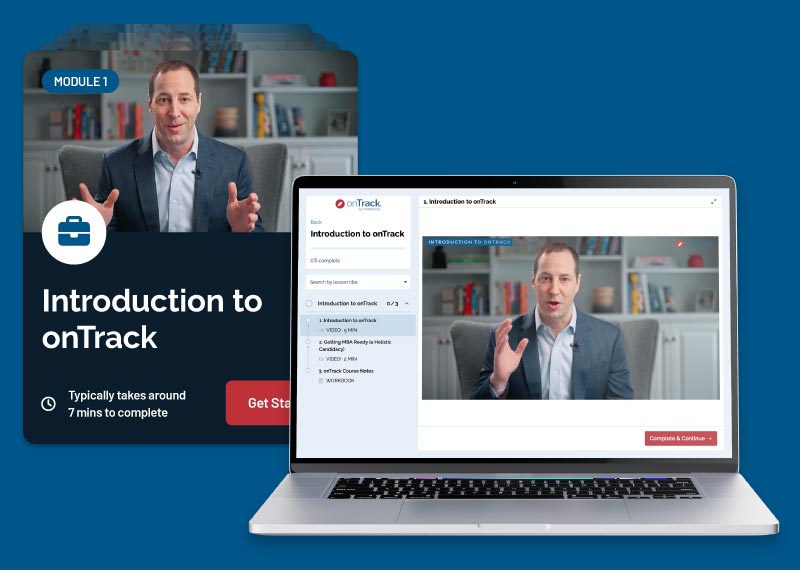
onTrack by mbaMission

A first-of-its-kind, on-demand MBA application experience that delivers a personalized curriculum for you and leverages interactive tools to guide you through the entire MBA application process.

Get Started!

2026–2027 MBA Essay Tips

Click here for the 2025–2026 MBA Essay Tips


MBA Program Updates

Explore onTrack — mbaMission’s newest offering allowing you to learn at your own pace through video. Learn more