Blog

Converting Your GRE Score to a GMAT Score

How can you convert your GRE score to a GMAT score? And should you? We get questions all the time on the topic of the GRE versus the GMAT. Our GRE-taking clients want to know what their equivalent GMAT score would be to ensure that they fall within the GMAT range for their target schools. Unfortunately, no exact conversion for these tests exists. Although you can plug your GRE score into the ETS site to see the general range of equivalent (“predicted”) GMAT scores, that does not give you the full picture!

Most U.S. business schools accept both the GMAT and the GRE (and some even accept the executive assessment—we see you, Columbia Business School and NYU Stern!), but the GRE has historically trailed the GMAT as the standardized test of choice for MBA programs. However, it has gained significant traction in recent years, and now, approximately 30% of applicants to the top 25 business schools submit GRE scores. Because of the GRE’s “newer” status, though, the range of acceptable GRE scores has historically been a bit more flexible than the range of GMAT scores.

Take, for example, Kellogg’s admissions stats: the average GMAT score for incoming members of the Class of 2025 was 731. The median GRE scores for this same group of students were 163 Verbal and 163 Quant. According to the ETS conversion tool, these GRE scores equated to a predicted GMAT score of 690, more than 50 points lower than the school’s average. Essentially, Kellogg admitted candidates who had a lower “equivalent GMAT” when they submitted the GRE instead. 

So, the conversion of a particular score does not convey one’s chances of admission based on that score. Using the Kellogg stats just mentioned, if a candidate with the school’s median GRE score (163) had converted that number to a predicted GMAT score (690) and assessed their chances of admission based on that information, they would have likely assumed that their chances were low. They might not have even applied to Kellogg as a result! But, given Kellogg’s median GRE score, we know this process is clearly more of an art than a science, and the definition of a “strong” GRE score simply varies more widely.  Pay more attention to a school’s GRE score ranges than to its average GMAT figure.

If you have questions about your test scores, need some basic guidance on your application essays, or wonder which schools you would be competitive at, you can start getting answers from an experienced mbaMission consultant. Sign up for a free 30-minute consultation with one today!

Should I Consider Chicago Booth and Wharton for Marketing?

You may be surprised to learn that the University of Chicago Booth School of Business is making inroads into an area that its crosstown rival (Northwestern University’s Kellogg School of Management) is known to dominate: marketing. Through the James M. Kilts Center for Marketing—named for the Chicago Booth graduate who was formerly CEO of Gillette and Nabisco (and is now a partner at Centerview Partners, which he co-founded)—Chicago Booth offers students roughly a dozen marketing electives. In particular, the school is growing its experiential opportunities in the marketing field, with students taking part in marketing management labs (semester-long consulting projects) at companies that in the past have included Abbott Laboratories, Bank of America, and Honeywell International. Further, professors in the department saw opportunities for increased practical involvement and created “hybrid” classes such as “Digital Marketing Lab” and “Lab in Developing New Products and Services” that involve a lecture component but also allow students to work on shorter-term consulting projects. In addition, students can apply for Kilts Fellowships, which provide scholarship funds and a two-year mentoring relationship.

Another potentially overlooked destination for marketing-driven MBA applicants is the Wharton School of the University of Pennsylvania, which might be best known for its reputation in finance (as its original name, the Wharton School of Finance and Commerce, would imply). Nevertheless, the school prides itself on the breadth and depth of its expertise in a multitude of business areas.

For instance, consider these facts about Wharton’s highly regarded marketing program:

  • Wharton has “the largest, most cited, and most published marketing faculty in the world,” according to the marketing department’s website.
  • The school’s marketing department was ranked #2 in the 2024 U.S. News & World Report MBA rankings by specialty.
  • A Wharton marketing professor developed conjoint analysis, a tool that has helped shape 20th century marketing practices.
  • The Wharton Marketing Conference brings together approximately 300 students, faculty members, alumni, and leading marketing experts to explore various themes central to the industry. Past conferences themes have included “Rewriting the Playbook” and such panel discussions topics as “Marketing within Data Sensitive Industries” and “Building Engaged Content Communities,” with panelists and speakers hailing from such companies as Peloton, the Kellogg Company, Curology, and TikTok.

Indeed, to dismiss Wharton as simply a finance school would be a mistake.

For a thorough exploration of what Chicago Booth, Wharton, and other top business schools have to offer, check out our free mbaMission Insider’s Guides.

Why Personalized Recommendations Matter but Some Details May Not

If your supervisor is writing your business school recommendation and you are having trouble ensuring that they are putting the proper thought and effort into it, you are not alone. Because of this asymmetry of power, junior employees can only do so much to compel their supervisor to commit the necessary time and write thoughtfully. So, before you designate your supervisor as a recommender, you must first determine how committed this person really is to helping you with your business school candidacy. In particular, your recommender needs to understand that using a single template to create identical letters for multiple business schools is not okay. Each letter must be personalized, and each MBA program’s questions must be answered using specific examples.

If your recommender intends to simply write a single letter and force it to “fit” a school’s questions or to attach a standard letter to the end of the school’s recommendation form (for example, including it in the question “Is there anything else you think the committee should know about the candidate?”), then they could be doing you a disservice. By neglecting to put the proper time and effort into your letter, your recommender is sending a very clear message to the admissions committee: “I don’t really care about this candidate.”

If you cannot convince your recommender to write a personalized letter or to respond to your target school’s individual questions using specific examples, look elsewhere. A well-written personalized letter from an interested party is always far better than a poorly written letter from your supervisor.

In addition, although details are important in recommendation letters, remember that sometimes small points in MBA applications are really just that—small points. We are often asked, “Should this be a comma or a semicolon?” and want to respond, “Please trust us that the admissions committee will not say, ‘Oh, I would have accepted this applicant if they had used a comma here, but they chose a semicolon, so DING!’” That said, we are certainly not telling you to ignore the small things. Details matter—the overall impression your application makes will depend in part on your attention to typos, font consistency, and grammar, for example—but we encourage you to make smart and reasonable decisions and move on. You can be confident that your judgment on such topics will likely be sufficient.

The mbaMission Podcast: Your Ultimate Guide to Navigating the MBA Admissions Process

We are thrilled to announce the launch of The mbaMission Podcast, a game-changing new weekly show that provides you with invaluable insights into the world of business school admissions. Hosted by mbaMission Senior Consultant Harold Simansky, this podcast is your go-to resource for everything you need to know about applying to MBA programs and crafting a standout application.

Each week, Harold is joined by a different MBA admissions expert for a deep dive into various aspects of the business school admissions process, from how to select the right schools to choosing and managing your recommenders to drafting compelling application essays and preparing for MBA interviews.

A brand new episode of The mbaMission Podcast is released every Tuesday, and you can find it on all the major podcast streaming platforms, including Spotify and Apple Podcasts. You can now stay easily up-to-date with the latest tips, trends, and news in MBA admissions, whether you are commuting, working out, or just relaxing at home.

Past Episodes: A Wealth of Knowledge

Previous episodes have already covered a wide range of topics that are crucial for MBA applicants:

Upcoming Topics

Looking ahead, we are excited to bring you even more compelling content and expert MBA application advice in the following episodes:

  • Debbie Choy, who was recently named one of Poets&Quants Most Favorably Reviewed MBA Admission Consultants of 2024, will share her expertise on school selection and how to avoid fatal flaws your applications.
  • mbaMission Senior Consultant Kate Richardson will offer insights into the often intimidating Wharton Team-Based Discussion.

Subscribe for New Episodes, Released Every Tuesday

The mbaMission Podcast is more than just an information source; it is a comprehensive guide to mastering the MBA admissions process. Featuring expert guests, actionable advice, and timely topics, each episode will help you put your best foot forward and achieve your business school goals.

Subscribe today, and join us on this exciting journey to MBA success. We look forward to helping you navigate the path to your dream program!

More of a visual learner? Check out our YouTube channel to access each week’s podcast episode in video format.

mbaMission Offers Free In-Person Consultations in San Francisco!

 class=

Are you a business school applicant in need of some guidance from an admissions advisor? If so, then we want to meet you for a free in-person consultation in San Francisco, California!

  • mbaMission Senior MBA Admissions Consultant Nisha Trivedi will be holding free in-person, one-on-one consultations at the The Palace Hotel in San Francisco on June 4, 2024.

During your free in-person consultation, your admissions advisor will answer all your most pressing MBA application questions, including the following:

  • What are my chances of being admitted?
  • How can I differentiate myself from so many other applicants?
  • What is the best way to showcase my accomplishments or mitigate my weaknesses?

If you would like to meet with Nisha to discuss your MBA applications, please provide some basic information about your candidacy via the submission form. We will reply to you within one business day with a link to schedule your in-person, 30-minute consultation.

We look forward to getting to know some of this season’s best and brightest business school applicants!

*This offer is valid only for those applicants who have not already had an mbaMission free 30-minute consultation.


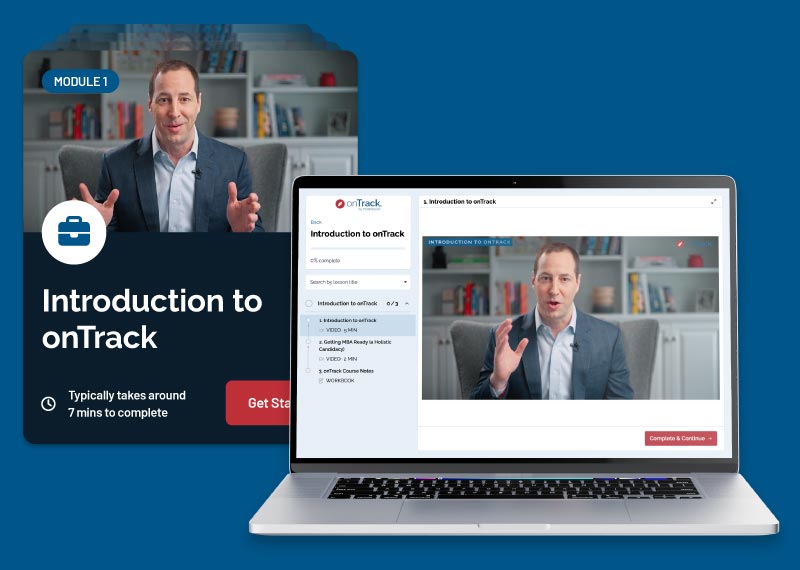
onTrack by mbaMission

A first-of-its-kind, on-demand MBA application experience that delivers a personalized curriculum for you and leverages interactive tools to guide you through the entire MBA application process.

Get Started!

2026–2027 MBA Essay Tips

Click here for the 2025–2026 MBA Essay Tips


MBA Program Updates

Explore onTrack — mbaMission’s newest offering allowing you to learn at your own pace through video. Learn more