Blog

Heading South for an MBA: The University of Texas McCombs School of Business and Emory University’s Goizueta Business School

The McCombs School of Business at the University of Texas, Austin, features several highlights in its MBA program that allow students to benefit from expanded opportunities for work experience (including with nonprofits), entrepreneurship, and leadership programming. For example, in the Texas McCombs Labs program, students learn marketing and supply chain skills by working hands-on for such major firms as Dell and Sam’s Club. All first-year MBA students are eligible to apply to the program, which runs through the course of one academic year.

Another notable program, the Texas Venture Labs Investment Competition, awards MBA scholarships to the winners of a start-up pitch competition, in which both admitted and prospective students can compete. The competition awards nearly $50,000 in prizes annually. In the area of nonprofit work, McCombs hosts a chapter of the Net Impact program, which affords students the chance to work on socially and environmentally responsible projects aimed at solving major societal problems.

Another Southern institution, Emory University’s Goizueta Business School—named after late Coca-Cola CEO Roberto C. Goizueta—is deeply rooted in a legacy of global business leadership. Goizueta’s MBA program offers one- and two-year formats, strives to maintain an intimate learning environment, and offers its students the benefit of being located in a significant global commercial hub. One of the program’s notable advantages has been its success in attracting recruiters. The school’s recruiting strengths seem to be reflected in its latest employment report as well—99% of the Class of 2021 received job offers within three months of graduation and accepted positions with such major companies as Amazon, Deloitte, EY, Google, Microsoft, PwC, and UPS.

Penn State Smeal College of Business Essay Tips and Examples

How to Get Into Smeal College of Business: Penn State Smeal Essay Tips and ExamplesThe Penn State Smeal College of Business takes a straightforward, no-nonsense approach to its one required, written application essay, asking candidates to explain the most basic factors behind their pursuit of an MBA: where they want to go professionally, why they believe they are positioned to reach their career objectives, and what role the MBA plays in their plans. The other required “essay,” however, is a total 180, in which applicants must respond on video to several random, unknown questions, with less than a minute in which to prepare for each. Smeal appears to want to capture both sides of its candidates—the formal and carefully planned and considered side and the instinctive, improvised, and unguarded side—in its assessment of them. Read on for our more thorough analysis of the school’s application essays for 2022–2023. 

Penn State Smeal 2022–2023 Essay Tips

Admissions Essay: What are your short-term and long-term career goals? How does your past experience enable you to achieve these goals? How do you see your MBA experience fitting into this plan? (600 Word Limit)

To craft a successful essay response to this rather classic prompt, you will need to accomplish a few things (though not necessarily in the order we are about to present them). One, clearly present both your immediate post-MBA goal and your longer-term aspiration. Two, ensure that the connection between these two objectives is clear, and if not, provide appropriate context or explanation to reveal the connection and why the transition from one to the other is reasonable and attainable for you. Three, describe the skills and background you already possess that position you for success in your desired roles and industry, along with those you still need to attain via an MBA education (thereby demonstrating your understanding of what is required to reach your stated positions and thrive there). And four, identify the resources and experiences that Smeal offers (and, ideally, that other top business schools do not) that will allow you to gain the abilities and exposure you currently lack. We explain these concepts and how to achieve them in more detail in our mbaMission Personal Statement Guide, which is available free of charge. Download your complimentary copy today!

Video Application Response: You will be asked to respond to a series of interview questions using a webcam. For each question, you will have limited time to consider your response and a set amount of time to respond as the system records. The system allows for unlimited practice sessions but once you start the formal video interview process, you will only have one chance to respond to each question. Your application will not be considered complete or evaluated by the committee until you have completed this part of the process, which is separate from the Penn State Graduate School application.

Technical Requirements: Visit the video application website to get started. You will need an internet-connected computer with a functioning webcam and microphone.

Time Required: 15 to 20 minutes to respond to all the questions. You can register within the system beforehand and complete your interview later at your convenience.

Required video components—and especially spontaneous ones like this—can easily strike fear into the hearts of business school candidates, but let us reassure you a bit and unpack this component of the Smeal application process, in hopes of helping you relax and put your best self forward. First of all, keep in mind that these video questions are not meant to trip you up or entice you to do or say anything that would get you immediately disqualified from consideration. Videos are generally opportunities for the admissions committee to put a “face” on your written application and learn a little more about your personality, energy level, communication style, and other such intangibles. By putting you on the spot and under stress to some degree, the video questions allow the school to see how you act under pressure and intuitively, which naturally reveals more of one’s true character. Rather than being intimidated by this fact, though, try to see it as a chance to show Smeal the real you and your enthusiasm about participating and sharing. Step beyond the stats and the restrictive boxes of the written application and let your personality shine through.

Professor Profiles: Katherine Schipper, Duke University Fuqua School of Business

 width=

Many MBA applicants feel that they are purchasing a brand when they choose a business school. However, the educational experience you will have is what is crucial to your future, and no one will affect your education more than your professors. Today, we focus on Katherine Schipper from the Duke University Fuqua School of Business.

Katherine Schipper is the Thomas F. Keller Professor of Business Administration at Fuqua and has typically taught one of the MBA program’s core accounting courses, “Financial Accounting.” She previously served in several roles for the American Accounting Association and is currently the president of the International Association for Accounting Education and Research. Schipper was editor of the Journal of Accounting Research for many years and was a member of the Financial Accounting Standards Board from 2001 to 2006, before joining Fuqua. In 2007, Schipper was the first woman inducted into the Accounting Hall of Fame.

A second-year student we interviewed who had taken the course “Global Institutions and Environment” (which is not available during the 2021–2022 academic year) with Schipper said, “She was outstanding. It was amazing to have professors of their caliber teaching the first class we experienced at Fuqua.” Another second year told us, “I was really nervous about accounting, but she made it very accessible, and even occasionally fun.” When asked which professor impressed her most, a second year we interviewed named Schipper, praising her rigor in the classroom: “She held every single person to an impeccably high standard and set the tone for graduate level expectations.”

For more information about the Duke University Fuqua School of Business and 16 other top-ranked business schools, check out our free mbaMission Insider’s Guides.

What to Do If You Are Just Getting Started with the GMAT

With regard to the GMAT, raw intellectual horsepower helps, but it is not everything. Manhattan Prep’s Stacey Koprince teaches you how to perform at your best on test day by using some common sense.

If you are just getting started with the GMAT and are trying to figure out what to do, we have got several big categories of things to discuss: mind-set, devising a study plan, and learning how to study.

Mind-Set

If you do what most people do and try to prepare for this test in the same way that you prepared for tests in school, you are not going to get the best score that you could get.

If you are not sure what is tested on the GMAT or what the different question types look like, take some time to wander around this section of the official GMAT website.

Next, read this short article: “In It to Win It.” This will help you to start to adjust your mind-set so you can maximize your GMAT score. Okay, we are essentially done with the mind-set category, but I have to say one more thing. I put mind-set first for a reason: if you have the wrong mind-set, it will not matter how much you learn or practice. You still will not get the best score that you are capable of getting.

Devising a Study Plan

Get started with this article: “Developing a GMAT Study Plan.” Note: make sure to follow the instructions about taking and analyzing a practice test.

Next, read this article about time management. As you will have already learned from our discussions of mind-set and scoring, effective time management is crucial to your success on this test

How to Study

One key GMAT skill is learning to recognize problems. “Recognize” means that we actually have a little light bulb go off in our brain—“Hey, I’ve seen something like this before, and on that other one, the best solution method was XYZ, so I’m going to try that this time, too!”

When you recognize something, you have given yourself two big advantages: you save yourself time, because recognizing is faster than figuring something out from scratch, and you are more likely to get it right because you know what worked—and what did not—the previous time. You will not be able to recognize every problem, but the more you can, the better.

Read the “How Do I Learn?” section in the second half of the “Developing a GMAT Study Plan” article. Make sure to follow the links given in that section—those links lead to the tools that will help you learn how to learn from GMAT questions.

If you want to take advantage of online forums to chat with teachers and other students (and I strongly recommend that!), learn how to make the best use of the forums.

Finally, ask for advice! So many resources are out there that it can be overwhelming, but most companies offer free advice (Manhattan Prep does here!), and you can also benefit from talking to fellow students.

Columbia Business School’s Financial Studies Program and Increasingly Flexible Curriculum

Already well known as a finance powerhouse, Columbia Business School (CBS) stepped up its finance game in 2010 with the establishment of the Program for Financial Studies. This umbrella initiative connects faculty who approach financial studies from a variety of disciplines with students, alumni, and external organizations. The program’s main goals are to support research, to enhance the CBS finance curriculum and related resources, and to create opportunities for the exchange of ideas between CBS students and faculty and members of the external finance community. The program’s recent studies have included “ABC Coalition Game: Relationships and Bargaining,” “Amazon: Taking on India,” and “Anheuser-Busch InBev and ZX Ventures: Thirst for Self-Disruption.”

The structure of CBS’s core curriculum has also evolved throughout the years and now includes an increased emphasis on cross-disciplinary thinking. The program’s core courses utilize online teaching tools in an attempt to “free up more classroom time for deeper dives and discussions,” as a 2013 Poets&Quants article explained. In addition, students may take exemption exams in areas in which they are already proficient, thereby accessing the option to replace core courses with electives. This revised curriculum was developed in response to student feedback that a full term was not needed to cover the “core” elements in certain courses, and the change has given students significantly more flexibility in the first year.

CBS has attempted to find a middle ground where students learn what the school considers fundamentals while having the latitude to specialize, and anecdotally, students have responded favorably.

For a thorough exploration of what CBS has to offer, download a free copy of the mbaMission Insider’s Guide to Columbia Business School or one of our 16 other complimentary Insider’s Guides.


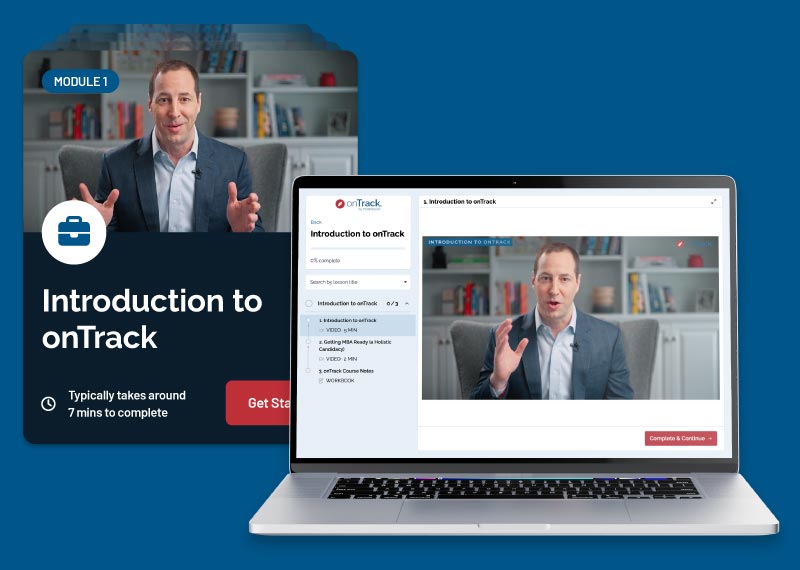
onTrack by mbaMission

A first-of-its-kind, on-demand MBA application experience that delivers a personalized curriculum for you and leverages interactive tools to guide you through the entire MBA application process.

Get Started!

2026–2027 MBA Essay Tips

Click here for the 2025–2026 MBA Essay Tips


MBA Program Updates

Explore onTrack — mbaMission’s newest offering allowing you to learn at your own pace through video. Learn more