
Blog

Getting the 80/80 Score on the GMAT

With regard to the GMAT, raw intellectual horsepower helps, but it is not everything. Manhattan Prep’s Stacey Koprince teaches you how to perform at your best on test day by using some common sense.

What is the “80/80”? All schools look at your overall three-digit GMAT score (the one given on the 200–800 scale). In addition, a few of the very top business schools, such as Harvard, Stanford, and Wharton, look for the 80/80 score: an 80th percentile score or higher on the individual Quant and Verbal subsections. Essentially, if someone hits a 700 but does so by scoring 99th percentile in one subsection and only 60-something in the other, the schools might be concerned about the lower-scoring area. From their point of view, an “80/80” minimum ensures that you have got a solid base in both areas.

What if I score in the 75th percentile?

The 80/80 guidelines are just that—guidelines. The schools do not use these parameters as a hard cutoff. In other words, a score in the 70s is generally fine, as long as the overall score is also within a school’s desired target range. If, on the other hand, the overall score is a bit low, the GPA is a bit low, and one or both of the GMAT subscores are low… Well, you still might get in, but doing so just became a lot harder.

What if I score in the 60s?

Unless there is something else that is stellar in your profile and can therefore offset this lower score, the 80/80 schools will likely be concerned about a Quant or Verbal percentile in the 60s—particularly so for Quant. For Verbal, they have a whole host of other tools with which to assess your communication skills, starting with your essays. A 60s (or lower) Quant score, though, could indicate that you will have trouble handling the quantitative portions of the MBA curriculum. You might be able to offset this concern if you can demonstrate that your current job involves significant quantitative components; make sure that your recommendations highlight your quant skills. Alternatively, perhaps you excelled in quant-focused classes in school (calculus, accounting, physics, statistics), and your transcripts show A grades.

If not, then something needs to be done. Two paths are possible here, and you can follow just one or both. First, the no-brainer: take the GMAT again and get a score in the 70s (or higher!). I call that a “no-brainer” in the sense that there is no question that you should try to do this. You might not succeed, though. An alternative, then, is to take a calculus or accounting class at a local university. If you do this, you must get an A; getting a B at this stage will not inspire confidence in the admissions staff. In addition, taking such a class will involve a decent amount of lead time; these classes often run over a period of two to four months, so this is not a last-minute solution.

The big picture? Ideally, get the GMAT done well in advance of admissions season so that you have ample time to address unexpected or unwelcome surprises during the process.

Professor Profiles: Barry Nalebuff, Yale School of Management

 width=

Many MBA applicants feel that they are purchasing a brand when they choose a business school. However, the educational experience you will have is what is crucial to your future, and no one will affect your education more than your professors. Today, we profile Barry Nalebuff from the Yale School of Management (SOM).

Perhaps best known as one of the founders of Honest Tea, Barry Nalebuff is the Milton Steinbach Professor of Management at the Yale SOM. An expert in game theory and strategy, Nalebuff has been a professor at the SOM since 1989. A second year told mbaMission that in the classroom, Nalebuff “is a favorite for his sharp wit and insights.” Nalebuff is also an accomplished author with more than 400,000 copies in print. His book The Art of Strategy: A Game Theorist’s Guide to Success in Business and Life (W.W. Norton & Co., 2008), for example, explores how almost all interactions—business and personal alike—have a game theory component. Nalebuff’s new book, Split the Pie: A Radical New Way to Negotiate (Harper Business), explores the art of negotiation and will be released in March 2022.

Nalebuff and Adam Brandenburger, a professor of business economics and strategy at New York University’s Stern School of Business, developed the concept of a new business strategy called “co-opetition,” which they write about in the book Co-Opetition: A Revolutionary Mindset That Combines Competition and Cooperation: The Game Theory Strategy That’s Changing the Game of Business (Crown Business, 1997). The book’s listing on Amazon.com describes co-opetition as “a business strategy that goes beyond the old rules of competition and cooperation to combine the advantages of both. Co-opetition is a pioneering, high profit means of leveraging business relationships.”

A first year noted in a SOM Community Blog post, “Prof. Nalebuff never misses an opportunity to illustrate the ways in which companies can cooperate to grow the PIE (potential industry earnings). Of course, he then always reminds us that these same companies should compete aggressively to secure the biggest piece of that newly expanded PIE.”

For more information about the Yale SOM and 16 other top-ranked business schools, check out our free mbaMission Insider’s Guides.


How to Minimize Careless Errors While Taking the GMAT

With regard to the GMAT, raw intellectual horsepower helps, but it is not everything. Manhattan Prep’s Stacey Koprince teaches you how to perform at your best on test day by using some common sense.

Remember those times when you were sure you got the answer right, only to find out that you got it wrong? For a moment, you even think that the answer key must have a mistake in it. Then, you take another look at the problem, check your work, and say, “I can’t believe I did that!”

By definition, a careless mistake occurs when we did actually know all of the necessary info and we did actually possess all of the necessary skills, but we committed an error anyway. We all make careless mistakes; our goal is to learn how to minimize these mistakes as much as possible.

A lot of times, careless errors are due to one of two things: (1) some bad habit that actually increases the chances that we will make a mistake or (2) our own natural weaknesses.

Here is an example of the former: they ask me to find how long Car B takes to go a certain distance, and I do everything perfectly, but I solve for Car A instead. So, what is my bad habit here? Often, I did not write down “Car B = ?” I also noticed that I was more likely to make this mistake when I set up the problem such that I was solving for Car A first; sometimes, I would forget to finish the problem and just pick Car A’s time.

So, I developed several different good habits to put in the place of my various bad habits. First, I set up a reminder for myself: I skipped several blank lines on my scrap paper and then wrote “B time = ______?”

I also built the habit of solving directly for what I wanted. Now, while I am setting up the problem, I always look first to see whether I can set it up to solve directly for Car B, not Car A.

So, what did I do here? First, I figured out what specific mistake I was making and why I was making it. Then, I instituted three new habits that would minimize my chances of making the same mistake in the future. Incidentally, one of those habits (solving directly for what is asked) also saves me time!

Happy studying, and go start figuring out how to minimize those careless mistakes!

MBA Application Tips for Family Business Applicants

MBA admissions officers covet applicants who expect to lead significant family businesses because, simply put, they have a higher likelihood of career success. However, family business applicants do not get a free pass. They must still show that they have the professional skills and strong determination to do well in their long-term career. Here we share our top advice for MBA applicants who expect to run a family business after graduating from business school.


Show that you can earn it.

Top MBA programs might have a slight bias in favor of candidates who have a clear path to the CEO’s chair, but they absolutely have a bias against entitlement and privilege. Family business applicants need to demonstrate that they have not simply been handed one opportunity after another but can actually earn such opportunities on their own merits. Candidates who have worked outside the family business prior to applying to an MBA program can often establish this fairly easily, but those who are still working within the family business need to be sure that they can detail accomplishments that are independent from a family member. If you are currently working in your family business, you must be able to say you “owned” this accomplishment and can substantiate your depth of commitment in your interviews, essays, resume, and other parts of your application. In addition, maintaining significant engagement in community activities and pursuing personal goals can be quite important and helpful for individuals in a family business—including pursuing entrepreneurial ambitions—because doing so sends the message that they are capable of achieving success on their own.


Have your own vision.

The MBA admissions committees are less interested in applicants who plan to become CEO and then simply put the family business on autopilot. They want to see that you can honor the past while having your own ambitions and growth agenda, and that you intend to take what you learn from your MBA experience to propel your family business to the next level. The schools want to know that you can be a catalyst, not just a caretaker. So keep this in mind when sharing your goals in your personal statements or when responding to questions about your aspirations in your interviews. Never disparage the past, but clearly show that you have a personal vision for growth in a new area or a plan to change the company in an exciting way. Hypothetically, if you were in a third-generation manufacturing business, you could discuss anything from reinvesting in robotics to developing new product lines to diversifying profits into entirely different industries. The admissions committee will be less concerned about the specific path you describe and more concerned that the idea you have in mind is exciting and, most of all, yours.


Consider recommenders carefully.

That you should not ask a family member for a letter of recommendation should go without saying, but this does not mean that you lack strong options. Instead, you could ask, for example, a client, supplier, mentor, independent board member, or advisor to the family business to write on your behalf. What is most important is that whomever you ask to write your recommendation, you must advise them to not just be a cheerleader but to write a thoughtful and even critical letter, just as they would for any applicant. Your letter must clearly be objective because anything else could seem disingenuous and damage your candidacy. As long as their letter comes across as honest and thoughtful, your recommender can establish credibility and help your chances.


If you are a family business applicant and you have questions about how to manifest an “earn it” identity, how to communicate your vision for your firm, or whom to choose as your recommenders, we encourage you to sign up for a free consultation with an mbaMission admissions expert. We have worked with many family business applicants over the years and can answer your most pressing questions during this complimentary half-hour session.

Identifying Your Career Goals: Advice for Starting Business School

This post was written by our resident Career Coach, Elissa Harris. To sign up for a free 30-minute career consultation with Elissa, please click here.

Many MBA candidates believe that business school will offer them time to explore different careers or gain clarity on their career goals. Unfortunately, this does not magically happen. Developing this kind of insight requires a significant time commitment on your part, along with a lot of targeted research and reflection.

So, what parameters and process for your research and reflection will yield maximize results without putting you into a circle of “analysis paralysis”? Consider the following seven tips:

1. Recognize that you will never have 100% perfect information to help you decide on your post-MBA career goals. For example, none of us could have predicted how things have unfolded since March 2020. Significant business challenges have arisen, but so have interesting new opportunities. Your career will be iterative and will likely include lots of twists and turns through which you will learn more about yourself and continue to find new positions that offer more fulfillment.

2. Hold yourself accountable to a process and timeline. Write down weekly and monthly goals and milestones, estimating the amount of time required for each, and then work backward. For example, if you plan to start school in August, ask yourself what you need to accomplish by the end of May, June, and July, respectively.

Schedule actual blocks of time on your calendar for your job search–related activities and write down the outcome of your actions; this will not only ensure that you do the tasks but will also provide tangible evidence of your progress.

3. Leverage your MBA program’s resources. Check and see whether summer self-assessment resources are available—perhaps access to external tools such as CareerLeader or internally developed exercises and industry-specific content. Read this blog post for tactical advice on starting your job search before you even arrive on campus.

4. Identify themes from your past experiences. Explore your previous experiences (go back to your brainstorming documents for MBA program applications) to figure out what key elements you want in your next professional role. Ask yourself questions like What did you like most at work (or in your extracurriculars), and why? What did you like least, and why? When were you at your best? What skills were you constantly praised for demonstrating? What type of problem solving excited you? What are you most curious about?

5. Conduct a 360-degree review. Ask five to seven (or maybe even more) people who know you well—managers, colleagues, direct reports, vendors, friends—for feedback and advice. Prompt them with specific questions, such as the following: What do you think are my biggest strengths? What skills do you think will be most beneficial to a long-term career? In what type of situations am I at my best? When have you seen me most engaged in something?

6. Narrow your options. Evaluate your best options, given the marketplace realities and your interests, skills, and risk tolerance. Use insights from items 4 and 5 to build a set of criteria/priorities for your target role. Identify two or three potential careers, then gather information on each pathway, noting any unanswered questions for future exploration.

7. Network to confirm areas of interest. Speak with people in your target roles, and focus your questions on areas of priority (e.g., if stability and a structured career path are important to you, ask questions on that topic). Seek to understand potential employers’ needs through questions such as these: What type of people are most successful in this role? What skills enable you to be successful in this role? What are the biggest obstacles you face on a day-to-day basis? What are the most effective strategies for job searching in this space?

Finally… although we understand that having someone simply tell you exactly what career to pursue would be great (and certainly much easier), we strongly believe that devoting the necessary energy to making this decision for yourself will lead to more success in recruiting and more satisfaction in the role you ultimately accept.


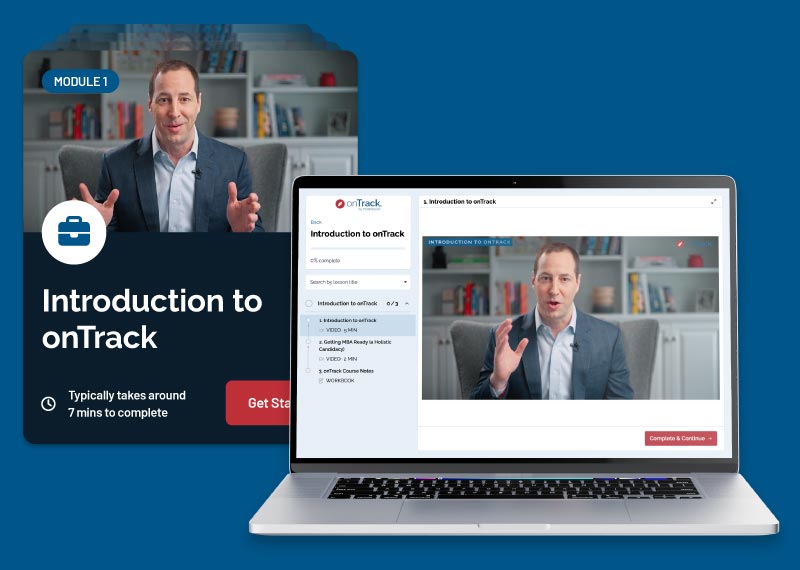
onTrack by mbaMission

A first-of-its-kind, on-demand MBA application experience that delivers a personalized curriculum for you and leverages interactive tools to guide you through the entire MBA application process.

Get Started!

2026–2027 MBA Essay Tips

Click here for the 2025–2026 MBA Essay Tips


MBA Program Updates

Explore onTrack — mbaMission’s newest offering allowing you to learn at your own pace through video. Learn more