Blog

Why Your Test Scores Still Matter 

When the COVID-19 pandemic first struck, the MBA admissions world (like the rest of the world) was thrown into chaos. Admissions officers fretted that the candidates they had already admitted would not be able to travel to campus, so they opened their doors to new applicants—who could not take the usual entrance exams because the test centers were closed! The obvious solution in the short term? Programs such as MIT Sloan, Northwestern Kellogg, and Michigan Ross waived their testing requirements entirely. Then, as “take from home” GRE and GMAT options began to be offered, some admissions officers quickly reverted back to their original mandatory testing policies, while others allowed applicants to apply for test waivers, and still others expanded their testing options to include the Executive Assessment (EA), MCAT, DAT, and similar exams. So, which option is best for you? Should you take the GRE or GMAT, apply for a waiver, or target an alternative test?

Here are five reasons you might still need (or even want!) to take the GRE or the GMAT:

Your target MBA programs still require the GMAT or GRE.

The most obvious reason for taking one of the conventional tests is that at least for now, virtually all the top MBA programs still require these scores. Although this is subject to change, as of the writing of this blog post, only seven of the top 30 programs (Michigan Ross, UVA Darden, NYU Stern, Cornell Johnson, Texas McCombs, UNC Kenan Flagler, and UW Foster) offer applicants the opportunity to apply for a test waiver, and you have no guarantee that they will grant your request. So, unless your target programs are on that short list and your waiver requests are granted, you will need to take either the GMAT or GRE to keep your options open.  If you want to apply to Harvard Business School, Stanford GSB, and/or UPenn Wharton, you need to get cracking on your GMAT/GRE studies. If you were hoping to avoid taking a test altogether, your options at the moment are quite few.

But wait, what about those alternative tests we mentioned? A small group of full-time MBA programs is accepting scores from such tests as the EA (essentially a mini GMAT), the MCAT, and the LSAT, among others. For now, the EA has the most traction in the MBA world because it is accepted by most Executive MBA programs and is thus more of a known entity among admissions officers. One of the nice things about the EA is that it is a threshold test, which means you simply need to achieve a minimal score to prove your competence, rather than having to match or exceed a target program’s lofty average.

Executive Assessment MCAT/LSAT/PCAT/DAT Waivers
UVA Darden Y Y Y
Michigan Ross X Y Y
NYU Stern Y Y Y
Duke Fuqua Y N N
Columbia University Y N N
Carnegie Melon Tepper Y N N
Texas McCombs Y N N

While the option of taking the EA or another alternative test might be appealing, you will likely run into a  problem ¾ your target list is unlikely “covered’ by these alternative tests.. So, if you want to apply to a top-30, full-time MBA program with the EA or the LSAT, your options are likely to be limited. And when you are applying to your dream MBA programs, you do not want to limit your options!

Professor Profiles: Gautam Kaul, University of Michigan Stephen M. Ross School of Business

Professor Profiles: Gautam Kaul, University of Michigan Stephen M. Ross School of Business - mbaMission

Many MBA applicants feel that they are purchasing a brand when they choose a business school. However, the educational experience you will have is what is crucial to your future, and no one will affect your education more than your professors. Today, we profile Gautam Kaul from the University of Michigan Stephen M. Ross School of Business.

Gautam Kaul, professor of finance and the Robert G. Rodkey Collegiate Professor of Business Administration, teaches both core curriculum courses and electives. Kaul also served as the Special Counsel for Digital Education and Innovator in Residence at the University of Michigan from 2012 to 2018. He has served as a board member for the school’s Social Venture Fund since 2014.

In addition to referencing his intellectual capabilities, students with whom mbaMission spoke described Kaul as extremely friendly and having a great sense of humor. He is also known for his willingness to help students both inside and outside the classroom. In 2005, in direct response to student interest, Kaul developed the elective course “Finance and the Sustainable Enterprise.” In return, students recognized his efforts and awarded him the Sustainability Pioneer Award and a plaque in his honor on one of the chairs in the main auditorium of the university’s School of Natural Resources and Environment.

Kaul has been nominated for an MBA Teaching Excellence Award (which is voted on by the student body) numerous times, most recently in 2019, and he won the award five times. He is also the 2009 recipient of the Victor L. Bernard Leadership in Teaching Award from the university’s Center for Research on Learning and Teaching.

For more information about Michigan Ross and 16 other top-ranked business schools, check out our free mbaMission Insider’s Guides.


A New Guide for Those Stuck on the GSB and HBS Essay Prompts 

mbaMission Publishes New Essay Guide for GSB and HBS ApplicantsAs we turn the page on a new business school admissions season, you might be one of the thousands of applicants wondering exactly what you will end up communicating to the admissions committees in your application essays. Those who plan to apply to Harvard Business School (HBS) or the Stanford Graduate School of Business (GSB)—two of the world’s most prestigious business school programs—might be especially nervous; HBS and the GSB have continuously vexed applicants with open-ended prompts: 

“As we review your application, what more would you like us to know as we consider your candidacy for the Harvard Business School MBA program?” (Harvard Business School)

“What matters most to you, and why?” and “Why Stanford?” (Stanford Graduate School of Business) 

We at mbaMission are proud to offer our “What Matters?” and “What More?”: 50 Successful Essays for the Stanford GSB and HBS (and Why They Worked) guide written by Jeremy Shinewald, Founder/President of mbaMission, and Liza Weale, Founder of Gatehouse Admissions, in partnership with Poets&Quants

Having helped hundreds of candidates gain acceptance to HBS and the GSB, Jeremy and Liza have pooled their collective experience to analyze a carefully curated collection of 50 successful essays to both schools, breaking down why each essay worked. The result is a truly essential guide to crafting essays confidently and effectively.   

“What Matters?” and “What More?”: 50 Successful Essays for the Stanford GSB and HBS (and Why They Worked) offers the following: 

  • Actual HBS and Stanford GSB essays, submitted by past candidates who were ultimately admitted, along with expert commentary on the strengths (and sometimes weaknesses!) of each one
  • Ten “pairs” of essays for HBS and the GSB, showing how the same candidate approached the two schools’ differing essay prompts
  • Two essays by reapplicants, highlighting useful tactics for writing these essays the second time around
  • Overviews and examples of four different approaches you can take to composing your essays: thematic, inflection points, single anecdote, and mosaic
  • Best practices for each essay question, such as how to handle the prompts’ vastly different word counts and what not to include in your essays

The guidance, samples, and critiques in “What Matters?” and “What More?” will help you find the best approach for sharing your strongest stories with these programs—and position yourself for success!

If you plan to apply to HBS or the Stanford GSB, this digital guide is a must-have resource, and it is on sale now for just $24 (from $60). Purchase your copy today—and be sure to contact us if you are interested in speaking one-on-one with an mbaMission expert admissions consultant via a free 30-minute consultation.  

MBAs for Professionals at Villanova School of Business and Krannert School of Management

With a satellite campus in Center City, Philadelphia, the Villanova School of Business (VSB) at Villanova University specializes in part-time programs for working professionals, allowing them to enjoy the benefits of a full-time curriculum without leaving their job. In this vein, the school offers an accelerated, two-year, part-time Fast Track degree option, for which students meet twice a week, as well as the more customizable Flex Track degree option, which typically takes three years to complete and accommodates varying course loads.

One advantage of the accelerated option is the opportunity to partake in the school’s three-part capstone project, which includes the “Social Enterprise Consulting Practicum,” “Global Practicum,” and “Global Strategic Management” courses—each lasting 14 weeks. In the “Social Enterprise Consulting Practicum,” students work with local nonprofit organizations to identify strategies in such areas as branding, funding, and membership retention. Alternatively, the latter two courses entail working with a multinational corporation to gain firsthand experience analyzing market issues. VSB also hosts a variety of elective international immersion courses, through which students may travel abroad over winter break or during the summer.

Another option for professionals is Purdue University’s Krannert School of Management, whose two executive MBA programs focus on helping professionals gain their advanced business degrees while maintaining a career. Students can select the traditional executive MBA program, which features five residencies at Krannert and one abroad, or the IMM Global Executive MBA program, during which students are divided into cohorts and take part in residencies in each of the five IMM partner schools (including Krannert). Locations for the residencies include Brazil, the Netherlands, and Italy. Both of these executive MBA programs take place over the course of 19 months and include online learning modules in addition to in-person studies.

Which mbaMission Service Is Right for Me?

Over the years, many MBA hopefuls have come to us with one resounding question:

Which admissions consulting service is right for me?

Maybe you are just getting started with the GMAT exam and admittedly have not even thought about your business school applications yet. Or maybe you are already well into the application process but are seeking some last-minute advice from an honest professional. Or perhaps you are a reapplicant who cannot understand what went wrong the first time around.

No matter where you are in the application process, mbaMission is here to help you. If you are unsure about which service might be the most beneficial to your candidacy, read on. In this blog post, we provide several different scenarios (one of which you might find yourself in now) and the corresponding best mbaMission service for each one.

“I need help with my MBA applications, but I don’t know where to start!”

Best for: Those who are (or plan to be) committing themselves fully to the MBA application process
The cost: Flat fee per school, starting at $5,900 for a one-school package with a Senior Consultant
The commitment: Extensive—This flat-fee option gives you unlimited brainstorming assistance, ongoing feedback and advice, and as many revisions to your essays, resume, and other application elements as you feel you need to craft the most successful application possible.

Our package services work best for those who are beginning the MBA application process and have committed themselves wholeheartedly. mbaMission’s package clients benefit from having no limitations on the amount of time spent brainstorming for essay ideas, the number of essay revisions allowed, the number of rounds of changes to resumes, and so on. If you intend to devote significant time to the application process, our Complete “Start-to-Finish” Package is for you.

With the Complete “Start-to-Finish” Package, you have the option to add additional schools to your purchase at any time within your contract agreement (May 1–April 30). So, if you decide to apply to another school (perhaps in a later round), you can do so with the help of mbaMission.

“I’ve started my applications, but I need help with a few elements.” 

Best for: Business school applicants who need help with discrete tasks rather than their overall application
The cost: Starting at $385 per hour to work with a Senior Consultant, with special “bundle” pricing available for clients purchasing five hours.
The commitment: Flexible—Use your hours however you choose, whenever you choose. Start with our minimum of two hours, and if you require more guidance, you can add hours to your purchase at any time within your contract agreement (six months from the purchase date).

Hourly services are a great option for applicants who need help with a few application elements rather than their entire application. For example, perhaps you feel your essays are strong, but you are unsure of how to assemble a compelling resume to accompany them. Or maybe you have been invited to interview and could benefit from some practice and feedback beforehand. Or perhaps just one essay is giving you trouble, so you feel you need assistance only with that portion. Whatever the task, we can serve your needs through our a la carte hourly services.


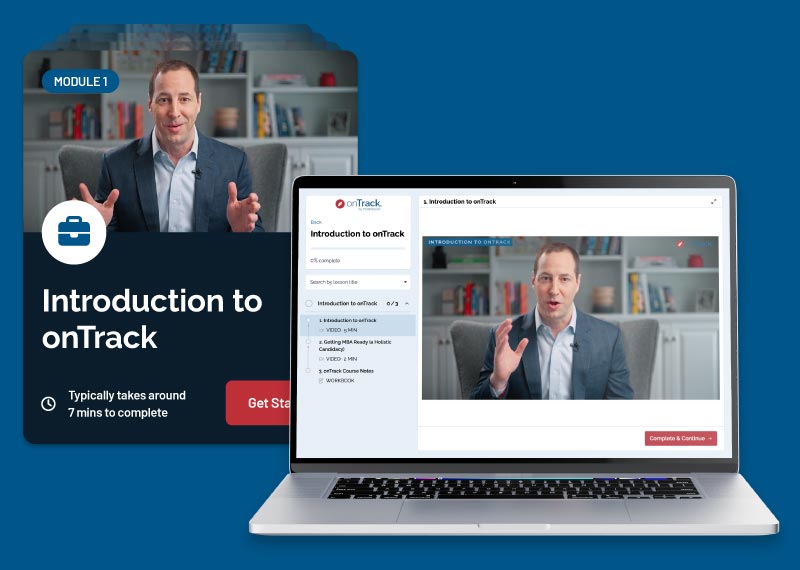
onTrack by mbaMission

A first-of-its-kind, on-demand MBA application experience that delivers a personalized curriculum for you and leverages interactive tools to guide you through the entire MBA application process.

Get Started!

2026–2027 MBA Essay Tips

Click here for the 2025–2026 MBA Essay Tips


MBA Program Updates

Explore onTrack — mbaMission’s newest offering allowing you to learn at your own pace through video. Learn more