Blog

Should You Interview On Campus or Off Campus?

You have received a coveted invitation to interview at your target business school, but the school is giving you a choice: interview on campus with an admissions committee member or student interviewer, or interview off campus with a graduate of the program. Which should you choose?

MBA Interview Options

Every business school has different admissions interview requirements. Historically, NYU Stern and Harvard Business School (HBS) offered interviews only with admissions committee members, either on campus or in select locations in the United States and abroad, wherever admissions committee members traveled. Columbia Business School (CBS) and the Stanford Graduate School of Business (GSB) offered alumni interviews all over the world. And Northwestern Kellogg, Dartmouth Tuck, and Duke Fuqua offered a hybrid—candidates could choose to interview on campus or could schedule a meeting with a member of the school’s alumni network in a city near them.

For the past two years, because of the COVID-19 pandemic, almost every MBA program has relied on virtual interviews, with applicants interviewing with admissions committee members, students, or alumni via Zoom. For the 2022–2023 MBA admissions season, a few schools are offering on-campus and off-campus, in-person interview options. Some, including HBS, CBS, and Duke Fuqua, are using both in-person interviews and virtual ones. At this point, we do not anticipate that the virtual interview option will go away anytime soon for most programs.

Which Interview Format Should You Choose?

If a school offers a variety of interviews options, do they all generally carry the same weight? In short, yes! They are essentially the same. Think of it this way, why would an admissions committee allow alumni to interview applicants off campus if they did not feel that they were getting quality reports on those applicants? And often, the line of questioning is virtually the same for on-campus interviews as for off-campus interviews, especially when those interviews are blind, meaning that the interviewer has not read the candidate’s full application beforehand.

These alumni interviewers are carefully chosen and trained to interview applicants and have a very defined line of questioning that they follow.

Here is one exception, though: if you have not yet visited your target school and doing so would not be an imposition on you, you should use an on-campus, in-person interview (if available, of course) as an opportunity to travel to campus, attend a class, and perhaps meet with a student or two. This will position you to then be able to speak far more intelligently about your target program, potentially even in your interview, depending on how the timing works out. If you have already visited the school or cannot make the trip during the interview period, do not worry! Admissions committees understand when applicants cannot visit, whether because of work, cost, or location. If you are given options, do not obsess over making the “right” choice; just focus on preparing for your interview and then performing your best with whoever ultimately interviews you.

For help with preparing for your upcoming interview, download a free copy of the mbaMission Interview Guide and any applicable school-specific Interview Guides, which include more in-depth information about the types of interviews your target schools conduct, along with sample interview questions provided by past applicants.

For even more preparation support, consider scheduling a mock interview with an mbaMission application expert. You can sign up for a general Mock MBA Interview Session, a Wharton Team-Based Discussion Simulation, or an HBS Intensive Interview Simulation, facilitated by our HBS Interviewer in Residence, Devi Vallabhaneni.

The Role of Exercise in Your GMAT Preparation

Exercise Makes You Smarter - mbaMission

With regard to the GMAT, raw intellectual horsepower helps, but it is not everything. Manhattan Prep’s Stacey Koprince teaches you how to perform at your best on test day by using some common sense.

The New York Times’ Well blog featured a fascinating post on exercise. Exercise has a whole host of benefits, including ones associated with memory. Two studies delved even deeper into how this works.

How does exercise help memory?

In the blog post, New York Times journalist Gretchen Reynolds details two studies—one conducted on humans and the other conducted on rats.

In the human study, elderly women who already had some mild cognitive impairment were split into three groups. One group lifted weights, the second group engaged in moderate aerobic exercise, and the third group did yoga-like activities.

The participants were tested at the beginning and end of the six-month exercise period, and the results were striking. First, bear in mind that, in general, we would expect elderly people who are already experiencing mental decline to continue down that path over time. Indeed, after six months, the yoga group (the “control” group) showed a mild decline in several aspects of verbal memory.

The weight-training and aerobic groups, by contrast, actually improved their performance on several tests (remember, this was six months later!). The women were better at both making new memories and remembering/retrieving old ones!

Another group of researchers conducted a similar study, only this time, rats were getting some cardio in or lifting weights. (The rats ran on wheels for the cardio exercise and, get this, for the weight lifting, the researchers tied little weights to the rats’ tails and had them climb tiny ladders!)

At the end of six weeks, the running rats showed increased levels of a brain protein that helps create new brain cells. The tail-weight-trainers had higher levels of a different protein that helps new neurons survive.

How can I use this? Get up and MOVE!

Reading this study has made me want to exercise more—and not even for the GMAT! I would like to stave off mental decline in my old age.

The women in the study were performing fairly mild exercises only twice a week (remember, they were elderly), so we do not suddenly have to become fitness fiends. We do not know, of course, exactly how the study results might translate to younger people, but the general trend is clear: exercise can help us make and retain memories. That is crucially important when studying for the GMAT—every last bit will help!

Get a little bit of both weight training and cardio in every week. You do not have to become a gym rat (pun intended). Engaging in some moderate activity every few days is probably enough. Look for ways to incorporate mild exercise into your daily routine. For example, when I go to the grocery store, I carry a basket around on my arm rather than push a cart (unless I really have to buy a lot). I will fill that basket right up to the brim—often, I end up having to use both hands to continue carrying the thing. I figure that every time I do that, it has to be worth at least 10 to 15 minutes of pumping iron!

Studying for the GMAT is tiring, so use this news as an excuse to take a brain break. Get up and walk around the block for 15 minutes, or turn on some music and dance or run the vacuum cleaner (vigorously!). Then sit back down and enjoy the brain fruits of your physical labors.


Professor Profiles: Kevin Murphy, University of Chicago Booth School of Business

 width=Many MBA applicants feel that they are purchasing a brand when they choose a business school. However, the educational experience you will have is what is crucial to your future, and no one will affect your education more than your professors. Today, we focus on Kevin Murphy from the University of Chicago Booth School of Business.

In 2005, Chicago Booth professor Kevin Murphy—who has a joint appointment in the Kenneth C. Griffin Department of Economics at the University of Chicago, where he teaches PhD-level courses—became the first business school professor to win the MacArthur Genius Grant, which he received for his groundbreaking economic research. Murphy’s course “Advanced Microeconomic Analysis” is affectionately called “Turbo Micro” because of its enormous workload. One recent graduate told mbaMission that a typical Chicago Booth class is supposed to be complemented by five hours of homework per week but that Murphy’s course demands roughly 20 hours. So, why would students clamber to take the class? The alumnus with whom we spoke raved that it was taught at the PhD level and that Murphy is deserving of his “genius” title, pushing students to think about their opinions in profoundly different ways. A first year we interviewed identified Murphy’s course as the most impressive he had taken thus far, saying it offered “a very complicated but logical way to view the world.” Murphy also teaches such MBA courses as “Big Problems,” which is open to both business and law students, and “Sports Analytics,” which explores such themes as decision making, causation, and fixation through the context of sports.

For more information about Chicago Booth and 16 other top-ranked business schools, check out our free mbaMission Insider’s Guides.

Studying for and Struggling with the GMAT: The Most Common Issues

With regard to the GMAT, raw intellectual horsepower helps, but it is not everything. Manhattan Prep’s Stacey Koprince teaches you how to perform at your best on test day by using some common sense.

Have you been studying for the GMAT for a while now but find yourself struggling to lift your score? Perhaps you have some problems of which you are unaware, or you are studying in an inefficient or ineffective way.

This article includes links to a number of additional articles. If you see something that applies to your situation, follow the link!

Time Management

Almost everyone has timing problems; many people think they do not, but they are wrong. If you have been studying for a while but your score does not seem to be changing much, then one of the culprits is probably timing. Another common sign: your practice test scores fluctuate up and down.

Next, analyze your most recent practice test to see whether you have any timing problems and, if so, what they are.

Content

You may also, of course, have content problems—maybe modifiers are driving you crazy, or combinatorics.

Not all content areas have equal value. Some areas are more commonly tested than others, and those areas are obviously worth more of your time and attention. For example, modifiers are very commonly tested, but combinatorics questions are infrequent. If you are struggling with this topic, good news! Forget about it.

How do you know which areas are more or less commonly tested? This changes over time, so ask your instructor or post the question on some GMAT forums.

The test review we discussed in the time management section will also tell you your content strengths and weaknesses. Your next task is to figure out how to study in a more effective way.

How to Study

Many people do huge quantities of problems, but we are not going to memorize all these problems. If that is what you have been doing and you are struggling or taking forever, stop now!

What we want to do instead is use the current practice problems to help us learn how to think our way through future new problems. When doing GMAT-format problems, be aware that roughly 80% of your learning comes after you have finished doing the problem. Your goal here is not to do a million questions but to do a much more modest number of questions and really analyze them to death. Here is how to review GMAT practice problems.

Super-High Score Goal

What if you are going for a super-high score (730+) and find that you are stagnating? Maybe you have hit 700 but cannot get past that mark. First, do you really need such a high score? Not many schools will reject a 700-scorer for that reason.

If you are determined to push into the stratosphere, learn the differences between a 700-scorer and a 760-scorer. A super-high scorer has certain skills and habits, and you will need to learn how to develop them. Also, recognize that you might need outside help from a class or tutor to make this leap.

My Score Dropped!

Have you experienced a big score drop (more than 70 points) on a recent practice test or an official exam? I know you are disappointed, but you are not alone. Your task now is to figure out what went wrong, so that you can take steps to get back to the pre-drop level.

Something Else?

Finally, if you just cannot figure out what is holding you back, then you likely need the advice of an expert. You can get free advice on various forums (including the Manhattan Prep forums!). You could also take a class or work with a tutor—this will cost money, of course, but if you have really been banging your head against the wall for a long time, then you might decide the investment is worth it.


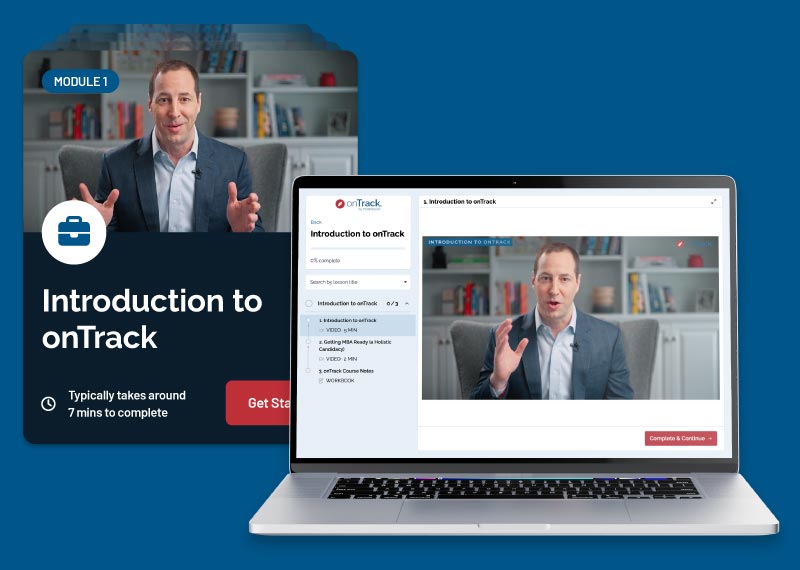
onTrack by mbaMission

A first-of-its-kind, on-demand MBA application experience that delivers a personalized curriculum for you and leverages interactive tools to guide you through the entire MBA application process.

Get Started!

2026–2027 MBA Essay Tips

Click here for the 2025–2026 MBA Essay Tips


MBA Program Updates

Explore onTrack — mbaMission’s newest offering allowing you to learn at your own pace through video. Learn more