Blog

Fixing Common Interviewing Mistakes, Part 2: Be Confident!

Click here to read Fixing Common Interviewing Mistakes, Part 1: Follow the “Answer First” Model.

Many MBA students tend to get in their own way when interviewing. Although they prepare structured stories to share with their interviewer, they do not end up telling those stories with confidence or energy. Your word choice, tone, and body language are critical for success in your interview.

A lack of confidence manifests itself in an inability to

  • communicate your experiences as relevant for the job,
  • build a connection with the interviewer, and
  • project authority and credibility.

This makes the interviewer less confident about your ability to do the job. To improve your performance, we encourage you to reflect, research, and take action.

Reflect: Ask yourself, “What is the root cause of my lack of confidence?” Recall situations in which you felt confident and ones in which you lacked confidence. Can you identify any similarities or common threads between these two types of situations? Uncovering what makes you feel nervous allows you to find remedies for it. Recognize that different tactics work for different candidates, but in the end, be kind to yourself and believe in your abilities.

Tip: Practice reframing exercises; remind yourself that you are the expert on you. Read workplace psychologist Adam Grant’s article about overcoming his fear of public speaking for many useful tips. Listen to upbeat music. Repeat positive mantras.

Research: Analyze the target job description and talk with current employees at the firm to identify the most important competencies for the role. Identify details in each of your stories that correspond with those competencies, and focus on numbers that can prove the scope, complexity, and impact of your work.

Tip: Sell your accomplishments. You are expected to highlight specifics about how you helped your previous employers or transformed outcomes for an organization; this information helps the interviewer understand your value.

Take Action: Prepare talking points for your interview. Identify the three or four key ideas you want to communicate about yourself and the three or four reasons you are passionate about the role and company you are interviewing for. Aim to connect with the interviewer, not impress them. Take back some power—you need to like the interviewer (and their company/the target role) just as much as they need to like you!

Tip: Practice interviewing (aloud!). Find friends or—even better—people who do not know you well to conduct a mock interview with you. Record and review your practice sessions, looking to learn from the moments when you appear most (or least) confident.

Finally, remember that the firm selected you for an interview, so the interviewer is eager to hear how you can help the organization.

To learn other strategies for improving your interview performance, schedule a complimentary 30-minute consultation with an mbaMission Career Coach.

What the GMAT Really Tests

What the GMAT Really Tests

What the GMAT Really Tests

With regard to the GMAT, raw intellectual horsepower helps, but it is not everything. Manhattan Prep’s Stacey Koprince teaches you how to perform at your best on test day by using some common sense.

The GMAT is not a math test. Nor is it a grammar test. Sure, you have to know something (well, a lot of things!) about these topics to get a good score, but this exam is really testing your executive reasoning skills.

The term might be unfamiliar, but you already have—and use—these skills every day. Consider the following:

You arrive at work in the morning and think about all the things you could do that day. You cannot get it all done, so which things will have to wait until this afternoon or tomorrow or next week? Which one thing should you start working on first?

You have a choice between working on Project X or Project Y. Project Y will result in about 5% more revenue to the company, but Project Y will also take 50% longer. Which do you do?

None of those decisions are easy ones (and many would likely require more information than I gave in the little scenario). This complex decision making is exactly what a good executive needs to be able to do well—and this is what the test writers and business schools actually care about.

How does that help me take the test?

Great decision makers have both expertise and experience: they have thought about how to make various kinds of decisions, and they have actually practiced and refined these decision-making processes. While the clock is ticking, they do not hesitate to make a decision and move forward, knowing that they are going to be leaving some opportunities behind.

If you know how the GMAT works and you know what kinds of trade-offs to think about when deciding how to spend your time, then you can learn how to make the best decisions to maximize your score.

Okay, how does the GMAT work?

Glad you asked. I talk to students nearly every day who tell me that they just cannot give up on a question, or they figure that, if they “know” they can get something right, they might as well take the time to get it right, even when that means running out of time later on.

(Note: I put “know” in question marks there because… well, you do not really know. In fact, the longer we spend, the more likely we are to get stuff wrong.)

So here is what you need to do: you need to grow up.

I am not saying, “Oh, grow up!” in a harsh way. I am saying that you need to graduate from school. The way that we were trained to do things in school is often not the way things work in the real world. You already know this—you learned it when you got out into the working world.

In school, you are supposed to do what the professors assign. At work, you are supposed to think for yourself.

So get yourself out of school. Graduate to the real world. Approach the GMAT as a test of your business ability and decision-making skills.

Graduation day

If you can graduate to the business mindset, you will have a much better shot at hitting your goal score. If you stick with the “school” mindset, then you are almost certainly not going to get the score you want.

So first, keep reminding yourself that the GMAT is a decision-making test, not an academic test. React accordingly.

Next, the two articles “In It to Win It” and “But I Studied This—I Should Know How to Do It!” will also help you make this mental switch.

Follow those up by educating yourself on the subject of time management. Great businesspeople know how to manage their time and make trade-off decisions; great GMAT test takers have this same skill.

Finally, remember that your ability to get better hinges on your ability to analyze your own thought processes and the test questions themselves. Your goal is not academic. Your goal is to learn how to think.

Professor Profiles: George Geis, UCLA Anderson School of Management

 width=Many MBA applicants feel that they are purchasing a brand when they choose a business school. However, the educational experience you will have is what is crucial to your future, and no one will affect your education more than your professors. Today, we profile George Geis from the UCLA Anderson School of Management.

George Geis has been voted Outstanding Teacher of the Year five times while at UCLA Anderson, most recently in 2012. In the past, Geis has served as the associate dean and faculty director of the Anderson Executive MBA program as well as faculty director of the school’s Mergers and Acquisitions Executive Program. Geis has also maintained a mergers and acquisitions blog and a biotech corporate development blog.

One alumnus described Geis to mbaMission as an experienced investor and a funny and credible guy. The graduate added that he had very much enjoyed the guest speakers Geis brought to class, as well as the strategic analysis of the board game industry, covered in a case discussion about the game Trivial Pursuit.

For more information about the UCLA Anderson School of Management and 16 other top-ranked MBA schools, check out our free mbaMission Insider’s Guides.

Storytelling: Talking About Yourself to Potential Employers

This post was written by our resident Career Coach, Elissa Harris. To sign up for a free 30-minute career consultation with Elissa, please click here.

Many MBAs use their degree to pivot or enhance their careers. But in order to secure an offer, you must excel at explaining who you are and how you can add value to your target employer. So, how do you build a compelling story?  

Know Your Target Audience

Step 1: Identify requirements for your target role. Seek to understand the skills, experiences, and attributes required for success. Check out our mbaMission Career Guides, review the Learn Educate Discover podcast, talk with classmates who have direct experience in your target areas, and/or listen to employer informational sessions. 

Know Yourself

Step 2: Catalog your pre-MBA experiences. Think about your functional and industry expertise but also the transferable skills you developed doing your job. Review your application essays and performance reviews. Reflect on what you liked most about what you did prior to your MBA program and the skills you used to achieve success. 

Step 3: Find the common threads. Ask yourself the following question: where is the overlap between the requirements of your target role and your pre-MBA experiences? Common threads could be things like serving key stakeholders and convincing them to take specific actions, analyzing data to drive decision making, understanding drivers of growth or company success, or communicating complex concepts in easy-to-understand ways. 

Step 4: Brainstorm specific examples of when you demonstrated each of these common threads. Look at bullet points on your resume for ideas. Brainstorm your biggest accomplishments and how you made them a reality. Think about the situation, your key actions, and the outcomes of those actions. 

Step 5: Identify elements that were missing from your previous role but are desirable to you and exist in your target role. Perhaps your previous role focused on one industry but a different industry excites you, or perhaps your previous role was very operational and you are now seeking to contribute in a more strategic way. 

Prepare Your Story 

Step 6: Curate the information gathered in Steps 1 to 5 to craft your story. Put yourself in the mindset of the employer; start with content that will be compelling to them and use keywords that will resonate with them. Show your excitement and commitment to their company/role. Prepare three different versions of your story:

  • A one-sentence version to introduce yourself to a larger group of people
  • A 30- to 45-second version to introduce yourself to a smaller group of two to three people or one-on-one for networking purposes
  • A 90- to 120-second version to introduce yourself one-on-one in an interview setting

Bottom line: Compile and deliver a relevant, memorable, and concise story that engages the listener while connecting the dots between your previous experiences and your interest in/qualifications for your target roles.  

Meet Devi Vallabhaneni, Harvard Business School Interview Expert

Prepare for Your HBS Interview with a Former HBS Interviewer: Devi Vallabhaneni, mbaMission

Prepare for Your Harvard Business School Interview with a Former HBS Interviewer: Devi Vallabhaneni, mbaMission

Meet Devi Vallabhaneni

Devi Vallabhaneni has almost two decades of admissions experience, including interviewing and evaluating Harvard Business School (HBS) candidates, a passion she first developed when she herself was a second-year student at the school. She is a Managing Director at mbaMission, as well as our Harvard Business School Interviewer in Residence, offering HBS Intensive Interview Simulations to HBS hopefuls. In fact, her services are so popular that she always has a waitlist of candidates who want to prep with her for the coveted HBS admissions interview. Here, she answers some questions about the Harvard Business School interview.

How do you prepare to prepare applicants for their Harvard Business School interview?

The HBS interview season is only about eight weeks over the two rounds, so it’s what I do the remaining 44 weeks that’s important. There is a through-line between each year’s MBA applicant pool and current events in business, which is why I think of admissions as being in the business of business.

CNBC or Bloomberg is always on in my office. I love following the markets, which allows me to be several steps ahead of my interviewees, who are working on the most newsworthy SPACs [special purpose acquisition companies], latest innovations across industries, newest business models, and the most pressing societal problems. My job isn’t to give them answers but to ask the right questions and challenge their thinking for them to formulate their own viewpoints.

I hear you give homework to your clients. What does that mean?

Recently, I was helping an interviewee who was sharing his struggles at his service-based start-up. He was advising leadership that to be customer-centric, they had to be employee-centric first, but leadership was having a hard time making this connection. I gave him homework: to study the Service Profit Chain developed by HBS Professor James Heskett. He shared it with his leadership, who started listening to him. Because there is no divining rod of who will be accepted, I make sure to leave them with something tangible they could use on their job as well as during the HBS interview.

How do you address EQ [emotional quotient]?

Some clients haven’t fully processed their emotions around their path and inadvertently infuse their answers with regret and negativity. The interview process can be emotional, and at times, people cry telling me heart wrenching stories about their setbacks or disappointments. The more that is processed during practice, the better. Confidence comes when you understand yourself emotionally, so if that’s the bottleneck, that’s what we focus on. It’s amazing to see the lightness of their persona when emotions are processed in a safe and nonjudgmental way.

Why is Harvard Business School interview prep so important to you?

Prepping clients for the HBS interview is a strangely intimate, intense, and personal experience for me. They know nothing about me, yet I know everything about them. Our exchanges become their biggest priorities for a few weeks. They place their past, their future, their hopes, their disappointments, their goals, and, most importantly, their trust in my hands. I’m constantly thinking, What do I need to ask them to get them to where they need to go or for them to see their path differently? My process is more of an art than a science. I view each client like a protagonist in a case study. Instead of analyzing whether a company should launch a product or build a new plant somewhere, the case study is their life.

It’s a privilege to be trusted with someone’s yet-to-be-written story. It’s a privilege to be the second call after their immediate family to share in their acceptance!


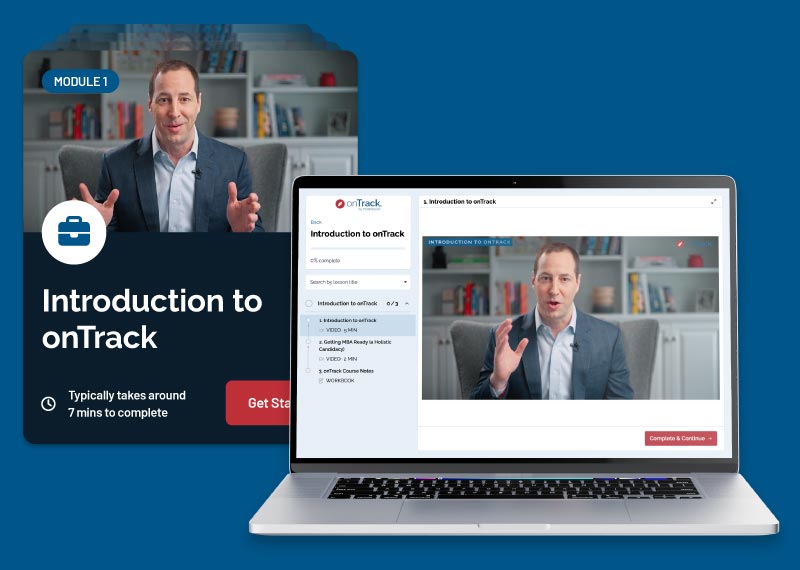
onTrack by mbaMission

A first-of-its-kind, on-demand MBA application experience that delivers a personalized curriculum for you and leverages interactive tools to guide you through the entire MBA application process.

Get Started!

2026–2027 MBA Essay Tips

Click here for the 2025–2026 MBA Essay Tips


MBA Program Updates

Explore onTrack — mbaMission’s newest offering allowing you to learn at your own pace through video. Learn more