
Blog

Professor Profiles: Jonathan Knee, Columbia Business School

Professor Profiles: Jonathan Knee, Columbia Business School

Many MBA applicants feel that they are purchasing a brand when they choose a business school. However, the educational experience you will have is what is crucial to your future, and no one will affect your education more than your professors. Today, we focus on Jonathan Knee from Columbia Business School (CBS).

Jonathan Knee is the Michael T. Fries Professor of Professional Practice of Media and Technology at CBS and the co-director of the school’s Media and Technology Program. He is also still active in the private sector as a senior advisor at the advisory and investment firm Evercore Partners.

Knee is perhaps best known among CBS students for his book The Accidental Investment Banker: Inside the Decade that Transformed Wall Street (Oxford University Press, 2006) and, we are told, brings a unique perspective into the classroom by showing where entertainment and finance cross paths. In his latest book, Class Clowns: How the Smartest Investors Lost Billions in Education (Columbia Business School Publishing, 2017), Knee explores investors’ efforts in higher education. Students reported to mbaMission that his “Mergers and Acquisitions in Media” class is intense and that the course’s final presentation—made before a guest panel of practicing investors—feels like the real deal. One CBS graduate who took a class with Knee said the benefits of having an active advisor as a teacher were the business insight and guest speakers the professor brought into the classroom.

For more information about CBS and 16 other top-ranked business schools, check out our free mbaMission Insider’s Guides.
The Dos and Don’ts of GMAT CATs, Part 2

With regard to the GMAT, raw intellectual horsepower helps, but it is not everything. Manhattan Prep’s Stacey Koprince teaches you how to perform at your best on test day by using some common sense.

What are the Dos and Don’ts to get the most out of your CATs? If you have not yet read the earlier installment of this series here, go take a look!

Most of the time, DON’T take a CAT more than once every three weeks

There are two broad modes of study: the “trying to improve” phase and the “final review” phase. Most of our study is the first phase; the final review phase kicks in for just the last couple of weeks.

During the “trying to improve” phase, taking a CAT more frequently than about every three weeks is a complete waste of time. Really! The whole point of taking the practice CAT is to figure out what needs to get better. Then, go get better! Until you have made substantial progress toward whatever issues were uncovered, taking another practice CAT is just going to tell you that you still have those same issues.

That even applies when you are trying to improve timing or stamina issues; you have other ways of addressing these issues besides taking a CAT. If quant timing is a struggle, GMAT Focus is a great “intermediate” resource from the real test makers. You can also set up longer sets of questions for yourself (in the 15- to 20-question range)—your practice sets do not have to be 37 or 41 questions for you to learn to handle the timing better. (Read this article on time management for more.)

You can practice building stamina every time you study. Figure out everything that you are going to do for the next hour or two hours. (I try to set up what I think will be three hours’ worth of work, just in case I finish faster than I think; if I do not finish, I save the rest for the next day.) Then, go for one hour without stopping—no email, no smart phone, no food, nothing. If you want to do a second hour, take a 15-minute break and go again for a second hour without stopping.

After that second hour, do take a substantial break (at least one hour, but ideally two) before you study any more that day. Making new memories is more mentally fatiguing than recalling memories (you only need to recall memories during a CAT), so do not do this exercise for more than about two hours in a row or your study will suffer.

Once you hit the “final review” phase, you can take a CAT once a week for the last couple of weeks; at this point, your goal is to solidify everything and develop your game plan.

The Dos and Don’ts of GMAT CATs, Part 1

With regard to the GMAT, raw intellectual horsepower helps, but it is not everything. Manhattan Prep’s Stacey Koprince teaches you how to perform at your best on test day by using some common sense.

What are the Dos and Don’ts to get the most out of your CATs? Learn more in this three-part series.

Know WHY you take GMAT CATs

Practice CATs are very useful for three things:

(1) Figuring out your current scoring level (assuming you took the test under official conditions)

(2) Practicing stamina and/or timing

(3) Analyzing your strengths and weaknesses

The third item is the MOST important—this is how we actually get better at this test!

Practice CATs do not help us to improve while taking the test. If you have been training to run a marathon, you will not learn how to get better while running the marathon itself; at that stage, you are just trying to survive. Rather, you learn how to improve in between races while doing all kinds of training activities and analyzing your performance.

DO take a GMAT CAT at the beginning of your study

Many people put off taking their first CAT, often because they say that they have not studied yet, so they know they will not do well. Your goal in taking your first CAT is NOT to do “well.” Your goal is simply to get a handle on your strengths and weaknesses. Whatever they are, you want to know them right away so you can prioritize your study.

One caveat: Familiarizing yourself with the five question types before that first exam (particularly Data Sufficiency) is important, but definitely do not worry about learning all of the formulas and grammar rules. Your first test performance will tell you what you do and do not yet know.

One caution in particular here: a decent percentage of the people who put off their first CAT do so because they are feeling significant anxiety about taking the test. These are the people who do need to take that first test early—pushing off the practice tests will just exacerbate your anxiety.

DON’T take a GMAT CAT more than once a week

Have you ever had this happen? You take a CAT and you get a disappointing score. Maybe you even really mess things up—run out of time or finish 20 minutes early—and your score plummets. So, a couple of days later, you take another CAT to “prove” to yourself that the bad test was just a fluke.

If you have ever done that, you wasted your time and a practice CAT, both of which are very valuable.

That bad test was not a fluke. Something happened to cause that performance. Figure out what that thing was and fix it before you spend another 3.5 hours taking a second test.

In fact, whether you like the score or not, whenever you take a CAT, do not waste time taking another until you have addressed whatever issues popped up during your analysis of the first test. (This article will help you analyze MGMAT CATs.)

Innovative Opportunities at the University of California’s Business Schools

Thanks to its proximity to the Tech Coast, the Paul Merage School of Business at the University of California (UC), Irvine, offers significant opportunities for students with an eye toward innovative business. Indeed, an emphasis on innovation and business pioneering is built directly into what Merage calls its “innovative curriculum,” supplementing conventional business disciplines with such areas as strategic innovation, information technology, analytic decision making, and collaborative execution. The school recently revamped its curriculum to “create unparalleled learning experiences with a single goal: preparing [the students] to propel [their] career[s] and lead [their] organization to success in our digitally driven world,” as the website describes. The updates include a new concentration in Analytics in Digital Leadership and a STEM designation for the entire program.

In addition, several of Merage’s special course offerings and programs showcase the school’s commitment to putting students in contact with the rapidly shifting face of business. The “EDGE” course, for example, offers the opportunity to gain cutting-edge insight into the relationship between business trends, globalization, and technology. Through the school’s practicum Consulting Projects, students gain hands-on experience with current business practices by working directly with locally based global companies over a ten-week period. Merage students can also participate each year in the university-wide New Venture Competition, whose winners collectively claim up to $100K in funding for their proposed start-up ventures.

At the UC Davis Graduate School of Management—under the same university umbrella but approximately an eight-hour drive from the Merage School of Business—the full-time MBA program focuses on preparing students to become innovative leaders. Leadership is woven into the curriculum in the form of core courses, a ten-week management capstone course, and the Collaborative Leadership Program, which offers first-year students leadership training via workshops, assessment exercises, a mentorship program, a Personal Leadership Development Plan, and the option of applying to the Advanced Collaborative Leadership Program in the second year.

Fixing Common Interviewing Mistakes, Part 3: Positioning Yourself for Success in Video Interviews

Click here to read Fixing Common Interviewing Mistakes, Part 1: Follow the “Answer First” Model and click here to read Part 2: Be Confident.

Even as many employees return to the workplace, companies continue to engage with job candidates via video conferencing platforms such as Zoom, Google Hangouts, and Teams. This technology has made managing interview logistics easier for some firms.

To help you successfully stand out in video interviews (or in networking conversations), we offer these easy-to-follow tips:

  • Pay Attention to Your Setting: Find a quiet, private, well-lit area that is free from potential interruptions or distractions. Position your camera so that you have a neutral background.
  • Test Your Technology in Advance: Set up and test the software platform prior to the interview start time. Put your phone away; do not let it distract you during the interview.
  • Wear Appropriate Attire: Dress as you would for an in-person interview, but consider selecting softer colors rather than bright ones, and avoid busy patterns. If you wear glasses, adjust the lighting in the room to reduce glare from the lenses.
  • Pay Attention to Your Body Language: Look at the camera when you are speaking, and avoid the instinct to look directly at your interviewer. Do not use notes during the conversation; a hiring manager can easily tell when you are reading rather than speaking naturally.
  • Polish Your Storytelling: Prepare for the standard questions that are typically asked during in-person interviews. Know your value proposition and connect it to the needs of the company and role.
  • Practice: You want to demonstrate confident body language and a sense of comfort on camera. Your goal is to make the interviewer feel as though you are in the same room with them. Do a trial run by scheduling a mock video interview with an mbaMission Career Coach or with one of your friends.

This is the bottom line: Prepare and behave exactly the same as you would for an in-person interview. You want to be professional but also let your personality shine through.

You can find more interview preparation guidance in these other career coaching blog posts: Tell Me About Yourself, Avoiding Interviewing Pitfalls, and Answering the Dreaded “Failure” Question.


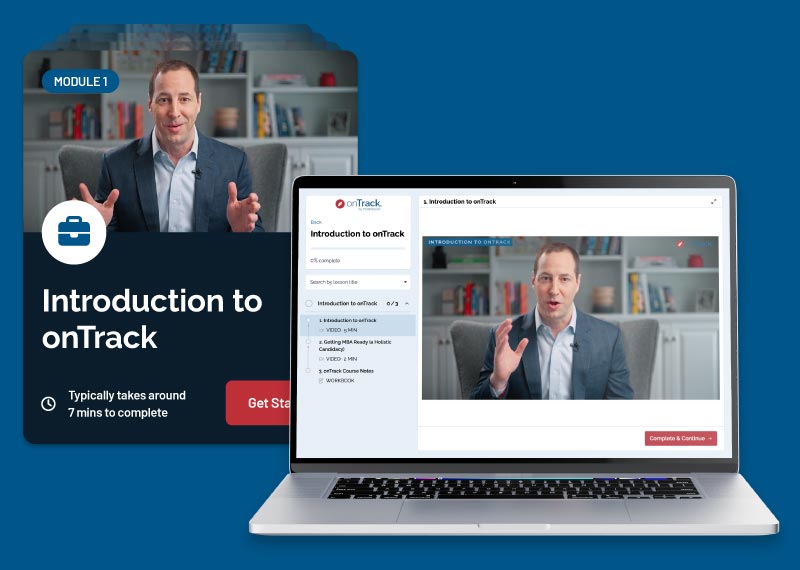
onTrack by mbaMission

A first-of-its-kind, on-demand MBA application experience that delivers a personalized curriculum for you and leverages interactive tools to guide you through the entire MBA application process.

Get Started!

2026–2027 MBA Essay Tips

Click here for the 2025–2026 MBA Essay Tips


MBA Program Updates

Explore onTrack — mbaMission’s newest offering allowing you to learn at your own pace through video. Learn more