Blog

How to Research Social Impact Careers and Programs for Aspiring MBAs

Aspiring MBA students increasingly desire careers with social impact, ones that allow them to make a difference in the world. Many are prioritizing impact over financial reward. As a result, we have seen a significant shift in the MBA landscape, with business schools introducing new coursework and resources related to social impact.

If you are an applicant seeking to integrate social impact with your business degree, how should you go about researching your career and program options?

Before we dive in, let us take a look at the social impact careers that are possible for MBAs. Many avenues exist to a profession with social impact. Here are several paths we have seen in our work with MBA candidates:

  • Corporate social responsibility (CSR)
  • Diversity, equity, and inclusion (DEI)
  • Social impact consulting
  • Impact investing
  • Sustainability/cleantech
  • Supply chain/sustainable sourcing
  • Nonprofits/foundations
  • Corporate roles (e.g., marketing, finance) within socially responsible companies
  • Social enterprise/social entrepreneurship

Once you have identified the areas of social impact that interest you, gather information to confirm your career goals. Look for job openings on LinkedIn and other job search sites that have a social impact focus, such as Net Impact and Idealist. Network and speak with people in your target areas of social impact. Ask them how they got to where they are today, what skills enable their success, and what experiences helped prepare them. Also, check out these blog posts by our mbaMission Career Coach on Identifying Your Career Goals and the Four Key Qualities of a Successful Job Seeker.

Next, self-evaluate to identify how your background aligns with your desired roles. What skills and experiences do your target positions require? Do you have any significant gaps in your skill set? Earning your MBA should help close many of them (more on that later), but you could still consider pursuing a certification, investing in online coursework, participating in more regular volunteering to show your passion for social causes, join a DEI committee or CSR efforts at work, or seek out a junior board position to demonstrate leadership within a nonprofit organization.

Lastly, as you think about how the MBA fits into your social impact career path, look for business schools that have robust opportunities related to social impact. We have highlighted a few such programs in the past (including Berkeley Haas, the Yale SOM, and Duke Fuqua), but this list is rapidly growing. Depending on which area of social impact interests you, we also recommend Harvard Business School, Stanford GSB, UPenn Wharton, Chicago Booth, MIT Sloan, Northwestern Kellogg, Dartmouth Tuck, Michigan Ross, NYU Stern, and Oxford Saïd. Consider downloading free copies of mbaMission Insider’s Guides and International Program Guides to learn more about these schools and what they have to offer with respect to social impact.

As you research school options, we recommend you focus on three keys areas:

  1. Career: Dig into each school’s employment report. Some programs publish the percentage of graduates going into the nonprofit sector, but look beyond that percentage because many social impact careers can be categorized in other industries (e.g., consulting, finance). Sometimes, schools also report the percentage of graduates focused on impact across sectors. For instance, Berkeley Haas indicated that 18% of its 2022 graduates accepted a role with a social impact component. Also, check to see if you can find several desirable organizations on the school’s major employer list. Talk to students (or recent alumni) to get their take on social impact career opportunities. How supported are/were they in their social impact career search?
  2. Curriculum: Look through the program’s academic offerings and resources thoroughly. Does the school have an impact-focused major or concentration, such as UPenn Wharton’s new DEI and ESG (environmental, social, and corporate governance) concentrations? Does it have a center that focuses on impact, such as Chicago Booth’s Rustandy Center? Does the curriculum include at least five or six elective courses related to social impact? Are lab courses available that provide real-world exposure, such as the Yale SOM’s “Social Impact Lab”? Do any of the school’s professors conduct research in the areas of social impact that interest you?
  3. Community: Familiarize yourself with the school’s extracurricular resources and student culture. Are any student clubs focused on social impact, such as Net Impact? Does the program offer conferences or case competitions related to social impact, such as Berkeley Haas’s Patagonia Case Competition? Are board fellowship opportunities available, such as Fuqua on Board at Duke Fuqua? Are scholarships offered for students pursuing social impact careers, such as Oxford Saïd’s Skoll Scholarship, or loan forgiveness programs? Is “impact” noted as part of the school’s mission statement or values?

We hope that by exploring your business school options with these questions in mind, you will be able to create a short list of programs that could equip you to pursue a career with impact. We at mbaMission have helped many MBA applicants on their way to pursuing social impact careers. If you would like more targeted guidance on identifying the right MBA program to pursue to help you launch your social impact career, we encourage you to sign up for a free 30-minute consultation with one of our admissions experts.

Luxury Brand Management at the GCU British School of Fashion and London Business School

Luxury Brand Management at the GCU British School of Fashion - mbaMission

Scotland’s Glasgow Caledonian University (GCU)—known as a leader in fashion education since the 19th century—inaugurated a fashion business school in London in 2013 and soon after opened a satellite campus in New York City. Rather than focusing on the design aspect of fashion, however, the GCU British School of Fashion offers a specialized business education with applications to the fashion industry, as the school’s then-director, Christopher Moore, explained in a BBC article when the new campuses were being revealed: “The remit of the school is clear: we are about the business of fashion. And while there are other great international design schools, we are quite different. Our aim is to be a leading school for the business of fashion.”

The GCU British School of Fashion’s MBA in Luxury Brand Management program aims to impart industry tools and skills related to such topics as consumer behavior, globalization, and strategic management. The school also professes a commitment to social responsibility, sustainability, and fair trade as part of its core values. With support from a number of British fashion brands, which have included Marks & Spencer, House of Fraser, AllSaints, and the Arcadia Group, the school’s faculty also features a team of honorary professors and fashion industry leaders. The program was designed “to meet the growing demand for experienced managers who really understand luxury brand management in a global context,” the school’s website states. The school also offers programs in Luxury Marketing, Fashion and Lifestyle Marketing, and Fashion Business Creation.

London Business School Essay Analysis - mbaMissionLondon Business School has also taken steps to attract applicants with an interest in luxury brand management and retail. Although the school does not offer a degree on the subject, students can partake in numerous activities in the field throughout their studies. One of the most notable opportunities is the Walpole Programme in Luxury Management, a partnership with the Walpole British Luxury brand. The program equips students with the tools necessary to enter global management positions after graduation. Students take elective courses, visit companies, participate in workshops, complete internships, and work with a mentor from Walpole throughout the program.

The London Core Application Practicum (LondonCAP) module, which was launched in 2017, is a hands-on learning opportunity during which students work with companies on projects related to their interests—a notable past partner is the British Fashion Council. Students can also join the Retail & Luxury Goods Club, which is one of the largest clubs on campus, with reportedly more than 4,500 members. The group welcomes industry speakers and organizes career treks to such locations as Milan and Paris, in addition to hosting an annual e-commerce conference, whose past speakers have represented such companies as Net-a-Porter, Marks & Spencer, and LVMH. The theme of the Retail & Luxury Goods Club’s 2022 conference was “Learning from the Past Decade to Build a Better Future,” and the event welcomed such speakers as the founder of Stuart Weitzman, the managing director of The Savoy, and the president of The Business of Fashion.

Dean Profiles: David Schmittlein, MIT Sloan School of Management

Dean Profiles: David Schmittlein, MIT Sloan School of Management - mbaMission

Business school deans are more than administrative figureheads. Their character and leadership often reflect an MBA program’s unique culture and sense of community. Today, we focus on David Schmittlein from the MIT Sloan School of Management.

David Schmittlein first came to the Massachusetts Institute of Technology (MIT) in 2007 after spending almost 30 years in the marketing department at Wharton. Upon joining MIT, Dean Schmittlein announced his top priorities in a press release: “to enhance MIT Sloan’s visibility and engagement with leaders of the business community, regionally and globally, especially among the school’s alumni. MIT Sloan should be a wonderful focal point for the professional lives and development of Sloan alumni and others in the broader MIT community who are engaged in business and innovation.”

In addition to enhanced global visibility, a significant focus of Schmittlein’s deanship thus far, according to MIT’s website, has been “to work with the faculty in creating new high-quality management education programs, to develop enhanced educational opportunities for current students, and to develop and disseminate business knowledge that has impact and that will stand the test of time.” In an interview with mbaMission, the school’s assistant dean of admissions at the time, Rod Garcia, remarked that one noticeable change since Schmittlein entered the position is that “the dean has placed a huge emphasis on concept-based action learning. We have our Entrepreneurship Lab, our [Sustainable Business] Lab, our China Lab, … among others. The movement toward these labs has accelerated during the dean’s tenure as he has engaged with our alumni around the world.”

For more information about MIT Sloan and 16 other top-ranked business schools, check out our free mbaMission Insider’s Guides.

Tackling Reading Comprehension Problems in the GMAT

With regard to the GMAT, raw intellectual horsepower helps, but it is not everything. Manhattan Prep’s Stacey Koprince teaches you how to perform at your best on test day by using some common sense.

We previously examined how to read Reading Comprehension (RC) passages. If you have not read our earlier article, go ahead and do so right now.

Today, I want to talk about the three primary types of questions that appear on RC: Main Idea, Specific Detail, and Inference. I also want to talk about how to analyze RC problems.

In general, we learn the most from a problem after we have finished doing it. Our review is the real learning experience. Any problem can (and should!) be analyzed using the questions discussed in this “How to Analyze a Practice Problem” article.

How would that work with a Reading Comprehension question? Glad you asked. This article contains an example of a complete RC Inference problem analysis—you will learn not only how to analyze an RC problem but also how to tackle Inference problems. (In general, Inference problems ask us to deduce something from some piece of evidence provided in the passage.)

Let us tackle Main Idea questions next. These questions focus on the main point of a passage, though we could also be asked to give the main point of just one paragraph.

Specific Detail questions ask us to address some particular detail mentioned explicitly in the passage. We could be asked what the passage says. Knowing if you are dealing with a What question is important. Think about the answers to these two questions: What are you studying? Why are you studying it? Completely different answers!

Those will cover most, if not all, of the RC question types you will see when you take the GMAT. You might also encounter a Strengthen or Weaken question, similar to the questions that we see in the Critical Reasoning section. These are fairly rare in RC, though—chances are good that you will not actually see one.

So go ahead and tackle those Reading Comprehension question types and remember this: when you are studying, your goal is not (just) to get the question right. Your goal is to learn something that you could apply on a different question (or questions) in the future!

The Dos and Don’ts of GMAT CATs, Part 3

With regard to the GMAT, raw intellectual horsepower helps, but it is not everything. Manhattan Prep’s Stacey Koprince teaches you how to perform at your best on test day by using some common sense.

What are the Dos and Don’ts to get the most out of your CATs? If you have not yet read the earlier installments of this series here and here, go take a look! 

DON’T take a practice CAT within five days of the real test

Would you run a practice marathon a few days before a real marathon? Of course not! You risk tiring yourself out or (mentally) injuring yourself (by reducing your confidence) just before the real test.

If your score is not where you want it to be, postpone the test; you are not going to change it substantially by taking a practice CAT at the last minute (or doing anything else).

DON’T go months without taking a CAT

When someone does this, the impetus is usually anxiety. You feel nervous that you will not get the results that you want, so you avoid getting any results at all. Alternatively, maybe you plan to study everything and then when you take the test, you are confident that you will get the score you want… but practicing without any CAT data is going to cause you to build bad habits (such as spending too much time on a question) and fail to build good ones (such as learning how and when to cut yourself off and guess).

If your last CAT was so long ago that you are no longer sure what your strengths and weaknesses are under testing conditions, it is time to take another CAT.

Takeaways

In short, do take a CAT pretty early on in your study process. Then analyze the results and use that analysis to inform your study plan. When you have addressed a substantial proportion of the major issues identified via that analysis, take another CAT. Most of the time, you should be able to find at least two to three weeks’ worth of issues to address after every CAT.

Once you have your score where you want it to be, start your final review. During this phase (which typically lasts a couple of weeks), plan to take one CAT two weeks before and another CAT one week before your real test date. Read the article “The Last 14 Days: Building Your Game Plan” to learn what to do with this data.

Good luck and happy studying!


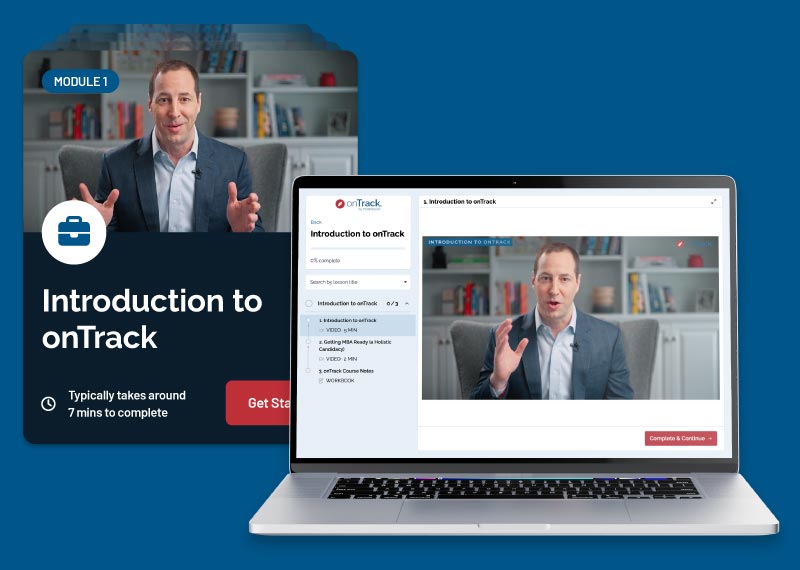
onTrack by mbaMission

A first-of-its-kind, on-demand MBA application experience that delivers a personalized curriculum for you and leverages interactive tools to guide you through the entire MBA application process.

Get Started!

2026–2027 MBA Essay Tips

Click here for the 2025–2026 MBA Essay Tips


MBA Program Updates

Explore onTrack — mbaMission’s newest offering allowing you to learn at your own pace through video. Learn more