Blog

GMAT Impact: All About Integrated Reasoning, Part 5

When it comes to the GMAT, raw intellectual horsepower helps, but it is not everything. In this weekly blog series, Manhattan GMAT’s Stacey Koprince teaches you how to perform at your best on test day by using some common sense.

And on we go—this is the fifth entry in what began as a three-part series on the GMAT’s new Integrated Reasoning (IR) section. I can’t help it—they keep releasing new and important info—so we’ll just keep going until either we get sick of the topic or GMAC stops giving us new things to discuss.

GMATPrep 2.0 has been out for nearly a month now, and we’ve got some important details to share. First, if you haven’t heard already, the new software is Mac compatible (finally!). Second, I got a bit of a nasty surprise when I took my second GMATPrep—the IR questions were exactly the same ones I saw on the first test!

So here’s our first big tip for you: Save 12 official IR questions for your second GMATPrep: one Multi-Source Reasoning with three questions, and three each of the other three types. (Note: this is not the exact guaranteed mix on the real test, but it’s one of the possible mixes.) You can get these questions from within the practice section of the GMATPrep software or from the OG13 IR question bank.

You can also just skip the IR section on the second test, but the problem is that this might give you an artificial advantage on the quant and verbal portions (because you won’t be as mentally fatigued as you’d normally be). As such, we strongly recommend that you save 12 questions to make the second GMATPrep experience as much like the real test as possible.

An “updates available” feature is built into GMATPrep 2.0. If you see that icon pop up, click on it. Eventually, I’m sure they’ll add a second “real” IR section to the test, so you want to get that update when it’s available!

Finally, a little OG news. The Official Guide for GMAT Review, 13th edition, (OG13) has a code for an online question bank consisting of 50 IR questions. Your access is good for six months from the date of activation, so don’t activate the set until you’re ready to do your first OG IR problem.

Also, if you’ve already bought OG12 but are planning to take the new test, good news: you can purchase access to just the online IR question bank for $10. This option will be available until June 5; after that, the 50-question IR bank will be available only with the purchase of OG13.

What I Learned at…Haas: Part 2

In our “What I Learned at…” series, MBAs discuss the tools and skills their business schools provided as they launched their careers.

Mili Mittal is a former mbaMission consultant and now the CEO and cofounder of mor.sl, a recipe recommendations platform designed to help busy professionals cook. mor.sl was recently featured in TechCrunch. Mili received her MBA and a Certificate in Entrepreneurship from the Haas School of Business at the University of California–Berkeley (UC Berkeley Haas) in 2010. In Part 2 of this four-part series, Mili discusses the hands-on experience she gained at Haas and how the lessons she learned continue to help her today.

In Part 1 of this series, I talked about the importance of community in business school. The quality of the people who surround you on campus is arguably the most important factor to consider when deciding which schools to apply to—but it’s obviously not the only one.

As I mentioned before, I chose Haas for its strength in the fields that I ultimately wanted to pursue: entrepreneurship and social responsibility. The greatest thing about the program was that I didn’t actually have to wait two years to work in these fields. With the incredible array of experiential learning integrated into the curriculum and overall Haas experience, I was living and breathing and building in both right away.

 width=In Kellie McElhaney’s “Strategic CSR [Corporate Social Responsibility] Consulting” course, I not only learned about building smart CSR strategies, but I also implemented my learnings by consulting to eBay and building that company’s social media marketing strategy for its social platforms. Even though I ultimately did not take the CSR career path, the lessons I learned and experiences I had are invaluable in my current path—knowing best practices on how to deploy social media to campaign your cause, build awareness and implement other such strategies is something I use day in and day out at mor.sl. I built on this experience during my summer internship, working for Hewlett Packard’s CSR division, devising the company’s five-year CSR strategic plan.

In my second semester at Haas, I was writing my first business plan—not for mor.sl, but for a different start-up. This was for the “Entrepreneurship 101” class taught by Professors Jerry Engel and John Danner. At 8:00 a.m. every Thursday morning, for three hours, I worked with three other teammates (Team Awesome) to strategize and iterate, and to build a business model, a pitch deck, a financial model and a marketing plan. Each week, we presented our work to our professors, classmates and a panel of mentors (experienced entrepreneurs and investors), received feedback and continued to iterate. I learned the basics of how to develop and deliver a start-up’s story. I still use materials from this class today! And these professors, for whom I was a Teaching Assistant the following year, became my mentors and friends.

In Professor Sara Beckman’s “New Product Development” class, I learned to build a product without actually building one—minimizing the costs of learning by getting in front of customers early and often. I worked with fellow MBA, engineering and design students to develop and iterate a prototype for a product similar to mor.sl, one designed to preserve ethnic cooking traditions in America.

Meanwhile, in Professors Steve Blank and Eric Ries’s “Customer Development in High Tech Enterprise” course, I learned more than I had bargained for: methods for developing a tech company by “getting out of the building” and finding out what customers need and want. In this class, guest speakers included Dave McClure (500 Startups) and Hiten Shah (KISSmetrics). Think about how much you might pay to see these people speak at a conference—now think about being in a 60-person classroom with each of them for three hours. Amazing.

I also served as fundraising chair for the Global Social Venture Competition and overcame my fear of asking people for money (a critical skill for an entrepreneur). Beyond that, I developed a firsthand perspective of what investors (who served as competition judges) look for when evaluating companies for investment. By participating in a number of on-campus competitions, including the Big Ideas @ Berkeley Contest, the Walmart Better Living Business Challenge and the UC Berkeley Business Plan Competition (now called the UC Berkeley Startup Competition), I learned the key points of pushback on my pitch and was able to modify it accordingly.

I learn best by doing, so I took advantage of a program that offers a lot of doing—Haas—and now find myself applying all that knowledge as I build mor.sl. Maybe you learn better by listening or by analyzing. If so, choose a program that offers a lot of that. You’ll thrive.

mbaMission Annual Consultant Training Conference: Raising the Bar in the Industry

At mbaMission, we believe that to give MBA applicants the best possible admissions advice, we must continuously train our consultants and stay up-to-date on admissions trends. To do this, we have a weekly full staff meeting at which we discuss new ways to serve our clients and identify developments in the admissions field. We also have a robust mentoring program and peer review process, which keeps our consultants at the top of their game. And most importantly, every year, we have an in-person, two-day conference for our consultants. For this intensive event, we fly our team in from around the world (London, San Francisco, Chicago, etc.) and focus on training and developing best practices. This year’s conference was held on May 6 and 7 in New York City—highlights include sessions with…

  • Pauline Jennett, former admissions officer at HBS: “Reviewing Business School Applications as Admissions Directors”
  • Chris Ryan, Head of Curriculum Development at Manhattan GMAT: “Relevance of the Integrated Reasoning Section of the GMAT” (integrated reasoning is the new section of the GMAT)
  • Consulting firm 4Thirty3: “Optimizing Client Relationships”
  • Jeremy Shinewald, mbaMission President: “Case Discussions and Best Practices”

mbaMission is a different kind of MBA admissions consulting firm, because we actually are a firm (not just a Web site with a bunch of part-time consultants who have little to no training). We are a full-time team, dedicated to excellence for our clients, and our annual conference—one of a kind in the industry—proves that fact. Check out some photos of the mbaMission team in action at this year’s conference:

GMAT Impact: All About Integrated Reasoning, Part 4

When it comes to the GMAT, raw intellectual horsepower helps, but it is not everything. In this weekly blog series, Manhattan GMAT’s Stacey Koprince teaches you how to perform at your best on test day by using some common sense.

Since we started our three-part series on IR, GMAC has released even more information on this new test section. So let’s call this Part 4 of the no-longer-three-part series, and we’ll just see how long we can keep it going.

In Part 1, we talked a bit about scoring. We’ve since learned that scores will be based on the percentage of correct answers, and no penalty will be incurred for incorrect answers. (This is in contrast to the quant and verbal sections of the test.) Although the IR section is not adaptive, we are still not allowed to return to questions that we’ve already answered; once you answer, that question is gone forever.

What does that info mean? It means, luckily, that our strategies generally stay the same. Answer everything—never leave anything blank. There’s no penalty for getting the question wrong, and if you answer, you just might get lucky and get it right instead! Also, as with the quant and verbal, timing is going to be tight. Do what you can in the time that you have for each question, but know how to cut yourself off and how to make educated guesses when possible. Don’t spend so much time on too-hard earlier questions that you have to guess on later questions simply because you’re about to run out of time.

The section will also include experimental questions (questions that don’t count), just as we see on quant and verbal. Don’t try to guess which ones are experimental, and don’t let yourself get so caught up in one question that you blow a bunch of time—just in case it really is experimental.

Finally, all question types are created equal. The test involves four different question types, and the test does not weight any one of these types over any of the others. That’s good news—it means we can each concentrate on whatever types are the easiest for us, based on our own strengths and weaknesses.

What I Learned at…Haas: Part 1

In our “What I Learned at…” series, MBAs discuss the tools and skills their business schools provided as they launched their careers.

 width=Mili Mittal is a former mbaMission consultant and now the CEO and cofounder of mor.sl, a recipe recommendations platform designed to help busy professionals cook. mor.sl was recently featured in TechCrunch. Mili received her MBA and a Certificate in Entrepreneurship from the Haas School of Business at the University of California–Berkeley (UC Berkeley Haas) in 2010. In Part 1 of this four-part series, Mili describes how her Haas classmates turned into friends who supported and guided her when she was starting her own company.

I went to UC Berkeley Haas already knowing that I wanted to start my own business after I graduated. After four years as a human resources and information technology consultant at the Corporate Executive Board Company, where I gained “intrapreneurial” experience building a new product line, and after having also cofounded and launched a dance company, I’d caught the entrepreneurial bug. I thought I was going to business school to round out my skills—to learn finance, accounting—the technical things I would need to build a business. I was wrong.

At Haas, I learned and gained so much more than just academic knowledge (not to undermine those things, however—for example, learning to build a financial model in Professor Sarah C. Tasker’s “Designing Financial Models That Work” course was invaluable). I chose Haas because of its strength in entrepreneurship and social responsibility, because it supported students with crazy “I’m gonna change the world” ideas and because students emerged from that campus and did just that. When I got there, I was energized and excited, not just by everything the school had to offer, but also by the energy and ambition of my peers. At Haas, with only 240 students in my class, these peers quickly turned into friends.

The single most beneficial resource I had on my entrepreneurial path at Haas was the support of these friends. When you’re starting a company at Haas, you don’t feel alone, even though entrepreneurship is generally a very lonely path. Instead, you have a community of professors, friends and mentors who act as your cheerleaders. They work for you from the get-go, both inside and outside the classroom. Professors like John Danner and Kellie McElhaney worked to introduce me to the likes of Whole Foods’ and Wegmans’ executives so that I could gain invaluable industry perspective on my company.  Professor Mario Rosati sent my pitch to Silicon Valley investors for their feedback. Fellow entrepreneurs in my “Entrepreneurship Workshop” class worked tirelessly to offer perspective on my business plan, pitch and product iterations.

Moreover, I found my first teammates at business school—I originally started the path to mor.sl by working on a venture called myChef, which I founded with fellow Haasies. Even our classmates who were going the more traditional route of marketing or finance offered their support—filling out SurveyMonkey questionnaires about their pantries and tastes, testing various iterations of the product and offering their own connections as resources. Based on these individuals’ input and feedback, we realized the initial concept for our venture required too much user input to stay accurate, and quickly pivoted to a new model.

What’s even more awesome? These friends continue to support me to this day, nearly two years after graduation. Those who have gone on to see entrepreneurial success of their own offer their advice and materials for me to learn from—sample term sheets, partner agreements, seed-round pitch decks that worked for them. Those who aren’t entrepreneurs offer their skills, too. For example, my friend who works at a digital marketing agency offered tips on effective Facebook marketing when I needed them. Haasies are my champions—and my company’s champions. They share our success on Facebook, pass the mor.sl URL along to their friends, introduce me to potential partners. And all of them, together, have been my rock, continually encouraging me to push forward even when I’m not optimistic, and championing my small wins. Basically, they’ve got my back.

When you are choosing a business school—whether you’re looking to start your own venture or not—take a close look at who you’ll be sitting next to in class. Make sure they can quickly go from being your peers to your friends, because it’s your friends who will support you on your journey, no matter what your path is.


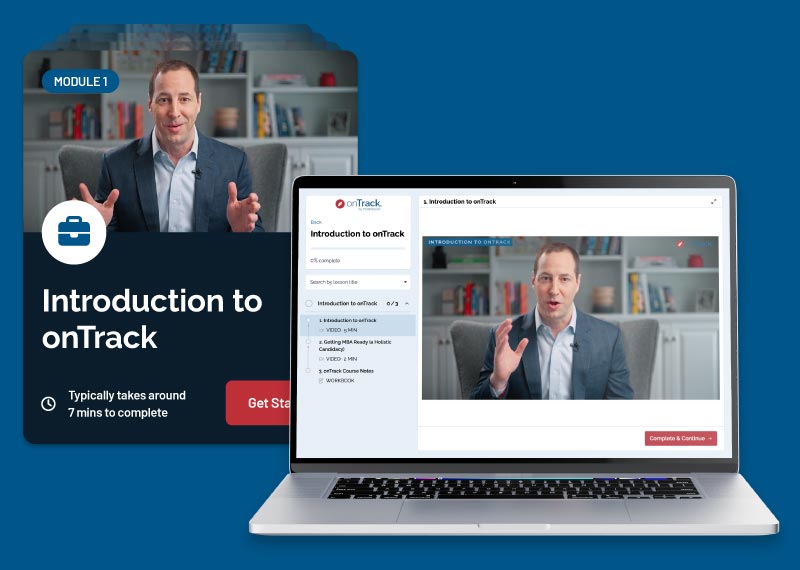
onTrack by mbaMission

A first-of-its-kind, on-demand MBA application experience that delivers a personalized curriculum for you and leverages interactive tools to guide you through the entire MBA application process.

Get Started!

2026–2027 MBA Essay Tips

Click here for the 2025–2026 MBA Essay Tips


MBA Program Updates

Explore onTrack — mbaMission’s newest offering allowing you to learn at your own pace through video. Learn more