

Blog

GMAT Impact: Take Your Time

When it comes to the GMAT, raw intellectual horsepower helps, but it is not everything. In this weekly blog series, Manhattan GMAT’s Stacey Koprince teaches you how to perform at your best on test day by using some common sense.

Since the beginning of this month, I have spoken with dozens of students who are becoming increasingly panicked about achieving their goal GMAT score before the June 5 switch to the Next Generation GMAT. We’re currently a little more than two weeks out, and I have a message for you: if your practice scores are not what you want them to be right now, then stop pressuring yourself to take the old test.

The Integrated Reasoning (IR) section is not that bad. I promise. More importantly, if your results aren’t what you want them to be, chances are they’re not going to change much in two weeks. That’s always been true, but it’s especially true if you’re telling yourself, “This is my last chance. I have to get the score right now or… or…”

Or what? Your head’s not going to explode. The world isn’t going to end. You just have to take the IR section. IR scores will not be anywhere near as important as the quant and verbal scores, so you only need to aim for a “decent” score on that section. Further, IR is a pretty good mix of the skills you need for the existing quant and verbal sections, so whether quant or verbal is your stronger area, you already have some strengths to take into IR!

Give yourself the time you need to get your quant and verbal scores where you want them to be. Then add some extra time to deal with this newfangled IR stuff. I’d recommend that most people plan to add from two to six weeks to get comfortable with IR. You have two goals: (1) earning a “decent” score on IR and (2) knowing how to handle IR well enough that it doesn’t completely exhaust you before you get to the quant and verbal.  For the former, we don’t yet know what a “decent” score will be, but you will probably be okay if you can answer half or more of the questions correctly. For the latter, handling IR “well enough” includes recognizing when something is just too hard and letting those questions go without getting stressed out.

The nutshell: if you’re very stressed out about whether you can achieve your goal score before the test changes, then you are probably too far from that goal. It’s okay to decide to postpone. Remove that artificial pressure and give yourself the time you need to do this well!

What I Learned at…Haas: Part 3

In our “What I Learned at…” series, MBAs discuss the tools and skills their business schools provided as they launched their careers.

Mili Mittal is a former mbaMission consultant and now the CEO and cofounder of mor.sl, a recipe recommendations platform designed to help busy professionals cook. mor.sl was recently featured in TechCrunch. Mili received her MBA and a Certificate in Entrepreneurship from the Haas School of Business at the University of California–Berkeley (UC Berkeley Haas) in 2010. In Part 3 of this four-part series, Mili discusses how UC Berkeley’s connections among its schools and in the community aided in the early development of her company.

I’ve covered the importance of having high-quality peers and of choosing a program whose method of teaching fits your style of learning. But what about the importance of synergy? You may be wondering what the heck I’m talking about. Synergy is important—what does your target business school offer beyond your school? For me, I’d stumbled (well, very consciously) into an incredibly synergistic campus. UC Berkeley is located an hour from Silicon Valley and in the heart of the slow food movement’s birthplace. What better place to start a food tech company? None.

UC Berkeley’s reach extends far. The synergy that the school shares with its surrounding area is incredible. Because of the strength of the Berkeley connection, I was able to meet one-on-one with incredible people, including some of my role models—Mitch Kapor and Will Rosenzweig. And I lived just two blocks from Chez Panisse restaurant, where Alice Waters founded the slow food movement many decades earlier.

But Berkeley’s reach is also deep—extending into other programs on campus. There is a synergy between the various schools at the university—the Goldman School of Public Policy, the UC Berkeley School of Information, the College of Engineering, the Boalt School of Law. In fact, through the Boalt School’s “New Business Counseling Practicum Seminar,” led by Professor William (Bill) Kell, my cofounders and I were able to get pro bono legal assistance that was critical to our early development and strategy. Michael Pollan, a professor at the Berkeley Graduate School of Journalism and the infamous author of Omnivore’s Dilemma: A Natural History of Four Meals and In Defense of Food: An Eater’s Manifesto, was kind enough to meet with my team while our venture was still in its infancy, just because we were Berkeley students.

Finally, Berkeley’s synergy is evident in everyday campus events. This synergy is what brings renowned speakers and industry veterans to campus to participate in the Entrepreneurial Best Practices Series and the Haas Women in Leadership Conference.

As you consider your school choices, think about where each school’s synergies lie. Figure out what kind of “spillover effect” you could benefit from, based on the school’s location and connection to other programs, alumni and resources that may be valuable in your projected career or venture. You won’t regret it!

Beyond the MBA Classroom: Formal Events at HBS

When you select an MBA program, you are not just choosing your learning environment, but are also committing to becoming part of a community. Each Thursday, we offer a window into life “beyond the MBA classroom” at a top business school.

Formal events are reportedly a big part of Harvard Business School (HBS) social life. As the name suggests, Holidazzle is HBS’s annual holiday party, which takes place in early December. According to the HBS Students Association, it is the business school’s longest-running event, and starts with first-year section dinners followed by drinks (open bar) and dancing. The Newport Ball is held each spring in tony Newport, Rhode Island, which is just a short drive from Boston. Students attending the ball enjoy dinner and dancing at a Newport mansion and typically decide to stay for the entire weekend, touring the city’s historically preserved estates, such as The Breakers, Rosecliff and Marble House, built by titans of the gilded age.

For in-depth descriptions of social and community activities at HBS and 15 other top MBA programs, check out the mbaMission Insider’s Guides.

Mission Admission: Leave Your Parents Out of It

Mission Admission is a series of MBA admission tips; a new one is posted each Tuesday.

When you are applying to business school, leave your parents out of the process! Although this MBA admission tip may seem obvious to most candidates, those who are a part of “Gen Y” or “The Millennials” may have parents who are accustomed to helping guide their children’s choices, having done so throughout the candidates’ high school and college years. These parents naturally want to be involved in the MBA admissions process as well and are now leaving many admissions officers across the country shaking their heads.

Of course, having a parent call to confirm whether an important document was received when an applicant is perhaps traveling/working abroad and/or cannot make such a call him- or herself during work hours is certainly not the same as having a parent call to ask why his/her son or daughter hasn’t gotten an interview invitation yet. Unless the matter at hand is an entirely practical one, candidates have nothing to gain by having their parents act as their agents. On the contrary, they have everything to lose. An aggressive parent can reflect badly on an applicant for a variety of reasons, the most obvious being that it suggests that the candidate lacks maturity and perhaps even the ability to make independent judgments and decisions.

Think very carefully before you involve your parents in any aspect of the application process except sitting at home and waiting for great news—successful applicants do it all the time!

Free “Ding” Review Offer from mbaMission

With this application season nearing its end, the time has come for applicants to make some choices. While many are now in the fortunate position of choosing between schools, some are suddenly confronting a different and unexpected question: “Where did I go wrong?” Each year, we extend an olive branch to those in the broader applicant pool who plan to reapply to business school in the coming year and seek to analyze their applications. Recognizing that many candidates have suffered enough in this application year, we offer to review one application for up to 20 applicants, free of charge ($500 value), hoping to provide some direction for those who plan to move forward and try again next year.

If you are interested in a free Ding Review, please send one complete application to [email protected]. We will randomly select 20 applicants, and if you are chosen, we will contact you about your free session.


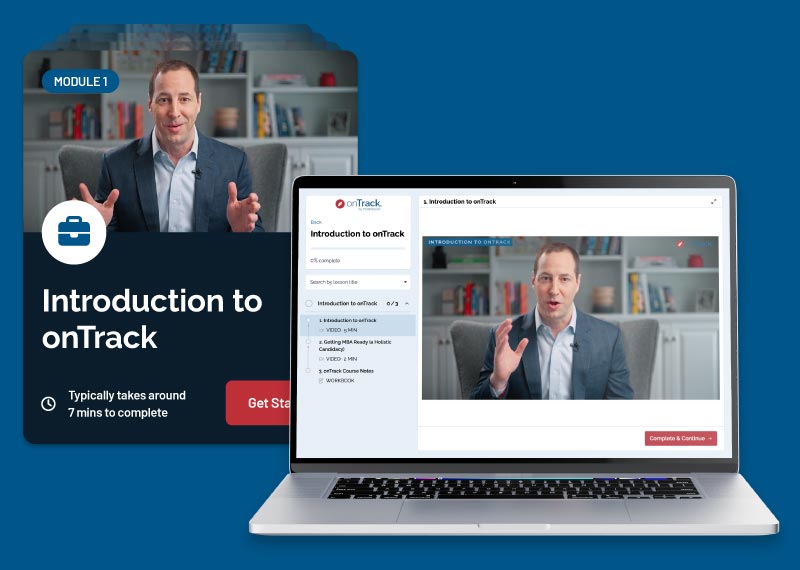
onTrack by mbaMission

A first-of-its-kind, on-demand MBA application experience that delivers a personalized curriculum for you and leverages interactive tools to guide you through the entire MBA application process.

Get Started!

2026–2027 MBA Essay Tips

Click here for the 2025–2026 MBA Essay Tips


MBA Program Updates

Explore onTrack — mbaMission’s newest offering allowing you to learn at your own pace through video. Learn more