Blog

New York University (Stern) Essay Analysis, 2019–2020

NYU Stern

*Please note: You are viewing an essay analysis from the 2019-2020 admissions cycle. Click here to view our collection of essay analyses for the current admissions season.  

After slightly modifying its MBA application essay prompts last year, the New York University (NYU) Stern School of Business has opted to make no changes this season. Candidates must obtain and submit two EQ (emotional intelligence) endorsements as part of their application, which provide the school’s admissions committee with valuable complementary insight into applicants’ personalities—”things that people don’t necessarily talk about themselves,” as Associate Dean of MBA Admissions and Program Innovation Isser Gallogly told Poets&Quants when the EQ element was added last year. As for what candidates must write themselves, the program requests a rather classic personal statement and the challenging but very revelatory “Pick Six” submission, which seems appropriate in these days of rampant social media. As a result, you should be able to present a good balance of your professional and personal sides for the admissions committee. Our more thorough application essay analysis follows…

Essay 1: Professional Aspirations
(500 word maximum, double-spaced, 12-point font)

  • What are your short and long-term career goals?
  • How will the MBA help you achieve them?

With this rather no-nonsense query about your motivation to earn an MBA and expectations as to where you will go with it after graduation, NYU Stern simply wants you to spell out what you have in mind as you approach this phase of your life and career. The school does not ask specifically about past experiences or what about its program in particular makes it the best one for you, though brief mentions of either would be acceptable if they are central to your main points. The three core components of this essay prompt are typical elements of a traditional personal statement, so we encourage you to download your free copy of the mbaMission Personal Statement Guide. This complimentary publication explains ways of approaching these topics effectively and offers several sample essays as examples.

And for a thorough exploration of NYU Stern’s academic program, unique offerings, social life, and other key characteristics, check out the mbaMission Insider’s Guide to New York University’s Leonard N. Stern School of Business, which is also available for free.

Essay 2: Personal Expression (a.k.a. “Pick Six”)

Describe yourself to the Admissions Committee and to your future classmates using six images and corresponding captions. Your uploaded PDF should contain all of the following elements:

  • A brief introduction or overview of your “Pick Six” (no more than 3 sentences).
  • Six images that help illustrate who you are.
  • A one-sentence caption for each of the six images that helps explain why they were selected and are significant to you.

Note: Your visuals may include photos, infographics, drawings, or any other images that best describe you. Your document must be uploaded as a single PDF. The essay cannot be sent in physical form or be linked to a website.

We imagine that the initial reaction most candidates have to pretty much any prompt that does not request a traditional essay is momentary panic (though, to be fair, that is likely many applicants’ reaction to traditional essays as well), but let us reassure you a bit before we delve more deeply into how best to approach this one. One could argue that in many ways, this essay prompt is merely asking you to do something we assume you are already doing every day and have possibly been doing for years—curate an impression of yourself for others by sharing certain images and other media that resonate with you. Is that not what people regularly do via Twitter, Facebook, Snapchat, Instagram, and any number of other social media venues by posting photos, memes, infographics, cartoons, and the like, typically along with a related comment? When you think of the task NYU Stern has presented you with this framework in mind, do you feel a little more confident about mastering it? We hope so.

Northwestern University (Kellogg) Essay Analysis, 2019–2020

Northwestern University (Kellogg)

*Please note: You are viewing an essay analysis from the 2019-2020 admissions cycle. Click here to view our collection of essay analyses for the current admissions season.  

For this application season, the Kellogg School of Management at Northwestern University has kept is first essay question largely the same but updated the second to focus on applicants’ guiding principles rather than (past and future) growth. Interestingly, both of Kellogg’s essays now center on “value(s),” but in very different ways, according to two separate definitions of the term. In this way, Kellogg’s questions seem to address two key aspects of business today, and candidates will need to demonstrate their awareness of both and potential to fulfill them. For more guidance on how to interpret and approach Kellogg’s essay prompts for 2019–2020, read on.

Interested in learning how to tackle this year’s Kellogg application essay? Watch the short video below before you continue reading the full analysis!

Required Essay 1: Kellogg’s purpose is to educate, equip and inspire brave leaders who create lasting value.  Provide a recent example where you have demonstrated leadership and created value. What challenges did you face, and what did you learn? (450 words)

This is a fairly straightforward essay prompt, and we recommend responding in an equally straightforward manner. Launch directly into the story of your leadership experience, and detail the specific actions you took in directing others to achieve a positive result. The key here is to show you shared a valuable experience with colleagues, extracted the most from your team members, and attained a desired outcome. Although we often note that not all great leadership stories necessarily have to end in success, Kellogg’s request for evidence of “value” certainly implies that the school wants to hear about a situation that had a preferable resolution. 

Note that Kellogg does not specify that the experience you share must be related to your workplace or career. Leadership does not need to have an official title attached to it, and it can be expressed in a community service or even family life setting just as much as in a workplace, so explore all the different areas of your life for possible stories. This season, Kellogg has added the qualifier “recent” to the prompt, so avoid reaching too far into your past for options here, and focus on situations that best illustrate your current capabilities and values. We recommend using a narrative approach to present your story, but be sure to also share the thought process and motivation(s) behind your actions. This way, the admissions committee will take away both a clear picture of what you accomplished and the aspects of your character that inspired you and helped enable your success.

That said, the school acknowledges within the prompt that even endeavors that have a positive result are rarely smooth sailing from beginning to end—hence the question about challenges faced. A mistake applicants often make in writing this kind of essay is presenting a strong narrative in which they are incredible leaders, and then near the end, making a brief (and typically disjointed) reference to a hardship or conflict encountered along the way, meant to fulfill the “challenges” element of the essay query. To be effective and believable, your ups and downs must be woven intrinsically into your narrative, rather than simply acknowledged at the end. Clearly explaining how you approached and prevailed over the challenge at hand is crucial, so go beyond simply describing the roadblock itself and ensure that you detail your response and the inner workings of your decision making at that point.

Lastly, do not forget or neglect to explain what you learned from the experience—Kellogg specifically asks you to do so! And keep in mind that for your takeaways to be “meaningful,” they have to be profoundly connected to your narrative. The admissions reader should be able to easily understand the connection between the situation you describe and your subsequent learnings.

Required Essay 2: Values are what guide you in your life and work. What values are important to you and how have they influenced you? (450 words)

Kellogg offers another very straightforward essay question here, so not a lot of interpretation is needed. On its admissions FAQ page, the school lists “values and motivations” among the elements it seeks in candidates, so a frank query on the topic only makes sense. Kellogg wants to know how your values influence your decisions and actions, and in particular, which ones tend to guide you most often or intensely. Simply stating that you embrace certain values is easy, so the admissions committee is understandably asking for illustrations of this phenomenon to better gauge this for itself. Having an idea of how you tend to incorporate your core beliefs into your life will help the school better envision how you might fit into its classrooms and the business world after you graduate.

University of Virginia (Darden) Essay Analysis, 2019–2020

University of Virginia (Darden) Essay Analysis - mbaMission

*Please note: You are viewing an essay analysis from the 2019-2020 admissions cycle. Click here to view our collection of essay analyses for the current admissions season.  

After completely reworking its MBA application essay questions last season, the admissions committee at the University of Virginia’s Darden School has done just a little fine-tuning this year. Candidates must still respond to five prompts and do so within a 700-word limit, but a new query has been added, while two previous ones have been combined into a single question. As a whole, the prompts again cover applicants’ personal, educational, and career objectives while touching on aspects of Darden’s particular character and ethos—notably, its learning teams, vast international reach, and (now) diversity. In this analysis, we offer our best essay advice for all of the school’s 2019–2020 questions.

Interested in learning how to tackle this year’s UVA Darden application essays? Watch the short video below before you continue reading the full analysis!

Leadership: Darden strives to identify and cultivate responsible leaders who follow their purpose. Please provide an example of a situation in which you have made a meaningful impact. (200 words)

Darden’s first essay prompt is an interesting hybrid of two questions it posed last season, one about leadership style and the other about impact. This new presentation cleverly touches on both, the assumption likely being that when you brought about the meaningful result in question, you did so while in a leadership position or at least when acting in a leadership capacity. Therefore, by describing what you achieved and how you did so, you will naturally also reveal information about your leadership style.

At mbaMission, we love when admissions committees request examples, because they invite essays that use a narrative structure, and we believe such essays tend to be not only more revelatory but also more interesting to read (always good when trying to make an impression on someone who reads literally thousands of essays each year!). For example, you might start by launching directly into your story: “Although I had never led a committee that spanned three departments before, I found myself….” In a Darden FAQs blog post, an admissions representative advises, “Our basic advice is to show don’t tell—examples are always best” but also cautions applicants to “not be so broad as to preclude self-reflection and meaningful insight. We are interested in getting to know how you think, how you approach working with others, your sense of self-awareness and your willingness to be self-reflective.”

Because Darden wants to know about your “impact,” you will have to clearly show the results of your actions, but the admissions committee also wants to understand that the decisions you made and steps you took clearly paid off and that a project, company, organization, individual, or product experienced some kind of change as a result. In other words, in addition to explaining what was achieved and why it was significant, you must illustrate the values, thought process, and initiatives that made it possible. Also, make note of the words “responsible” and “purpose” in this prompt and keep them in mind as you brainstorm ideas for this mini essay. Qualities related to these concepts would be good ones to highlight if they are truly part of your authentic story.

Diversity: Diversity and inclusion are critical to our mission and they work best when they are an integral and celebrated part of our community. Read University of Virginia’s Diversity & Inclusion Vision Statement. Share a time in which you engaged with a perspective, identity, community, or experience that was different from your own and how it impacted your worldview. (200 words)

In business school—as in life in general—you will encounter people who think differently from you, operate according to different values, and react differently to the same stimuli. And success in an endeavor often involves considering and incorporating others’ input and standpoints. Via this essay, Darden hopes to learn how you view, approach, and react to such differences. Once enrolled in the school’s MBA program, you will be surrounded every day by people who are unlike you in a multitude of ways, and you will need to work in tandem with and alongside these individuals when analyzing case studies, completing group projects, and participating in other activities both inside and outside the classroom. The school is clearly seeking evidence that you are capable of listening, reflecting, learning, and growing and that you are open and receptive to things beyond your usual frame of reference. And by asking you to share a time when a novel “perspective, identity, community, or experience” changed you in some fundamental way, Darden is requesting actual evidence of this open-mindedness in action.

University of Pennsylvania Wharton School Essay Analysis, 2019–2020

Wharton School at the University of Pennsylvania

*Please note: You are viewing an essay analysis from the 2019-2020 admissions cycle. Click here to view our collection of essay analyses for the current admissions season.  

After making some small adjustments to its essay prompts last season, the Wharton School at the University of Pennsylvania appears to have settled on questions that elicit the kind of information it is seeking from its applicants, because they have not changed for 2019–2020. Together, the prompts ask that you outline the kind of give-and-take you foresee from your engagement in the Wharton experience. Question 1 asks what Wharton can do for you, and question 2 asks—via the story of a significant achievement or other experience—what you can do for Wharton. Your greatest assets in approaching both prompts will be your knowledge of the school and the level of detail you infuse into your essays. Be knowledgeable, be authentic, and be thorough, and you should be well positioned to submit persuasive essays. Read on for more guidance on each question individually.

Interested in learning how to tackle this year’s Wharton application essays? Watch the short video below before you continue reading the full analysis!

Essay 1: What do you hope to gain professionally from the Wharton MBA? (500 words)

In a mere 500 words, you must discuss your career goals—giving very brief context for why they are realistic for you—and then reveal how Wharton will help you pursue these goals by demonstrating a thorough understanding of what the school offers and a well-thought-out game plan for availing yourself of these offerings. To effectively do this and write a reasoned, nuanced essay, you must first familiarize yourself with Wharton’s various resources and pinpoint those that truly pertain to you and the direction in which you hope to head. Go the extra mile in learning about the school—connect with multiple students and alumni, attend admissions events in your area, and especially, visit the campus (if at all possible). This will provide the kind of in-depth insight that will show the admissions committee you are really serious about Wharton and are confident you belong there. Simply presenting a list of classes and clubs you think sound interesting will not suffice, and absolutely avoid vague statements about how great the school is. You must reveal clear connections between your aspirations, what you need to achieve them (e.g., skills, experience[s], connections, exposure), and what Wharton in particular can provide that will enable you to fill those gaps.

Note that Wharton asks you to address only the professional aspect—not the professional and personal aspect—of your business school goals. This allows you to share your career-related stories and ambitions more fully, which in turn means you can and should use the other essay(s) to discuss non-work aspects of your life and thereby provide a more complete and well-rounded picture of yourself for the admissions committee.

In many ways, this prompt is asking for a typical MBA personal statement. We therefore encourage you to download your free copy of the mbaMission Personal Statement Guide. This complimentary guide offers detailed advice on approaching and framing these subjects, along with multiple illustrative examples. Be sure to claim your copy today.

Essay 2: Describe an impactful experience or accomplishment that is not reflected elsewhere in your application. How will you use what you learned through that experience to contribute to the Wharton community? (400 words)

The phrase “not reflected elsewhere” will likely cause some applicants a bit of anxiety, but let us reassure you—you will not be ejected from the applicant pool for taking an experience represented in a single bullet point on your resume and exploring it here in essay form. Likewise, the school will not penalize you if one of your recommenders ends up writing about the same “impactful experience” you decide to showcase in this essay, because, most likely, you will not even know what they have written about! The key here is to focus on the “impactful experience or accomplishment” itself. As long as it is not described in depth in your resume or short answers, it should pass the “not reflected elsewhere” test.

University of Michigan (Ross) Essay Analysis, 2019–2020

University of Michigan (Ross) Essay Analysis - mbaMission

*Please note: You are viewing an essay analysis from the 2019-2020 admissions cycle. Click here to view our collection of essay analyses for the current admissions season.  

In announcing the school’s application essay prompts for this season, Soojin Kwon, the director of full-time admissions at the Ross School of Business at the University of Michigan, acknowledges that the questions posed last season were effective in coaxing information from applicants that proved useful in the evaluation process. Understandably, then, the prompts remain almost exactly the same, except for a slight tweak in one of the short-answer options. Rather than the intro phrase “I find it challenging when people,” candidates can now choose “I was challenged when,” which would indeed change the potential content and angle of their responses. Discussing a personal experience with difficulty or setback is very different from pinpointing an aspect of others’ behavior that is troublesome to deal with. Ross’s longer “official” essay again asks applicants to share and explain their short-term professional aspirations, thereby showing that they have a plan in mind and have given serious thought to why they need an MBA to achieve their goal. Our full analysis of Ross’s 2019–2020 essay prompts follows.

Interested in learning how to tackle this year’s Michigan Ross application essay? Watch the short video below before you continue reading the full analysis!

Part 1: Short Answer Questions

Select one prompt from each group of the three groups below. Respond to each selected prompt in 100 words or fewer (<100 words each; 300 words total).

Group 1

I want people to know that I:
I made a difference when I:

Group 2

I was humbled when:
I am out of my comfort zone when:

Group 3

I was aware that I was different when:
I was challenged when:

In a past blog post about the school’s short-answer prompts (which were new at the time), Kwon asserted, “[We want to] get to know more about you than we would in a traditional essay where you’d talk at length about one topic.” And this week, she noted, “We encourage you to share personal examples in these short answers to allow us to learn more about who you are as a person.” Clearly, the admissions committee is hoping these short answers—which we tend to think of more as mini essays—will reveal distinctive facets of applicants’ personalities in a straightforward manner, unencumbered by extraneous text. Given the mere 100-word maximum, you might be tempted to just jump in and start writing, but thinking strategically about who you are as an applicant is critical here.

We encourage you to first consider very carefully which option of each pair feels more authentic to and revelatory of who you are as an individual. Then, thoroughly and thoughtfully brainstorm to identify your strongest possible responses. You want to be able to “own” your answer—as we like to say—meaning that no other applicant could write the same thing as you do. Using the second prompt of the first group as an example (“I made a difference when I…”), writing something like “gave back to my community by volunteering with the local homeless shelter” would be far too general a response and could likely be stated by multiple applicants. Instead, something much more specific like “dedicated every Saturday morning for three years to helping cook and serve breakfast at the local homeless shelter, where I also instituted a bulk-shopping plan that saved hundreds of dollars each year on supplies” would stand out for its originality and paint a clearer picture of the candidate who wrote it with respect to their values, dedication, and fiscal creativity. We suggest that in treating this as a mini essay, you consider using a narrative approach to paint a dynamic picture of how you conduct yourself and to engage your reader with a compelling story that has a clear beginning, middle, and end. If you choose to simply discuss a trait without a narrative, you could risk bragging, and you will certainly waste an opportunity for the admissions reader to get to know you in more depth.


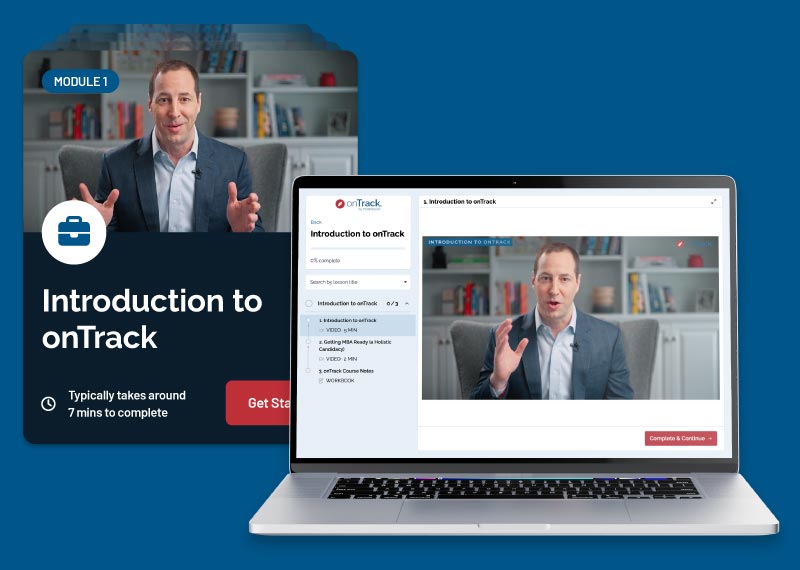
onTrack by mbaMission

A first-of-its-kind, on-demand MBA application experience that delivers a personalized curriculum for you and leverages interactive tools to guide you through the entire MBA application process.

Get Started!

2026–2027 MBA Essay Tips

Click here for the 2025–2026 MBA Essay Tips


MBA Program Updates

Explore onTrack — mbaMission’s newest offering allowing you to learn at your own pace through video. Learn more