Blog

Yale School of Management Essay Analysis, 2019–2020

Yale School of Management Essay Analysis - mbaMission

*Please note: You are viewing an essay analysis from the 2019-2020 admissions cycle. Click here to view our collection of essay analyses for the current admissions season.  

The Yale School of Management (SOM), like Harvard Business School, takes a bit of a “go big or go home” approach with its application essay question in that it poses just a single query to its applicants, giving them only one shot to make their desired impression on the admissions committee. The Yale SOM prompt is less open-ended, however, and requires candidates to focus on a significant past commitment and its underlying reasons and value. It also limits applicants to 500 words, so you will need to be clear, direct, and rather succinct in your response, without much preamble or extraneous text. Read on for our full analysis of the Yale SOM essay question for 2019–2020.

Describe the biggest commitment you have ever made. (500 words maximum)

In a Yale SOM blog post about the school’s essay prompt when it was originally introduced, Assistant Dean for Admissions Bruce DelMonico noted that the “seemingly simple and straightforward question” was composed with assistance from one of the program’s organizational behavior professors. Yale’s admissions committee clearly takes the application essay seriously and is thoughtful about the types of behaviors it wants to see in the school’s students. In an online Q&A session with several leading admissions officers we hosted last year, Bruce declared himself “agnostic” about whether applicants should discuss a personal commitment or a professional one, noting that he wants to gauge the level to which candidates commit themselves, rather than the context of the engagement: “We don’t have a preference for professional or personal accomplishments. . . . We are not making value judgments about what that commitment is, but it is more about how you approach that commitment, how you have demonstrated that commitment, and what sorts of behaviors underlie that commitment.”

You may initially think this prompt is rather narrow in scope, allowing you space to share the story of just a single professional or community project and nothing more. Although you can certainly discuss your dedication to a particular project or cause, you are definitely not restricted to this approach. Consider this: you can also be committed to an idea (e.g., personal liberty) or a value (e.g., creating opportunity for others), and approaching your essay from this angle instead could enable you to share much more of and about yourself with the SOM admissions committee. For example, you might relate a few anecdotes that on the surface seem unrelated—drawing from different parts of your life—but that all support and illustrate how you are guided by a particular value. Or, to return to the example of personal liberty as a theme, you could show how you take control of your academic and professional paths, adhering steadfastly to your values and vision. Whatever you choose to feature as the focus of your commitment, your actions and decisions, manifest via a variety of experiences, must allow you to own it as a genuine part of who you are as an individual. Identifying a theme that you think no one else will ever use is not your goal here; presenting authentic anecdotes that powerfully support your selected theme is what is important.

If you elect to focus on a single anecdote, the commitment you claim must be truly inordinate. Being particularly proud of an accomplishment is not enough to make it an effective topic for this essay. You need to demonstrate your constancy and dedication in the face of challenges or resistance, revealing that your connection to the experience was hard won. Strive to show that you have been resolute in following a sometimes difficult path and have doggedly stayed on course, citing clear examples to illustrate your steadfastness. Nothing commonplace will work here—you must make your reader truly understand your journey and leave them more impressed by your effort than the outcome.

Within its application, the Yale SOM also poses the following question:

How did you arrive at these career interests? How have you or how will you position yourself to pursue them? (250 words maximum)

Although this is not presented by the school as an official essay question, its length (at 250 words) and topic lead us to feel a little guidance might be helpful with this submission. Here, the admissions committee is essentially asking for context for your professional aspirations, which typically involves some level of information about your work history, and wants to learn how you expect to use the Yale SOM experience and degree to move your forward on your path to achieving your goals. 

Haas School of Business at the University of California, Berkeley, Essay Analysis, 2019–2020

Haas School of Business at the University of California, Berkeley, Essay Analysis - mbaMission

*Please note: You are viewing an essay analysis from the 2019-2020 admissions cycle. Click here to view our collection of essay analyses for the current admissions season.  

Applicants to the Haas School of Business at the University of California, Berkeley, this season will be responding to two totally new required essay questions. We were a little sad to see that the school’s unique and challenging six-word story prompt had been removed, but we imagine many candidates are not. Instead, Berkeley Haas wants applicants to dig deep on a personal level and discuss something about which they are passionate. For their second essay, candidates must explain the school’s role in their anticipated development as a leader. For its optional essays, the admissions committee has maintained its multipart questionnaire prompt (which is much less complicated than it may seem at first glance) and an open-ended prompt that gives applicants the opportunity to address any unclear or problem areas in their profile. These four essays together should allow you to present a well-rounded impression of yourself to the school, complementing the information presented in your resume, recommendations, and basic stats with insight into who you are as an individual and who you hope to be as a future business leader. Our full essay analysis for Berkeley Haas follows…

Required Essay #1: What makes you feel alive when you are doing it, and why? (300 words maximum)

Perhaps you are familiar with the psychological concept of “flow,” which is a mental state people enter when they are completely immersed in and focused on something they enjoy and are enthusiastic about—it is also described as being “in the zone.” With this question, Berkeley Haas is basically asking you to discuss what puts you in the zone. If you are truly excited about something—and, we would assume, therefore engage in it on a regular basis—writing about it should not prove too challenging. Like all other application questions, this one has no “right” answer, so do not try to guess what you think the school wants to hear. Authenticity is key to your success here. Note that the prompt includes the words “when you are doing it,” so although you may feel strongly about certain causes or values, such as animal rights or environmental matters, for this essay, you will need to discuss an activity rather than an ideology.  

The school does not stipulate that your topic needs to come from a specific area of your life (e.g., professional life, community service, personal life). We appreciate that you are likely passionate about your career, but this is not automatically your best choice for a topic here, especially given that the school’s second required essay offers a better opportunity to discuss your professional side. What Berkeley Haas wants to learn from this essay is what gets your heart pumping and mind racing. Enthusiasm and intensity can be very inspiring and energizing and can lead to big ideas and actions. Sharing what incites such feelings in you gives the admissions committee an idea of where you might someday make an impression on the world, how you might leave your mark—especially once you are equipped with all you will gain and learn during your MBA experience.

That said, do not worry if the thing you feel so fervently about might initially seem commonplace to someone else. For example, perhaps you feel passionate about basketball. Because this is an interest anyone could share and enjoy, you might have concerns that it could sound pedestrian or unremarkable—and for many, this is a completely unremarkable pastime and one they should not write about. If, however, you can show that you have engaged with basketball in a way that takes the activity well beyond being a commonplace hobby and that it is something you connect with on a deep level and in various ways—perhaps having played for many years, you now coach youth teams from underprivileged neighborhoods in your community—then it most definitely becomes an acceptable discussion topic. In such a case, basketball could be used to reveal intensity, dedication, commitment to yourself and others, growth, longevity, and/or resilience. Of course, we are offering basketball here just for illustration purposes. We imagine you likely feel the flow when engaging in a completely different activity or even engaging in disparate activities that are unified by a single behavior, such as when you are creating something, or perhaps motivating others. The options are very much endless.

Once you have identified the passion you wish to discuss, avoid simply telling the admissions committee about it and instead illustrate how it manifests in your life. For example, rather than starting your essay by stating, “I have been watching and playing basketball since I was a child,” you need to create a more vivid impression of your dedication and involvement, such as “From playing with my brothers after school to varsity ball in college to now coaching a youth league in my community, I can hardly remember a time when basketball wasn’t an integral part of my life.” Or consider a more narrative approach, such as, “Dripping with sweat, I thrust my right arm up and knocked the ball away, just as the buzzer sounded.” Once you have set the scene and presented the object of your fervor, you must then explain why you connect with it so strongly or so well—perhaps it gives you a sense of peace or purpose, or it makes you feel connected with others in a meaningful way, or it allows you to challenge yourself mentally or physically. A successful essay response will not only paint a clear picture of your passion but also highlight the elements of your personality that make it significant to you.

Texas McCombs Essay Analysis, 2019–2020

Texas McCombs Essay Analysis - mbaMission

*Please note: You are viewing an essay analysis from the 2019-2020 admissions cycle. Click here to view our collection of essay analyses for the current admissions season.  

Once again, the McCombs School of Business at the University of Texas at Austin has made only slight modifications to its MBA application essay prompts, simply refining the queries without changing the fundamental information on which they focus. The school’s required self-introduction essay (or video, for those who prefer that option) has been in play since at least 2013, and its second essay, for which applicants are asked to imagine themselves at graduation and to reflect on their time at McCombs, now specifies that candidates frame their response within the context of their goals, rather than the broader “post-MBA world.” Anyone with a potential problem area or unclear element in their profile can also submit an optional essay to address the issue(s). As a whole, the Texas McCombs essays give applicants ample opportunity to provide meaningful insight into their characters and strengths. Read on for our entire analysis of the program’s essay prompts for 2019–2020. 

Essay 1: We will learn a lot about your professional background through your resume and letter of recommendation, but we want to get to know you further. Please introduce yourself. Select only one communication method for your response. 

  • Write an essay (250 words) 
  • Share a video introduction (one minute in length)

The Texas McCombs admissions committee offers a little clarifying text before its straightforward request for an introduction, guiding applicants to steer away from aspects of their story that will already be covered in their resume and recommendations. Otherwise, candidates have an arguably blank slate from which to begin here. We imagine that the less guidance a program provides with its essay questions, the more panic is generated in the hearts of hopeful applicants, but let us reassure you that you do not need to be intimidated. Some patience, self-reflection, brainstorming, and authenticity—with a dash of creativity—and you should be on the road to a standout submission.  

First, determine the format that is more compatible with your personality. If you are the quiet, thoughtful type, an essay may be the better choice; if you are typically the life of the party or a better speaker than writer, you should probably select the video option. Next, start identifying the kind of information you might share by thinking about what you would like to know about a new person you are meeting and would find interesting, helpful, or intriguing. For example, would you consider someone’s age or undergraduate institution particularly important or compelling? Probably not, so you should skip mentioning such facts in your own introduction. (Remember, too, that your actual audience will be a member of the admissions committee, who will already know such basic information about you from the rest of your application.) You would likely be more curious about what someone does in their spare time, what interesting or exceptional skills they have, whether they are approachable/funny/hyperorganized/a risk taker/etc., whether they have extensive experience in a certain area or a more wide-ranging background, and so on.

So think about the aspects of your personality and profile that you believe truly define you as an individual—not just what you do and have done, but who you are—and fully explore your background, hobbies, talents, experiences, values, goals, and quirks. Brainstorm an extensive list and then eliminate any items that seem too common (e.g., a BA in finance) or basic (e.g., your hometown) until you have a collection of truly distinctive qualities you can weave into your response. Your goal is to provide a well-rounded picture of yourself that draws from multiple areas and shows that you possess characteristics and/or knowledge that would make you a positive addition to McCombs’ diverse community.

Remember to bring energy and enthusiasm to your submission. You are not filling out a job application—you are trying to connect with others, so charisma is welcome, and a less rigid and traditionally “professional” demeanor is okay. Forego any fancy essay-writing or dramatic tactics (e.g., starting with a quotation, launching into an anecdote), and just be as natural and authentic as possible. Do not pitch your candidacy, detail your career goals, or express your admiration for the program. As they say, you only have one chance to make a first impression, so dedicate the time and effort necessary to ensure that your introduction is engaging, substantive, and true to who you are.

If you choose to submit a video, think beyond what you will say and also consider the clothing you will wear, the setting or background, your tone of voice, your language style, whether you will include music, and other similar details. Brainstorm ways of nonverbally communicating some of your strongest attributes and key aspects of your life to help permeate your submission with as much information as possible. For example, if you are an avid biker, consider filming your video while you are actively riding. If you are a dedicated musician, perhaps incorporate your instrument into your message by playing it while you speak (if you are especially confident, you might even sing about yourself!). Think about what makes you who you are today, decide what you most want to share about yourself, and then let your creativity flow.

July 2019 Event Roundup

Are you applying to business school this year? If so, you can enroll in one of our free business school workshops, which are offered both online and in person in major cities across the country!

This July, the event lineup includes the following sessions:

  • July 11, 2019
    “What Matters?” and “What More?”: Writing Standout GSB and HBS Essays (Online) 
    Harvard Business School and the Stanford Graduate School of Business have two of the most challenging application essay prompts and leave many applicants struggling with where and how to even begin crafting a compelling response. In this brand-new event, we will discuss three established approaches you could take with these essays and then present several sample essays from past candidates, analyzing each one to highlight certain decisions—both good and bad—these writers made. We will show you that even effective essays are not truly perfect and hope to creatively inspire you as you get to work writing your own.
  • July 11, 2019
    San Francisco MBA Tour 
    Are you ready for your MBA? This summer, we at mbaMission are pleased to be attending The MBA Tour – US, where applicants from all over the country will meet with prospective MBA students, top business school admissions representatives, alumni, and other like-minded education enthusiasts to begin (or continue) their MBA journey!
  • July 15, 2019
    Houston MBA Tour
    Are you ready for your MBA? This summer, we at mbaMission are pleased to be attending The MBA Tour – US, where applicants from all over the country will meet with prospective MBA students, top business school admissions representatives, alumni, and other like-minded education enthusiasts to begin (or continue) their MBA journey!
  • July 17, 2019 
    Chicago MBA Tour
    Are you ready for your MBA? This summer, we at mbaMission are pleased to be attending The MBA Tour – US, where applicants from all over the country will meet with prospective MBA students, top business school admissions representatives, alumni, and other like-minded education enthusiasts to begin (or continue) their MBA journey!
  • July 18, 2019
    Essay Writing Workshop (Online)
    How can you write essays that grab the attention of MBA admissions committees? An experienced senior consultant will use this simple but often perplexing question as the starting point to a workshop for prospective business school applicants.
  • July 20, 2019 
    New York City MBA Tour
    Are you ready for your MBA? This summer, we at mbaMission are pleased to be attending The MBA Tour – US, where applicants from all over the country will meet with prospective MBA students, top business school admissions representatives, alumni, and other like-minded education enthusiasts to begin (or continue) their MBA journey!
  • July 23, 2019 
    Choosing The Right B-School (Online)
    Which MBA program is right for me? How can I find the best fit? An experienced senior consultant will help prospective MBAs understand the differences that exist among top MBA programs.
  • July 25, 2019 
    Washington, D.C. MBA Tour
    Are you ready for your MBA? This summer, we at mbaMission are pleased to be attending The MBA Tour – US, where applicants from all over the country will meet with prospective MBA students, top business school admissions representatives, alumni, and other like-minded education enthusiasts to begin (or continue) their MBA journey!

To enroll in one of our free seminars, click the event title in the list above. We look forward to having you join us!

Duke University Fuqua School of Business Essay Analysis, 2019–2020

Duke University Fuqua School of Business

*Please note: You are viewing an essay analysis from the 2019-2020 admissions cycle. Click here to view our collection of essay analyses for the current admissions season.  

Although Duke University’s Fuqua School of Business has not yet officially released its MBA application for 2019–2020, Assistant Dean of Admissions Allison Jamison recently announced some modifications it has made to the essay portion. Fortunately (in our opinion), the school has elected to maintain its distinctive “25 random things” prompt, which we love for the freedom it gives applicants to get creative and paint a well-rounded picture of themselves for the admissions committee. And the program’s community engagement essay likewise remains the same. Rather than three short-answer essay questions, however, applicants must respond to just two, though the heart of the information requested really has not changed much at all. In our full essay analysis that follows, we offer our best guidance on how to make the most of all the school’s prompts for this season. 

Interested in learning how to tackle this year’s Duke Fuqua application essay? Watch the short video below before you continue reading the full analysis!

Required short-answer essay questions

  1. Why is pursuing an MBA the right next step for you? (500 characters, or about 100 words) 
  2. What are your post-MBA career goals? Share with us your first-choice career plan and your alternate plan. (500 characters, or about 100 words)

With these two questions, Fuqua is essentially asking for a standard, albeit very brief, personal statement, with the addition of one rather nonstandard component in the second—the suggestion of an alternative path. Candidates often feel they must be totally unequivocal in their career goals to impress the admissions committee, but in this case, Fuqua is directly instructing applicants to speculate on and articulate multiple options. The school knows that sometimes the best-laid plans do not play out as expected or may even yield unintended results, and it wants to know that you are prepared to switch gears and recommit to a different path, if necessary—and that you are fully capable of doing so. The key in answering this question is showing that your backup goal is just as connected to your skills, interests, and ambitions as your original plan and does not come “out of left field,” so to speak. For example, you would probably have a difficult time convincing the admissions committee that your short-term goal is to work in technology consulting while your alternate goal would be to work in human resources, because these industries, for the most part, require entirely different skills and personalities. Just be mindful that both goals you present must be plausible and achievable.

As for the first question, the natural assumption is that if you have reached a point in your professional journey where you believe an MBA is necessary to move forward, you must have an understanding of why the degree is a critical part of continuing on that journey. This is simply your chance to outline your reasoning and needs for the admissions committee so it can be confident you have given this important step an appropriate amount of thought and are committed to your decision.

As we have noted, these questions concern several of the core topics covered in a traditional personal statement, so we encourage you to download your free copy of the mbaMission Personal Statement Guide, which helps applicants write this style of essay for any school. This complimentary guide offers detailed advice on approaching and framing these subjects, along with multiple illustrative examples. Be sure to claim your copy today.

First required essay: 25 random things about yourself

Instructions: Present your response in list form, numbered 1 to 25. Some points may be only a few words, while others may be longer. Your complete list should not exceed two pages.

For context: Fuqua believes different types of people, points of view, and experiences bring out the best in everyone. And above all, we place a premium on succeeding while making a positive impact on businesses, organizations, and the world.  These ways of thinking set the Duke MBA experience apart, and this concept extends beyond the student body to include faculty, staff, and administration. When a new person joins the Admissions team, we ask that person to share with everyone in the office a list of “25 Random Things About Yourself.” As an Admissions team, we already know the new hire’s professional and academic background, so learning these “25 Random Things” helps us get to know someone’s personality, background, special talents, and more. 

In this spirit, the admissions committee also wants to get to know you–beyond the professional and academic achievements listed in your resume and transcript. You can share with us important life experiences, your likes/dislikes, hobbies, achievements, fun facts, or anything that helps us understand what makes you who you are. Share with us your list of “25 Random Things” about YOU.

Be prepared to have fun creating this list for your Fuqua application! Before you start scribbling down random things, though, stop and take some time to thoroughly brainstorm. You cannot simply draft a list of “typical” accomplishments—remember, the school is asking for a random list, and keep in mind that your reader should learn more about you as an individual with each item presented. Make sure that every new story or tidbit of information you share gives the admissions committee a different window into your personality, into what really makes you tick and makes you you. Most important is that you own all the points on your list—that your final list could apply to no one but you. For example, a statement such as “I love the movie Goodfellas and have watched it multiple times” could easily be made by many applicants—therefore, it could not be considered truly yours. However, if you were to instead write, “At least once a year, my friends and I get together to watch our favorite movie, Goodfellas, all wearing dark suits, eating fresh pasta with homemade sauce, and reciting the dialogue line-for-line,” you would present an experience that is unquestionably yours, because few—if any—other candidates would be likely to say this exact same thing.


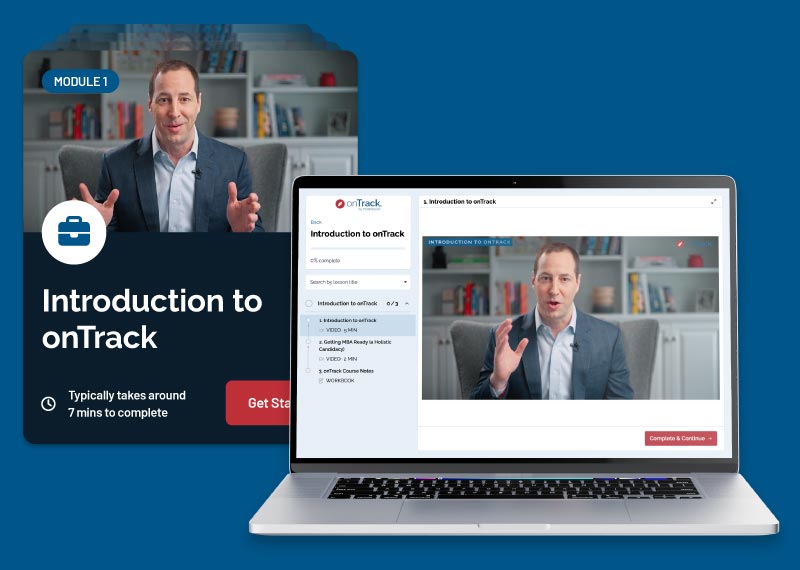
onTrack by mbaMission

A first-of-its-kind, on-demand MBA application experience that delivers a personalized curriculum for you and leverages interactive tools to guide you through the entire MBA application process.

Get Started!

2026–2027 MBA Essay Tips

Click here for the 2025–2026 MBA Essay Tips


MBA Program Updates

Explore onTrack — mbaMission’s newest offering allowing you to learn at your own pace through video. Learn more