Blog

The Ohio State University Fisher College of Business Essay Analysis, 2019–2020

The Ohio State University Fisher College of Business Essay Analysis 2019–2020 - mbaMission

*Please note: You are viewing an essay analysis from the 2019-2020 admissions cycle. Click here to view our collection of essay analyses for the current admissions season.  

The Fisher College of Business at The Ohio State University has expanded its application essay questions this year, giving candidates more of an opportunity to discuss their profiles beyond the statistics and other basic data conveyed in the rest of their application. The school’s first required essay is a rather traditional career goals statement for which the maximum word count has been cut back from 750 to 500. Perhaps this reduction was to allow for the addition of a second required essay without adding too much to the amount applicants need to write. For that new second essay, candidates must share a significant achievement from their past and explain how the experience has equipped them to be an additive member of the Fisher MBA community. If needed, a 250-word supplemental essay is also available for candidates with unusual or unclear elements in their profiles. All aspiring Fisher MBAs must complete a video interview soon after submitting their application, and although this is not technically an essay, we offer some tips for addressing it as well in our complete essay analysis, which follows.

You will be required to complete two written essay responses. The essay questions give you the opportunity to present yourself more fully to our MBA Admissions Committee and to provide insight into your experiences, goals, and thought processes.

ESSAY TOPIC 1: What are your short-term and long term goals? How/why will an MBA help you achieve those goals? (Maximum words: 500)

The Fisher admissions committee is hardly breaking any new ground with this essay prompt, which differs in wording from the one it posed last season but is otherwise very similar in content. Like all MBA programs, Fisher is interested in hearing where you see yourself going after you graduate and how you believe a business degree will equip you to fulfill your vision. Because this essay question covers several of the main components of a traditional personal statement, we encourage you to download a free copy of the mbaMission Personal Statement Guide, in which we offer detailed advice on approaching these topics, along with multiple illustrative examples.

ESSAY TOPIC 2: Please tell us about the accomplishment you are most proud of. How will this experience allow you to contribute a unique perspective to the Fisher community? (Maximum words: 400)

We imagine that at this point in your life, you have achieved a number of things both personal and professional that you could use as fodder for an application essay. However, your goal here is not simply to impress the admissions committee with the scale or impact of your accomplishment but to offer one that best fits the essay prompt. This means you will need to select one that was truly meaningful for you on a profound level and that also left with you with a belief, mind-set, or understanding that would make you a valuable member of the Fisher network. The school does not stipulate whether the achievement you discuss should be from your career or your personal life, so thoroughly consider all your possibilities to identify the one that is most appropriate for this submission. Although sharing a non-work-related accomplishment in this essay could serve as a nice complement to your discussion of your career goals in Essay 1, do not feel that this is strictly necessary. What is most important is that the story you present clearly conveys your values (why you feel most proud of this achievement in particular) and explains how your takeaways have molded you into the kind of person Fisher would want in its ranks.   

We would recommend using only the first 100–150 or so words of this essay to describe your chosen experience, so that you will have sufficient leeway in which to then clearly reveal what you learned from it and how it has equipped you to contribute to the Fisher community in a substantial way. Do your best in this limited space to “show,” or really spell out, how things unfolded—rather than just stating the accomplishment or flatly presenting the situation—to give the admissions reader some perspective on how you conduct yourself and achieve. 

You will then need to demonstrate both self-awareness and a thorough understanding of the Fisher MBA experience by outlining your takeaway(s) and drawing a connection between what you learned and what you can subsequently bring to the school as a member of its community. For example, you may have gained some useful insights you could share with your classmates in a related class or club, or maybe you now have an interesting viewpoint on commitment, determination, teamwork, or other such value. To effectively illustrate a connection between your takeaway from the experience and your expectation for applying it at Fisher, you will need to fully familiarize yourself with the program’s various resources and the characteristics of its community. Go the extra mile in learning about the school—connect with multiple students and alumni, attend admissions events in your area, and especially, visit the campus (if at all possible). This will provide the kind of in-depth insight that will show the admissions committee you are really serious about Fisher and understand how and why you belong there. 

SUPPLEMENTAL ESSAY (OPTIONAL): This optional essay can be used to address any circumstances you’d like the Admissions Committee to be aware of (gaps in work history, academic performance, choice of recommenders, etc.). (Maximum words: 250)

This short essay is your opportunity—if you need it—to address any lingering questions that an admissions officer might have about your candidacy, such as a poor grade or overall GPA, a low GRE or GMAT score, or, of course, one of the issues Fisher lists in the prompt. If you feel you may need to submit an additional essay for such a reason, consider downloading a free copy of our mbaMission Optional Essays Guide, in which we offer detailed advice on when and how to take advantage of the optional essay (along with multiple sample essays) to help mitigate any problem areas in your profile.

INSEAD Essay Analysis, 2019–2020

INSEAD - mbaMission

*Please note: You are viewing an essay analysis from the 2019-2020 admissions cycle. Click here to view our collection of essay analyses for the current admissions season.  

We noted no adjustments in INSEAD’s MBA application essay prompts this year. This season’s candidates must respond to four short career-focused queries and provide three motivation essays that together total 1,200 words.  Applicants are also tasked with completing a video component for which they answer four questions as four separate video recordings. Given the sheer number of prompts, tasks, and questions involved, some candidates may find INSEAD’s essay gauntlet a bit intimidating, if not outright punishing. Read on for our full analysis of the school’s prompts, which we hope will make the process a little easier to manage.

Job Description 1: Briefly summarise your current (or most recent) job, including the nature of work, major responsibilities, and where relevant, employees under your supervision, size of budget, clients/products and results achieved. (short answer) 

Job Description 2: What would be your next step in terms of position if you were to remain in the same company? (short answer) 

Job Description 3: Please give a full description of your career since graduating from university. Describe your career path with the rationale behind your choices. (short answer) 

Job Description 4: Discuss your short and long term career aspirations with an MBA from INSEAD. (short answer) 

For the school’s job-related short-answer questions (essentially mini essays), we encourage you to start by very carefully parsing exactly what data the school requests for each. Together, these four prompts cover many of the elements seen in a traditional personal statement essay, including info about one’s career to date, interest in the school, and professional goals. However, the topics are clearly separated among individual submissions rather than covered in a cohesive single essay, and INSEAD also asks applicants to comment on their expected progression within their current firm were they to remain there rather than entering business school.

The first prompt requires that you outline roughly six different aspects of your current or most recent position. Be sure that you address each of the elements the school lists, and do not skip any just because you would rather write more about some than others. You may also want to consider providing a very brief description of your company or industry, if the nature of either might not be readily clear to an admissions reader. For the second question, your response should be fairly straightforward. If your firm has a clearly defined management hierarchy in which one position leads directly to a higher one—and you would be interested in adhering to that system—you simply need to explain this and perhaps offer a short description of the new responsibilities your next position would entail. If your company does not have such an arrangement or you would want to move in a different direction, simply explain what your preferred next role would be and the duties involved. 

The third prompt is rather self-explanatory with respect to detailing the various stages of your career to date, but do not be remiss in responding to the “rationale” and “choices” aspects of the query. The school wants to know that your progression has not been passive, with your simply accepting the next good thing to come along, but rather that you have made thoughtful decisions with clear motivations and intentions behind them. For the fourth question, you will need to present your professional goals within the context of an INSEAD MBA education. Do your research on the school to identify specific resources it offers that relate directly to the skills and experiences you need to be successful in your career, thereby illustrating how INSEAD would help you achieve your aims. Above all, be sure to show determination and direction—that you are focused firmly on your intended end points and will not be easily deterred. 

For all your job description responses, avoid using any acronyms or abbreviations that would not be easily recognizable to most people. Using shortcuts (in the form of abbreviations/acronyms) and skipping basic contextual information could make your answers less understandable and therefore less compelling and useful to an admissions reader, so do yourself a favor by depicting your situation as clearly as possible. 

As we have noted, these questions cover many elements of a traditional personal statement, so we encourage you to download a free copy of our mbaMission Personal Statement Guide. In this complimentary publication, we provide a detailed discussion of how to approach such queries and craft effective responses, along with multiple illustrative examples.

Optional Job Essay: If you are currently not working or if you plan to leave your current employer more than 2 months before the programme starts, please explain your activities and occupations between leaving your job and the start of the programme. 

With this essay, INSEAD hopes to see signs of your interest in ongoing self-improvement, knowledge or experience collection, and/or giving back. Whether you are choosing to leave your job a few months before the beginning of the MBA program or are asked to do so by your employer, simply explain what you expect do and gain in the interim. The admissions committee wants to know that you are the kind of person who takes advantage of opportunities and to understand what kinds of opportunities appeal to you. For example, perhaps you plan to complete a few quantitative courses to be better equipped to hit the ground running in your related MBA classes, or perhaps you want to spend some time with distant family members or volunteering in your community because you know that your availability to do so will be limited when you are in school, and you want to maintain those important connections. Maybe you want to travel to improve your language ability in a more immersive environment before coming to INSEAD, given the importance of this skill in the school’s program. Or you might arrange informational interviews, job-shadowing opportunities, and/or unpaid internships, which could help in various ways with recruiting and job selection. Whatever your goals and plans, clearly convey how you anticipate that your experience(s) will add to or change your character, enhance your skill set, and/or increase your understanding of yourself or others—all of which are valuable in business school.

Emory University’s Goizueta Business School Essay Analysis, 2019–2020

Emory University’s Goizueta Business School Essay Analysis - mbaMission

*Please note: You are viewing an essay analysis from the 2019-2020 admissions cycle. Click here to view our collection of essay analyses for the current admissions season.  

Although the content covered in the essay questions for Emory University’s Goizueta Business School has not changed much this season, the school has switched things up a bit by making one of its required submissions a video essay. Thankfully for its applicants, Goizueta not only provides the question(s) for the video in advance but also gives candidates three options from which to select. In their written essays, applicants must discuss their short-term career goals and a past leadership experience, and in the video, they are expected to address either a personal passion, some valuable counsel they once received, or a value they have in common with the school. Candidates may use the Additional Information option to provide clarification or explanation about elements of their candidacy, if necessary, but must do so very succinctly, given the 100-word limitation. On the whole, Goizueta’s essay prompts focus more heavily on applicants’ professional sides, though perhaps the combination of a personal question and the video component is enough to sufficiently round out each candidate’s profile for the admissions committee. Read on for our complete analysis of the program’s 2019–2020 essay questions.

POST-MBA CAREER GOALS: Define your short-term post-MBA career goals. How are your professional strengths, past experience, and personal attributes aligned with these goals? (300 word limit)

Like most business schools, Goizueta wants to learn the reasons behind its applicants’ decision to pursue an MBA, but unlike many programs these days, it still asks candidates to actually write an essay on the topic. Very simply, the admissions committee wants to know that you have given serious thought to your professional trajectory and have identified where you want to go, how equipped you already are to get there, and how an MBA will help you move forward. The specific goal you present is less important here than showing that you understand what is involved in progressing toward your objectives and recognize the qualities and abilities you currently possess that will help position you for success.

Because this essay covers several key elements of a personal statement, we encourage you to download a free copy of the mbaMission Personal Statement Guide, which discusses in depth how to approach and write these types of submissions (with numerous examples).  

LEADERSHIP IN BUSINESS: The business school is named for Roberto C. Goizueta, former Chairman and CEO of The Coca-Cola Company, who led the organization for 16 years, extending its global reach, quadrupling consumption, building brand responsibility, and creating unprecedented shareholder wealth. Roberto Goizueta’s core values guide us in educating Principled Leaders for Global Enterprise. Provide an example of your leadership in a professional setting and explain what you learned about yourself through the experience. (300 word limit)

Goizueta Business School clearly holds the leadership abilities and professional accomplishments of the former trustee after which it was named in high regard. The leadup to the actual essay prompt mentions the business leader’s core values and lists some of his most impressive accomplishments at Coca-Cola’s helm. However, the prompt itself makes no reference to values and does not request that applicants discuss a comparable achievement. The implication, we believe, is simply that the school has high expectations for the members of its community and seeks individuals who aspire to make a real impact on the world around them. They are guided by their values and seek to create positive outcomes for others as well as themselves. The admissions committee is not expecting you to be able to claim an accomplishment on the level of Roberto Goizueta’s, but you should strive to identify a story from your career that best illustrates both your leadership style and your long-term potential.

Because you have only 300 words for this essay, we recommend responding in a straightforward manner. Launch directly into the story of your leadership experience, detailing the specific actions you took in directing others to achieve your result. Although we often note that not all great leadership stories end in success, in this case, you should discuss a situation that had a positive resolution. The key here is to show you shared a valuable experience with colleagues, extracted the most from your team members, and attained a desired outcome. 

We recommend using a narrative approach for your story, but be sure to include the thought process and motivation(s) behind your actions. This way, the admissions committee will take away both a clear picture of what you accomplished and the aspects of your character that inspired you and helped enable your success. Lastly, do not forget or neglect to explain what you learned from the experience—the admissions committee specifically requests that you do so! Omitting this element from your essay could be viewed as an indication that you are not good at delivering what is asked and/or at engaging in constructive self-reflection, and you definitely want to avoid this. You also want to avoid sharing that you learned a specific skill or business truth, because the prompt specifically says, “learned about yourself” (italics ours). To craft a compelling response, you will need to give serious thought to how the situation made you aware of a facet of your character that you had not previously perceived.

What to Expect on GMAT Test Day

With regard to the GMAT, raw intellectual horsepower helps, but it is not everything. Manhattan Prep’s Stacey Koprince teaches you how to perform at your best on test day by using some common sense.

I have talked to a ton of students who were surprised by some detail of test day—and that detail affected their performance. Let’s talk about what is going to happen when you finally get in there to take the test.

When you arrive

There will be some kind of outer waiting area, an inner office containing the biometric equipment, and finally the “inner sanctum”: the testing room.

When you first arrive, you will be asked to read (and digitally sign) a bunch of legalese and will show your ID. Check the guidelines to determine what kind of ID you must bring.

But wait! You are not done with security yet. They will take a digital photo of you. You will also have the veins in your palm digitally scanned—turns out our palm veins are even more unique than fingerprints. Who knew?

Finally, before you enter the inner sanctum, you will place all of your belongings (except your ID) into a locker to which you will have the key. Everything goes in this locker: your wallet or purse, your money, your mobile phone, your keys, everything. Do not bring any study notes into the test center with you, do not use any electronic devices, and do not write anything down at any time—even on the breaks. Do not give them any reason to think you might be cheating.

Starting the test

You will be given a five-page booklet of laminated paper on which to take notes. If you use up the booklet, raise your hand, and a proctor will give you a new booklet in place of the used one.

During the test, you are allowed to request a new note booklet at any time, even if you have not finished using up the previous one. I have heard reports of some proctors refusing such requests; if this happens, ask again (politely). Tell them that you specifically asked ahead of time and that GMAC (the organization that owns the GMAT) confirmed that you do not need to use up a test booklet before requesting a new one.

You will have access to tissues and earplugs provided by the test center; you cannot bring your own. Some test centers also have headphones available (in addition to earplugs).

Officially, you are not permitted to write down notes or set up your scrap paper before the test starts. When you sit down, the proctor will start the test. You can try to jot down some timing benchmarks or a few formulas during the short pre-test instructions, but stop if the proctors tell you to stop. Do not count on being able to spend any time at all writing things down ahead of time.

Breaks

Breaks are optional, but I strongly recommend that you take them!

You have to leave the test room during the break. The break is eight minutes long—but, wait, you do not have your watch! It is in your locker. The testing center is required to have a clock on the wall in every room; check when you first arrive. If no clock is visible or the clock has stopped working, say something to the proctors right away!

As soon as you get out to the waiting room, look at the clock. Plan for about six minutes (it takes about a minute to get out of the room and another minute to get back in).

Then open up your locker and have something to eat and drink. Walk around. Stretch. Use the restroom. Do not sit down, do not start reading a magazine, and do not start thinking about the test or how you are doing on it. Try to empty your brain and think only about what you are actually doing: stretching, eating, drinking.

When you head back into the testing center, they will scan your palm again and also match you against your digital photo. This takes a minute—plan for it.

How else can I get ready?

GMAC has posted a short video showing how the test center works; I highly recommend watching it. The mba.com site also contains other resources about what to expect on test day (follow the link in the previous sentence). If you are even a little bit nervous about the test (and most of us are!), look through their resources. The more you know about what to expect, the better prepared you will be to handle your nerves on test day.

Georgetown McDonough Essay Analysis, 2019–2020

Georgetown McDonough Essay Analysis, - mbaMission

*Please note: You are viewing an essay analysis from the 2019-2020 admissions cycle. Click here to view our collection of essay analyses for the current admissions season.  

Georgetown University’s McDonough School of Business has made some substantial changes to its application essay questions this year, broadening candidates’ opportunity to present their strongest qualities to the admissions committee for evaluation. Applicants must still provide one 500-word written essay but now get to choose from three question options. Rather than being strictly required to discuss a single defining moment, they can write about leading outside of their comfort zone, a failure-as-learning-opportunity situation, or their personal connection with the brand of someone they admire. The school’s video essay remains unchanged and allows candidates to creatively showcase their individuality and personality. Finally, although the school offers only one optional essay this season, rather than two, the prompt gives candidates the leeway to discuss anything they feel is necessary, so it should be sufficient to meet everyone’s needs. Our full essay analysis follows, in which we offer ideas and advice for addressing all the school’s prompts.

We want to hear your story. When responding to our required essays, be authentic and take time to reflect on your goals and past experiences. Craft a response that explains how these experiences led you to pursue an MBA.

Our goal at Georgetown McDonough is to craft a diverse class with people who have had varying personal and professional life experiences. As such, we want to give our applicants the opportunity to select one essay (from a list of three) that allows them the ability to best highlight their experiences, characteristics, and values that showcase the value proposition that they can bring to the McDonough community. Please select one of the following three essays to complete in 500 words or less and include the essay prompt and your first/last name at the top of your submission.

Essay Option One: It can be said that life begins outside your comfort zone. Describe a situation when you were asked to lead outside of your comfort zone. What leadership characteristics did you exemplify in this situation that allowed you to succeed?  

Although this is a brand new essay question for the school, it carries echoes of the standalone prompt from last year, which asked candidates about a challenge they faced and how they ultimately exceeded expectations. Here, the challenge now stems from being outside one’s comfort zone, and “exceeding expectations” is expressed as “success.” 

As a business school student, you will regularly be pushed beyond the boundaries of your comfort zone. This will happen more often for some than others, of course, and in slightly different ways for each individual, but it will happen. McDonough wants to know how you draw on your strengths, skills, experience, and attitude at such times to meet the challenge and see things through to a positive conclusion. This is about revealing not only the leadership qualities you already possess but also your instincts in identifying the ones that are appropriate and helpful in a given situation and in applying them effectively.

We want to highlight the phrase “asked to lead,” which may influence your choice of story for this essay. The wording implies that in the incidence you are describing, someone has requested (or possibly even demanded) that you step up, rather than your having taken the initiative and volunteered yourself for the role. Perhaps the school is interested in the fact that someone either believed in your capacity to deal with the issue at hand, despite your unfamiliarity with some aspect of the situation, or recognized in you qualities they felt would be positively applicable, and this could shine an interesting new light on the admissions committee’s interpretation of your experience.  

Note that McDonough does not specify that the experience you share must be related to your workplace or career. Leadership does not need to have an official title attached to it, and it can be expressed in a community service or even family life setting just as much as in a workplace, so explore all the different areas of your life for possible stories. Then begin your essay by providing some narrative context that sets the stage for the significant moment or experience. Clearly explaining how you approached, assessed, and ultimately prevailed is crucial, so go beyond simply describing the scenario and ensure that you detail the inner workings of your decision making as you and your team progressed toward your positive outcome.

The admissions committee does not ask what you learned from the experience, so we caution you against using valuable word count on this point. Instead, focus on conveying why you consider the incident “outside your comfort zone” (what was foreign or uncomfortable for you), perhaps why you in particular were chosen to lead, the skills you engaged and steps you took to guide your team to triumph, and your thought processes along the way. This way, the admissions committee will gain both a clear picture of what you accomplished and the aspects of your character that inspired you and helped enable your success.


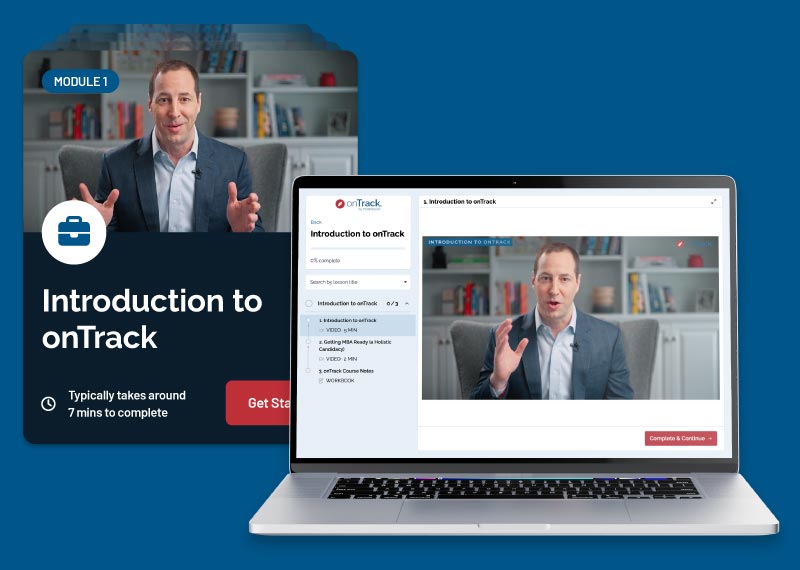
onTrack by mbaMission

A first-of-its-kind, on-demand MBA application experience that delivers a personalized curriculum for you and leverages interactive tools to guide you through the entire MBA application process.

Get Started!

2026–2027 MBA Essay Tips

Click here for the 2025–2026 MBA Essay Tips


MBA Program Updates

Explore onTrack — mbaMission’s newest offering allowing you to learn at your own pace through video. Learn more