Blog

Professor Profiles: Lubos Pastor, University of Chicago Booth School of Business

Lubos Pastor, Chicago Booth

Many MBA applicants feel that they are purchasing a brand when they choose a business school. However, the educational experience you will have is what is crucial to your future, and no one will affect your education more than your professors. Today, we focus on Lubos Pastor from the University of Chicago Booth School of Business.

Despite his relatively young age, Lubos Pastor has already received considerable recognition for his research on the stock market and asset management and was once featured among “The Best 40 B-School Profs Under the Age of 40” by Poets&Quants. At Chicago Booth, which Pastor joined in 1999, he is currently the Charles P. McQuaid Professor of Finance, the Robert King Steel Faculty Fellow, and the co-director of the Fama-Miller Center for Research in Finance.

Pastor’s work has been influential, earning him such high-profile accolades as the NASDAQ Award, the Goldman Sachs Asset Management Prize, and the Barclays Global Investors Prize, as well as the McKinsey Award for Excellence and Teaching, two of Chicago Booth’s own Faculty Excellence Awards for MBA Teaching, and the Chicago Booth Phoenix Award, “for greatly enriching the learning experience of the Full-Time MBA Class of 2019.” One student quoted in the Poets&Quants article said “his witty style elevates classroom conversations and facilitates retention of core concepts.” At Chicago Booth, Pastor currently teaches the MBA course “Portfolio Management,” in addition to several executive education courses.

For more information about Chicago Booth and 16 other top-ranked business schools, check out our free mbaMission Insider’s Guides.

Intimate Class Sizes in the South at Scheller College of Business and Mays Business School

The Scheller College of Business at Georgia Tech might rival MIT Sloan and Carnegie Mellon’s Tepper School of Business with respect to its focus on the direct application of Internet technology to global business problems. The school’s rather small (approximately 60–80 students each year) and innovation-focused program was nevertheless ranked 29th among full-time MBA programs in the United States by Bloomberg Businessweek in 2021.

Situated in the heart of Technology Square in Midtown Atlanta, Scheller offers students numerous networking and innovation resources within the city’s high-tech business community, including the Advanced Technology Development Center business incubator. In addition, the Enterprise Innovation Institute, or EI2, bills itself as “the nation’s largest and most comprehensive university-based program of business and industry assistance, technology commercialization, and economic development” on its website and provides students with resources for career options at the intersection of business and technology. As an indicator of the school’s overall strengths in information technology and operations management, manufacturing/engineering was the most common pre-MBA industry among the Class of 2023.

Meanwhile, at the Texas A&M University Mays Business School, students follow a full-time, 49-credit MBA curriculum that can be completed in just 16 months (over an 18-month period of August to December) or customized for an extended period of time. Although the core curriculum is very rigid, with foundational management courses spanning the entirety of the program, Mays also offers the option of pursuing certificates and career specializations beyond the 16-month core.

What really stands out about the Mays program, however, is its dedication to maintaining a strong sense of community. Similar to Scheller, the relatively small class size—the 2020 incoming class, for example, featured 86 students—facilitates an intimate classroom setting and personalized attention from faculty and staff at Mays.

Professor Profiles: James E. Schrager, the University of Chicago Booth School of Business

James E. Schrager

Many MBA applicants feel that they are purchasing a brand when they choose a business school. However, the educational experience you will have is what is crucial to your future, and no one will affect your education more than your professors. Today, we focus on James E. Schrager from the University of Chicago Booth School of Business.

Although he has a PhD from the University of Chicago in organizational behavior and policy, James E. Schrager is not just an academic, but also a practitioner who helped take the first private American company public on the Tokyo Stock Exchange and helped turn around aspects of the Pritzker family holdings, which were ultimately sold to Warren Buffett’s Berkshire Hathaway. Students we interviewed noted that Schrager brings his high-level experiences to class but remains entirely in touch with students’ more modest perspectives, adapting his anecdotes accordingly and creating practical learning points that pertain to what students will face early in their post-MBA careers.

Schrager is a three-time winner of the university’s Emory Williams Award for Excellence in Teaching (in 2007, 2001, and 1996), and he received the Faculty Excellence Teaching Award in 2017. One second-year student told mbaMission, “He is not up in the sky, but very practical, and by the way, his class is always full.” Students’ grades in Schrager’s “New Venture Strategy” class are based in part on the success of a business idea the students present to their peers—the other students act as venture capitalists and give feedback on the idea.

For more information about Chicago Booth and 16 other top-ranked business schools, check out our free mbaMission Insider’s Guides.

The Master Resource List for GMAT Reading Comprehension, Part 4

With regard to the GMAT, raw intellectual horsepower helps, but it is not everything. Manhattan Prep’s Stacey Koprince teaches you how to perform at your best on test day by using some common sense.

Part 1 of this series covered how to read Reading Comprehension (RC), and Part 2 introduced the first two major question types: Main Idea and Specific Detail. In Part 3, we discussed Inference questions and Why questions. If you have not already done so, start by reading those posts, and then continue with this final post in the series.

Put It All Together

All right, now you have all the pieces:

  • What to read and what not to read
  • How to find the main point
  • How to answer Main Idea, Specific Detail, Inference, and Why questions

We should now test your skills! This first article talks about how to read tough science passages.

Next, test your understanding of the passage on this Inference question, and then try this Why question.

Timing

As I mentioned earlier, we really do not have much time to read RC passages. Aim for approximately two to two and a half minutes on shorter passages and closer to three minutes for longer ones. Of course, you cannot possibly read everything closely and carefully in such a short time frame—but that is not your goal! The goal is to get the big picture on that first read-through.

Aim to answer Main Idea questions in roughly one minute. You can spend up to two minutes on the more specific questions. In particular, if you run across an Except question, expect to spend pretty close to two minutes; Except questions nearly always take a while.

As always, be aware of your overall time. If you find that you are running behind, skip one question entirely; do not try to save 30 seconds each on a bunch of questions. Also, if RC is your weakest verbal area, and you also struggle with speed, consider guessing immediately on one question per passage and spreading your time over the remaining questions.

Great, I Have Mastered RC!

Let us test that theory, shall we? Your next step is to implement all these techniques on your next practice test while also managing your timing well. Good luck!


The Master Resource List for GMAT Reading Comprehension, Part 3

With regard to the GMAT, raw intellectual horsepower helps, but it is not everything. Manhattan Prep’s Stacey Koprince teaches you how to perform at your best on test day by using some common sense.

Part 1 of this series covered how to read Reading Comprehension (RC), and Part 2 introduced the first two major question types: Main Idea and Specific Detail. Start with those posts and then continue with this post.

Inference

In this section, we are going to talk about two big things: how to handle Inference questions and how to analyze RC problems in general (you can then use these techniques on any question type).

Inference questions ask about specific details in the passage, but they add a twist: we have to deduce something that must be true, given certain facts from the passage.

For example, if I tell you that my favorite type of book to read is biography, what could you deduce?

Watch out for the trap: do not use your “real world” conclusion-drawing skills. In the real world, you might conclude that I like reading books in general or perhaps that I am interested in history or maybe that I am a nerd. (Really? Biographies are my favorite?) These things do not have to be true, though.

What has to be true? I do not like fiction as much as I like biographies. I have read at least one book in a nonbiography category (otherwise, I would not be able to tell that I prefer biographies, which implies a comparison).

What is the difference? GMAT deductions are usually things that would cause us to say “Duh!” in the real world.

“My favorite category of book is biography.”
“Oh, so you must not like fiction as much as you like biographies.”
“Uh… well, yeah, that’s what ‘favorite’ means. I don’t like anything else better.”

A GMAT deduction should feel like a “duh” deduction—something totally boring that must be true, given the information in the passage.

Why Questions

Specific questions can come in one other (not as common) flavor: the Why question. Why questions are sort of a cross between Specific Detail and Inference questions: you need to review some specific information in the passage, but the answer to the question is not literally right in the passage. You have to figure out the most reasonable explanation for why the author chose to include a particular piece of information.

Timing

As I mentioned earlier, we really do not have much time to read RC passages. Aim for approximately two to two and a half minutes on shorter passages and closer to three minutes for longer ones. Of course, you cannot possibly read everything closely and carefully in such a short time frame—but that is not your goal! The goal is to get the big picture on that first read-through.

Aim to answer main idea questions in roughly one minute. You can spend up to two minutes on the more specific questions. In particular, if you run across an Except question, expect to spend pretty close to two minutes; Except questions nearly always take a while.

As always, be aware of your overall time. If you find that you are running behind, skip one question entirely; do not try to save 30 seconds each on a bunch of questions. Also, if RC is your weakest verbal area, and you also struggle with speed, consider guessing immediately on one question per passage and spreading your time over the remaining questions.

Great, I Have Mastered RC!

Let us test that theory, shall we? Your next step is to implement all these techniques on your next practice test while also managing your timing well. Good luck!


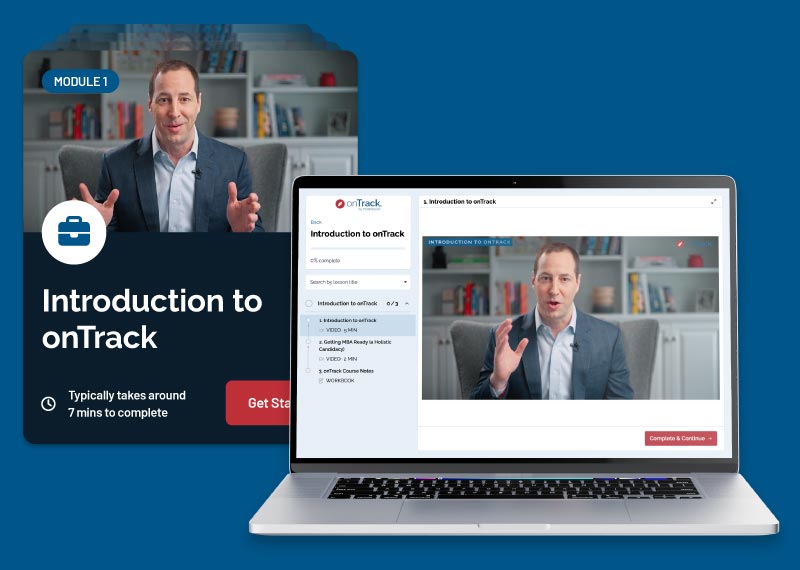
onTrack by mbaMission

A first-of-its-kind, on-demand MBA application experience that delivers a personalized curriculum for you and leverages interactive tools to guide you through the entire MBA application process.

Get Started!

2026–2027 MBA Essay Tips

Click here for the 2025–2026 MBA Essay Tips


MBA Program Updates

Explore onTrack — mbaMission’s newest offering allowing you to learn at your own pace through video. Learn more