Blog

Meet Devi Vallabhaneni, Our Harvard Business School Interviewer in Residence

Prepare for Your HBS Interview with a Former HBS Interviewer: Devi Vallabhaneni, mbaMission

Devi Vallabhaneni, mbaMission’s HBS Interviewer in Residence

Devi Vallabhaneni has almost two decades of admissions experience, including interviewing and evaluating Harvard Business School (HBS) candidates, a passion she first developed when she herself was a second-year student at the school. She is a Managing Director at mbaMission, as well as our Harvard Business School Interviewer in Residence, offering HBS Intensive Interview Simulations to HBS hopefuls. In fact, her services are so popular that she always has a waitlist of candidates who want to prep with her for the coveted HBS admissions interview. Here, she answers some questions about the Harvard Business School interview, excerpted from a recent conversation between Devi and mbaMission Founder and President Jeremy Shinewald.

How do you prepare to prepare others for their Harvard Business School Interview?

The HBS interview season is only about eight weeks over the two rounds, so it’s what I do the remaining 44 weeks that’s important. There is a through-line between each year’s MBA applicant pool and current events in business, which is why I think of admissions as being in the business of business.

CNBC or Bloomberg is always on in my office. I love following the markets, which allows me to be several steps ahead of my interviewees, who are working on the most newsworthy SPACs [special purpose acquisition companies], latest innovations across industries, newest business models, and the most pressing societal problems. My job isn’t to give them answers but to ask the right questions and challenge their thinking for them to formulate their own viewpoints.

I hear you give homework to your clients. What does that mean?

Recently, I was helping an interviewee who was sharing his struggles at his service-based start-up. He was advising leadership that to be customer-centric, they had to be employee-centric first, but leadership was having a hard time making this connection. I gave him homework: to study the Service Profit Chain developed by HBS Professor James Heskett. He shared it with his leadership, who started listening to him. Because there is no divining rod of who will be accepted, I make sure to leave them with something tangible they could use on their job as well as during the HBS interview.

How do you address EQ [emotional quotient]?

Some clients haven’t fully processed their emotions around their path and inadvertently infuse their answers with regret and negativity. The interview process can be emotional, and at times, people cry telling me heart wrenching stories about their setbacks or disappointments. The more that is processed during practice, the better. Confidence comes when you understand yourself emotionally, so if that’s the bottleneck, that’s what we focus on. It’s amazing to see the lightness of their persona when emotions are processed in a safe and nonjudgmental way.

Why is this so important to you?

Prepping clients for the HBS interview is a strangely intimate, intense, and personal experience for me. They know nothing about me, yet I know everything about them. Our exchanges become their biggest priorities for a few weeks. They place their past, their future, their hopes, their disappointments, their goals, and, most importantly, their trust in my hands. I’m constantly thinking, What do I need to ask them to get them to where they need to go or for them to see their path differently? My process is more of an art than a science. I view each client like a protagonist in a case study. Instead of analyzing whether a company should launch a product or build a new plant somewhere, the case study is their life.

It’s a privilege to be trusted with someone’s yet-to-be-written story. It’s a privilege to be the second call after their immediate family to share in their acceptance!!

Be sure to check out Devi’s top five tips for acing your MBA interview!

Do you want to prep for your HBS interview with Devi? Click here to learn more about her HBS Intensive Interview Simulations and reserve your spot. 

Earn an MBA in Pennsylvania at the Tepper School of Business or Smeal College of Business

Students aspiring to sharpen their analytic and quantitative skills are well served at Carnegie Mellon University’s Tepper School of Business. Boasting a faculty that includes multiple Nobel Prize winners, Tepper has pioneered “management science,” a supplement to traditional case studies that draws on more scientific—rather than historical—strategies for complex business decision making. Management science depends on tools such as computer modeling, organizational behavior, and economic theory.

In addition to this overall “quant” emphasis in its curriculum, Tepper offers an MBA track for Business Analytics. In the track, students are immersed in highly focused computational analysis, examining different theories of finance, stochastic calculus modeling, and statistical methodologies, in addition to the managerial skills they learn in the MBA program’s marketing, strategy, communications, and operations courses. While such schools as Chicago Booth and Columbia Business School may garner a higher rank for careers in finance, few MBA programs offer such uniquely intensive academic resources for a specialization in business analysis.

Elsewhere in the state, Pennsylvania State University’s Smeal College of Business is perhaps best known for balancing traditional course work with immersive learning. Smeal’s modular curriculum structure includes eight modules over the course of the two-year MBA program. The program begins with the week-long orientation program, after which students take the week-long course “Concentration Intensive,” during which they participate in various seminars to learn more about the program’s four available main concentrations. The second course module, for example, focuses on such themes as “Foundations in Finance” and “Economics for Managers.” The “Communication Skills for Leaders” course runs through the entire first year and is described on the school’s website as “a signature hallmark of the Penn State Smeal MBA experience.”

Smeal’s curriculum also includes a required international experience component, the “Global Immersion,” which takes place in the second year. Students travel to such countries as South Africa, Croatia, and China to visit international organizations across various industries.

Professor Profiles: Gavan Fitzsimons, Duke University’s Fuqua School of Business

 width=

Many MBA applicants feel that they are purchasing a brand when they choose a business school. However, the educational experience you will have is what is crucial to your future, and no one will affect your education more than your professors. Today, we focus on Gavan Fitzsimons from Duke University’s Fuqua School of Business.

Students and administration members alike sing the praises of Fuqua’s “fun” and “engaging” marketing professor, Gavan Fitzsimons, who spearheaded the creation of the Duke-Synovate Center for Shopper Insights in 2011 and serves as its faculty principal today. Fitzsimons is the Edward and Rose Donnell Professor of Marketing and Psychology at Fuqua and has received an Excellence in Core Teaching Award at the school three times, in addition to two honorable mentions.

His work, which focuses on the ways in which consumers are subconsciously influenced, has been published and popularized in prestigious academic journals and media outlets from the Journal of Consumer Research and the Journal of Marketing Research to NPR, CNN, and the Wall Street Journal. Fitzsimons has also served as an associate editor of the Journal of Consumer Research and an editorial board member for such publications as the Journal of Consumer PsychologyMarketing Letters, and the Journal of Macromarketing.

For more information about Duke Fuqua and 16 other top-ranked business schools, check out our free mbaMission Insider’s Guides.

The Process for Tackling Any Critical Reasoning Problem on the GMAT

With regard to the GMAT, raw intellectual horsepower helps, but it is not everything. Manhattan Prep’s Stacey Koprince teaches you how to perform at your best on test day by using some common sense.

I want to share a four-step Critical Reasoning (CR) process with you, a process that can be used on any CR problem.

Here is the overall process:

Step 1: Identify the question.
Step 2: Deconstruct the argument.
Step 3: State the goal.
Step 4: Work from wrong to right.

Those steps might sound obvious to some people and very vague to others. I will explain each in more detail, but I want to say first that each step is there for a very important reason, and each step has been split off from the others for a very important reason. You can find the full article on the Manhattan Prep blog, as well as additional articles that illustrate how to use this process with each of the various CR question types. Here are a few additional details for each step:

Step 1: Identify the question. Use the question stem to identify the question. Each question type has certain characteristics; learn them.

Step 2: Deconstruct the argument. Arguments can contain up to four main building blocks: premises, counter-premises, conclusions, and background. Every argument has premises, but that is the only component common to all. In addition, some arguments “contain” assumptions—that is, the assumptions are not written but can be implied based on the premises and conclusion.

Step 3: State the goal. Each question type asks us to do a certain kind of reasoning; we need to make sure we know what it is. Each question type also has common error categories; remind yourself what they are, and you will be less likely to fall for them!

Step 4: Work from wrong to right. This is just a fancy way of saying find and eliminate the wrong answers until only one answer is left. Your first focus is elimination; get rid of everything you know is wrong. Do not even ask yourself what might be the right answer until you have gone through all five answers once. Then compare any remaining, tempting answers.

Professor Profiles: Irv Grousbeck, Stanford Graduate School of Business

Irv Grousbeck. Stanford Graduate School of Business

Many MBA applicants feel that they are purchasing a brand when they choose a business school. However, the educational experience you will have is what is crucial to your future, and no one will affect your education more than your professors. Today, we focus on Irv Grousbeck from the Stanford Graduate School of Business.

One of the founders and former directors of the Center for Entrepreneurial Studies at the Stanford Graduate School of Business (GSB), Irv Grousbeck first began teaching at the business school in 1985 after co-founding Continental Cablevision (later Media One) in 1964 and teaching at Harvard Business School (1981–1985), where he helped found the entrepreneurial management department. He is a co-owner, a managing partner, and an executive committee member of the Boston Celtics, a National Basketball Association team.

One of Grousbeck’s popular classes, “Conversations in Management,” features role-play with characters ranging from mid-level executives to external respondents. During the 2020–2021 academic year, Grousbeck also taught the “Entrepreneurial Acquisition” course, which is intended for aspiring entrepreneurs looking to acquire small businesses. In addition to his work at the GSB, Grousbeck has in recent years taught a course at the Stanford Medical School titled “Managing Difficult Conversations” that is available to medical students and second-year business school students “who aspire to improve their ability to deal effectively with difficult interpersonal situations,” the GSB website states.

For more information about the Stanford GSB and 16 other top-ranked business schools, check out our free mbaMission Insider’s Guides.


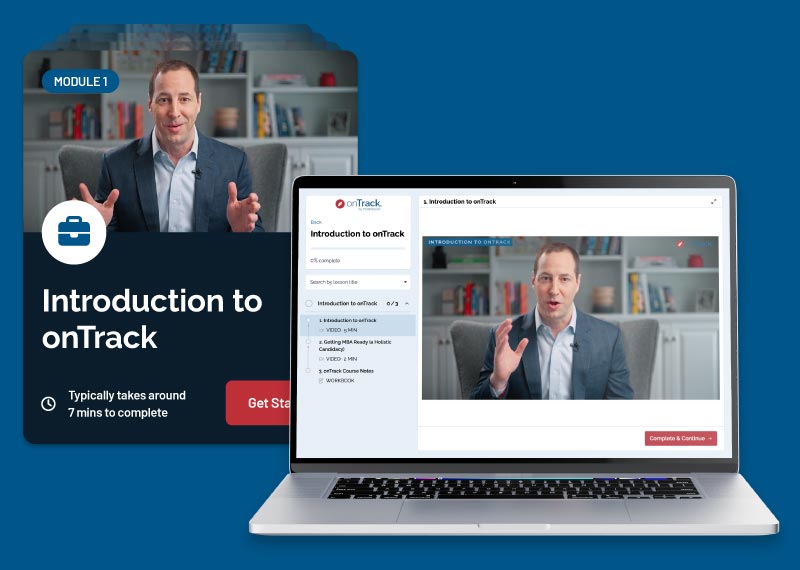
onTrack by mbaMission

A first-of-its-kind, on-demand MBA application experience that delivers a personalized curriculum for you and leverages interactive tools to guide you through the entire MBA application process.

Get Started!

2026–2027 MBA Essay Tips

Click here for the 2025–2026 MBA Essay Tips


MBA Program Updates

Explore onTrack — mbaMission’s newest offering allowing you to learn at your own pace through video. Learn more