Blog

Pluralize Nouns and Vary Sentence Length in Your MBA Application Essays

One way to conserve words in your MBA application essays and short-answer responses is by pluralizing nouns whenever possible. Singular words often require an article such as “a,” “an,” or “the.” These words can add unnecessarily to your word count, thereby cluttering your page without contributing to your argument or style. Consider the following example:

“A manager with an MBA can ascend the corporate ladder faster than a manager who lacks an MBA.” (18 words)

Now consider this version, in which many of the singular nouns have been pluralized:

“Managers with MBAs can ascend the corporate ladder faster than managers without MBAs.” (13 words)

As you can see, both sentences present the same idea, but one sentence is five words shorter than the other. Given that essays can include dozens or even hundreds of sentences, pluralizing wherever possible is helpful in meeting word count requirements and decluttering the text.

Although decluttering your essays is important, ensure that all of your sentences are not the same length. Many business school applicants use medium-length sentences (like this one) in their essays. Few use short sentences (like this one). Likewise, few use long sentences in their essays, even though long sentences (like this one) can often play a useful role in an essay’s structure and story.

Confused? Consider the following example:

“At XYZ Inc., I was the manager in charge of leading a team of 12 staff members. Included in my team were four engineers, four marketing professionals, and four market analysts. Our goal was to develop a new thingamajig within six months. We worked really hard over the six months and succeeded. The new thingamajig is now on the market and is selling well. As a result of my efforts, I was promoted to vice president.”

All these sentences have approximately the same number of words and the same rhythm/cadence, making the paragraph fairly boring to read. Nothing changes—the structure just repeats itself over and over again, with one medium-length sentence following another medium-length sentence.

Now consider this example:*

“At XYZ Inc., I was the manager in charge of leading a thingamajig development team of 12 staff members, four of whom were engineers, four were marketing professionals, and four were market analysts. We had just six months to launch our new product. The team worked really hard and succeeded, and the new thingamajig is now on the market, where it is selling well. As a result of my efforts, I was promoted to vice president.”

The sentences in this paragraph are varied—the first is quite long, the second is very short, the third is medium-long, and the fourth is medium-short. Sentence variety makes for a much more interesting read, and one very short sentence in the middle of some longer ones can provide precisely the kind of contrast and drama that MBA application essays so often need.

*Please note that this is a simplified example for illustration purposes. If this were an actual essay, we would encourage the applicant to offer greater insight into their experience launching the product.

Watch Our Mock Harvard Business School Interview with a Former HBS Interviewer

Harvard Business School

Harvard Business School

If you are one of the thousands of applicants whose sights are set on attending Harvard Business School (HBS), odds are you have wondered if you will receive a coveted invitation to interview with the school’s admissions committee. Whether you have already applied and are preparing for your admissions interview or you are researching the process in anticipation of applying, you are likely asking yourself an important question:

What can I expect during a Harvard Business School interview? 

With its unique and intensive interview approach, HBS has continuously vexed MBA applicants for years. To help, we at mbaMission recently teamed up with Poets&Quants to create a new resource for HBS applicants that presents exactly the types of questions one might expect to be asked during a typical HBS admissions interview—and the best way to answer them. 

Poets&Quants Founder John A. Byrne sat down with mbaMission’s Managing Director and HBS Interviewer in Residence Devi Vallabhaneni for a one-of-a-kind mock HBS interview, in which Devi interviewed John just as she has hundreds of real HBS applicants.

As an HBS graduate, a former HBS alumni interviewer, and a former HBS Admissions Board member, Devi has interviewed thousands of HBS candidates in Boston, London, and Paris. Over her more than 20 years working in MBA admissions and readiness, she has helped candidates across all industries, geographies, and backgrounds showcase their best attributes via the interview process—and now she is using her unique experience to better inform and benefit the pool of today’s HBS applicants.

During the 30-minute mock interview and subsequent debrief, John and Devi illuminated common HBS interview concerns including the following:

  • What is stressful about the HBS interview?
  • What are the myths surrounding preparation for the HBS interview as well as the interview itself?
  • How can someone prepare? Isn’t it hard to know what is covered?
  • What does it mean to be “authentic” in the interview?
  • Does your interview have to be perfect for you to be accepted? What if you feel like you messed up an answer?
  • What is HBS really looking for in the interview? Can it make or break someone’s candidacy?

Although no two HBS interviews are the same, the intention of the mock interview video session was to present some types of thought-provoking questions and answers that HBS intends to cover during an interview.

We encourage you to watch the full video below or via our YouTube channel

Common Worries About the HBS Admissions Interview

Prepare for Your HBS Interview with a Former HBS Interviewer: Devi Vallabhaneni, mbaMission

Devi Vallabhaneni, mbaMission’s HBS Interviewer in Residence

Devi Vallabhaneni, an HBS graduate and former HBS MBA interviewer, is mbaMission’s HBS Interviewer in Residence, conducting HBS Intensive Interview Simulations

Being invited to interview with Harvard Business School (HBS) is unquestionably exciting and a positive step in your admissions journey, but it can also trigger a lot of concerns and questions. Here, I draw on my six years as an HBS interviewer to address some of the most common worries applicants have about the HBS admissions interview, in hopes of easing any apprehension you may be feeling about your upcoming meeting.

“I don’t know what to expect.”

The HBS interview is unlike any other business school interview or even a job interview. It is designed to meet the interviewee where they are, meaning that it conforms to the applicant’s style rather than following a preconceived format set by the school. It is dynamic, extremely personal, and tailored to the specific individual. The interviewer will read your entire application before your interview and will base their questions on that information. As a result, no two interviews are the same because no two applicants are the same. Do not let what you read online or have heard about someone else’s interview worry you. Those stories most likely do not apply to you.

“I have limited presentation or public-speaking experience.”

The HBS interview is not a speech or a typical work presentation but more like a conversation between two business professionals. You do not need to prepare anything formal in advance, and having extensive presentation experience is certainly not required to have a successful interview. What is imperative is knowing yourself and your story extremely well. The interviewer will be focused on you as an individual, your potential contributions as an MBA student, and your career goals. Your personal communication style is less important.

“I work in a very technical and complex field.”

HBS has interviewed candidates from all backgrounds, including science, technology, engineering, and medicine. Your interviewer’s goal is not to understand the technical details of your job but rather how you work and communicate, who you are as a person, how you think about your career, and what your values are. Think of your HBS interview as similar to a discussion you might have about your job with your company’s CEO, which would be a higher-level conversation, beyond the nuts and bolts.

“I have a nontraditional background.”

This does not put you at a disadvantage. Whether you work at a start-up of just three people or with your parents and siblings in a family business, your HBS interview will unfold the same way it would for someone who works at IBM, Goldman Sachs, Google, or McKinsey & Company. You should feel confident in communicating your unique professional challenges and accomplishments. Your preparation for your HBS interview should be no different from that of someone who works at a larger or more conventional company.

“I’m an international applicant.”

HBS is a global community and understands that some candidates might feel less comfortable with their ability to speak English. If you feel your English could use some polishing, that is a personal decision, and you should do what will make you most comfortable for your interview. You will not be penalized for verbal errors or accents because of the high-stress nature of the interview. Practice and prepare the same way you would for an important business meeting in English.

“I work in consulting [or banking] and don’t know how to stand out.”

Your HBS interview is not about standing out per se. It is about viewing your background in the context of what you could contribute to the HBS community. This could include a particular high-impact project, a leadership position outside of work, or a post-MBA career goal that builds on your past professional experience. If you look at yourself as strictly “a consultant applicant” or “a banking applicant,” you will likely be limiting yourself in your self-perception. Instead, take your entire life story and career path into consideration when determining how to communicate who you are.

Stressed Out? Meditate to Lower Your Anxiety and Boost Your GMAT Score

Stressed Out? Meditate to Lower Your Anxiety and Boost Your GMAT Score - mbaMissionWith regard to the GMAT, raw intellectual horsepower helps, but it is not everything. Manhattan Prep’s Stacey Koprince teaches you how to perform at your best on test day by using some common sense.

Are you feeling overwhelmingly stressed out when you sit down to study for the GMAT? Do you find that concentrating on the task at hand is difficult?

Researchers at the University of California at Santa Barbara published the results of a study following 48 undergrads preparing for the GRE. Jan Hoffman details the research in a blog post at the New York Times.

The motivation for the study

“We had already found that mind-wandering underlies performance on a variety of tests, including working memory capacity and intelligence,” said Michael D. Mrazek in the NYT blog post.

We have all had this experience. We are taking a test, the clock is ticking, and we keep finding ourselves thinking about something other than the question we are supposed to be answering at that moment. Maybe we are stressing about our score. Maybe we are thinking about applications. Maybe we are even distracted by work, significant others, family, or other issues that have nothing to do with the test!

How do we stop fixating on other things and concentrate on the task at hand? This study tried to find out.

The study

First, the students were given some “baseline” tests, including one verbal reasoning section from the GRE (yes, the GRE, not the GMAT).

The students were then split into two groups. One group (group M) attended meditation classes four times a week; these students learned lessons on “mindfulness,” which focuses on breathing techniques and helps minimize distracting thoughts.

The other group (group N) attended nutrition classes, designed to teach the students healthy eating habits.

Afterward, the students did another GRE verbal section. The performance of students in group N stayed the same; the nutritional studies did not make a difference.

Group M students, however, improved their GRE scores by an average of 12 percentile points! The students also reported (subjectively) that they were better able to concentrate the second time around; they felt that their minds wandered less than they had before. Here is the best part: the study took just two weeks.

How did that happen?

The students did not become smarter or learn (much) more in that time frame. Rather, the mindfulness techniques helped the students perform closer to their true potential by reducing negative thoughts or habits that were interfering with performance. Think how much better you could do if you could turn off, or at least minimize, all those distracting thoughts that interrupt you when you are trying to concentrate!

How can I use this?

That short, two-week time frame is both good news and bad news. The good news is that you can achieve results without having to study meditation for six months. The bad news is that we do not know whether this provides only a short-term boost—the effects may fade over time.

So let’s speculate that the effects will fade unless you keep up with a regular meditation schedule. Let’s also assume that most people are not going to make meditation a regular part of their daily life; most will try it for a time and then drop it.

Here is what to do, then: Start learning some of these mindfulness techniques about eight weeks before you plan to take the test. Give yourself enough time to learn what to do, and then make these meditation sessions a part of your regular study schedule until you take the test. (If you would like to continue after that, great!)

Here is a resource to get you started: the Mindful Awareness Research Center at UCLA. They offer free meditation lessons and podcasts. They also periodically offer a six-week online course (for a small fee, roughly $200 at the time of this publication); in addition to the prerecorded classes, you will be able to take advantage of live chats with an instructor. If you would rather meet with someone in person, run a Google search to find someone in your area.

Take a deep breath, exhale, and start learning how to minimize distractions and concentrate on the task at hand. Good luck!

Professor Profiles: Saras D. Sarasvathy, University of Virginia Darden School of Business

 width=Many MBA applicants feel that they are purchasing a brand when they choose a business school. However, the educational experience you will have is what is crucial to your future, and no one will affect your education more than your professors. Today, we focus on Saras D. Sarasvathy from the University of Virginia (UVA) Darden School of Business.

Saras D. Sarasvathy is the Paul M. Hammaker Professor in Business Administration at UVA Darden, and she also teaches doctoral-level courses at schools in Africa, Asia, Europe, and Latin America. Sarasvathy wrote her dissertation at Carnegie Mellon on entrepreneurial expertise and has parlayed that into a specialization in the area of “effectuation,” which examines the creation and growth of new organizations and markets. Her book Effectuation: Elements of Entrepreneurial Expertise (Edward Elgar Publishing, 2009) examines the way entrepreneurs think. In addition to serving on the editorial boards of various management journals, she writes a monthly column for the Economic Times. In 2015, UVA awarded Sarasvathy the Mead-Colley Honored Faculty Award for her active engagement with students. In 2007, Fortune Small Business magazine named Sarasvathy one of 18 top professors in the field of entrepreneurship.

Students we interviewed feel that Sarasvathy, who has been teaching at Darden since 2004, is one of the up-and-coming scholars of entrepreneurship in the world. One alumnus described her to mbaMission as “very encouraging, supportive. She allows people to share ideas rather than looking for the right answer.” Another told us that he found himself in her “Starting New Ventures” class by mistake; he had lingered too long in the classroom after his previous class had ended and was still there when Sarasvathy’s class began. He was so impressed by her teaching that he added her course to his schedule, even though he was already overloaded. He found even at that first lesson that she “challenged conventional beliefs,” and he was “impressed at her insights and the way that she articulated basic assumptions to bring out the less obvious, deeper levels.”

For some interesting perspectives on entrepreneurship and business, see Sarasvathy’s presentations on BigThink at https://bigthink.com/community/sarassarasvathy.

For more information about UVA Darden and 16 other top-ranked business schools, check out our free mbaMission Insider’s Guides.


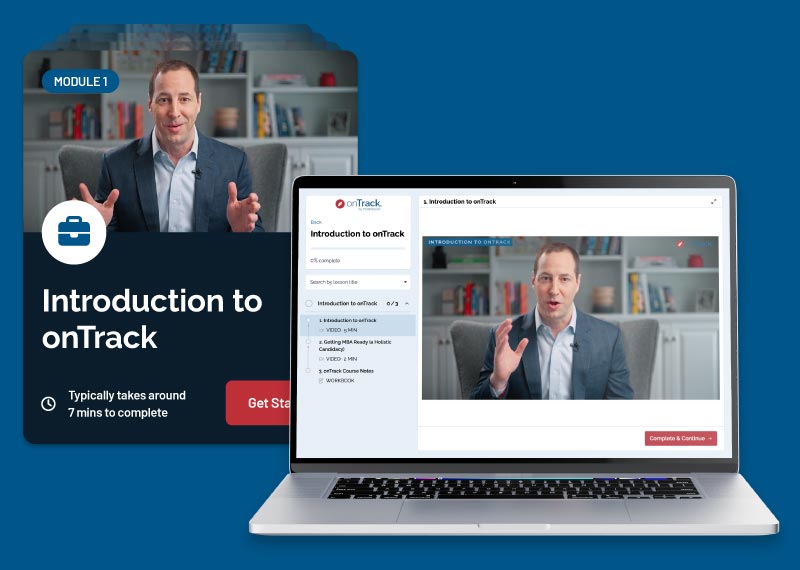
onTrack by mbaMission

A first-of-its-kind, on-demand MBA application experience that delivers a personalized curriculum for you and leverages interactive tools to guide you through the entire MBA application process.

Get Started!

2026–2027 MBA Essay Tips

Click here for the 2025–2026 MBA Essay Tips


MBA Program Updates

Explore onTrack — mbaMission’s newest offering allowing you to learn at your own pace through video. Learn more