
Blog

Professor Profiles: Gary B. Gorton, Yale School of Management

Professor Profiles: Gary B. Gorton, Yale School of Management - mbaMission

Many MBA applicants feel that they are purchasing a brand when they choose a business school. However, the educational experience you will have is what is crucial to your future, and no one will affect your education more than your professors. Today, we focus on Gary B. Gorton from the Yale School of Management.

Gary B. Gorton has been the Frederick Frank Class of 1954 Professor of Management and Finance at the Yale School of Management (SOM) since 2008, before which he taught at the Wharton School of Business at the University of Pennsylvania. Gorton was formerly a director of the research program on banks and the economy for the Federal Deposit Insurance Corporation and a senior economist at the Federal Reserve in Philadelphia, and his research focuses on such topics as the role of stock markets, banks, and bank regulation. His books Fighting Financial Crises: Learning from the Past (University of Chicago Press, USA, 2018; co-written with E. W. Tallman), Misunderstanding Financial Crises: Why We Don’t See Them Coming (Oxford University Press, USA, 2012), and Slapped by the Invisible Hand: The Panic of 2007 (Oxford University Press, USA, 2010) offer in-depth analysis and discussion of the 2007–2008 financial crisis. Gorton, who wrote his PhD dissertation on bank crises while studying at the University of Rochester in 1983, once noted on the SOM website, “When I wrote it, I never dreamed I would live through one.”

The “Capital Markets” course Gorton teaches likewise focuses on the 2007–2008 financial crisis, particularly as it related to capital markets. In it, he uses a mixture of case studies and lectures that touch on current financial events, and he expects students to keep up with the latest developments on the finance scene by reading the business section of the New York Times, the Financial Times, and the Wall Street Journal. During the 2020–2021 academic year, Gorton also taught a course titled “The Digitalization of Money.”

For more information about the Yale SOM and 16 other top-ranked business schools, check out our free mbaMission Insider’s Guides.


The Master Resource List for GMAT Reading Comprehension, Part 2

With regard to the GMAT, raw intellectual horsepower helps, but it is not everything. Manhattan Prep’s Stacey Koprince teaches you how to perform at your best on test day by using some common sense.

In Part 1 of this series, we discussed how to read Reading Comprehension (RC); if you have not yet read that post, do so now, and then continue with this post.

The RC Question Types

Do you remember the last thing I said at the end of the first post? When you have mastered the reading skills, you are then ready to tackle the questions. Do not make the mistake of thinking that you can ignore the previous post and just go straight for the questions. You will be slower, and you will make more mistakes if you do that.

RC has three main question types: Main Idea, Specific Detail, and Inference. Each of those question types can have nuances or subtypes. We will tackle the first two in this post and cover Inference and the minor Why question type in the next post.

Main Idea

Most passages will include one Main Idea category question. Most commonly, you will be asked for the “primary purpose” (i.e., the main idea) of the entire passage, though a question could also ask for the primary purpose or role of just one paragraph.

If you are asked for the purpose of the entire passage, then the correct answer has to cover the overall “real estate” of the passage as a whole. Wrong answers will often be too narrow (e.g., something that applies primarily to just one paragraph) or too broad (e.g., something that includes the main idea but goes beyond it to encompass ideas that were not presented in the passage). Follow the link at the beginning of this paragraph to get some practice.

Specific Detail

This category refers to questions that ask about a particular detail in the passage. Most commonly, these questions will begin with “According to the passage….” Your task on these is to find an answer choice that matches something stated specifically in the passage.

That sounds easy—if the information is stated right there in the passage, how hard can it be?

As you already know very well, they can make it quite hard. First, the language in the passage is seriously complex; it is not always easy to understand what they are talking about. Second, right answers will often contain synonyms for words that appeared in the passage, while some wrong answers will often contain the exact language used in the passage. If you are not careful, you will be tempted to cross off that right answer because the language does not match exactly!

Specific Detail Rule: Use the question wording to figure out where to go in the passage. Then reread that detail carefully. Do NOT rely on your memory!

Why not? I was once taking a standardized test (not the GMAT, but similar), and I was about to pick an RC answer. Then I remembered that I should check the proof in the passage first, so—even though I was sure I was right!—I made myself find the proof.

The passage was about some mammals, one of which was the kangaroo rat. I looked at the passage, glanced back at my answer… and suddenly realized that the answer said kangaroo not kangaroo rat! I would have been really mad to get a question wrong for that reason!

The moral of the story: find the proof in the passage. Every single time.

Try this specific detail question to get started. Want another? Here you go.

The Master Resource List for GMAT Reading Comprehension, Part 1

With regard to the GMAT, raw intellectual horsepower helps, but it is not everything. Manhattan Prep’s Stacey Koprince teaches you how to perform at your best on test day by using some common sense.

The Pep Talk

So, let me get this straight. The GMAT test writers are going to give me somewhat obscure, very dense topics with very complicated ideas and sentence structures. I am going to have about three minutes to read this passage, and then I have to start answering questions about the material. That is a completely artificial setup; it would never happen in the real world!

Actually, yes it will. You are going to do lots of case studies in business school. You often will not be given enough time to read through every last detail carefully; instead, you will have to determine relative levels of importance and concentrate on the most crucial pieces, while putting together a framework for the main ideas and the big changes in direction or opinion.

At work, you often have to make decisions based on incomplete information. At times, you actually do have a ton of information—but not enough time to review it all before you have to take action. These situations are far from rare in the real world.

So when you find yourself a bit unmotivated because you know you have got to study boring Reading Comprehension (RC) today, remind yourself that RC will actually help you develop much-needed skills for business school and beyond!

The Disclaimers

First, this list includes only free resources, no paid ones. Second, this list is limited to my own articles simply because I am most familiar with my own material. There are a lot of good resources out there that cost some money and/or were not written by me—those resources are just not on this list!

How to Read

Before you dive into individual question types, you must know some overall processes for RC, starting with how to read! You already know how to read in general, of course, but do you know how to read RC?

You will notice that the first article, linked to in the previous paragraph, discusses not only what to read but also what not to read. When you have only a few minutes, you also need to know what you can skip or skim (and how to make that decision). For more, check out this lesson on what not to read.

If, after trying the suggestions from this article, you still find yourself really struggling with either reading speed or comprehension, here are some resources to help you improve your reading skills. This article is especially important for people who do not read regularly in English, either for work or for fun; this is particularly true if your native language is also not English and you did your undergraduate studies in another language.

Finally, one of our two main goals when first reading a passage is to find the main point. (The other main goal is to take some light notes on each paragraph to understand the organization of the information.)

When you have mastered those skills, you will be ready to learn how to tackle the questions.

Professor Profiles: Sankaran Venkataraman, University of Virginia Darden School of Business

Sankaran Venkataraman, UVA's Darden School of Business Administration

Many MBA applicants feel that they are purchasing a brand when they choose a business school. However, the educational experience you will have is what is crucial to your future, and no one will affect your education more than your professors. Today, we focus on Sankaran Venkataraman from the University of Virginia Darden School of Business.

Sankaran Venkataraman—who is known around the campus of the University of Virginia’s (UVA’s) Darden School of Business as simply “Venkat”—is an internationally recognized expert on entrepreneurship. Venkat is the MasterCard Professor of Business Administration at Darden and the senior associate dean for faculty and research, and he teaches courses in the full-time MBA and executive MBA programs—including first-year courses in entrepreneurship, strategy, and ethics.

Venkat has edited the Journal of Business Venturing and consulted with the U.S. Department of Commerce on promoting entrepreneurship globally. He is also a coauthor of The Innovation Journey (Oxford University Press, 2008) and coeditor of Entrepreneurship in Emerging Regions Around the World: Theory, Evidence and Implications (Edward Elgar Publishing, 2008).

Venkat earned one of Darden’s awards for outstanding faculty in 2008 and is generally considered one of the school’s most popular professors. In 2010, he earned the Academy of Management’s Decade Award for a paper published ten years earlier that was judged to have had the greatest impact on scholarship in the fields of management and organizations.

For more information about UVA Darden and 16 other top-ranked business schools, check out our free mbaMission Insider’s Guides.

Professor Profiles: Baba Shiv, Stanford Graduate School of Business

 width=

Many MBA applicants feel that they are purchasing a brand when they choose a business school. However, the educational experience you will have is what is crucial to your future, and no one will affect your education more than your professors. Today, we profile Baba Shiv from the Stanford Graduate School of Business (GSB).

“Baba Shiv is a legend,” said a first-year GSB student with whom we spoke. Baba Shiv, the Sanwa Bank, Limited, Professor of Marketing who also teaches in the executive MBA program, received his MBA from the Indian Institute of Management and his PhD from Duke University before joining the Stanford GSB faculty in 2005. Shiv was also the Amman Mineral Faculty Fellow for the 2020–2021 academic year. Shiv’s research concentration is in the area of neuroeconomics, and he focuses his studies on the systems of the brain that lead individuals to like and want things and how those systems shape people’s decisions. His work explores self-control and why people make certain choices, even when logic tells them that those choices may not be in their best interest. During the 2020–2021 academic year, Shiv taught the elective course “Designing Solutions by Leveraging the Frinky Science of the Human Mind.”

A GSB alumni magazine article once described Shiv as “a favorite uncle who is always interested in your life and eager to talk about new, exciting ideas,” and Dan Ariely, a colleague of Shiv’s and a professor at Duke Fuqua, noted in the same article, “Shiv’s mere presence makes everything around him seem better.” A second year and Marketing Club officer told mbaMission that Shiv “tries to be a career resource for people who want to pursue marketing careers” and is “engaging and exciting to listen to. He is one of the favorite members of the whole faculty; people love him.”

For more information about the Stanford GSB and 16 other top-ranked business schools, check out our free mbaMission Insider’s Guides.
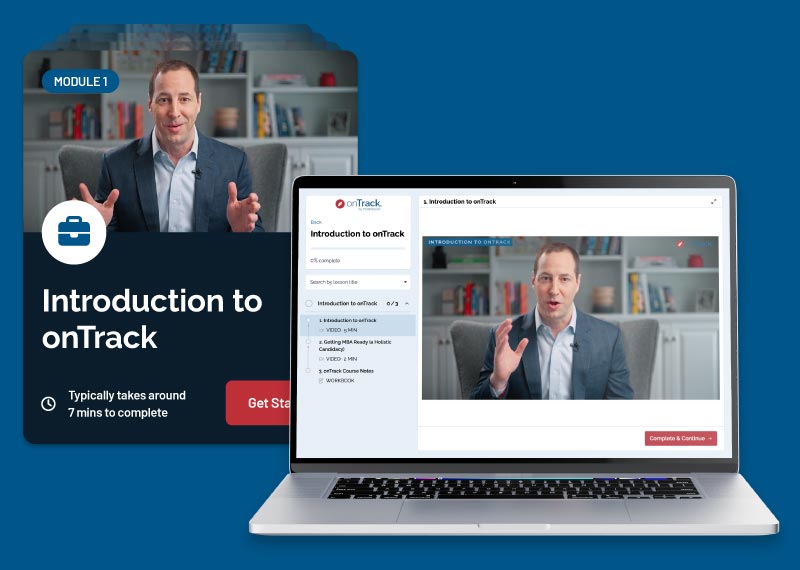

onTrack by mbaMission

A first-of-its-kind, on-demand MBA application experience that delivers a personalized curriculum for you and leverages interactive tools to guide you through the entire MBA application process.

Get Started!

2026–2027 MBA Essay Tips

Click here for the 2025–2026 MBA Essay Tips


MBA Program Updates

Explore onTrack — mbaMission’s newest offering allowing you to learn at your own pace through video. Learn more