Blog

Which Schools Will Accept the New GMAT Focus Test During the 2023–2024 Application Season?

Are you applying to business school this application season and are wondering whether you should take the “classic” GMAT or the new GMAT Focus? The answer depends on several factors, most importantly when you are planning to apply. The Graduate Management Admission Council (GMAC) announced in August 2023 that the GMAT Focus will be available for test takers starting November 7th, 2023. However, GMAC provided a much less specific timeframe for when the classic GMAT will be phased out and stated that the test will be available “until early 2024”. Since most business schools have their Round 1 deadlines in the early fall, the GMAT Focus will not be available for applicants who are hoping to apply in the first round. For Rounds 2 and 3, which typically have deadlines between October and April, many schools will accept the GMAT Focus. Keep in mind that since GMAT scores are valid for five years, you can still take the classic GMAT test and apply with that score until early 2029.

Some schools, including Harvard Business School (HBS) and the Wharton School of the University of Pennsylvania, made the decision to not accept the GMAT Focus until 2024—HBS will accept the test only from applicants to its 2+2 program, which has its deadline set in April 2024, and Wharton will only accept it starting January 2024, when the classic GMAT will not be available anymore. For more schools and their policies on the GMAT, see our chart below.

Accepted in Round 2? Accepted in Round 3?
Berkeley Haas Yes Yes
Chicago Booth Yes Yes
Columbia Business School Yes Yes
Cornell Johnson Yes Yes
Dartmouth Tuck Yes Yes
Duke Fuqua Yes Yes
Harvard Business School No No*
INSEAD No Yes
Michigan Ross Yes Yes
MIT Sloan Yes Yes
Northwestern Kellogg Yes Yes
NYU Stern No Yes
Stanford GSB Yes Yes
UCLA Anderson Yes Yes
UPenn Wharton No** Yes
UVA Darden Yes Yes
Yale SOM N/A N/A

* HBS will accept GMAT Focus scores only from 2+2 applicants during the 2023–2024 application season.
** Wharton will accept GMAT Focus scores beginning at the end of January 2024.
As always, information is subject to change. Be sure to check the schools’ websites for the most up-to-date information.

Information is subject to change. For the most up to date information, consult the school directly.

The Five Most Common MBA Interview Mistakes

So, you applied to business school and finally landed that coveted interview! Excited, you rush to prepare—researching the most likely questions you will be asked, memorizing your answers, and rehearsing them in front of a mirror, right?

Wrong.

MBA interviews are not about memorizing answers but rather about having a thoughtful conversation regarding who you are. Here are the five most common mistakes applicants make when approaching their business school interview:

Overpreparing

Walking into an MBA interview with all your answers scripted and planned prevents your interviewer from truly getting to know you and creates distance between you and them. Rather than having a thoughtful conversation with them and truly listening to them, you are busy sifting through your mental file to figure out which preplanned answer to give. Overpreparing also puts you at risk of getting thrown off if the interviewer asks a question that you have not prepared for. Instead, know your story, and give some thought to the types of questions you could be asked and—in general—how you would answer them, but when the day comes, go into your interview prepared to listen and engage.

Not “reading the room”


Being aware of your surroundings is important, as is building rapport with your MBA interviewer. For example, if you are meeting your interviewer in their office at an investment bank in the middle of the week, do not show up in jeans and a blazer. Similarly, if you are meeting at a Starbucks on a weekend and the interviewer has told you to dress casually, do not show up in your best suit. In addition, pay attention to your interviewer’s reactions during your answers—if they start to look disinterested or attempt to interrupt you, try to quickly wrap up your answer. Just as you would in any conversation, be aware of the give-and-take, and do not ramble on.

Being unfamiliar with the school

Whether interviewers are alumni or work in the admissions office, they have a personal connection to the school and are proud of it. You do not have to know every single professor’s name or actual course numbers, but you do need to be able to articulate in detail how the school will help you achieve your career goals. Also, take time before your interview to scan recent press releases from the school so you are up-to-date and aware of any major news about the program. A great resource to help you get to know your target schools in more depth is the mbaMission Insider’s Guides series, which covers 17 top-ranked MBA programs. You can download these free guides to brush up on the schools’ defining characteristics, notable courses, clubs, experiential opportunities, and popular social/community events.

Asking inappropriate questions

Most interviewers will conclude the interview by asking, “Do you have any questions for me?” Please, we urge you—do not ask basic questions about the application process or about what the interviewer thought of you. Likewise, do not ask any questions for which the answers can be easily found on the school’s website. Further, if the program is dealing with any negative press, do not ask about it. And definitely do not ask questions that might be perceived as attempts to trick the interviewer, such as those about obscure courses. Instead, pose thoughtful questions about topics you are genuinely interested in, ones that show you have an awareness of the school’s culture and offerings. If the interviewer is a graduate of the program, you could ask questions about their personal experience or what advice they have for you, for example, or if they are an admissions office interviewer, you could ask about their observations of the school.

Giving the interview too much weight

We often hear clients say, “I aced the interview, so I’ll definitely get in” or “I didn’t get in, so I must have blown the interview.” Likely, neither of these interpretations is true. The interview is merely one factor in the MBA admissions decision—just one! You could have a terrific interview and not get in or a weak one and be accepted, just as you could get in despite a subpar GMAT score or not be accepted with an amazing score. Giving the business school interview too much weight can cause you to be so nervous that you are unable to engage in an authentic conversation.

mbaMission has created a robust library of free resources designed to help you prepare for your MBA interview, such as the following:

  • The mbaMission Interview Guide describes the different kinds of interviews business schools offer and the types of questions typically asked. It also includes valuable tips on what to do before, during, and even after your interview.
  • mbaMission’s school-specific Interview Guides provide insight into what each program is evaluating during the admissions interview and hoping to gain from it, along with an explanation of the school’s specific interview approach. In addition, the guides offer lists of each school’s most common interview questions and themes, as well as advice on how to respond to them, plus our tips on managing the entire interview process, from scheduling to writing thank you notes.

If you are looking for one-on-one help preparing for your MBA interview, consider these mbaMission services:

  • Mock Interview Sessions: Meet with an experienced mbaMission admissions consultant who will ask you actual questions your target school’s interviewers have posed to previous applicants.
  • HBS Mock Interview and Post-Interview Reflection Support: Speak with an experienced mbaMission consultant who will have read your entire Harvard Business School (HBS) application and prepared customized questions based on your candidacy. Plus, get feedback on your post-interview essay.
  • HBS Intensive Interview Simulation: Practice for your upcoming interview at HBS with mbaMission’s Devi Vallabhaneni, a veteran interviewer who has years of experience interviewing literally hundreds of HBS candidates.
  • Wharton Team-Based Discussion Simulation: Via this simulation, applicants participate anonymously with three to five other MBA candidates in an online conversation, which is moderated by two of mbaMission’s experienced Senior Consultants familiar with Wharton’s format and approach. All participants then receive feedback on their performance, with special focus on their interpersonal skills and communication abilities.

To learn other strategies for improving your interview performance, sign up for a complimentary 30-minute consultation with an mbaMission Career Coach.

Assessing the MBA Job Market: Fall 2023

This post was written by mbaMission resident Career Coach Elissa Harris. To sign up for a free 30-minute career consultation with Elissa, please click here.

As job recruiting for full-time MBAs begins, many students are pondering questions such as the following:

  • How competitive is the job market?
  • Who is hiring? What types of opportunities are available right now?
  • How can I position myself for success?
  • How will the economy affect my career options?

Unfortunately, these questions have no simple answer. The information coming out of consulting firms—which are traditionally big MBA employers—is less than positive. According to a spring article in the Wall Street Journal and a more recent article in Poets&Quants, start dates for the Class of 2023 are being pushed back by major consulting firms, and overall, full-time hiring for the Class of 2024 is lighter than in past years. 

But the full picture can be a bit more complicated and sector specific, and we know that the job market can change rapidly.

To better understand what kind of job market you might face, consider these factors:

Career interests

What are your professional goals? Are you making a big career change? Which organizations are you targeting? Do they hire a large number of MBAs?

Experience and skills

What functional and industry expertise do you have? What are your strongest skills? What types of problems can you solve, or what contributions could you make to a prospective employer?

Storytelling

How well can you connect the dots between your experiences and your desired position?

School support

Does your MBA program have strong relationships with its alumni and with your desired employers? What type of career coaching support is available?

Marketplace realities

What are the business and hiring trends in the industry you hope to enter? What challenges are your target companies facing? How much hiring have these companies done in the past 12 months? Have they had any layoffs?

Personal resources and attributes

How strong is your network? How comfortable are you reaching out and leveraging that network? Will you hustle in the job search?

Setting realistic expectations and positioning yourself for the best opportunities will require that you develop an informed perspective on your target industry.

Start with these steps: 

Speak with representatives from your school’s career management center.

They are often in close contact with major MBA employers.

Connect with people currently employed in your target area

– and with classmates who just completed internships at your target companies.

Identify and read industry-specific business news

Discover related trade publications and websites. 

And finally, remember that regardless of the strength of the job market, you always need to position yourself as a compelling candidate. The following mbaMission blog posts offer actionable advice on standing out in a positive way:

For more career advice, download our free career guides, which have been written in conjunction with industry insiders who provide intriguing perspectives on the fields.

HKUST Business School Essay Tips and Examples

How to Get into HKUST Business School: HKUST Essay Tips and Examples

 The Hong Kong University of Science and Technology (HKUST) Business School asks candidates to submit two brief essays as part of their application. The first concerns the applicant’s self-assessed strengths and how they have applied them in the past in a beneficial way. The second essay involves basic topics commonly seen in business school applications: one’s professional goals and how attending the school can help in achieving them. Any applicants who feel the need to share more information with the admissions committee can use the optional essay to do so. Read on for our more in-depth analysis of all the program’s prompts.

HKUST 2023–2024 Essay Tips


Essay 1: What are your strengths? Please also share an example of how you have used your strengths to make a difference at work or outside of work. (Max 350 words)

We think we do not really have to state this, but just in case, be honest about your strengths in this essay, and do not try to “guess” what the committee wants to hear. Be truthful in describing who you legitimately are and what you have been able to accomplish by applying yourself. Transparent or disingenuous statements will not fool or convince anyone and will only reveal you as someone incapable of critical self-evaluation.

We encourage you to first thoroughly and thoughtfully brainstorm to identify your most compelling and revelatory possible responses. Where do you feel you truly excel? What do you repeatedly bring to the table that has allowed you to make meaningful contributions? It might be a hard skill, such as an aptitude for coding or managing finances. It could be a softer skill, such as being able to communicate easily with a wide range of people in just about any circumstance. And do not discount qualities such as empathy and creativity that might lead you to view situations in ways that others do not, thereby allowing you to identify opportunities for change/improvement that others overlook.

With respect to offering an illustrative example of your strengths in action, you want to be able to “own” your answer—as we like to say—meaning that no other applicant could write exactly the same thing as you do, even if the qualities or stories you choose to highlight are very similar. For example, writing something like “One of my greatest strengths is compassion, and I’ve made a difference in my community by volunteering with the local homeless shelter” would be far too general a response and could likely be stated by multiple applicants. Instead, something much more specific like “dedicated every Saturday morning for three years to helping cook and serve breakfast at the local homeless shelter, for which I also devised a bulk-shopping plan that now saves the organization hundreds of dollars each quarter” would stand out for its originality and paint a clearer picture of the candidate who wrote it with respect to their values, dedication, and fiscal creativity. In addition, using a narrative approach is a good way to paint a dynamic picture of how you conduct yourself and to engage your reader. 

Essay 2: What are your short and long-term goals. How do you plan to use HKUST’s MBA program to help you achieve those goals? (Max 350 words)

The HKUST admissions committee is simply looking for some rather straightforward information here. With 350 words, you should have plenty of space to outline your professional and business school aspirations in a direct and concise way. Ideally, the connection between your short-term objective and your long-term one will be readily evident and feasible. If not, provide whatever context or explanation is necessary for the admissions committee to understand your intended trajectory and why the transition from one to the other makes sense and should be attainable for you. 

BU Questrom School of Business Essay Tips and Examples

How to Get into Questrom School of Business: BU Questrom Essay Tips and ExamplesApplicants to Boston University’s Questrom School of Business can either submit a written essay or respond on video to three questions, though the school does not provide these prompts in advance. This approach gives Questrom candidates the opportunity to choose the format that better fits their character and personality and that they feel more comfortable with. An optional essay is available for any applicants who want or need to share additional information with the admissions committee. Our more in-depth analysis of the school’s rather straightforward prompts for 2023–2024 follows.

BU Questrom 2023–2024 Essay Tips

Essays

In order to get to know you on a more personal level, applicants to our full-time and part-time MBA programs are required to complete either three short video essays OR one written essay during the application process. Because everyone expresses themselves in different ways, the choice is yours.

VIDEO ESSAYS

If you’re someone who feels they can better express themselves and their reasons for applying to the Questrom School of Business through a video, we encourage you to complete the video essays.

We will first ask you a question that all candidates will receive. You’ll have thirty seconds to prepare, and then 60 seconds to record your answer. This will then repeat for two additional random short-answer questions.

You can practice an unlimited number of times with Kira Talent’s provided example questions, but once you start the formal video essay questions, you are only allowed one opportunity. This allows the committee to see your candid responses. The formal process should only take you about five minutes to complete, and can be done on your own time.

Questrom applicants will not know beforehand which questions they will need to answer in these short video essays. However, given that candidates can submit either these videos or a written essay—which implies that the two options are likely designed to elicit generally the same information from applicants—we suspect that the topics covered in the two formats are probably similar. In the written essay, which we will address more fully later in this post, the school asks candidates to “explain to the admissions committee why you’d like to earn your degree from the Questrom School of Business specifically. . . . address why you have selected the program you are applying to . . . and how that program will help you achieve your post-graduate goals.” So, in preparing to respond to the program’s video questions, be sure you are ready to speak to these subjects in case they are in fact addressed in the queries you receive.

You want to be prepared to respond to any questions that relate to your “fit” with Questrom as well. This means you should be able to provide evidence that you have done your research on the school and developed a true and thorough understanding of its culture. You should be ready, if needed, to convince the admissions committee that you are eager to take advantage of opportunities at the school, that you have thoughtfully considered your potential role and place within the program’s community, and that you understand what you could offer as a Questrom MBA student. To prepare, read student blogs, peruse discussion boards, catch up on the past year or more of the program’s press releases, and spend some time on Questrom’s YouTube channel. These are all good places to start (or better, continue!) educating yourself about what life there is really like. 


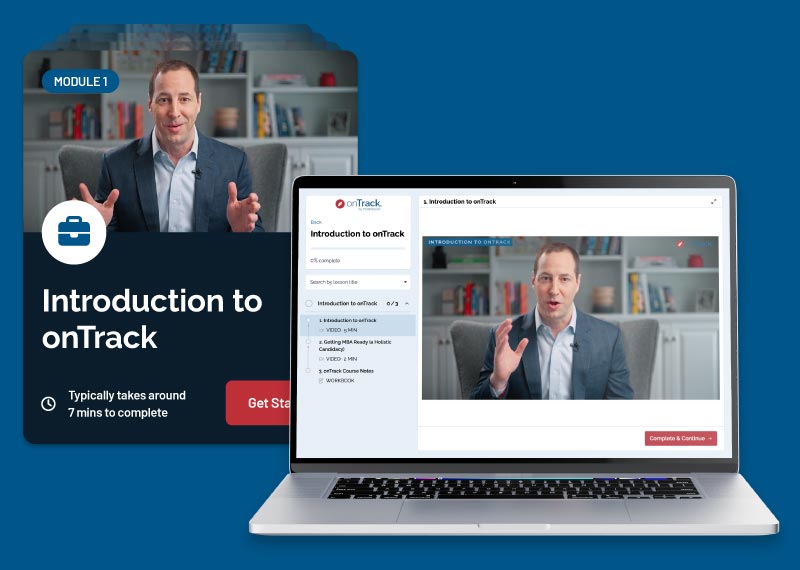
onTrack by mbaMission

A first-of-its-kind, on-demand MBA application experience that delivers a personalized curriculum for you and leverages interactive tools to guide you through the entire MBA application process.

Get Started!

2026–2027 MBA Essay Tips

Click here for the 2025–2026 MBA Essay Tips


MBA Program Updates

Explore onTrack — mbaMission’s newest offering allowing you to learn at your own pace through video. Learn more