Blog

Four Key Tips for Round 2 Harvard, Stanford, and Wharton Applicants

Now that the Round 1 deadlines have passed for Harvard Business School (HBS), the Stanford Graduate School of Business (GSB), and the Wharton School, candidates might worry that their chances for admission have diminished. However, these schools will tell you that they strive to make admissions odds across Rounds 1 and 2 roughly equivalent, and although the admissions committees cannot perfectly predict how many candidates will apply in each round, they always leave ample room in the class for Round 2, which tends to attract the largest number of applicants. If you are planning to apply to one of these programs this year, here are a few tips to keep in mind. 

Take the right test.

Fall 2023 is bringing big changes to the two main standardized tests for business school, the GMAT and the GRE. The shorter, redesigned GMAT Focus will launch on November 7, while the regular GMAT will remain available until sometime in the first quarter of 2024. If you are applying this year in Round 2, make sure you are taking the correct version of this test for the programs you are targeting. Neither HBS nor Wharton will accept the new GMAT Focus in Round 2 this year. HBS will accept it only for 2+2 deferred enrollment applicants, and Wharton will accept it only for Round 3 and Moelis Advance Access deferred enrollment applicants. So, if you are applying to either of those schools in Round 2, make sure to take the standard GMAT. If you are targeting the Stanford GSB only, however, you can take either the GMAT or the GMAT Focus; it accepts both. 

The revamped GRE launched on September 22, and the new version of the test completely supplanted the old one. Because only one version of the GRE is offered, all three schools will accept either the old or new version, as long as your test date falls within the eligible range and you complete your testing before the program’s deadline. 

Do your homework.

Fall tends to be a busy time. Perhaps because things are so hectic, Round 2 applicants often rush through their applications without taking the time to build the critical self-awareness they need for the process. Avoid falling into this trap. Take the necessary time to think deeply about who you are and what you care about. This reflection will be your North Star as you fill out your applications. 

With school back in session in the fall, you have an excellent opportunity to get a feel for your target programs while campuses are active. All three programs offer incredible MBA experiences, but they are very different! Get to know the schools beyond the most cursory research. If you visit campus, try to sit in on classes in action. Reach out to club officers and admissions ambassadors, who are typically far more available in the fall than they tend to be in summer. Review the latest class profile, and check out the school calendars to see what events and speakers are scheduled. Not only will all this research help you refine your interests and preferences, but it will also prepare you to be able to articulate much more thoughtful answers to such essay questions as “Why Stanford?” and “How do you plan to make specific, meaningful contributions to the Wharton community?“

Differentiate yourself.

All candidates need to assess their strengths and weaknesses in any round, but by Round 2, many seats in the class are already occupied, so differentiation becomes even more critical. Look beyond the basics to identify the other dimensions you bring: your core values, your identity across multiple lenses, and your personal experiences. If you are in an overrepresented category in the applicant pool, consider highlighting the elements that set you apart. However, we are not encouraging you to make hollow statements that you think schools want to hear. You still want to stay true to yourself and steer clear of gimmicks. We simply suggest that you think broadly to be able to demonstrate throughout your applications the individuality you can bring to the class. 

Given HBS’s emphasis on building a “mosaic of perspectives” in its classroom, consider what you might add to your section beyond the norm, and highlight this where appropriate. You might bring this viewpoint to the main essay, in which you discuss “what more” the admissions committee should know; or you might bring out unique experiences in the short answers of the application. With approximately 1,850 potential words in the combined main and optional essays, the GSB gives you plenty of space in which to tell your story. Use the application’s different components to showcase multiple dimensions of your candidacy, avoiding repetition wherever possible. With Wharton, you must leverage a tighter space, but thinking outside the box could make you a stronger candidate. All schools want diverse voices and perspectives. How might you add something different to the Wharton community beyond what others could contribute?

Do not delay.

Whether you slipped to Round 2 from an earlier application round or are just getting started, you will likely find that the early January deadlines come quickly. In the fall, most companies are in “back to work” mode, surging ahead on projects and deals. At the same time, Round 2 is full of holidays, which often demand one’s attention to family or other obligations. Finally, illness becomes more of a factor in Round 2. Whether from a new COVID strain or the flu, applicants are more likely to get sick in the fall and winter months, slowing their application progress. So, start as early as you can, and keep moving forward on all application deliverables. That way, if a delay arises, you will have less difficulty getting back on track. Remember, HBS has no Round 3, and the GSB and Wharton have very small “shaping” rounds in which admission is much more difficult, so missing the Round 2 deadline could force you to delay your plans to the following year. 

To view the upcoming Round 2 application deadlines for these and other MBA programs, click here. And if you have any questions about how to best position your candidacy or approach these challenging applications, we encourage you take advantage of a free, 30-minute consultation to discuss your options with one of our experts.

MBA Application Tips for Entrepreneurs

If you are an entrepreneur who is planning to apply to an MBA program, you have some huge advantages! First and foremost, most MBAs dream of starting a business at some distant point in their post-MBA future, and you already have that experience—which means not only that you can offer an important and underrepresented voice in the class but also that you have a higher likelihood of being an entrepreneurial standout going forward. You have both immediate and long-term contributions you can make! However, you also have some challenges that you will need to manage proactively to ensure that you do not inadvertently send the admissions committees the wrong message.

If your business is currently operating, you must clearly convey to the school that you are committed to your selected program and to the entire MBA experience. This should probably be obvious, but you have to be crystal clear on this point because admissions officers will worry that you might have one foot out the door at all times and that you could prioritize your business over engaging in the MBA experience. So, you might want to address this potential concern head on in the optional essay, explaining that you have a plan in place to manage your business during your time in the MBA program because you want to focus on your education. 

Also, in your goal statement, make a point of very specifically highlighting the skills you need to develop and showing that you have a clear sense of purpose in pursuing your MBA. Furthermore, even if you have wrapped up all the loose ends and sold your business prior to applying to business school, you will still need to convey your seriousness about the educational experience. You cannot risk inadvertently creating any mystery about your level of intent that could cause the admissions office to question whether you will truly be present in class or just quietly incubating your own ideas as business school goes on around you.

Another unique consideration you have as an entrepreneur is who should write your letters of recommendation. Although you do not have a conventional boss, you still have lots of options, and the admissions committees will understand why you cannot offer a conventional supervisor letter. Maybe you have an investor you could ask to write a recommendation letter for you? A board member? A mentor? A key client? A supplier? These are just some of your options! What is important here is that your recommender write with sincerity about you but do so at the same distance a supervisor would. So, your board member or mentor, for example, cannot simply be a “cheerleader” for you. They must write objectively, describing your strengths and weaknesses and assessing you thoughtfully and critically.

Another facet to examine is your goals. Think carefully about how you discuss your goals in your essays and interviews. You have likely done something exciting in the course of your entrepreneurial pursuits, so keep the excitement going. And although we have seen applicants successfully do so, as an accomplished entrepreneur, you will have a tough time selling the admissions committee on the idea that you would go into a conventional “job” after graduation. You might be able to present the case for targeting a high-level role at a start-up or an associate position in venture capital, rather than launching another business, but convincingly arguing that you would go into consulting, for example, would be much more difficult.

Finally, we should address the case of the unsuccessful entrepreneur. If you took a big swing that ended up being a big miss, just own it! Whether you are discussing the experience in an interview or writing about it an essay, take pride in the gutsiness you exhibited in your attempt and own the outcome while revealing what you learned along the way. That we all learn from setbacks is not a cliché. Show that you have gained certain knowledge and skills as a result and are resilient. Schools want to admit applicants with character, and you will have demonstrated that you have it.

If you wonder which schools you would be competitive at or have questions about your application essays, sign up for a free 30-minute consultation with an mbaMission consultant.

How to Approach Lifting Your GMAT Score

With regard to the GMAT, raw intellectual horsepower helps, but it is not everything. Manhattan Prep’s Stacey Koprince teaches you how to perform at your best on test day by using some common sense.

How do you maximize your score on the GMAT? Sure, you have to learn to answer harder questions correctly—but that is not actually enough.

Let us stipulate a couple of things. First, whenever I say “easier” or “harder” in this post, I am referring to easier or harder for you, the reader; everything here is relative to your current scoring level and your desire to lift that level to whatever your goal score is. In other words, this works at every level and for every goal.

Second, as a general rule, you take (on average) more time to answer harder questions than you take to answer easier ones.

Okay, so what does that mean? Most people do not spend much time studying the things that they generally already know how to do; they do not analyze questions that they answered correctly unless there was some other issue (such as spending too much time).

That is a mistake—and not just because we can still learn things from questions that we answer correctly. More importantly, if you want to lift your score, then the questions that you find of medium difficulty today need to turn into questions that you find easier in the future.

Think about how the test works: if you are scoring in the 80th percentile, then 65th percentile questions are generally fairly easy for you, the 75th to 85th range is medium, and 90th percentile questions are too hard. If you want to lift your score to the 90th percentile, sure, you have to learn how to tackle those harder questions. At the same time, the 75th to 80th percentile questions have to become your “easier” question pool—“medium” level will no longer be good enough!

Remember when I said that we generally take more time to answer the harder questions? That is okay, within reason (say, up to 30 seconds beyond the average for that question type). To have that extra time, though, you have got to be saving time on the easier questions. Those questions that are medium for you right now—you have actually got to be able to do them more quickly for them to turn into easier questions in the future.

Beyond all of that, there is yet another benefit. Shortcuts or alternate solution methods that you figure out for those easier and medium questions can often be used on harder questions as well. You will actually learn how to tackle some of the harder stuff by getting even better at the easier and medium stuff.

If you are going for a really high score (720+), then I will leave you with a couple of “challenge” exercises. Answer this math question and this Critical Reasoning question in one minute (or less). Good luck!

Are You Ready for Your Harvard Business School Interview?

Harvard Business School

Harvard Business School (HBS) sent out Round 1 interview invitations this week. HBS will send one batch of interview invites, along with notifications of “Further Consideration” for those who will be asked to wait until Round 2 (at which point HBS will review their application again) and “early release,” which are sent to candidates who will not be moving forward in the application process. 

Now is the time to get ready for this crucial step in your application process. Check out these important resources created by mbaMission specifically for Harvard Business School interview candidates.

INTENSIVE SIMULATION

Prepare for Your HBS Interview with a Former HBS Interviewer: Devi Vallabhaneni, mbaMission

Prepare for Your HBS Interview with a Former HBS Interviewer: Devi Vallabhaneni

Devi Vallabhaneni, a former HBS alumni interviewer, former HBS admissions board member, and mbaMission’s HBS Interviewer in Residence, offers candidates the opportunity to prepare for their Harvard Business School interviews via live intensive interview simulations. With more than 20 years in MBA admissions and readiness and having conducted thousands of real and mock HBS interviews with candidates across all industries, geographies, backgrounds, and personal stories, Devi has the experience and passion to help applicants feel confident and ready for their HBS interviews. The live interview simulation includes the following components:

  • One or more 30-minute interview experiences customized to your application. Before your first session, Devi will spend several hours reviewing your written application, following the same process she used when conducting candidate interviews for HBS. This allows her to target her questions based on what she discovers about you from your application.
  • Personalized feedback. After each interview session, Devi will provide you with targeted feedback, talking you through her impressions and offering strategic advice for improving your Harvard Business School interview skills.
  • A reflection period.  Those who choose to work on two or more interview simulations will have time between their interview sessions with Devi to internalize the feedback and adjust accordingly before trying again.
  • Post-Interview Reflection support. After their interviews, intensive-simulation clients who are not already working with an mbaMission Consultant can have Devi provide targeted support on their HBS Post-Interview Reflection.

For more information and to secure your spot, please visit our HBS Intensive Interview Simulation page.

Esade Essay Tips and Examples

How to Get into Esade Business School: ESADE Essay Tips and ExamplesOn its site, Esade states, “We deliberately limit the number of places on our MBA programme to ensure that your Esade Business School experience is focused and personalised. As a result, competition for places is intense.” We would add that the process of completing its application is also rather intense, considering that candidates must write multiple essays on a variety of topics, when most MBA programs have been cutting back on the number and lengths of their essays in recent years. Be ready to do a lot of brainstorming, introspection, and research—and a decent amount of writing. Read on for our full analysis of all the school’s prompts for this season.

ESADE 2023–2024 Essay Tips

Short Answer 1: Are you applying to other Schools? Please provide detail of Schools and Programmes. This information is for our own records; it will not affect the Admissions Committee’s decision. Maximum 255 characters (including spaces).

This is really just a straightforward request for information, so simply present the information Esade wants clearly and directly, with no extraneous verbiage. As the school notes in the prompt, your response will not have any effect on your chances of being accepted (or denied), so you do not need to overthink this. 

Short Answer 2: Did you learn about this programme through an Alumnus recommendation? If so please provide us with the name and graduation year. Maximum 255 characters (including spaces).

This prompt is another straightforward request. Again, simply convey the information the school is seeking: the name of the alumnus or alumna, their graduation year, and perhaps which program they completed, especially if it is different from the basic full-time MBA. 

Essay 1: Which aspects have you improved on during your academic and professional career so far? Which tools or values have helped you achieve this? (Maximum 3,000 characters, including spaces)

With this question, Esade wants to know what you already bring to the table, so to speak, perhaps in part to get an idea of your potential not only in your stated area of interest but also in the other areas you might not have considered but could be just as successful. This is also a chance for you to demonstrate that you understand what is required of someone in the professional role or industry you are targeting and have the self-awareness to know which of those requirements you might already meet. Highlight the specific skills you have developed and the knowledge you have acquired that you feel represent your strengths. To fulfill the latter portion of Esade’s request, pinpoint the qualities you possess that have helped you in your development. Were you raised to be ambitious or intellectually curious, perhaps? Are you a quick learner who uses logic and deduction to intuitively master new concepts and tools? What aspects of yourself personally (whether innate characteristics or learned behaviors) have facilitated your growth?

Essay 2: How will your background, values and non-work-related activities enhance the experience of other ESADE MBA students and add to the diverse culture we strive for at ESADE? (Note: The goal of this essay is to get a sense of who you are, rather than what you have accomplished). (Maximum 3,000 characters, including spaces)

With this essay prompt, Esade clearly wants to see evidence that you have done your research on the school’s culture and community and developed a true and thorough understanding of it. Ideally, your essay will convince the admissions committee that you are eager to take advantage of opportunities to participate and contribute, that you have thoughtfully considered your place within the school’s community at length, and that as a result, you know the value of what you can offer and have a clear vision of how this will manifest when you are an Esade student. If you hypothesize incorrectly about what you could add to the school—meaning that what you propose is just not possible there or does not align with the program’s values and culture—this will definitely not help you get in. Read student blogs, peruse discussion boards, catch up on the past year or more of the program’s press releases, spend some time on Esade’s YouTube channel—these are all good places to start (or better, continue!) educating yourself about what life at the school is really like.  

By not specifying that what you discuss should relate strictly to either inside or outside the classroom, the admissions committee keeps the scope of the query broad, offering you equal opportunity to discuss ideas that relate to course work and those that are extracurricular. Perhaps, for example, you could assist in writing a case on a topic that relates to your professional background and that will be used in future classes for several years. Or maybe you have a depth of knowledge or years of professional experience in a particular business area or industry, so you could serve as a kind of subject matter expert for those around you in the program or as a valuable component in someone’s recruiting network. If you are particularly funny, creative, or athletic, you might be the ideal fit to lead an extracurricular group or play a significant role in a nonacademic project or event. Like all other application questions, this one has no “right” answer, so do not try to guess what you think the school wants to hear. Authenticity and enthusiasm are the keys to your success with this essay.

Another tool to help you gain a more thorough understanding of what the school offers is our free ESADE Program guide, which explores its curriculum, campuses, international opportunities, and other key aspects. Download your complimentary copy today! 

Essay 3: What are your motivations in pursuing a full-time MBA at this point in your life? Describe your mid-term and long-term visions for your post-MBA career path. What is it about ESADE you think will help you reach your goals? (Maximum 3000 characters, including spaces)

Your essay response to this prompt will include several key factors of a traditional personal statement: what your post-MBA career goals are, why you need an MBA to be successful at this particular point on your professional path, and why the school you are applying to is the right one for you. 

To craft an effective essay response, you will need to accomplish a few things (though not necessarily in the order we list them here). One, present your post-MBA career objectives for a few years down the road as well as in the more distant future, making sure that the connection between them makes sense. Avoid going into excessive detail about your past, but be sure to offer enough information to provide context and support for your stated goals so that the progression from one stage of your career to the next is clear and reasonable. Two, explain why an MBA is the crucial factor in your being able to attain your objectives. A good way to frame this argument is by noting the skills and experiences you need to develop via the MBA experience to be successful in your desired role/industry (thereby demonstrating your understanding of what will be required of you). Three, clarify what makes now the right time for you to earn this degree. And four, explain how being an Esade MBA student is key to achieving your goals. 

You need to demonstrate that you have dedicated just as much thought—or maybe even more—to why you want to study at Esade as you have to where you want to go professionally. Think carefully about what you need to learn or experience (e.g., skills, network, knowledge base), and then detail which specific resources and opportunities at Esade you believe will allow you to do so. Your goal is to convince the admissions committee that the school is the missing link between who and where you are now and who and where you envision yourself in the future.


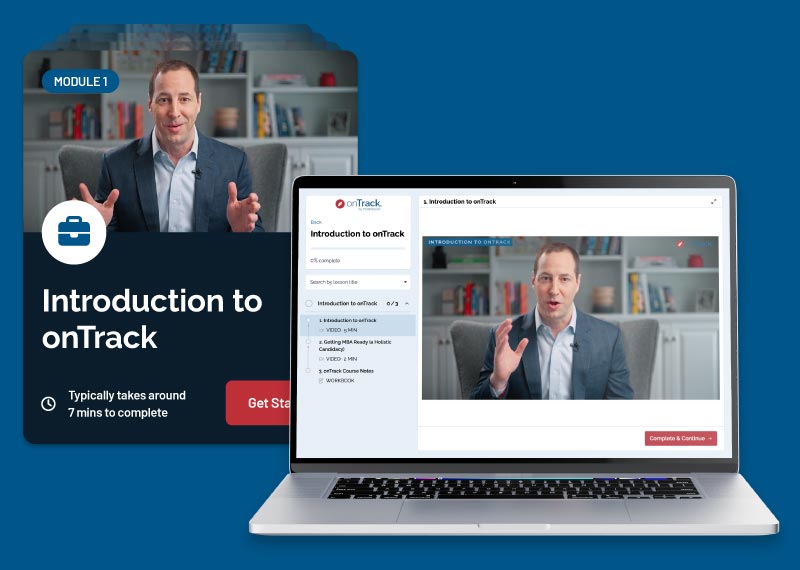
onTrack by mbaMission

A first-of-its-kind, on-demand MBA application experience that delivers a personalized curriculum for you and leverages interactive tools to guide you through the entire MBA application process.

Get Started!

2026–2027 MBA Essay Tips

Click here for the 2025–2026 MBA Essay Tips


MBA Program Updates

Explore onTrack — mbaMission’s newest offering allowing you to learn at your own pace through video. Learn more