

Blog

MBA Admissions Myths Destroyed: I Am Too Old to Get into Business School

We at mbaMission often receive panicked phone calls from applicants in their late 20s, asking if they are too old to get into business school. Why do so many candidates have this concern?

Over the past decade or so, several top schools have declared their openness to younger candidates and have even been courting them. Harvard Business School has welcomed “direct admits” (those entering immediately after completing their undergraduate degrees) and started the 2+2 Program to encourage undergraduates to consider deferred acceptance. Chicago Booth followed suit and launched the Chicago Booth Scholars Program, which grants deferred admission to undergraduate seniors from all schools, in addition to various Early Career Candidate programs to attract candidates with one to three years of experience. Such schools as MIT Sloan and Northwestern Kellogg also offer deferred MBA programs. Although the Stanford Graduate School of Business does not publish the average age of its students, it does state that its students have an average of approximately four-and-a-half years of work experience. So, if you are an “older” candidate at 27, 28, 29, or—dare we even write it?—30, should you even bother applying?

First of all, we must note that not all schools have jumped on the bandwagon with admitting younger candidates. Dartmouth Tuck, for example, states on its Admissions FAQ page that “typically,” it does not accept applicants without work experience. The average work experience of students at the University of Virginia’s Darden School of Business is listed as four years, with a range of one to ten—meaning that the school typically does not accept direct admits, though the school notes on its website that it does not have an official minimum work experience requirement. Michigan Ross requires that students complete their undergraduate degree before applying, meaning that college seniors are ineligible.

However, if you are focused on a school that is open to younger candidates, you should still think logically about the situation: you cannot get any younger, so you can either self-select out of the application process or let the admissions committee read your application and make its own decision. Further, applicants should not confuse an openness to younger candidates with an aversion to older candidates. If you have something special to offer, you are still in the running—no secret cutoff is in play that would immediately eliminate you from the applicant pool.

As we have written before, business schools are governed by self-interest. They want the best candidates they can get! If you are among the best, your age will not be an obstacle.

How to Ensure That You Deliver Compelling Interview Answers

As many of you prepare for interviews, we offer this mbaMission checklist to help you ensure that you craft and deliver the most compelling interview answers possible. If you can answer yes to all the following questions, you should be on your way to a successful interview!

Am I showcasing my relevant experiences?

You want to highlight your ability to contribute in and meet the requirements of your target role. For example, after hearing your response to the prompt “Tell me about yourself,” your interviewer should know two or three reasons you are qualified for the job.

Here is another example: when your interviewer asks you, “Tell me your greatest strength” or “Tell me your biggest accomplishment,” select an example that showcases skills or experiences that will reassure them that you are equipped to do the job.

Am I answering the question?

Prepare six to eight stories that could be used for various interview questions and that illustrate your relevant capabilities and experience. Then, when your interviewer asks you a question, decide which of those stories best fits and answers that question. Matching your story to what the interviewer asks is important.

And to clearly reinforce that you are responding to the interviewer’s query, repeat key words from the question in your answer. For example, if your interviewer says, “Tell me about a time when you convinced someone to adopt your way of thinking,” your response could begin with something like “A key time when I convinced someone to adopt my way of thinking was…” or “I’d love to tell you about the time I convinced the SVP of my department to shift sales strategies….”

Am I selling myself?

The interview is a great opportunity to really highlight your strengths and accomplishments. When sharing your stories, clearly describe your role in each project and outline how you contributed. The interviewer does not care so much about what the team did that you were a part of; they care about what you did personally. 

Use “I” statements to demonstrate ownership of your work and accurately convey your actions. Be specific with the benefit and impact of what you did, and focus on informing, not bragging. If you are concerned about not appearing humble, try using phrases like “I was proud when…” or “I was honored that my work was….”

Am I structuring my answers effectively?

Make your answer easy for the interviewer to follow. Use a PAR (project – action – result), SAR (situation – action – result), or STAR (situation – task – action – result) behavioral interview framework.

Concise answers (of 90 to 120 seconds, maximum) in which you take an “answer first” approach (i.e., describe at a high level what the story is about and what you achieved before going into the details) will be most effective. From there, succinctly explain the point of tension that you faced (i.e., what you had to overcome or what was at stake in the situation), and devote sufficient time to outlining your actions.

Am I communicating my thought process?

Interviewers ask behavioral questions (e.g., “Tell me about a time when…”) to gain insight into your past decisions and how you arrived at and acted on them.

When you outline the key steps you took to address a situation, be sure to also explain what specifically you did and why you chose to do it. This will help your interviewer better understand how you think and thereby give them some idea of how you would likely respond to and act in similar situations in the future.

This idea is also behind your answer to the “Tell me about yourself” prompt. Your resume tells your interviewer what you did, but in your interview, you get the chance to more fully explain your motivation for taking a specific role or making a certain career decision.

Am I demonstrating confidence and enthusiasm?

Interviewers want to hire candidates who are truly excited about the job they are pursuing. Your tone and body language play an important role in conveying this to the interviewer.

To ensure that your demeanor and delivery are communicating your genuine interest and enthusiasm, practice sharing your stories aloud with peers, friends, family members, and/or career center coaches and have them offer constructive feedback.

To learn other strategies for improving your interview performance, sign up for a complimentary 30-minute consultation with an mbaMission Career Coach.

Five Ways to Overcome Networking Nerves

We all know that networking can be a daunting task (despite being very important) in the job search process.

Often, clients are nervous about approaching contacts and conducting networking meetings. And although feeling a certain amount of anxiety is normal, finding ways to overcome your networking nerves is critical for success in your job search.

Here are five ways to calm your anxiousness:

1. Reframe how you think of networking.

  • At its core, networking is just a conversation between two people. You have conversations at work or school all the time. In many of these conversations, you ask people for things or seek their advice. Networking is no different.
  • Consider asking your contact for a shorter window of time (e.g., 10 to 15 minutes versus 20 to 30 minutes). Take the pressure off; refer to your upcoming conversation as an exchange of information instead of a networking call.
  • Focus on the outcome you desire rather than on what could go wrong.
  • For each conversation, define what constitutes a “successful” outcome. Many different positive outcomes are possible, such as gaining insight into a better way to talk about your experiences, learning a key piece of information about a target company, or being introduced to a new contact.

2. Create and internalize a positive mantra (e.g., “I have a lot to offer”).

  • Put yourself in the shoes of the person with whom you are talking; they are just like you.
  • Remember that your contact has agreed to talk with you, so they are willing to have the conversation and anticipate that you will ask for their advice and guidance.
  • No one expects you to be perfect. Plus, your contact’s actions or reactions to your conversation could have little to do with you and much to do with what is going on in their mind or life.
  • Remember to breathe. Go easy on the caffeine! Drinking too much coffee will increase your heart rate, potentially exacerbating your feelings of nervousness.

3. Show respect and gratitude.

  • Be an active listener. When you are a good listener, the conversation will likely flow more smoothly. The exchange is about building rapport, not simply gathering facts. You can do this by asking thoughtful follow-up questions or commenting on what the contact shares with you.
  • Make the interaction with your contact a two-way street by offering to reciprocate in some way. Maybe your contact is quietly looking for a new job, wants to understand the marketplace better, or has a family member who is searching for a contact like you.

4. Confront your fears.

  • What are you most worried about happening? With that answer in mind, plan out how you can be ready should that worst thing actually happen. What would you do? (You might even realize that your worst-case scenario is fairly unlikely.)
  • Determine whether (and what kind of) preparation will reduce your fears. Maybe consider role-playing?
  • Think about the times when you feel this type of fear elsewhere in your life. Why does it happen, and have you discovered any strategies to overcome it?

5. Prepare.

  • Set a reasonable goal for each conversation as well as overarching goals for the amount of networking outreach you plan to do each week.
  • Research your contact. Create an agenda, and draft customized questions before your call. You asked for the meeting, so you will be expected to drive it.
  • Practice! Know how you will introduce yourself, and be comfortable answering questions about your background and interests.

After each networking meeting, do not forget to acknowledge (and maybe even celebrate) the courage you showed in stepping outside your comfort zone. Every conversation is both a win and a learning opportunity.

For more career advice, download our free career guides, which have been written in conjunction with industry insiders who provide intriguing perspectives on the fields.

mbaMission’s Career Coaches are happy to explore with you any career-related topics, including selecting potential career paths, crafting your professional narrative, and maximizing the effectiveness of your job search, during a complimentary, 30-minute career consultation. Sign up for your free session today!

How to Study for the GMAT

With regard to the GMAT, raw intellectual horsepower helps, but it is not everything. Manhattan Prep’s Stacey Koprince teaches you how to perform at your best on test day by using some common sense.

This time, I have got a short and sweet post for you. Take a look at your calendar, and find a weekend to take off from your studies (or even an entire week). Yes, I am serious! People tend to get really burned out studying for the GMAT; you will be doing your brain a favor if you give it a bit of a break. (Note in general: when your brain is fatigued, it cannot make solid new memories. Do not keep pushing yourself to study under those circumstances!)

Second, I have a few resources for you. I put together a couple of posts that highlight what I think are the most useful articles from recent years. I do want to take time to mention explicitly the one post that I think is the most important and the first thing that every GMAT student should read: What the GMAT Really Tests.

Third, recently we discussed how to study for Critical Reasoning. Here are two available resources:

Explaining a Critical Reasoning Discrepancy

Top 10 Tips for GMAT Critical Reasoning

Finally, go take a break! Take a look at your calendar, and find a good time to rest your brain. I have never met anyone who can study effectively for months straight without at least one solid weekend break (and an entire week is often better!).

Is Visiting Business Schools Still Important?

Is visiting business schools in person still important? The short answer is this: maybe not and absolutely yes!

When researching schools, visiting them in person is not 100% necessary, particularly if a flight would be required. However, doing so, if possible, is certainly recommended. And if you live in the same general metropolitan area as a program you are applying to, you would be doing yourself a disservice to not visit. An in-person school visit offers so many benefits. 

First, it’s an invaluable way to determine whether the school is the right fit for you, academically and personally. You will naturally develop a gut feeling about a school after spending a day touring its campus, attending a class, speaking with professors, and conversing over lunch with students. Not only can that feeling be difficult to argue with, but it will also enable you to offer more-authentic responses to questions you are likely to get about why the school in question is right for you, either in an essay or an interview. Visiting a school’s campus is also an incredible opportunity to learn the “inside scoop” on the MBA program via conversations with enrolled students and to confirm that the actual experience matches what has been touted by the school in its marketing materials. Countless clients have shared with us meaningful insights they gleaned through one-on-one, in-person conversations with students that they would never have learned otherwise. 

Second, given the planning, time, and cost often involved, an in-person visit can be a signal to the admissions committee of your deep interest in the school’s MBA program. This is important as the committee assesses your candidacy, because the higher your interest level, the more likely you are to enroll if accepted. This in turn can affect the school’s yield rate, which is one of the factors considered in MBA rankings. So, if you are trying to stack all the odds in your favor, this is a very good way of doing so!

However, not everyone is able to visit their target business schools in person, often for very valid reasons. Luckily, one silver lining of the COVID-19 pandemic is that MBA programs have notably increased the number, frequency, and quality of their virtual events and school tours. This means you can come remarkably close to the experience of actually being at the school live and can participate in multiple discussions across a range of dates. Definitely make sure to at least take part in virtual events, not only to be better equipped to speak in depth about why the school is a strong fit for you and your career goals in your application and interview but also to confirm for yourself your true desire to attend.

Many schools also offer admitted-student weekends or special days for the applicants they have accepted. In these cases, the tables have turned, and the programs are trying to “sell” you on their value and convince you that they are the perfect fit for you! Without a doubt, attending admitted student events in person is highly recommended. After all, would you buy a house without ever stepping foot inside it or a car without first taking it for a test drive? Given the investment that business school demands both from a time and monetary perspective, you owe it to yourself to assess your potential new “home” as thoroughly as possible before committing to it.

Fortunately, you have a plethora of ways to learn about MBA programs these days—both in person and online—and thus have no excuse for not doing your due diligence for your applications. See the chart below for a high-level overview of both in-person and online opportunities to engage with some of the top U.S. business schools.

Attention: The internal data of table “1” is corrupted!

Accurate as of October 2023

For additional perspective on the differences between MBA programs and an assessment of your MBA applicant profile, sign up for a free 30-minute consultation here with one of mbaMission’s experts.


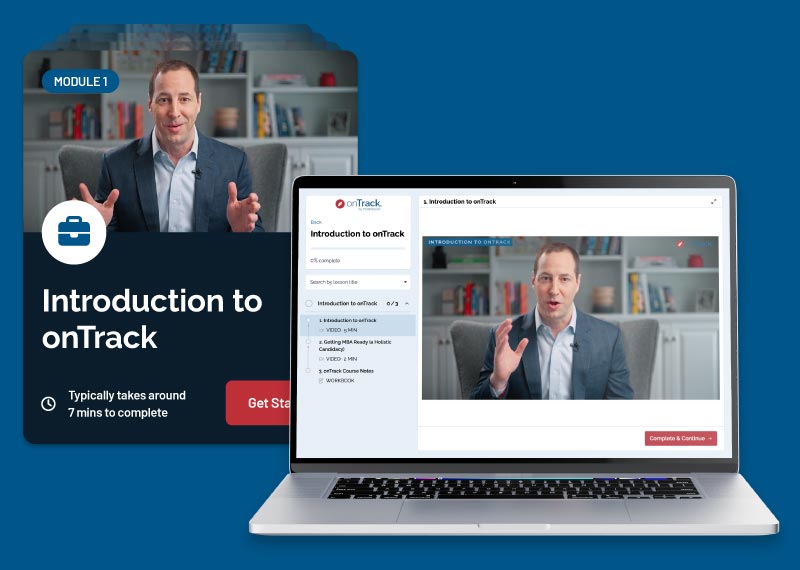
onTrack by mbaMission

A first-of-its-kind, on-demand MBA application experience that delivers a personalized curriculum for you and leverages interactive tools to guide you through the entire MBA application process.

Get Started!

2026–2027 MBA Essay Tips

Click here for the 2025–2026 MBA Essay Tips


MBA Program Updates

Explore onTrack — mbaMission’s newest offering allowing you to learn at your own pace through video. Learn more