Blog

Columbia Business School’s Student-Run Conferences

Columbia Business School (CBS) offers a series of student-run conferences throughout the year that give both first- and second-year students the opportunity to expand their knowledge across a variety of disciplines via panels and keynote speaker addresses, and to network with like-minded students, conference sponsors (who are often also big CBS recruiters), and even industry professionals.

During the popular Social Enterprise Conference, which typically takes place in the fall, speakers discuss the ways leaders and managers can use strategy as a tool to maximize social change and how organizations can incorporate a broader spectrum of social gains into their organizational strategies, among other issues. The 2023 Social Enterprise Conference was hosted on campus in October with the theme “Capital for Good” and the chief climate officer of the New York City Department of Environmental Protection serving as the keynote speaker.

Like the Social Enterprise Conference, the Marketing Association of Columbia (MAC) Conference usually enjoys a packed house in the fall. The MAC Conference has focused on such topics as the elevation, enhancement, and personalization of the brand experience for today’s mindful consumer. The 2023 event was hosted in November with the theme “Marketing in the Next Generation” and such keynote speakers as the founder of MaryamB and the founder and CEO of Kadima Careers.

The annual CBS Healthcare Conference, which is held in February, has featured such panel discussions as “The Business of Cancer: Innovations, Trends and Challenges in Delivering Cures” and “Healthcare M&A: Is Bigger Always Better?” The 2023 conference took place on campus throughout two days and had the theme “The New Patient Journey: Advancing Holistic and Personalized Care.” Keynote speakers included the head of the healthcare group and general partner at Welsh, Carson, Anderson & Stowe, while panel discussion topics included “Holistic Care Models: From Acute to Preventative Medicine.”

The year-round conference season at CBS also includes the India Business Conference and the Columbia Women in Business Conference. CBS often touts its New York advantage—students have the business world right outside the school’s door, ripe for exploration. As you can see, however, this advantage does not mean that CBS neglects to bring the business world to its students.

For more information on CBS or 16 other leading MBA programs, check out our free mbaMission Insider’s Guides.

Kelley School of Business and Fisher College of Business Offer MBAs in the Midwest

Business of Medicine MBA at Kelley School of Business - mbaMission

Kelley School of Business

As the demand for business-savvy health care professionals grows, business schools are taking notice. Leading the way is the Business of Medicine Physician MBA at Indiana University’s Kelley School of Business, which is designed to train practicing physicians to assume management positions and face a changing health care business environment. The two-year degree program was launched in 2013 and presents a new kind of opportunity at the intersection of business management and medical practice. The degree combines the basic curriculum of Kelley’s full-time MBA with specialized health care courses supported by the school’s Center for the Business of Life Sciences. Core courses within the program include “Data Analytics for Physician Leaders,” “Leading and Managing Human Capital in Healthcare,” and “Anatomy and Physiology of the U.S. Healthcare System.”

Dean Idie Kesner said in a Financial Times article regarding the launch of the program, “With this degree, physician leaders will emerge with the full skillset to transform individual institutions, the broad healthcare field and, most important, patient outcomes.” Part of the Business of Medicine Physician MBA program—approximately 10–14 hours a week—is taught online, drawing on Kelley’s pioneering strengths in distance learning, while the other part entails one weekend residence per month, allowing for a more flexible time commitment.

Ohio State’s Fisher College of Business - mbaMission

Fisher College of Business

Despite the size of its parent institution, the Fisher College of Business at Ohio State University, another Midwestern business school, boasts a relatively intimate classroom experience—with typically 100 students in each incoming full-time MBA class, although the three latest incoming classes have been smaller with 56, 61, and 59 students, respectively—and a close-knit community. Fisher students consequently benefit from the school’s wider university network (more than 580,000 alumni) and its proximity to major companies based both in Columbus and throughout the Midwest. Bloomberg Businessweek ranked Fisher 46th in its list of top full-time U.S. MBA programs in 2022.

The Fisher curriculum consists of a core sequence spanning the first year of the program and offers a plethora of optional pathways in which students can major, including Leadership, Corporate Finance, and Supply Chain/Logistics. Of the 60 credit hours required for graduation, 7.5 credits consist of experiential course work, including the Business Lab and the Social Impact Challenge. In these hands-on projects, students work with local and international businesses to apply the skills they have learned within the classroom to real-life scenarios. Nearly half (27 credit hours) of the required credit hours are dedicated to elective courses, proving that the Fisher MBA is a widely customizable program.

Why GMAT Prep Is Like Training for a Marathon

Our friends at Manhattan Prep often tell students to think of the GMAT as a long-distance race. Successful runners conquer race day through specific goals, consistent training, and mental toughness. The same holds true for successful GMAT test takers.

Setting a Goal Pace

The best runners do not just aim for completion; they set a goal pace. How do they arrive at a specific, measurable goal? Marathon runners test their abilities on shorter races (5K, 10K, half marathon) to determine an achievable goal for race day. Also, many runners are looking to beat various thresholds, such as completing a marathon in under four hours.

Similarly, if you are taking the GMAT, you should have a goal score in mind. You arrive at that goal score by taking a practice test to gauge your current proficiency and then setting a challenging but reasonable goal score. Usually that goal score also coincides with the benchmarks posted by the business schools you’re looking to attend. Having a specific goal in mind helps you develop an appropriate study plan and informs your test day strategies.

Training Consistently

The majority of a race’s outcome depends on the work you put in before you are on the race course; all the training that your legs have endured will push you across the finish line. For runners, following a consistent training plan produces the physiological changes necessary for improving their pace; it gets their bodies ready for challenges they will face on race day. Just as runners aim to train four or five days a week with a couple of rest days sprinkled in between, GMAT test takers should aim to do ~30 minutes of practice on most days and schedule longer (but not too long!) studying sessions for the weekends. Why?

Well, first off, spending long stretches of time away from test material will wipe away some of the “gains” you made in previous weeks. If two weeks have passed since you looked at a Critical Reasoning question, you will need to refresh your memory on the various types of Critical Reasoning questions and the approaches for each. Regularly exposing yourself to the material will keep you moving forward instead of having to repeat a chapter that you previously covered.

Second, consistent studying is more manageable than attempting to cram in many hours of studying on the weekend. If you are aiming to run 50 miles in a given week, trying to complete 40 of those miles over the weekend results in overtraining and perhaps even injury. Long, exhausting study sessions leave you tired and demoralized, and more importantly, mastering all the content covered during those sessions is very difficult because your brain is on overdrive. In fact, studies have shown that knowledge retention improves when students space out their study time. Shorter but more frequent study sessions also let you “sleep” on certain concepts and problems, and you will find that you are able to tackle challenging problems with greater ease if you step away from them for a day or two.

Lastly, consistent training leads to incremental improvements. Runs that felt tough two weeks ago start to feel easier because you have been training almost every day and your body is making the appropriate physiological adjustments. Jumping from a 500 to a 600 on the GMAT is impossible without making many small improvements along the way. Significant score improvements are achieved through a combination of incremental changes, such as mastering Quant topics, using alternative problem-solving strategies, and improving time management.

So open up a calendar and set a consistent study schedule. Feel free to vary things by studying in different locations, mixing topics, etc. You will feel yourself training your brain muscles, and the incremental improvements in performance will sufficiently prepare you for test day.

Preparing for the Big Day

Before race day, runners spend approximately one week “tapering.” Tapering involves reducing training volume to give your body rest, giving you that “fresh legs” feeling on race day. Staying up late the night before your test is a bad idea. Instead of frantically taking practice tests and completing problem sets during the week leading up to test day, try to taper the amount of studying so that you are well rested and “mentally fresh.”

On the big day, all runners are nervous. The runners who hit their goals manage their nerves and exhibit mental toughness. They are optimistic because they know that they have set appropriate goals and trained consistently toward those goals, and they do not let the challenges of race day get in their heads, focusing instead on producing the best outcome possible. Also, they are ready for the long haul. Instead of gassing themselves out by running too fast for the first half of the race, they conserve their energy to maintain the pace required to hit their desired finish time.

How does that translate into strategies for test day? On test day, you will be nervous and that is expected. Stay optimistic, gather confidence from all the hard work you have put into studying, trust yourself, and stay mentally resilient in the face of challenging problems. Oh, and if you manage to also have fun on test day, I am confident that you will deliver your best performance.

Manhattan Prep is one of the world’s leading test prep providers. Every one of its instructors has a 99th percentile score on the GMAT and substantial teaching experience. The result? Two decades and thousands of satisfied students. By providing an outstanding curriculum and the highest-quality instructors in the industry, it empowers students to accomplish their goals. Manhattan Prep allows you to sit in on any of its live, online GMAT classes—for free! Check out a trial class today.

Professor Profiles: Antonio Fatás, INSEAD

Many MBA applicants feel that they are purchasing a brand when they choose a business school. However, the educational experience you will have is what is crucial to your future, and no one will affect your education more than your professors. Today, we focus on Antonio Fatás from INSEAD.

The Portuguese Council Chaired Professor of European Studies, Antonio Fatás teaches macroeconomics on INSEAD’s Singapore campus. Fatás has served as a consultant for numerous international financial organizations, including the International Monetary Fund, the World Bank, the OECD, and the European Commission, as well as for the U.S. Federal Reserve and even the government of the United Kingdom. A recognized global expert on fiscal policy, business cycles, and the economics of European integration, Fatás has published pieces in the Journal of Economic GrowthCredit and Banking, the Quarterly Journal of Economics, the Journal of Money, the Journal of Public Economics, and the European Economic Review, among other outlets, and has been featured regularly on CNBC and BBC World News as well as in the Financial TimesForbes, the Huffington Post, The New York Times, and The Economist.

One student we interviewed who had taken Fatás’s macroeconomics class observed, “It was an incredible learning experience, and I enjoyed the course a lot. It’s one of those courses where you say, okay, the fee is worth this course, because I got so much from it that I feel very well rewarded.” And another student with whom we spoke described class with Fatás as “actually amazing.”

For more information about INSEAD and 16 other top-ranked business schools, check out our free mbaMission Insider’s Guides.

Hands-On Finance Opportunities at Michigan Ross and UCLA Anderson

You may not realize that students at the Ross School of Business at the University of Michigan do not have to travel all that far to get hands-on Wall Street experience. Through the John R. and Georgene M. Tozzi Electronic Business and Finance Center (known as simply the Tozzi Center), students can find themselves on Wall Street without ever having to leave Ann Arbor. Housed in a 5,800-square-foot facility on campus, the Tozzi Center boasts a state-of-the-art mock trading floor as well as an electronic modular classroom and an e-lab seminar room. The latest financial tools—including live news wires, trading systems, and data and research services—can be found at the center. The space has been designed to look and feel like the real thing, so do not be surprised if you hear “Sell, Sell, Sell!” when you walk by students in action.

Many acknowledge UCLA Anderson’s unique connections to the media and entertainment industry. However, far fewer MBA aspirants are aware of the tremendous opportunities Anderson provides to students interested in investment management. Established in 1987, the Anderson Student Asset Management (ASAM) program (formerly the Student Investment Fund) is a fellowship that provides up to 20 students with a hands-on opportunity to apply what they have learned thus far about investment theory. Students must apply for the opportunity to manage the portfolio, currently worth approximately $1M, for five academic quarters. ASAM Fellows engage in investment strategy, asset allocation, and security analysis, and they explore both value and growth approaches to investment as well as fixed income investments. Fellows get together weekly during the academic year and visit investment professionals throughout the fellowship to learn about different investment philosophies. Those interested in a career in investment management should give UCLA Anderson a closer look.

For more information on Michigan Ross, UCLA Anderson, or 15 other leading MBA programs, check out our free mbaMission Insider’s Guides.


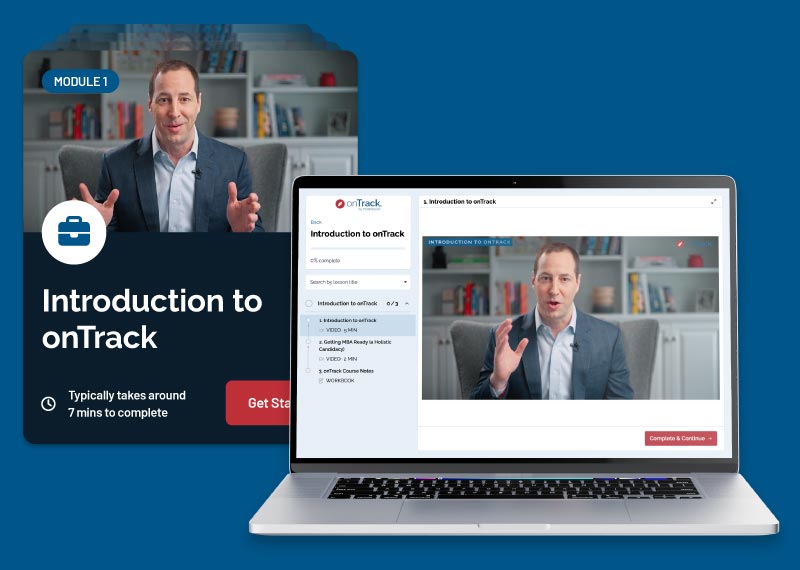
onTrack by mbaMission

A first-of-its-kind, on-demand MBA application experience that delivers a personalized curriculum for you and leverages interactive tools to guide you through the entire MBA application process.

Get Started!

2026–2027 MBA Essay Tips

Click here for the 2025–2026 MBA Essay Tips


MBA Program Updates

Explore onTrack — mbaMission’s newest offering allowing you to learn at your own pace through video. Learn more