In this new blog series, our mbaMission Career Coaches offer invaluable advice and industry-related news to help you actively manage your career. Topics include building your network, learning from mistakes and setbacks, perfecting your written communication, and mastering even the toughest interviews. To schedule a free half-hour consultation with one of our mbaMission Career Coaches, click here.
As you come to the end of the allotted time with your interviewer, he/she will likely invite you to ask a few questions. Although you may think the hard part of the interview is over, do not lose focus. These last few minutes can be particularly important in accomplishing the following:
Reiterating your interest in and qualifications for the position
Demonstrating your understanding of the company’s challenges
Gathering more information about the company and the role
Furthering your rapport with the interviewer
We suggest preparing five to seven questions to ask at the end of each interview, though you will likely have time to ask only one to three.
What types of questions are appropriate to ask?
We recommend asking questions that relate to the job (day-to-day responsibilities and metrics of success), the interviewer (his/her personal experiences at the firm), the company and/or team (mission, culture), and next steps (when you should expect to hear back). Remember, you do not have the job (yet), so keep your questions positive and not too probing or direct. You will have the chance to ask a lot more questions after an offer is extended to determine whether the job is the right fit for you.
With regard to the GMAT, raw intellectual horsepower helps, but it is not everything. In this weekly blog series, Manhattan Prep’s Stacey Koprince teaches you how to perform at your best on test day by using some common sense.
The Pep Talk
So, let me get this straight. The GMAT test writers are going to give me somewhat obscure, very dense topics with very complicated ideas and sentence structures. I am going to have about three minutes to read this passage, and then I have to start answering questions about the material. That is a completely artificial setup; it would never happen in the real world!
Actually, yes it will. You are going to do lots of case studies in business school. You often will not be given enough time to read through every last detail carefully; instead, you will have to determine relative levels of importance and concentrate on the most crucial pieces, while putting together a framework for the main ideas and the big changes in direction or opinion.
At work, you often have to make decisions based on incomplete information. At times, you actually do have a ton of information—but not enough time to review it all before you have to take action. These situations are far from rare in the real world.
So when you find yourself a bit unmotivated because you know you have got to study boring Reading Comprehension (RC) today, remind yourself that RC will actually help you develop much-needed skills for business school and beyond!
In this new blog series, our mbaMission Career Coaches offer invaluable advice and industry-related news to help you actively manage your career. Topics include building your network, learning from mistakes and setbacks, perfecting your written communication, and mastering even the toughest interviews. To schedule a free half-hour consultation with one of our mbaMission Career Coaches, click here.
Interviewing is usually a stressful experience. However, the best thing you can do to quell your anxieties is prepare carefully and be ready to answer any question with confidence and authenticity.
The following prompt is one that tends to concern applicants: “Tell me about a time you failed.” To help you respond effectively to such a request, here is our recommended approach to crafting your reply:
Take some time to examine the experiences you might deem failures or setbacks. Think about what your specific struggle was, how you strategized to overcome it, what actions you took, and what you found challenging about the experience.
Choose an example that does not highlight a failure that would cast doubt on your skill set for your target role, your work ethic, or your ability to work well with others. In addition, consider sharing an example that did not happen very recently.
Be direct and concise when explaining your failure. Do not assign blame to others.
Most importantly, focus on what you learned—how you grew and changed as a result of the failure. Highlight the positive steps you have taken to ensure a similar failure does not happen in the future. Also, provide a more recent example of when you used the lessons learned and avoided failure.
Here are a few sample failures to consider. (Note: These are very simplistic examples; yours should be much more specific and detailed.)
In your MBA application essays, you must ensure that the tone you use allows the admissions committee to readily recognize your certainty and self-confidence. Being clear and direct about who you are and how you envision your future is vital. Consider the following example statements:
Weak: “I now have adequate work experience and hope to pursue an MBA.”
Strong: “Through my work experience, I have gained both breadth and depth, providing me with a solid, practical foundation for pursuing my MBA.”
——
Weak: “I now want to pursue an MBA.”
Strong: “I am certain that now is the ideal time for me to pursue my MBA.”
——
Weak: “I have good quantitative skills and will succeed academically.”
Strong: “I have already mastered the quantitative skills necessary to thrive in my MBA studies.”
Have you been admitted to business school? If so, congratulations! You are about to embark on an exciting and rewarding journey—one that will help prepare you for the job of your dreams!
Many MBA admits make the critical mistake of waiting until they arrive on campus to start their job hunt. During this pivotal moment in your life—before your MBA program even begins—you must have a clear plan to get your dream job. Have you carefully considered your career goals? Do you know what is necessary—and do you have the network—to get that job? Have you considered pursuing pre-MBA internships to facilitate a career transition?
We have created a one-of-a-kind online presentation to help answer all of your questions on how to prepare for—and eventually land—your ideal full-time, post-MBA position!
Join mbaMission’s founder and president, Jeremy Shinewald, on December 20 at 9:00 p.m. Eastern for an eye-opening online event and ensuing Q&A! Enroll for free today.
Are you an MBA admit, current student, or alum? Do you want to get a head start on defining your career goals? Do you need help preparing for job interviews or learning how to effectively network with your target employers? Or maybe you want to be a top performer in your current role but are unsure how to maximize your potential. Let an mbaMission Career Coach help via a free 30-minute consultation!
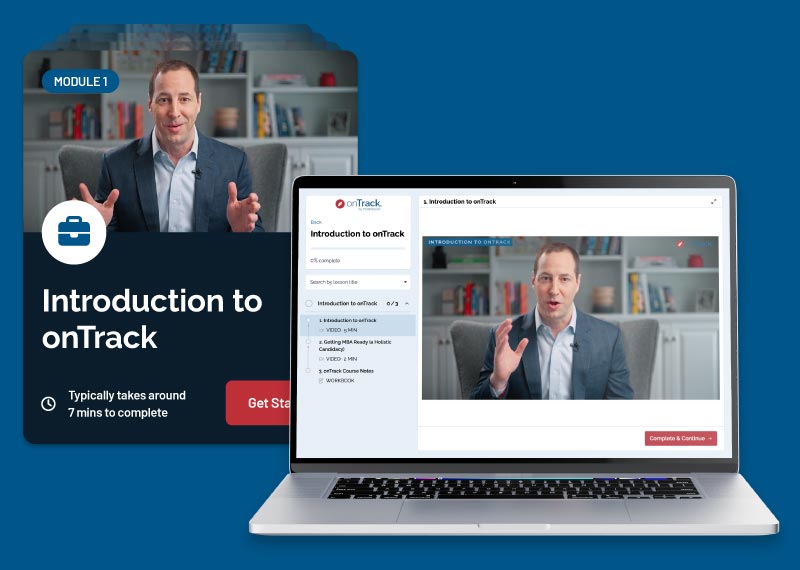
A first-of-its-kind, on-demand MBA application experience that delivers a personalized curriculum for you and leverages interactive tools to guide you through the entire MBA application process.



 In this new blog series, our mbaMission