Sometimes, incorporating a famous quote (or perhaps a lesser-known quote by a well-known person) into one of your application essays can add a little something special to the story you are trying to tell. If the quotation truly enhances your message in a significant way, it can serve as an effective tool, making your submission that much more compelling. Consider the following examples:
Example 1:
“The best executive is the one who has sense enough to pick good men to do what he wants done and self-restraint enough to keep from meddling with them while they do it.”
– Theodore Roosevelt
Roosevelt’s words are as true today as when he spoke them. The essence of a manager is…
Example 2:
As Peter F. Drucker said, “Management is doing things right; leadership is doing the right things.” I have found the distinction between management and leadership especially important…
However, some candidates may be tempted to use a quotation as a kind of crutch, essentially relying on someone else’s clever or poignant wordsmanship in place of their own. Think of using a quotation as a way of enriching an already interesting narrative, rather than as an easy shortcut to a more impressive essay.
Harvard Business School (HBS) offers an excellent MBA program—this is largely a given, and we are not questioning that. However, what we will call into question is whether HBS (or any other school, for that matter) is right for you. Every year, we get a few calls from confused MBA aspirants who say, “I visited HBS, and I am not sure if there is a fit,” as if that indicates some sort of problem. Indeed, and this may be shocking to some, HBS is not for everyone—particularly those who do not relate well to case-based learning, those who want a lot of flexibility in their first-year curriculum, and those who would prefer a small class size (HBS’s Class of 2018 has 934 students, while the same class at the University of California, Berkeley, Haas School of Business, for example, has just 252).
We hope that applicants will use this post as a jumping-off point to critically appraise their target MBA programs and determine which schools are indeed right for them. Start by asking yourself the following questions:
Would I prefer to be in a larger program, or would I feel overwhelmed by a larger program’s size?
Would I prefer to be in a smaller program, or would that feel claustrophobic?
Would I prefer to be at a school with a flexible curriculum and a consistent stream of new classmates and where I could make my own academic choices early on?
Would I prefer to learn in a comprehensive core curriculum where I am, for a period of time, learning the same material as my classmates and where academics would provide me with a course structure?
Am I best suited for the case method, lecture method, or programs with strong experiential components? (And do I really understand what each entails—for example, the teamwork and public speaking that is necessary within the case method?)
Do my target schools match my academic objectives?
Do my target firms recruit at my school?
Are alumni well placed in my industry/post-MBA location? (Are alumni even crucial to my career?)
Do my target schools have facilities and an environment that appeal to me?
Although New York University’s (NYU’s) Stern School of Business is perhaps not well known among the top MBA programs for sustainable enterprise or social entrepreneurship, the school in fact offers an array of resources for those interested in pursuing careers in such fields. The W.R. Berkley Innovation Lab serves as the hub of all entrepreneurial activities and events at the school, and in 2008, Stern introduced a Social Innovation and Impact specialization, thereby formalizing an academic track for students with this career path in mind.
Attending or helping to plan the “Think Social, Drink Local” marquee fundraiser is one of many options that socially conscious aspiring MBAs will find to fulfill their interests at Stern. With help from corporate sponsors such as Brooklyn Brewery and Crop Organic Vodka, the school’s Social Enterprise Association hosts the event in partnership with the Stern Luxury & Retail Club. In March 2016, the 11th annual event took place at 404 NYC and featured an open bar and the “I Heart New York” runway fashion show—a fundraiser for Stern’s Social Impact Internship Fund—in which Stern students and administrators modeled clothing by ecofriendly designers. The fashion show is a highlight of the evening each year and has raised more than $10K in past years.
Through Stern Consulting Corps, students can partner on consulting projects with New York City–based nonprofits. And for those who also have the entrepreneurial bug, Stern added a Social Venture Competition—in which participants compete for a $75K prize—to its traditional for-profit $300K Entrepreneurs Challenge.
In short, socially conscious Sternies have quite a bit to keep them busy!
For a thorough exploration of what NYU Stern and 15 other top business schools have to offer, please check out thembaMission Insider’s Guides.
With regard to the GMAT, raw intellectual horsepower helps, but it is not everything. In this blog series, Manhattan Prep’s Stacey Koprince teaches you how to perform at your best on test day by using some common sense.
Part 1 of this series covered how to read Reading Comprehension (RC), and Part 2 introduced the first two major question types: Main Idea and Specific Detail. Start with those posts and then continue with this post.
Inference
In this section, we are going to talk about two big things: how to handle inference questions and how to analyze RC problems in general (you can then use these techniques on any question type).
Inference questions ask about specific details in the passage, but they add a twist: we have to deduce something that must be true, given certain facts from the passage.
For example, if I tell you that my favorite type of book to read is biography, what could you deduce?
Watch out for the trap: do not use your “real world” conclusion-drawing skills. In the real world, you might conclude that I like reading books in general or perhaps that I am interested in history or maybe that I am a nerd. (Really? Biographies are my favorite?) These things do not have to be true, though.
With regard to the GMAT, raw intellectual horsepower helps, but it is not everything. In this blog series, Manhattan Prep’s Stacey Koprince teaches you how to perform at your best on test day by using some common sense.
In Part 1 of this series, we discussed how to read Reading Comprehension (RC); if you have not yet read that post, do so now and then continue with this post.
The RC Question Types
Do you remember the last thing I said at the end of the first post? When you have mastered the reading skills, you are then ready to tackle the questions. Do not make the mistake of thinking that you can ignore the previous post and just go straight for the questions. You will be slower, and you will make more mistakes if you do that.
RC has three main question types: Main Idea, Specific Detail, and Inference. Each of those question types can have nuances or subtypes. We will tackle the first two in this post and cover Inference and the minor Why question type in next week’s post.
Main Idea
Most passages will include one Main Idea category question. Most commonly, you will be asked for the “primary purpose” (i.e., the main idea) of the entire passage, though a question could also ask for the primary purpose or role of just one paragraph.
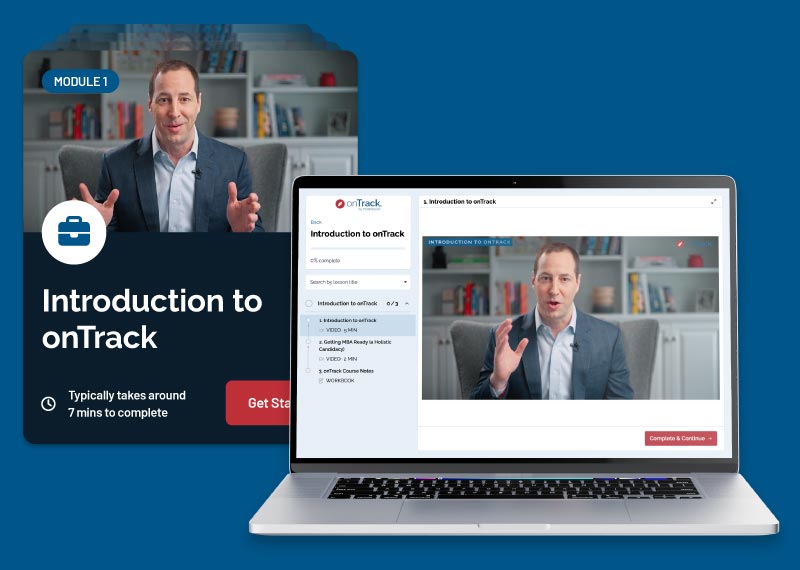
A first-of-its-kind, on-demand MBA application experience that delivers a personalized curriculum for you and leverages interactive tools to guide you through the entire MBA application process.