In this new blog series, our mbaMission Career Coaches offer invaluable advice and industry-related news to help you actively manage your career. Topics include building your network, learning from mistakes and setbacks, perfecting your written communication, and mastering even the toughest interviews. To schedule a free half-hour consultation with one of our mbaMission Career Coaches,click here.
Behavioral questions and prompts (e.g., “Tell me about a time when you…”) can help a hiring manager understand your ability to do a job, because your answers are a good predictor of your future success. Expect behavioral questions to focus on the competencies required for you to excel in your target role.
Our top five tips for successfully addressing behavioral questions are as follows:
Brainstorm your six to eight biggest accomplishments. Make note of which competencies (e.g., leadership, teamwork, analytics, persuasion) each story addresses or can be tweaked to address.
Start your story with a headline (i.e., a road map) that shows you are directly answering the question. And consider concluding your story by describing what you learned from the experience and/or how the experience makes you more interested in or qualified for the role.
Use a structured framework to answer the question in a concise manner (roughly 90 to 120 seconds). Consider using the Situation-Actions-Result framework: • Situation – Give enough information that the hiring manager has sufficient context to understand your actions. (This part should account for approximately 10%–15% of your answer time.) • Actions – Describe the actions you took. Make sure your actions illustrate the attribute you are demonstrating. Speak in terms of “I” versus “we.” (This part should account for roughly 70% of your answer time.) • Result – What happened? Quantify your impact. What did you accomplish? How did your actions benefit the group, department, company, or client? (This part should account for approximately 10%–15% of your answer time.)
Prepare for follow-up questions/prompts such as these:
-What happened after that?
-What did you say?
-How did you feel about that?
-Why did you decide to do that?
-What was your thought process?
-Tell me more about your interaction with X.
-How did you achieve X?
Practice, practice, and practice (out loud)!Think about your content as well as your delivery (word choice, confidence, nonverbal cues, etc.).
Mission Admission is a series of MBA admission tips; a new one is posted each Tuesday.
Many business school applicants worry about the impact having been laid off might have on their candidacy. Do the admissions committees view a layoff as a sign of failure?
One thing to remember is that many MBA candidates share this worry—thousands of them worldwide, in fact. For the admissions committees to dismiss all such applicants outright would simply not be practical. Moreover, the admissions committees know that the global financial crisis and subsequent recession are at the root of the problem, not necessarily the individual candidate’s performance. Indeed, layoffs and firings are not the same thing, so admissions committees will examine your application with that in mind, seeking your broader story.
If you find yourself in this situation, what is important is that you show that you have made good use of your time since the layoff by studying, volunteering, seeking work, enhancing your skills, etc. Each candidate will react differently, of course, but you need to have a story to tell of how you made the most of a difficult situation.
If you were to read a skilled professional writer’s work, you would find articles that are characterized by “connectivity.” Simply put, an adept writer ensures that each sentence is part of a chain—each sentence depends on the previous one and necessitates the next. With this linkage in place, the central idea is constantly moving forward, giving the story a natural flow and making it easy to follow. Although you do not need to write at the same level as a professional journalist, you should still embrace this concept, because it is central to excellent essay writing. With a “connected” MBA application essay, you will grab and hold your reader’s attention.
You can test your essay’s connectivity by removing a sentence from one of your paragraphs. If the central idea in the paragraph still makes complete sense after this removal, odds are you have superfluous language, are not advancing the story effectively, and should revise your draft.
Try this exercise with a random selection from the New York Times:
“For many grocery shoppers, the feeling is familiar: that slight swell of virtue that comes from dropping a seemingly healthful product into a shopping cart. But at one New England grocery chain, choosing some of those products may induce guilt instead. The chain, Hannaford Brothers, developed a system called Guiding Stars that rated the nutritional value of nearly all the food and drinks at its stores from zero to three stars. Of the 27,000 products that were plugged into Hannaford’s formula, 77 percent received no stars, including many, if not most, of the processed foods that advertise themselves as good for you. These included V8 vegetable juice (too much sodium), Campbell’s Healthy Request Tomato soup (ditto), most Lean Cuisine and Healthy Choice frozen dinners (ditto) and nearly all yogurt with fruit (too much sugar).”
If you were to delete any of these sentences, you would create confusion for the reader, proving that each sentence is connected and vital.
In this new blog series, our mbaMission Career Coaches offer invaluable advice and industry-related news to help you actively manage your career. Topics include building your network, learning from mistakes and setbacks, perfecting your written communication, and mastering even the toughest interviews. To schedule a free half-hour consultation with one of our mbaMission Career Coaches, click here.
When participating in a job interview, you can almost guarantee your interviewer will say, “Tell me about yourself” or “Walk me through your resume.” Although your first thought might be that he/she is asking for your autobiography, your interviewer actually means “What are your key selling points for this job?” or “Tell me why I should hire you.” Based on your response, he/she will be able to assess these qualities:
Your level of preparedness for/understanding of the job
Your skills, interests, passions, and motivations (to see if they match with the job)
We recommend that you approach your response to these prompts as follows:
Know your story. Do not read from your resume or assume your interviewer is familiar with it.
When telling your story, be structured and concise (i.e., keep your responses to less than two minutes). Start with a headline, so the recruiter knows what to listen for, and end your story with a strong statement about why you are interested in the role.
Highlight the experiences and skills that are most relevant to your target audience.
Tell a memorable story. Balance the “what” and the “why” of your job transitions.
Mission Admission is a series of MBA admission tips; a new one is posted each Tuesday.
With the 2016–2017 MBA application season moving along at full speed, we thought we should explore an issue that brings endless paranoia to business school candidates: when to schedule interviews. Many programs will give applicants a significant window in which to schedule their interview. Does scheduling an interview early convey that you are being too aggressive and do not have any other irons in the fire, or instead that you are eager to act and impress the admissions committee? Does scheduling an interview later imply that you are less interested in the program, or rather that you are highly sought after and are interviewing at multiple schools?
The reality is that scheduling your interview to occur early on in the school’s set time frame is really no different from scheduling it near the end. Neither option, nor any day in between, confers any advantage or disadvantage. The MBA admissions committees recognize that you, like all candidates, are busy and that your schedule is in flux as a result of work, community, and personal commitments. The committees focus on the interviews themselves, not on when they are scheduled. So pick a date that works for you—a time when you know you can be comfortable and relaxed, not distracted—and start preparing!
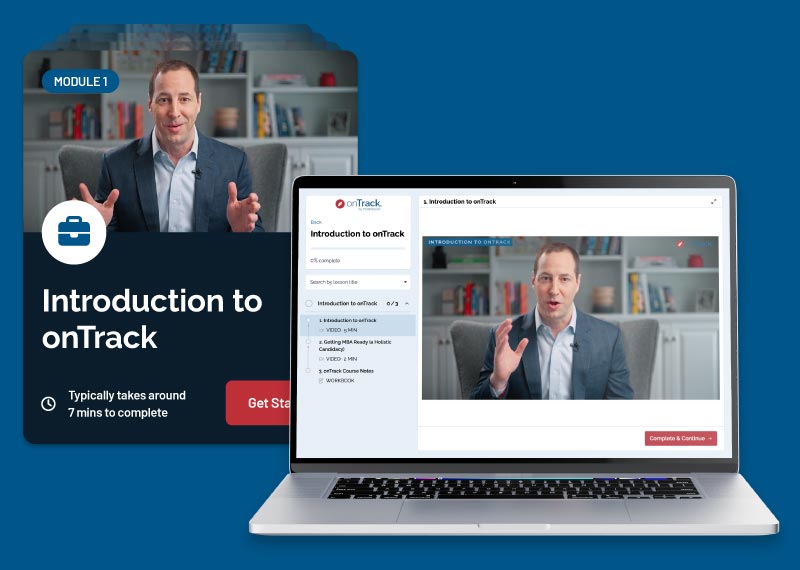
A first-of-its-kind, on-demand MBA application experience that delivers a personalized curriculum for you and leverages interactive tools to guide you through the entire MBA application process.


 In this new blog series, our mbaMission Career Coaches offer invaluable advice and industry-related news to help you actively manage your career. Topics include building your network, learning from mistakes and setbacks, perfecting your written communication, and mastering even the toughest interviews. To schedule a free half-hour consultation with one of our mbaMission Career Coaches, click here.

 Mission Admission is a series of MBA admission tips; a new one is posted each Tuesday.