Perennially ranked among the top business schools in the world, the Wharton School of the University of Pennsylvania—as its original name, the Wharton School of Finance and Commerce, indicates—is best known for its reputation in finance, which is still the school’s largest department. However, if you are interested in a career in consulting but believe that Wharton is the program of choice for future investment bankers only… well, think again!
Check out these four facts about consulting at Wharton:
Every year since 2005, more Wharton graduates have accepted positions in consulting than in investment banking.
Wharton’s Consulting Club is one of its largest student organizations.
One of Wharton’s most popular electives is “Strategy and Competitive Advantage.” Professor Nicolaj Siggelkow, a protégé of strategy guru Michael Porter, is notorious for pushing his students to clarify their answers. But if they use trite buzzwords such as “adding value” and “frameworks,” they may find themselves in the hot seat for 30 minutes of additional questioning!
The Wharton Global Consulting Practicum pairs student teams with participants from partner schools across the world to work with an international company or organization. Past projects include creating a marketing plan for a Colombian food provider, developing a business model for a private Kenyan foundation, and helping a Taiwanese company evaluate its options for expanding its market.
For more information on Wharton or 15 other leading MBA programs, check out the mbaMission Insider’s Guides.
Because MBA applicants can get carried away with rankings, we profile amazing programs at business schools that are typically ranked outside the top 15.
The Scheller College of Business at Georgia Techmay rival MIT Sloan and Carnegie Mellon’s Tepper School of Business with respect to its focus on the direct application of Internet technology to global business problems. The school’s rather small (approximately 60–80 students each year) and innovation-focused program was nevertheless ranked 28th among full-time MBA programs by Bloomberg Businessweek in 2016.
Situated in the heart of Technology Square in Midtown Atlanta, Scheller offers students numerous networking and innovation resources within the city’s high-tech business community, including the Advanced Technology Development Center business incubator. In addition, the Enterprise Innovation Institute, or EI2, bills itself as “the nation’s largest and most comprehensive university-based program of business and industry assistance, technology commercialization, and economic development” on its Web site and provides students with resources for career options at the intersection of business and technology. As an indicator of the school’s overall strengths in information technology and operations management, a large portion of Scheller’s student body tends to come from science, technology, engineering, and math backgrounds (50% of the Class of 2017, for example).
Letters of recommendation are an important part of your overall MBA application package—they provide the only outside information the admissions committee receives about you. However, one of the most stressful parts of the application process can be choosing your recommenders. The first question you should ask is who can write a valuable letter on my behalf?
Many candidates believe that recommenders must have remarkable credentials and titles to impress the admissions committee. However, selecting individuals who can write a personal and knowledgeable letter that discusses your talents, accomplishments, personality, and potential is far more important. If senior managers at your company can only describe your work in vague and general terms, they will not help your cause. Lower-level managers who directly supervise your work, on the other hand, can often offer powerful examples of the impact you have had on your company. As a result, their letters can be far more effective.
Nonetheless, not everyone who knows you and your capabilities well will make a good recommender. For starters, you should of course feel confident that your potential recommender likes you and will write a positive letter on your behalf. As you contemplate your choices, try to gather some intelligence on your potential recommenders. Have they written letters for anyone else? Are they generous with their time with regard to employee feedback and review sessions? Will they devote the effort and time necessary to write a letter that will really shine? (For more insight on this topic, see our blog post on choosing “safe” recommenders.)
If your prospective MBA program asks for two letters of recommendation, you should generally approach two of your recent supervisors, with one ideally being your current supervisor. Your letters will have added credibility if they are written by individuals who are senior to you, because your recommenders are in evaluative positions and will not have anything to lose by critically appraising your candidacy.
If you are unable to ask your current supervisor for any reason, do not panic. Read how to handle this situation in our blog post, “What If I Have No Supervisor?”
Mission Admission is a series of MBA admission tips; a new one is posted each Tuesday.
We at mbaMission try to encourage business school candidates to get as much “noise” out of the way as possible before the schools begin releasing their essay questions for the next admissions season. We want our applicants to have the freedom to reflect on their experiences, formally and thoroughly brainstorm, choose ideas, prepare outlines, and then focus on crafting powerful essays. Essentially, we want them to be unfettered as they engage in what is, for many, one of the most significant creative challenges they will ever face.
Using this time to address a task such as preparing your resume—a process that often requires several rounds of revisions—will allow you to focus better on the other elements of your application later. By revising your resume now, you can dedicate the time needed to do so at a more leisurely pace, before “crunch time” hits. Further, you will lay the foundation for brainstorming for your essays later, by reminding yourself of your most significant accomplishments.
If you prepare your resume now, you will definitely thank yourself later for having completed this task early.
Note: We recognize that you may achieve additional accomplishments in the next few months. We nonetheless suggest that you update your resume now, however, and then revisit and amend your most recent entry one to two weeks before your application deadlines.
With regard to the GMAT, raw intellectual horsepower helps, but it is not everything. In this blog series, Manhattan Prep’s Stacey Koprince teaches you how to perform at your best on test day by using some common sense.
Some time ago, I flew over to London to give an all-day workshop at London Business School. The audience comprised about 35 students who had already been admitted to a weekend master’s program, but that admission was contingent upon taking the GMAT and getting a “good enough” score (as defined by the school). The students had only about a month or two to fulfill this requirement.
What can you do in a six-hour crash course? Not much more than an introduction and orientation—but even that is incredibly valuable in helping people get started and know what to expect.
So what should someone do who is in the position of taking the test in four to eight weeks and has not studied a ton yet?
First, take a practice test under 100% official conditions. I always recommend this first step for anyone, but this is especially crucial for someone with limited time. You are going to have to prioritize heavily, and you have no effective way to do that without good practice test data.
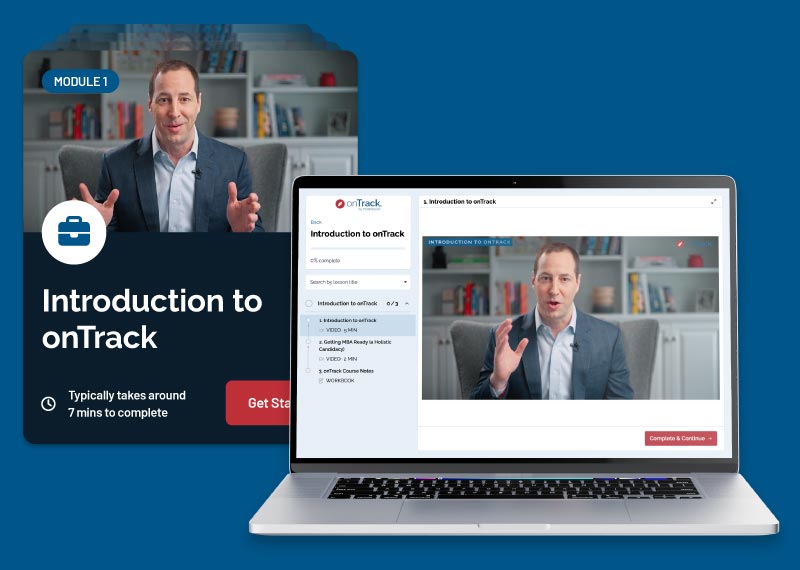
A first-of-its-kind, on-demand MBA application experience that delivers a personalized curriculum for you and leverages interactive tools to guide you through the entire MBA application process.


 Perennially ranked among the top business schools in the world, the Wharton School of the University of Pennsylvania—as its original name, the Wharton School of Finance and Commerce, indicates—is best known for its reputation in finance, which is still the school’s largest department. However, if you are interested in a career in consulting but believe that Wharton is the program of choice for future investment bankers only… well, think again!