
Blog

4 GMAT Myths Busted

There’s a lot of well-meaning advice for GMAT test takers out there. Unfortunately, some of the most reasonable-sounding and frequently-repeated claims are actually false. In this article, our friends at Manhattan GMAT look at four of the most common GMAT myths, and what you should do instead.

1. I need to get 90% of the questions right to get a 700.

It’s true, somebody who got a 700 on the GMAT probably got more questions right than somebody who got a 400. However, the opposite isn’t true: just getting more questions right doesn’t increase your score. The GMAT scoring algorithm doesn’t look at how many questions you answered correctly in a section. Instead, it looks at the difficulty level you’ve reached by the end of that section. You could reach the same difficulty level by missing a lot of questions, or by only missing a few, depending on where in the test you miss them and whether you finish the section on time. Check out this article for more info on what your GMAT score really means.

2. Quant is more important than Verbal.

This is a tricky one. In part, it depends on the programs you’re applying to and the strengths and weaknesses of the rest of your profile. Some schools will want a high Quant score, while others will care more about whether you hit a particular overall number. In some situations, Quant might be very important.

However, when it comes to achieving a high overall GMAT score, Verbal is slightly more important than Quant. Getting a 90th percentile Verbal score and a 50th percentile Quant score, for example, will give you a slightly higher overall score than if they were swapped. Also, many students, especially native English speakers, find it easier, quicker, and more fun to improve Verbal than Quant. If you just want to earn a particular overall score, you might get there faster by focusing on Verbal. Don’t leave points on the table by ignoring Verbal! Even if you’re starting with a high Verbal score, an improvement of just ten percentile points can go a long way.

Monday Morning Essay Tip: Vary Your Sentence Length

Many business school applicants use medium-length sentences (like this one) in their essays. Few use short sentences (like this one). Likewise, few use long sentences in their essays, even though long sentences (like this one) can often play a useful role in an essay’s structure and story.

Confused? Consider the following example:

“At XYZ Inc., I was the manager in charge of leading a team of 12 staff members. Included in my team were four engineers, four marketing professionals, and four market analysts. Our goal was to develop a new thingamajig within six months. We worked really hard over the six months and succeeded. The new thingamajig is now on the market and is selling well. As a result of my efforts, I was promoted to vice president.”
All these sentences have approximately the same number of words and the same rhythm/cadence, making the paragraph fairly boring to read. Nothing changes—the structure just repeats itself over and over again, with one medium-length sentence following another medium-length sentence.

Now consider this example:*

“At XYZ Inc., I was the manager in charge of leading a thingamajig development team of 12 staff members, four of whom were engineers, four were marketing professionals, and four were market analysts. We had just six months to launch our new product. The team worked really hard and succeeded, and the new thingamajig is now on the market, where it is selling well. As a result of my efforts, I was promoted to vice president.”
The sentences in this paragraph are varied—the first is quite long, the second is very short, the third is medium-long, and the fourth is medium-short. Sentence variety makes for a much more interesting read, and one very short sentence in the middle of some longer ones can provide precisely the kind of contrast and drama that MBA application essays so often need.

*Please note that this is a simplified example for illustration purposes. If this were an actual essay, we would encourage the applicant to offer greater insight into his/her experience launching the product.

Navigating Proper Interview Etiquette

Making a good impression on your MBA admissions interviewer goes beyond simply answering questions well. Knowing how to dress properly and how to navigate certain etiquette issues is also crucial. You want to leave your interviewer confident that you have the maturity and professionalism necessary to succeed after graduation. The following are our answers to four questions that often bedevil applicants with respect to proper interview etiquette.

Navigating Proper Interview Etiquette - mbaMissionWhat should I wear?

Always follow any guidelines the school provides about proper interview dress. If business casual is specified, wear business casual; if business attire, dress in business attire. Jeans, T-shirts, and ripped or unclean clothing are never appropriate. If the school does not specify a dress code, wear business attire for any on-campus interviews as well as for an off-campus interview with a member of the admissions staff. Business casual is often best when meeting an alumnus/alumna off campus, though you may consider politely asking the person you are meeting about proper attire in advance. Showing some creativity and style with your clothing is okay, but do not go overboard—remember that your meeting is a professional one, and your first impression is vital.

I am meeting my interviewer at a coffee shop. Who pays?

If you are meeting an alumnus/alumna at a café or similar establishment for an interview, try to avoid the awkward “who pays?” scenario altogether by arriving a few minutes early, purchasing your own beverage, and then offering to pay for the interviewer’s selection when he/she arrives. If the person you are meeting arrives before you, you might politely offer to pay for his/her drink, but if the interviewer declines, you should not insist.

Should I send a thank you note?

Yes, you should always send a brief thank you note after your interview. Write and send the note as soon as possible after your meeting—the same day or the next is ideal—and be sure to mention specifics from your conversation or your visit. Emailing the thank you is fine. Interviewers usually need to submit their feedback on candidates within 24 hours, so you want your message to be received quickly.

If I am not sure how I did, can I ask for feedback?

No! Feeling anxious about how you performed is natural, but do not ask your interviewer for feedback. Doing so will not help establish you as professional or mature and will instead leave the impression that you lack good judgment (and confidence). Just be patient and wait for the admissions committee to make its decision!

We offer more interview advice in our FREE Interview Primers, which are available for 16 top-ranked business schools. For even more individualized interview prep, check out our one-of- a-kind Mock Interview Sessions!

Monday Morning Essay Tip: How Will You Contribute to the Program?

Many business schools use their essay questions as an opportunity to ask about the unique contributions you will make to their particular program.

Unfortunately, candidates often make the mistake of thinking that a bland summary statement like “I will bring my leadership skills to XYZ School” will sufficiently express their intended contribution. One reason we prefer to work with business school candidates “from start to finish” is so we can prevent such problems. Simply relating a story about a past experience and then repeating the main point does not demonstrate that you can or will make a meaningful contribution to the school. Ideally, you want to go further, explaining how you would apply and use your experience and skills while at the school in a way that would offer some benefit to others, thereby demonstrating a true understanding of your fit with that particular program.

Example 1

“My experience as a stand-up comedian will allow me to bring humor to the Kellogg environment.”
With this statement, the MBA admissions committee is left wondering, “How exactly will this applicant bring humor to the environment? Does this person really know what our environment is about?” In contrast, consider our next example.

MBA Admissions Myths Destroyed: I Have a Gap!

The perfect MBA applicant does not exist. However, a perception of the perfect applicant does—an individual who is scaling greater and greater personal, community, and professional peaks unabated until he/she finally applies to business school. So, those who take time off at any point perceive themselves as disadvantaged. They worry that the admissions committees will see the gap(s) in their professional timeline and dismiss them outright. After all, they probably have numerous more determined individuals they could admit, right?

Time off can be destructive, true. If you spent a year sitting on your couch watching reality TV, you may be in trouble. If you have a strong professional history and spent one month between jobs sitting on your couch watching reality TV, your record should still speak for itself. But even if you do take (or have taken) an extended leave, as long as you are productive during that time and grow personally, you should still be just fine. In fact, an adventure may even add to your story and help you differentiate yourself.

If you spend six months or a year traveling before you start your professional career, you are certainly still eligible for a top MBA program. If you take personal leave to care for a family member, do charity work, or even pursue a personal passion—an art form, for example—as long as you can show purpose and reveal a broad record of competency, an admissions officer should still see your merits.
Admissions officers are—and this may be surprising to some—human beings. They understand that applicants are not robots and that they have interests, passions, and personal lives. If you make good use of your time, they will not condemn you. They just might envy you.


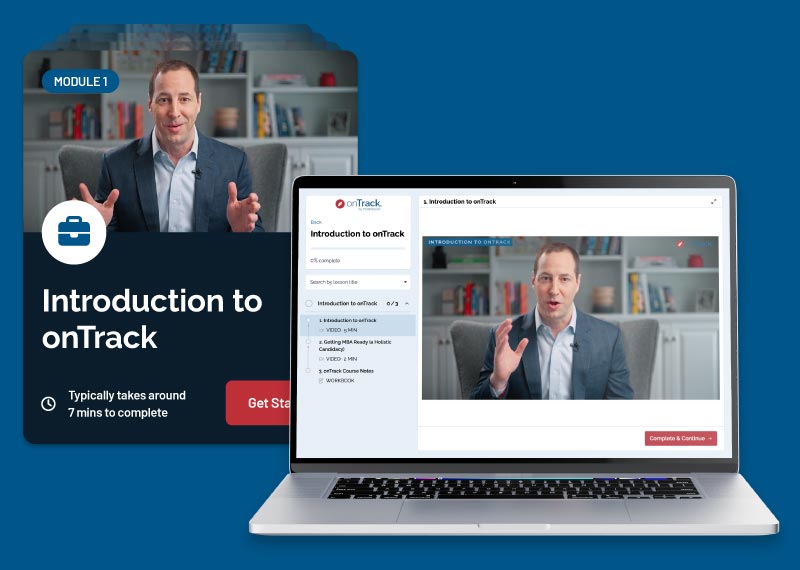
onTrack by mbaMission

A first-of-its-kind, on-demand MBA application experience that delivers a personalized curriculum for you and leverages interactive tools to guide you through the entire MBA application process.

Get Started!

2026–2027 MBA Essay Tips

Click here for the 2025–2026 MBA Essay Tips


MBA Program Updates

Explore onTrack — mbaMission’s newest offering allowing you to learn at your own pace through video. Learn more