Blog

September 2017 Event Roundup

Are you applying to business school this fall? If so, you can enroll in one of our free business school workshops, which are offered both online and in person in major cities across the country!

This month, we invite you to join us in Boston; NYC; and online! The event lineup includes the following sessions:

  • SEPTEMBER 5
    Essay Writing Workshop (Boston) 
    How can you write essays that grab the attention of MBA admissions committees? In this session, we will use this simple but often perplexing question as the starting point to a workshop for prospective business school applicants. Attendees will walk through a series of exercises that challenge them to uncover their personal and nuanced stories, craft compelling opening statements, develop meaningful goal statements, connect their goals to their target school’s resources, and more.
  • SEPTEMBER 14
    Assessing Your MBA Profile (Online) 

    In this session, learn to assess the quantitative and qualitative factors you bring to the table to better anticipate how you might be viewed by the admissions committee at the school of your dreams…and what you can do to improve that assessment!
  • SEPTEMBER 18
    The Last Minute MBA Application (Online) 
    In this session, we will review practical ways of making the most of the time you still have and provides concrete strategies for completing your applications on time—and with the quality you want.
  • SEPTEMBER 21
    Assessing Your MBA Profile (NYC)
    In this session, learn to assess the quantitative and qualitative factors you bring to the table to better anticipate how you might be viewed by the admissions committee at the school of your dreams…and what you can do to improve that assessment!
  • SEPTEMBER 28
    Choosing the Right B-School (Online)
    During this event, we will elaborate on areas that will profoundly affect both your academic life and your social life in business school, including flexibility of a program’s curriculum, breadth of core courses, different methods of instruction, and varying sizes of the cohorts. Start preparing now so you can be sure to make an educated decision when you apply!

To enroll in one of our free seminars, click the event title in the list above. We look forward to having you join us!

INSEAD Essay Analysis, 2017–2018

INSEAD - mbaMission

*Please note: You are viewing an essay analysis from the 2017-2018 admissions cycle. Click here to view our collection of essay analyses for the current admissions season. 

This application season, INSEAD has made almost no changes to its essay approach and prompts. The admissions committee is posing the same career-related short-answer questions, with just one notable tweak. Whereas last year, INSEAD asked candidates to share their short- and long-term career goals “with or without” an MBA from the school, this time, it is interested in hearing only the “with” option, having deleted “or without” from the prompt. Applicants must still submit three motivation essays and complete a video component, which involves answering four questions as four separate one-minute video recordings. The program does not share in advance what those four questions are or the topics they cover, though we imagine one is likely some variation of a “why INSEAD?” query. In this analysis, we offer our advice on responding to INSEAD’s suite of short-answer and essay questions.

Job Description 1: Briefly summarise your current (or most recent) job, including the nature of work, major responsibilities, and where relevant, employees under your supervision, size of budget, clients/products and results achieved. (short answer)

Job Description 2: What would be your next step in terms of position if you were to remain in the same company? (short answer)

Job Description 3: Please give a full description of your career since graduating from university. Describe your career path with the rationale behind your choices. (short answer)

Job Description 4: Discuss your short and long term career aspirations with an MBA from INSEAD. (short answer)

For the school’s job-related short-answer questions (essentially mini essays), we encourage you to start by very carefully parsing exactly what data the school requests for each. Together, these four prompts cover many of the elements seen in a traditional personal statement essay, including info about one’s career to date, interest in the school, and professional goals. However, the topics are clearly separated among individual submissions rather than covered in a cohesive single essay, and INSEAD also asks applicants to comment on their expected progression within their current firm were they to remain there rather than entering business school.

The first prompt requires that you outline roughly six different aspects of your current or most recent position. Be sure that you address each of the elements the school lists, and do not skip any just because you would rather write more about some than others. You may also want to consider providing a very brief description of your company or industry, if the nature of either might not be readily clear to an admissions reader. For the second question, your response should be fairly straightforward. If your firm has a clearly defined management hierarchy in which one position leads directly to a higher one—and you would be interested in adhering to that system—you simply need to explain this and perhaps offer a short description of the new responsibilities your next position would entail. If your company does not have such an arrangement or you would want to move in a different direction, simply explain what your preferred next role would be and the duties involved.

The third prompt is rather self-explanatory with respect to detailing the various stages of your career to date, but do not be remiss in responding to the “rationale” and “choices” aspects of the query. The school wants to know that your progression has not been passive, with your simply accepting the next good thing to come along, but rather that you have made thoughtful decisions with clear motivations and intentions behind them. For the fourth question, you will need to present your professional goals within the context of an INSEAD MBA education. Do your research on the school to identify specific resources it offers that relate directly to the skills and experiences you need to be successful in your career, thereby illustrating how INSEAD would help you achieve your aims. Above all, be sure to show determination and direction—that you are focused firmly on your intended end points and will not be easily deterred.

For all your job description responses, avoid using any acronyms or abbreviations that would not be easily recognizable to most people. Using shortcuts (in the form of abbreviations/acronyms) and skipping basic contextual information could make your answers less understandable and therefore less compelling and useful to an admissions reader, so do yourself a favor by more completely depicting your situation. Also, consider framing your responses to these rather straightforward queries in a narrative format to make them more interesting to the admissions reader, rather than simply outlining the basic information. Strive to incorporate a sense of your personality and individuality into your submissions.

As we have noted, these questions cover many elements of a traditional personal statement, so we encourage you to download a free copy of our mbaMission Personal Statement Guide. In this complimentary publication, we provide a detailed discussion of how to approach such queries and craft effective responses, along with multiple illustrative examples.

Optional Job Essay: If you are currently not working or if you plan to leave your current employer more than 2 months before the programme starts, please explain your activities and occupations between leaving your job and the start of the programme.

With this essay, INSEAD hopes to see signs of your interest in ongoing self-improvement, knowledge or experience collection, and/or giving back. Whether you are choosing to leave your job a few months before the beginning of the MBA program or are asked to do so by your employer, simply explain what you expect to do and gain during the  interim. The admissions committee wants to know that you are the kind of person who takes advantage of opportunities and to understand what kinds of opportunities appeal to you. For example, perhaps you plan to complete a few quantitative courses to be better equipped to hit the ground running in your related MBA classes, or perhaps you want to spend some time with distant family members or volunteering in your community because you know that your availability to do so will be limited when you are in school, and you want to maintain those important connections. Maybe you want to travel to improve your language ability in a more immersive environment before coming to INSEAD, given the importance of this skill in the school’s program. Or you might arrange informational interviews, job-shadowing opportunities, and/or unpaid internships, which could help in various ways with recruiting and job selection. Whatever your goals and plans, clearly convey how you anticipate your experience(s) to add to or change your character, enhance your skill set, and/or increase your understanding of yourself or others—all of which are valuable in business school.

Motivation Essay 1: Give a candid description of yourself (who are you as a person), stressing the personal characteristics you feel to be your strengths and weaknesses and the main factors which have influenced your personal development, giving examples when necessary (approximately 500 words).

Although INSEAD’s request for “main factors which have influenced your personal development” comes in the latter half of this essay prompt, we feel you should actually provide this context for your formative experiences before discussing the strengths and weaknesses you derived from them, because showing a clear cause-and-effect relationship between the two is important. The school asks that you offer examples “when necessary,” but your essay will be strongest if you present anecdotes to illustrate and support all your statements. Still, your essay should not end up being a hodgepodge of unconnected anecdotes that reveal strengths. Instead, focus on two or three strengths and one or two weaknesses in the mere 500 words allotted.

As always, be honest about your strengths (do not try to tell the committee what you think it wants to hear; truthfully describe who you legitimately are) and especially about your weaknesses—this is vital. Transparent or disingenuous statements will not fool or convince anyone and will only reveal you as someone incapable of critical self-evaluation.

Motivation Essay 2: Describe the achievement of which you are most proud and explain why. In addition, describe a situation where you failed. How did these experiences impact your relationships with others? Comment on what you learned (approximately 400 words).

For this essay, you will need to offer two anecdotes that reveal different sides of you as an applicant, describing a high moment from your life and a low moment. Because the school also asks you to address how these incidents subsequently influenced your interactions with others and what lessons they taught you, you must identify stories that not only involve a significant incident but also affected you personally in a meaningful and long-lasting way. These elements of your essay are just as important as the accomplishment and the failure you choose to share; your unique thoughts can differentiate you from other applicants, and showing that you recognize how these incidents changed you and your relations with others demonstrates your self-awareness and capacity for growth. Steer clear of trite and clichéd statements about your takeaways, and really reflect on these situations to uncover your deeper reactions and impressions. For example, everyone gains some level of resiliency from a failure, so you must offer something less common and more compelling and personal.

Be aware that the best failure essays are often those that show reasoned optimism and tremendous momentum toward a goal—a goal that is ultimately derailed. In most cases, you will need to show that you were emotionally invested in your project/experience, which will enable the reader to connect with your story and vicariously experience your disappointment. If you were not invested at all, it is hardly credible to discuss the experience as a failure or learning experience.

Motivation Essay 3: Describe all types of extra-professional activities in which you have been or are still involved for a significant amount of time (clubs, sports, music, arts, politics, etc). How are you enriched by these activities? (approximately 300 words)

Although stereotypes about the top MBA programs abound—this school wants consultants, that school is for marketing professionals, this other one is for techies and entrepreneurs—the truth is that they all want a diverse incoming class, full of people with various strengths and experiences that they can share with one another for the good of all. Discussing how you choose to spend your free time—explaining why your chosen activities are important to you and what you derive from them—provides the admissions committee with a window into your personality outside the workplace and classroom and an idea of what you could contribute to the student body and INSEAD as a whole.

Optional Motivation Essay: Is there anything else that was not covered in your application that you would like to share with the Admissions Committee? (approximately 300 words)

We tend to believe that the best use of the optional essay is to explain confusing or problematic issues in your candidacy, and this prompt offers an opportunity to do just that. So, if you need to, this is your chance to address any questions an admissions officer might have about your profile—a poor grade or overall GPA, a low GMAT or GRE score, a gap in your work experience, etc. We suggest downloading your free copy of the mbaMission Optional Essays Guide, in which we offer detailed advice on deciding whether to take advantage of the optional essay and how best to do so (with multiple sample essays), if needed.

INSEAD does not stipulate that you can only discuss a problem area in this essay, however, so you have some leeway to share anything you think may be pivotal or particularly compelling. We caution you against trying to fill this space simply because you fear that not doing so would somehow count against you. Remember, by submitting an additional essay, you are asking the admissions committee to do extra work on your behalf, so you need to make sure that time is warranted. If you are using the essay to emphasize something that if omitted would render your application incomplete, take this opportunity to write a very brief narrative that reveals this key new aspect of your candidacy.

Video

After submitting your INSEAD application, you will need to respond to four additional questions in video form.  You technically have until 48 hours after the deadline for the round in which you apply to complete this element of the process, but we strongly recommend doing so sooner rather than later while your mind is still in application mode and to ensure you do not somehow forget this task or have to rush through it at the end of the allotted time period.

Because all INSEAD interviews are conducted by the school’s alumni, members of the admissions committee have previously had no opportunity to see or meet with candidates; they had to learn all they could simply from the written portions of the application. This video component now gives the committee direct and dynamic insight into applicants’ character and personality, as well as another angle on their language abilities. About the videos, INSEAD says on its site, “The Admissions Committee is interested in obtaining an authentic view of you as a person, to see how you think on your feet and how you convey your ideas.” So when the time comes for you to record your responses, do your best to relax, answer genuinely, and let your true self shine through!

Business schools outside the United States are increasingly popular among MBA hopefuls, and we at mbaMission are proud to offer our latest publications: Program Primers for international b-schools. In these snapshots we discuss core curriculums, elective courses, locations, school facilities, rankings, and more. Click here to download your free copy of the INSEAD Program Primer.

The Next Step—Mastering Your INSEAD Interview: Many MBA candidates find admissions interviews stressful and intimidating, but mastering this important element of the application process is definitely possible—the key is informed preparation. We therefore offer our free Interview Primers to spur you along! Download your free copy of the INSEAD Interview Primer today.

London Business School Essay Analysis, 2017–2018

London Business School Essay Analysis - mbaMission

*Please note: You are viewing an essay analysis from the 2017-2018 admissions cycle. Click here to view our collection of essay analyses for the current admissions season. 

After several years of progressive changes to its application essay questions (and their maximum lengths), London Business School (LBS) has remained constant with its prompts this season. The school is once again stipulating just one required essay with a 500-word limit. Any candidates who believe this single brief essay is not enough opportunity to fully present themselves and their candidacy to the admissions committee can also submit a short optional essay. We offer here our guidance on making the most of LBS’s minimal essay options for 2017–2018.

Essays are a vital part of your application and we recommend that you spend a significant amount of time in their preparation.

Essay 1: What are your post-MBA goals and how will your prior experience and the London Business School programme contribute towards these? (500 words)

LBS’s primary essay prompt essentially requests several elements of a traditional personal statement. You will need to show that you have a long-term vision for yourself and your career and that you have a clear plan for how to get there with the help of an LBS MBA. The basic assumptions, of course, are that business school is the next logical and necessary step in your progress and that you need the LBS program in particular, because it offers specific experience, knowledge, skills, exposure, and/or other elements that are necessary for you to attain your long-term aspirations and chosen career. Ideally, you have already researched the school thoroughly to discover these important resources and areas of fit, but if not, do not skip this important step and/or refer only to basic offerings most business schools  have. Your essay must be LBS specific. Demonstrating your authentic interest in the program by offering concrete examples and drawing clear connections between what it offers, what you need, and who you are is key to crafting a compelling essay response here.

Because 500 words is not a lot, avoid going into excessive detail about your past, though you will need to offer enough information to provide context and support for your stated goals. As we have observed, this essay largely encompasses a standard personal statement, so we encourage you to download your free copy of the mbaMission Personal Statement Guide. In this complimentary guide, we present a much more detailed discussion of how to approach and craft this kind of essay, along with multiple illustrative examples.

Optional Essay: Is there any other information you believe the Admissions Committee should know about you and your application to London Business School? (500 words)

Applicants often use the optional essay to explain confusing or problematic elements of their candidacy—a poor grade or GPA, a low GMAT or GRE score, a gap in work experience, etc.—and LBS’s can certainly be used in this way. If you feel you need to clarify an aspect of your profile, first check the other parts of the school’s application, which already includes several opportunities to address certain issues (such as academic performance and disciplinary instances). If you can discuss your concern there instead, do so, and avoid using this essay to simply repeat any information provided via that avenue. If you have a problem to address that is not mentioned in the LBS application, we suggest downloading a copy of the mbaMission Optional Essays Guide, which is also available for free, and in which we offer detailed advice on deciding whether to take advantage of the optional essay and, if so, how best to do so to mitigate any concerning elements of your application.

However, if you do not feel your candidacy includes any elements in need of further clarification, you might use this essay instead to offer a more rounded, positive representation of yourself—but be thoughtful about this opportunity. Do not just copy and paste an existing essay you wrote for a different school here and hope for the best. Take a step back and carefully consider what the admissions committee already knows about you from the other parts of your application, including, of course, your other essay. Then, do your utmost to develop and convey a narrative that is truly crucial to understanding your character. Because this question is so open-ended, your options are somewhat limitless. You will need to honestly check your instincts and ask yourself whether you are simply tacking something extra onto your application with this essay or whether you are presenting an authentic representation of who you are as an individual. Be mindful and respectful of the admissions committee’s time, and remember that each additional file you submit requires more resources on behalf of the admissions office, so whatever you write must be truly worthwhile and clearly reveal that you made good use of this opportunity to provide further insight into your candidacy.

Business schools outside the United States are increasingly popular among MBA hopefuls, and we at mbaMission are proud to offer our latest publications: Program Primers for international b-schools. In these snapshots we discuss core curriculums, elective courses, locations, school facilities, rankings, and more. Click here to download your free copy of the London Business School Program Primer.

The Next Step—Mastering Your LBS Interview: Many MBA candidates find admissions interviews stressful and intimidating, but mastering this important element of the application process is definitely possible—the key is informed preparation. And, on your way to this high level of preparation, we offer our free Interview Primers to spur you along! Download your free copy of the London Business School Interview Primer today.

Texas McCombs Essay Analysis, 2017–2018

Texas McCombs Essay Analysis - mbaMission

*Please note: You are viewing an essay analysis from the 2017-2018 admissions cycle. Click here to view our collection of essay analyses for the current admissions season. 

As we have observed in the past, the McCombs School of Business at the University of Texas at Austin tends to tweak the wording of its essay prompts a bit each year, but the core of what the program hopes to learn from its applicants seems to stay largely static. The school always seems to find a way of pivoting the focus on the topics involved without veering away from them—keeping candidates on their toes (and, perhaps, admissions readers from getting bored!). For its first essay, McCombs has once again altered the scope of the implied intended audience, though we would be hard pressed to say definitively if the school has broadened it or narrowed it. Once framed as an introduction to one’s entire class (in 2013 and 2014), then to one’s cohort of approximately 65 students (in 2015), then to one’s study group of four to six classmates (in 2016), the command now stipulates no specific audience, which means applicants can envision any or all of these groups, or even a single person. For its second essay, the school has essentially flipped the prompt on a kind of temporal axis, having candidates imagine looking back on their time in the McCombs program rather than looking forward. Applicants with potential problem areas or unclear elements in their profile also have the opportunity to submit an optional essay to address these issues. Together, the McCombs application essays allow candidates to provide some fairly substantial insight into their personalities and values. In our analysis of the program’s prompts, we hope to help guide you in effectively doing so.

Essay 1: Introduce yourself. Select only one communication method that you would like to use for your response. Write an essay (250 words) OR  Share a video introduction (one minute)

As noted, last season’s prompt for this essay involved several sentences outlining the listeners or readers (depending on the submission type chosen) candidates should have in mind when crafting their response, along with some basic concepts to consider. This year, applicants have been presented with an arguably blank slate and offered just two words: Introduce yourself. We imagine that the less guidance a program provides with its essay questions, the more panic is generated in the hearts of hopeful candidates, but let us reassure you that you do not need to be intimidated. Some patience, self-reflection, brainstorming, and authenticity—with a dash of creativity—and you should be on the road to a standout submission.  

First, determine the format that is more compatible with your personality. If you are the quiet, thoughtful type, an essay may be the better choice; if you are typically the life of the party or a better speaker than writer, you should probably select the video option. Next, start identifying the kind of information you might share by thinking about what you would like to know about a new person you are meeting and would find interesting, helpful, or intriguing. For example, would you consider someone’s age or undergraduate institution particularly important or compelling? Probably not, so you should likely skip mentioning such facts in your own introduction. (Remember, too, that your actual audience will be a member of the admissions committee, who will already know such basic facts about you from the other parts of your application.) We imagine you would be more curious about what someone does in their spare time, what interesting or exceptional skills they have, whether they are approachable/funny/hyperorganized/a risk taker/etc., whether they have extensive experience in a certain area or a more wide-ranging background, and so on.

So think about the aspects of your personality and profile that you believe truly define you as an individual—not just what you do and have done, but who you are—and fully explore your background, hobbies, talents, experiences, values, goals, and quirks. Brainstorm an extensive list and then eliminate any items that seem too common (e.g., a BA in finance) or basic (e.g., your hometown) until you have a collection of truly distinctive qualities you can weave into your response. Your goal is to provide a well-rounded picture of yourself that draws from multiple areas and shows that you possess characteristics and/or knowledge that would make you a positive addition to McCombs’ diverse community.

Remember to bring energy and enthusiasm to your submission. You are not filling out a job application—you are trying to connect with others, so charisma is key, and a less rigid and traditionally “professional” demeanor is okay. Forego any fancy essay-writing or dramatic tactics (e.g., starting with a quotation, launching into an anecdote) and just be as natural and authentic as possible. Do not pitch your candidacy, detail your career goals, or express your admiration for the program. As they say, you only have one chance to make a first impression, so dedicate the time and work necessary to ensure that your introduction is engaging, substantive, and true to who you are.

If you choose to submit a video, think beyond what you will say and also consider the clothing you will wear, the setting or background of your video, your tone of voice, your language style, whether you will include music, and other similar details. Brainstorm ways of nonverbally communicating some of your strongest attributes and key aspects of your life to help permeate your submission with as much information as possible. For example, if you are an avid biker, consider filming your video while you are actively riding. If you are a dedicated musician, perhaps incorporate your instrument into your message by playing it while you speak (if you are especially confident, you might even sing about yourself!). Think about what makes you who you are today, decide what you most want to share about yourself, and then let your creativity flow.

On a practical note, be sure to speak clearly in your video. You naturally do not want any part of your message to be lost or misunderstood, and the admissions committee may view your communication skills and style as indicators of how you might interact with your classmates and/or speak in the classroom. Spend some time practicing in front of a mirror or a friend, but do not overrehearse. And definitely do not try to read from an off-camera script or notes (trust us—they will be able to tell!). You want to come across as genuine and natural.

Essay 2: Picture yourself at graduation. Describe how you spent your two years as a Texas MBA student, and how that experience helped to prepare you for the post-MBA world. (500 words)

McCombs has stripped some specifics from its second essay question this year, but the fundamental information the school is seeking has remained pretty consistent. Rather than framing the question as how will you use the McCombs program to get from where you are now to where you want to be?, the admissions committee is challenging you to imagine yourself where you want to be at the end of your studies (mentally, emotionally, professionally) and then explain how you used or navigated the MBA program to get there. So, without using the actual words “why McCombs?” and “how will you engage with our community?,” the school is nevertheless asking you for precisely this information.

The school essentially wants to know the reasons you have selected the McCombs program in particular and how you will take advantage of specific resources and experiences it offers. Why is it the most appropriate school for your goals, and why/how does it fit you personally? The assumption is that something you have learned about McCombs leads you to believe that the school would provide the experience, knowledge, skills, exposure, and/or other element you need to reach your goals. Likewise, something makes you feel you would fit well with the McCombs environment and be comfortable there, that you would be able to be and express the “real” you. So what are those things? All the top MBA programs want reassurance that the candidates they admit have not applied simply because of the school’s reputation or ranking but rather because they are truly excited to be a part of the community and to benefit from that specific learning experience. McCombs is not simply seeking warm bodies with which to fill its classrooms; it is striving to add to a long history of effective global business leaders and a network of alumni dedicated to the school and each other. Demonstrating your authentic interest in the program by offering concrete examples and drawing clear connections between who you want to be and what the school offers is key to crafting a compelling essay response.

If you have targeted McCombs because you feel it is the right program for you, you likely already have an idea of why that is true and how you would function as part of its community. If you do not yet have a handle on these points, you definitely need to start (now!) researching the school thoroughly, including interacting directly with students and/or alumni. Identify at least one (ideally more) resource, offering, or quality that McCombs has that is unique or that it excels in that directly relates to what you need to attain your post-MBA goals. And do not just offer a list—you must explain how the identified element(s) will fulfill particular needs for you.

Keep in mind that business school is not only about course work and recruiting. You can (and should!) also have fun, make friends, and be a contributing member of the community outside the classroom. So take care not to discuss only academic and professional development elements of the McCombs program. Explore the school’s social events and offerings—including affinity, social, and sports clubs, for starters—to identify other aspects of the experience that you anticipate will also play an important role in your MBA journey. Although we would not encourage you to force this angle and mention something just to tick a box, so to speak, addressing these options can be an effective way of revealing more of your values and personality to the admissions committee and thereby presenting a more well-rounded impression of yourself.

Optional Statement: Please provide any additional information you believe is important and/or address any areas of concern that will be beneficial to the Admissions Committee in considering your application (e.g. unexplained gaps in work experience, choice of recommenders, academic performance, or extenuating personal circumstances). (250 words)

We tend to believe that the best use of the optional essay is to explain confusing or problematic issues in your candidacy, and this prompt offers an opportunity to do just that. So, if you need to, this is your chance to address any questions an admissions officer might have about your profile—a poor grade or overall GPA, a low GMAT or GRE score, a gap in your work experience, etc. Consider downloading a free copy of our mbaMission Optional Essays Guide, in which we offer detailed advice on deciding whether to submit an optional essay and on how best to approach writing such a submission, with multiple examples.

However, because McCombs does not stipulate that you can only discuss a problem area in this essay, you have some leeway to share anything you think may be pivotal or particularly compelling. We caution you against trying to fill this space simply because you fear that not doing so would somehow count against you. Remember, by submitting an additional essay, you are asking the admissions committee to do extra work on your behalf, so you need to make sure that time is warranted. If you are using the essay to emphasize something that if omitted would render your application incomplete, take this opportunity to write a very brief narrative that reveals this key new aspect of your candidacy.

University of Pennsylvania Wharton School Essay Analysis, 2017–2018

Wharton School at the University of Pennsylvania

*Please note: You are viewing an essay analysis from the 2017-2018 admissions cycle. Click here to view our collection of essay analyses for the current admissions season. 

The Wharton School at the University of Pennsylvania has opted to maintain its two broad mandatory essay questions—one focusing on “why Wharton?” and the other on applicants’ expected contributions to the school’s community—this year, with no changes whatsoever. Wharton obviously wants to know that candidates have taken the time to get to know the school’s program and character in depth and can clearly visualize themselves as part of it. Applicants also have the opportunity to submit an optional essay, if they feel a need to do so, to address any problematic or potentially confusing elements of their profile. Altogether, the school’s prompts allow you to craft a rather personal impression of yourself for the admissions committee, one that should complement the more quantitative parts of your application. In our analysis, we proffer our advice on how you might accomplish this.

Required Essay 1: What do you hope to gain professionally from the Wharton MBA? (500 words)

In a mere 500 words, you must discuss your career goals—giving very brief context for why they are realistic for you—and then reveal how Wharton will help you pursue these goals by demonstrating a thorough understanding of what the school offers and a well-thought-out game plan for availing yourself of these offerings. To effectively do this, you must first familiarize yourself with Wharton’s various resources and pinpoint those that truly pertain to you and the direction in which you hope to go. Simply presenting a list of classes that you think sound interesting will not suffice here, and avoid vague statements about how great the school is. You must clearly demonstrate a connection between your aspirations, what you need to achieve them (e.g., skills, experience[s], connections, exposure), and what Wharton in particular can provide that will enable you to fill those gaps.

Note that Wharton asks applicants to address only the professional aspect—not the professional and personal aspect (as it has in past years)—of their business school goals. This allows you to share your career-related stories and ambitions more fully, which in turn means you can and should use the other essay(s) to discuss non-work aspects of your life and thereby provide a more complete and well-rounded picture of yourself for the admissions committee.

In many ways, this prompt is asking for a typical MBA personal statement. We therefore encourage you to download your free copy of the mbaMission Personal Statement Guide. This complimentary guide offers detailed advice on approaching and framing these subjects, along with multiple illustrative examples. Be sure to claim your copy today.

Required Essay 2: Teamwork is at the core of the Wharton MBA experience with each student contributing unique elements to our collaborative culture. How will you contribute to the Wharton community? (400 words)  

Whether this question is meant to be about teamwork or about contribution is not immediately clear. We see nothing wrong with relating some of your team-related experiences in this essay, but what the admissions committee is really interested in learning is what you can contribute to a team—and these are not necessarily the same thing. You can be an additive member of the Wharton community and culture in numerous ways. For example, perhaps you have specialized knowledge you could bring to your Wharton Learning Team that would provide context in analyzing certain business problems and cases. Maybe you have a character trait that has enabled you to bring people together in past communities, such as a good sense of humor or even strong listening skills. You might even have specific experience that pertains directly to a club you would like to lead or join.

We can think of almost limitless examples, and the ones we have presented here are possibly even a bit banal, because the key to being effective with this essay is to really own your proffered contribution. This you accomplish by sharing your unique personal stories and then relating them to specific resources at Wharton. We suspect that many applicants will discuss a certain trait or skill and then end their essay with a platitude like “And I will bring this skill to Wharton for the betterment of all.” To create a truly strong and compelling essay, you must convincingly show that you fully understand the Wharton experience and are prepared to make a distinct and individualized contribution.

To better familiarize yourself with the Wharton program and get an insider’s perspective on its academic program, unique offerings, social life, and other key characteristics, be sure to download a complimentary copy of the mbaMission Insider’s Guide to the Wharton School of the University of Pennsylvania.

Additional Essay:  Required for all reapplicants. Explain how you have reflected on the previous decision about your application, and discuss any updates to your candidacy (e.g., changes in your professional life, additional coursework, extracurricular/volunteer engagements). (250 words)

First-time applicants may also use this section to address any extenuating circumstances. (250 words)

If you are a Wharton reapplicant, this essay is pretty straightforward. Whether you have improved your academic record, received a promotion, begun a new and exciting project, increased your community involvement, or taken on some sort of personal challenge, the key to success with this essay is conveying a very deliberate path of achievement. Wharton wants to know that you have been actively striving to improve yourself and your profile, and that you have seized opportunities during the previous year to do so, because a Wharton MBA is vital to you. The responses to this essay question will vary greatly from one candidate to the next, because each person’s needs and experiences differ. We are more than happy to provide one-on-one assistance with this highly personal essay to ensure that your efforts over the past year are presented in the best light possible.

However, if you are not a Wharton reapplicant, pay special attention to the last line of this prompt: First-time applicants may also use this section to address any extenuating circumstances.  Here is your opportunity—if needed—to address any lingering questions that an admissions officer might have about your candidacy, such as a poor grade or overall GPA, a low GRE or GMAT score, or a gap in your work experience. If you feel you may need to submit an additional essay for such a reason, consider downloading your free copy of our mbaMission Optional Essays Guide, in which we offer detailed advice on when and how to take advantage of the optional essay (along with multiple sample essays) to help you mitigate any problem areas in your profile.

The Next Step—Mastering Your Wharton Interview: Many MBA candidates find admissions interviews stressful and intimidating, but mastering this important element of the application process is definitely possible—the key is informed preparation. And, on your way to this high level of preparation, we offer our free Interview Primers to spur you along! Download your free copy of The Wharton School of the University of Pennsylvania Interview Primer today.


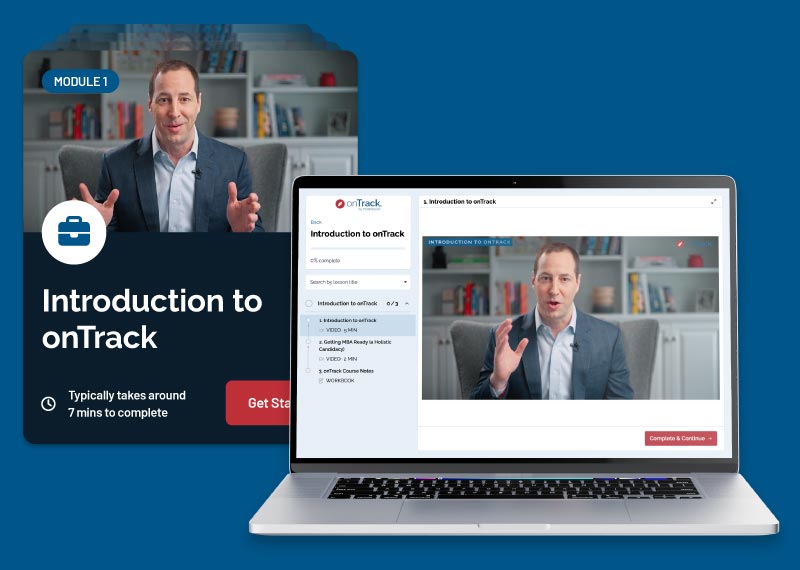
onTrack by mbaMission

A first-of-its-kind, on-demand MBA application experience that delivers a personalized curriculum for you and leverages interactive tools to guide you through the entire MBA application process.

Get Started!

2026–2027 MBA Essay Tips

Click here for the 2025–2026 MBA Essay Tips


MBA Program Updates

Explore onTrack — mbaMission’s newest offering allowing you to learn at your own pace through video. Learn more