Blog

March 2018 Event Roundup

Are you applying to business school this year? If so, you can enroll in one of our free business school workshops, which are offered both online and in person in major cities across the country!

This March, the event lineup includes the following sessions:

  • March 7
    MBA Interview Workshop (Online)
    What do you need to do to prepare for your business school interview? An experienced senior consultant will help prospective MBAs understand the types of questions that may be asked to best prepare for interviews.
  • March 14
    Choosing The Right B-School (Online)
    During this event, we will elaborate on areas that will profoundly affect both your academic life and your social life in business school, including flexibility of a program’s curriculum, breadth of core courses, different methods of instruction, and varying sizes of the cohorts. Start preparing now so you can be sure to make an educated decision when you apply!
  • March 21
    Assessing Your MBA Profile (Online)
    In this session, learn to assess the quantitative and qualitative factors you bring to the table to better anticipate how you might be viewed by the admissions committee at the school of your dreams…and what you can do to improve that assessment!
  • March 28
    MBA Interview Workshop (Online)
    What do you need to do to prepare for your business school interview? An experienced senior consultant will help prospective MBAs understand the types of questions that may be asked to best prepare for interviews.

To enroll in one of our free seminars, click the event title in the list above. We look forward to having you join us!

Managing Your MBA Interview

“What if I don’t know the answer to a question I’m asked?” This is probably the number one anxiety among business school candidates facing an admissions interview. Thankfully, however, it is largely an unnecessary one, because your interviewer will always be asking questions about a topic you actually know very well—you!—not questions that require applied knowledge or research. So, in an MBA interview, you will not need to know how to calculate a discounted cash flow or express your opinion about the U.S. interest rate policy. Instead, you must be able to reflect on and discuss your life experiences, why you want an MBA, the value you can add to your target program and how you expect to engage with it, and your reasons for wanting to attend the specific school at which you are interviewing.

When mbaMission spoke with Bruce DelMonico, the senior associate director of admissions at the Yale School of Management, he was clear that the program’s interviewers are not asked to create a stressful situation for candidates, explaining that the interview is instead a “fairly standard behavioral interview.” He added, “The purpose is not to trick you or throw curveballs but [to] really get a sense of the applicant.” Similarly, Kurt Ahlm, the associate dean for student recruitment and admissions at the University of Chicago Booth School of Business, told us, “Whether [conducted by] current students, alumni, or staff members, we approach interviews as a dialogue between two very interested parties who genuinely want to get to know each other.”

As you prepare for your interview, start by reviewing your entire application in depth, paying particular attention to the stories you presented in your essays. Be sure to reexamine your reasons for targeting the specific schools you have chosen and get comfortable speaking out loud about your short- and long-term goals and ambitions. In addition, take some time to think about the inflection points in your life and how and why you made the particular choices you did at those important times. Finally, consider instances when you have performed as an individual or a team player. In short, your goal in preparing for your interview is to be ready with anecdotes that highlight important aspects of your personality, capabilities, and experience and to be thereby equipped to engage in a thoughtful conversation with someone who is there to listen to and learn about you.

MBA interviews fall into two categories: blind and comprehensive. In a blind interview, your interviewer will not have read your file and will come to the meeting with very little information about you beyond, perhaps, what is listed in your résumé. As a result, you can expect to be asked primarily open-ended questions. For example, your interviewer may start with a fairly basic question like “Can you walk me through your resume?” or “Tell me about yourself—who are you?” As you answer this opening question, your interviewer may interject with a few questions along the way in response to certain topics as they arise. Or, he/she may just sit quietly and allow you to finish your response, then follow up with additional questions about why you feel you need to go to business school and why you have chosen this specific school. Later, your interviewer will likely ask you about your leadership and team experiences—both successes and failures—and may finish with questions about your personal interests and community activities. Blind interviews follow no real standard form. Your interviewer will pose the questions, but you can control a lot of the direction and tone of the interview by selecting the nature and content of your responses.

In a comprehensive interview, your interviewer will have read your entire application file and will already have questions in mind, most often ones that focus on how you make decisions or respond to certain situations. For example, a question for someone who was transferred for a promotion might be “What were the differences culturally between the Los Angeles office and the Boston office—and how did you adjust?” Or, alternatively, someone who gained an early promotion might be asked, “Why do you think ABC Consulting made the choice to promote you ahead of others?” Although you will not be able to control the agenda of a comprehensive interview as easily as you might that of a blind interview, you will probably end up feeling challenged but not as though you had been “grilled.” Your interviewer is not trying to poke holes in your stories or trip you up in any way, but rather to better understand your choices, motivations, and personality by probing into your experiences in more depth.

Regardless of the interviewer’s approach, many business school applicants still worry that they may be asked a single challenging question during the interview that will leave them awkwardly silent and that this moment will ultimately mark the end of their candidacy at the target school. We understand that such an experience would certainly be uncomfortable—and we suggest, of course, that you prepare as best you can to avoid this kind of predicament—but we can assure you that an uneasy pause in the middle of an interview is not enough to cancel out all the positive elements of your application. Still, we offer the following tips to help you mitigate any uncomfortable moments:

Resist the urge to launch into a story. Your instinct may be to just start speaking, hoping that you will find the right story as you progress. This is a high-risk strategy, because if it goes wrong, it can compound the problem. Instead, pause for a moment to form an appropriate response. You can even say, “That is a good question. I am going to have to think about it for a moment,” before answering.

Take a sip of water, if available. Many interviewers will offer candidates a glass of water at the beginning of the meeting. Take the water, if offered, and use it throughout the interview as a buffer to buy time or force yourself to slow down. If you get stumped, the water can offer a brief opportunity to pause naturally, alleviating any awkwardness before you begin speaking again.

Maintain your poise. If you absolutely cannot answer a question, do not become overly apologetic or grovel. Simply acknowledge that you are having trouble with the question and politely ask if you might come back to it at the end. This is not a best-case scenario, but it is certainly far better than rambling and apologizing. A confident approach during a tricky moment may even impress!

Forget about it. If you cannot answer a question, accept the fact and move on. If you spend the rest of the interview thinking about that moment, you will be distracted and struggle with any subsequent questions.

Many MBA candidates try to predict what their interviewer will ask them and memorize their interview responses in advance. Unsurprisingly, they later find themselves fumbling as they struggle to adapt their well-rehearsed answers to fit slightly different iterations of the questions they had expected—not a formula for a smooth, effective interview at all! Instead, we suggest that you compile a mental list of stories that you feel are important for you to share and then imagine different opportunities through which you might incorporate those stories into your interview. In other words, think about possible prompts to which you can “hook” the key points you hope to make. For example, if you spend one afternoon per week tutoring inmates to take the GED, you could include this story in your interview by adapting your response to different cues as follows:

Tell me about a time when you demonstrated initiative.

“I wanted to make a difference in my community but was looking for an opportunity to move beyond helping just high school students. So I researched where the biggest need was in my area and found a program that brings volunteers to prisons to tutor inmates who want to earn their GED…”

Tell me about a time when you went above and beyond.

“For the past few years, I have been engaged in some meaningful service—teaching GED prep in a local prison. I was surprised to find that inmates were only allowed to attend one hour of extra tutoring per week. Recognizing that my students needed additional help, I devoted extensive time and effort to developing a series of math and vocabulary flash cards for them to use between sessions…”

Tell me about a time when you had to motivate a reluctant person.

“I believe my best example occurred outside the office, as part of my volunteer work with inmates studying to take the GED. Although most of the inmates I tutor are very motivated, once in a while I work with someone who needs a little extra prodding. One inmate I worked with was not very willing to do the practice exercises, so I…”

We are not suggesting you respond to three different prompts with the same story, of course, merely illustrating how the same core story can be used for multiple types of questions. By identifying your key personal stories and examining them from several different angles before your interview, you can better ensure that you will find a way to share them during your interview.

mbaMission offers even more interview advice in our FREE Interview Primers, which are available for 17 top-ranked business schools.

November 2017 Event Roundup

Are you applying to business school this year? If so, you can enroll in one of our free business school workshops, which are offered both online and in person in major cities across the country!

This month, we invite you to join us in NYC and online! The event lineup includes the following sessions:

  • November 9
    Avoiding the Traps of the Overrepresented MBA Applicant (Online)
    How can you stand out if you are in an overrepresented applicant group? An experienced senior consultant will help prospective MBAs understand how to identify and showcase distinct aspects of your profile that will distinguish you from others.
  • November 14
    MBA Interview Workshop (Online)
    What do you need to do to prepare for your business school interview? An experienced senior consultant will help prospective MBAs understand the types of questions that may be asked to best prepare for interviews.
  • November 15
    MBA Admissions Myths Destroyed (Online)
    With the advent of chat rooms, blogs and forums, armchair “experts” often unintentionally propagate MBA admissions myths, which can linger and undermine an applicant’s confidence. Some applicants are led to believe that schools want a specific “type” of a candidate and expect certain GMAT scores and GPAs, for example. Others are led to believe that they need to know alumni from their target schools and/or get a letter of reference from the CEO of their firm in order to get in. Join us as we debunk these and other myths, strive to take the anxiety out of the admissions process, and refocus you on your applications.
  •  November 30
    Assessing Your MBA Profile (NYC)
    In this session, learn to assess the quantitative and qualitative factors you bring to the table to better anticipate how you might be viewed by the admissions committee at the school of your dreams…and what you can do to improve that assessment!

To enroll in one of our free seminars, click the event title in the list above. We look forward to having you join us!

MBA Admissions Myths Destroyed: I Love You So Much That I Cannot Stop Writing About It

Although admissions officers want to know that you are interested in their school, they do not want to read your repeated professions of love for it. Some candidates mistakenly believe they must include in each essay numerous enthusiastic statements about how they will improve their skills at their target school, regardless of whether the school asks for such information.

For instance, consider this entirely fictitious example of an individual who responds to the essay question “What achievement are you most proud of and why?” by writing the following:

“In starting ABC Distributors, I learned a great deal about entrepreneurship, and I hope to formalize this knowledge at the XYZ School of Management. Only with XYZ’s vast entrepreneurial resources and profound alumni connections will I be able to take my next venture to a higher level. At XYZ, I will grow my business skills and potential.”

We can identify numerous problems with this submission—including that the statements are cloying and have no real substance. However, the most egregious issue is that the school never asked the applicant to discuss how the program would affect his/her abilities. Thus, the “Why our school?” component is just empty pandering.

As you write your essays, always focus on answering the essay questions as they are written—do not try to anticipate or respond to unasked questions. So, if your target school does not explicitly request that you address the question “Why our school?,” do not look for ways to sneakily answer that question in your essay(s).

Of course, if the school does ask for this information, then certainly do your research and provide it. Again, the key is to always respond to the school’s question and give the admissions committee the information it wants.

Invited to Interview at Harvard Business School? Here Are Some Helpful Resources

On October 5, Harvard Business School (HBS) sent out its final batch of interview invitations for Round 1 applicants. If you are among the candidates who received an invitation, congratulations! Now it is time to get ready for this crucial step in your application process. Check out these important resources created specifically for HBS interview candidates.

MOCK INTERVIEW

During our HBS Mock Interview and Post-Interview Reflection Support sessions, you will speak with an experienced mbaMission consultant who will have read your entire HBS application. You will then be able to plan and practice your answers to typical questions posed by HBS interviewers to previous applicants. Through Q&A, feedback, and thorough response planning, we will help you improve the content of your answers, your time management skills, and your overall presentation.

HBS asks all interviewed applicants to write a post-interview essay and submit it within 24 hours of their interview. This essay has no word limit, and HBS suggests that candidates think of it as an email they would write to a friend or colleague, rather than as a formal essay.

As part of our targeted HBS interview package, an mbaMission consultant will help you strategize your approach to this special essay. Your consultant will also review a draft of the essay and provide feedback intended to assist you in making it stronger and more effective. Please note that because the HBS Admissions Office explicitly states that applicants are not to write anything in advance or receive outside help with this essay, your mbaMission consultant will not edit your writing but will instead offer detailed strategic direction via comments only. Given the 24-hour deadline, we will suspend our contracted two-business-day turnaround for this essay. You and your consultant will determine a schedule that accommodates both your needs and the school’s deadline.

Mock interviews are conducted via phone or Skype for $750. In-person mock interviews may be available for a $100 surcharge. To purchase your HBS mock interview preparation session, click here!

LIVE WEBINAR

HBS interview candidates are also invited to enroll in our free, live online Interview Workshop on October 11. During the presentation, we will offer advice on best practices to help you prepare for and succeed in your business school interviews. mbaMission Senior Consultant Rachel Beck will explore the different types of interviews, what each admissions committee is looking for, and tips for time management. To enroll for free, click here.

INTERVIEW PRIMER

Many MBA candidates find admissions interviews stressful and intimidating, but mastering this important element of the application process is definitely possible—the key is informed preparation. Download your complimentary copy of the Harvard Business School Interview Primer today.

In creating our primers, we have drawn on countless communications with MBA students, alumni, admissions officers, and applicants, in addition to our vast library of interview reports submitted by current and past clients. Our HBS Interview Primer provides:

  • Insight into what the school is evaluating and hoping to gain from the interview
  • An explanation of the school’s approach to interviewing (self-scheduled or invite only, blind versus comprehensive, etc.)
  • Past applicants’ firsthand accounts of their interview experiences and multiple sample interview question sequences
  • Tips on preparing for and responding to questions that most typically vex applicants
  • Help in formulating compelling questions of your own

Good luck to all!


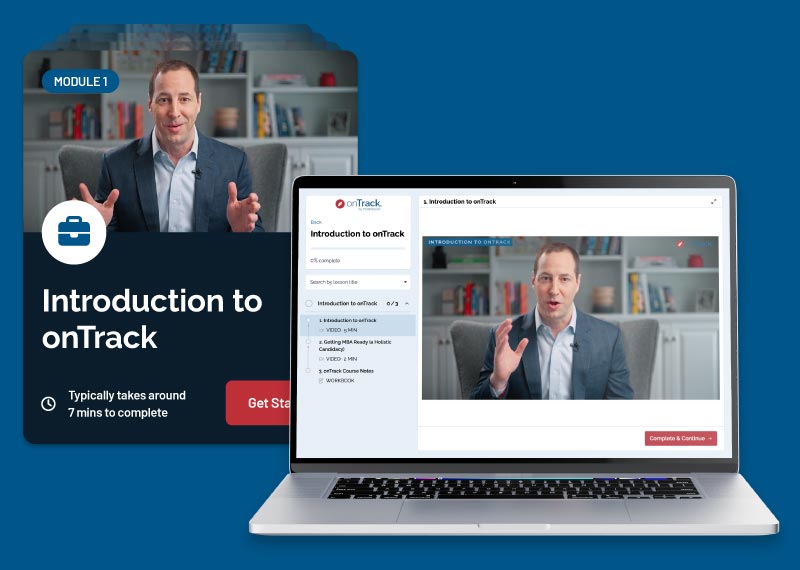
onTrack by mbaMission

A first-of-its-kind, on-demand MBA application experience that delivers a personalized curriculum for you and leverages interactive tools to guide you through the entire MBA application process.

Get Started!

2026–2027 MBA Essay Tips

Click here for the 2025–2026 MBA Essay Tips


MBA Program Updates

Explore onTrack — mbaMission’s newest offering allowing you to learn at your own pace through video. Learn more