Blog

MBA Admissions Myths Destroyed: I Should Quit My Job for the GMAT

The GMAT is the sole piece of data that is truly consistent from one candidate to another. Therefore, many MBA applicants get carried away and place undue emphasis on it, when the test is only one of several important aspects of an application. In extreme cases, some applicants consider quitting their jobs to focus on the GMAT full time—not a great idea!

Why is it not ideal to quit your job to improve your GMAT score? Quite simply, it sends the message that you cannot manage what many other MBA candidates can manage quite well. In your application, you will need to account for any time off; if you honestly note that you quit your job to study for the GMAT, you will place yourself at a relative disadvantage to others who have proved that they can manage work, study, and possibly volunteer work simultaneously. By taking time off, you will send the unintended message that you cannot achieve what many do unless you have an uneven playing field. This is not the message you want to send your target academic institution, which wants to be sure that you can handle the academic course load, a job hunt, community commitments, and more.

Regardless of the admissions committees’ perceptions of taking time off, we believe a calm and methodical approach is your best bet. By furthering your career as you study, you will have a sense of balance in your life. On test day, you will have a far better chance of keeping a level head, ensuring that you will do your best—which, of course, was the point in the first place.

University of Virginia (Darden) Essay Analysis, 2017–2018

University of Virginia (Darden) Essay Analysis, 2016–2017 - mbaMission

*Please note: You are viewing an essay analysis from the 2017-2018 admissions cycle. Click here to view our collection of essay analyses for the current admissions season. 

This application season, the University of Virginia’s Darden School is maintaining its single essay question approach, though the content of the query has changed. The school has been known to later add a few—much shorter—prompts, however, so you will need to stay alert for those, in case Darden does so again this year. In the meantime, focus your efforts on the program’s primary essay question, which prods applicants to discuss a past situation in which their opinion on a matter was changed as a result of input from and interaction with others. At first glance, we assume that with this prompt, Darden’s admissions committee is hoping to gain insight into applicants’ capacity for self-assessment and their openness and responsiveness to other viewpoints. You have only 500 words with which to convey all this, so you will need to be simultaneously thorough and concise. We offer our analysis to help you achieve this.

Essay 1: When preparing for class at Darden, students formulate an opinion on each case before meeting with their learning teams and class sections. When encountering different views and perspectives from their own, opinions frequently shift. Tell us about a time when your opinion evolved through discussions with others. (500 words maximum)

A cornerstone of the Darden MBA program is the case method of learning, in which students are presented with an actual business problem, along with all the relevant associated data, and tasked with identifying a solution to that problem. Each person analyzes the situation and information on his or her own, then discusses and debates it with the members of his or her learning team, and finally does so once again in the classroom. So having one’s ideas and opinions questioned and challenged is part and parcel of the Darden experience, which is undoubtedly why the admissions committee has chosen to pose this essay prompt. What better way to assess whether an applicant is the kind of person who would thrive in and benefit from such an interactive and intellectually stimulating environment?

Darden clearly wants evidence that you are capable of listening, reflecting, learning, and growing. If you are not able to do so, the school might assume that you simply do not have the necessary qualities to become an integral part of its next incoming class, let alone a standout manager later in your career. To craft an effective essay response to this query, focus on describing a “before and after” situation in which the information or input another person provided you served as an inflection point that triggered a dramatic change in your thinking.

In business school—as in life in general, in fact—you will encounter people who think differently from you, operate according to different values, and react differently to the same stimuli. And success in an endeavor often involves evaluating and even incorporating the views of others in one’s efforts, but it can also result from resisting opposing perspectives. With this essay prompt, Darden is hoping to learn how you act/react when faced with such differences, using the principle that past behavior is a fairly reliable predictor of future behavior. As we have explained, in the Darden MBA program, you will definitely be required to navigate and consider differing opinions in the course of analyzing case studies, as well as when completing group projects and pursuing other activities both inside and outside the classroom. Do you tend to hold firmly to your convictions, debating divergent views and attempting to persuade others to your mind-set? Or do you readily receive contrasting opinions, taking time to weigh them and consider their applicability to the situation in question? Using a narrative approach, share with the admissions committee a situation in which you faced a perspective that deviated from your own and how this difference influenced your subsequent thought processes and perhaps even your actions.   

For a thorough exploration of the UVA Darden academic program, unique offerings, social life, and other key characteristics, be sure to download your complimentary copy of the mbaMission Insider’s Guide to the UVA Darden School of Business Administration.

The Next Step—Mastering Your UVA Darden Interview: Many MBA candidates find admissions interviews stressful and intimidating, but mastering this important element of the application process is definitely possible—the key is informed preparation. To help you on your way to this high level of preparation, we offer our free Interview Primers. Download your free copy of the UVA Darden Interview Primer today.

Northwestern University (Kellogg) Essay Analysis, 2017–2018

Northwestern University (Kellogg)

*Please note: You are viewing an essay analysis from the 2017-2018 admissions cycle. Click here to view our collection of essay analyses for the current admissions season. 

The Kellogg School of Management at Northwestern University has made minimal changes to its application essay prompts this year. The school’s required first essay has maintained its focus on leadership, but gone is the reference to teamwork, replaced by a request for evidence of “lasting value.” Kellogg also no longer stipulates that the incident candidates share be “recent,” thereby allowing applicants to plumb the full range of their history as needed to identify the most compelling or appropriate story. As for the video essays, we note that Kellogg is not stating this season that one of the questions will definitely be about a challenge, though we take this to mean merely that some applicants may receive such a question while others may not. The bottom line with Kellogg’s video questions is that they have no wrong answers and are intended to help the admissions committee get a more authentic impression of your personality (not to intimidate you!), so we hope applicants are not too concerned by that part of the application. In our analysis, we present our thoughts on how to address all the school’s prompts for 2017–2018.

Required Essay 1: Kellogg’s purpose is to educate, equip & inspire brave leaders who create lasting value.  Tell us about a time you have demonstrated leadership and created lasting value.  What challenges did you face, and what did you learn? (450 words)

In reality, this is a fairly straightforward essay prompt, and we recommend responding in an equally straightforward manner. Launch directly into the story of your leadership experience and detail the specific actions you took in directing others to achieve some kind of enduring result. The key here is to show you shared a valuable experience with colleagues, extracted the most from your team members, and attained a desired outcome. Although we often note that not all great leadership stories necessarily have to end in success, Kellogg’s request for evidence of “lasting value” certainly implies that the school wants to hear about a situation that had a positive, if not victorious, outcome. You will need to convey not only your role in spearheading a group to achieve what you did but also how that achievement persists to this day.

Note that Kellogg does not specify that the experience you share must be related to your workplace or career. Leadership does not need to have an official title attached to it, and it can be expressed in a community service or even family life setting just as much as in a workplace, so explore all the different areas of your life for possible stories. We recommend using a narrative approach to presenting your story, but be sure to also share the thought process and motivation(s) behind your actions. This way, the admissions committee will take away both a clear picture of what you accomplished and the aspects of your character that inspired you and helped enable your success.

That said, the school acknowledges within the prompt that even endeavors that have a positive result are rarely smooth sailing from beginning to end—hence the question about challenges faced. A mistake applicants often make in writing this kind of essay is presenting a strong narrative in which they are incredible leaders, and then near the end, making a brief (and typically disjointed) reference to a hardship or conflict encountered along the way, meant to fulfill the “challenges” element of the essay query. To be effective and believable, your ups and downs must be woven intrinsically into your narrative, rather than simply acknowledged at the end. Clearly explaining how you approached and prevailed over the challenge at hand is crucial, so go beyond simply describing the roadblock itself and ensure that you detail your response and the inner workings of your decision making at that point.

Lastly, do not forget or neglect to explain what you learned from the experience—Kellogg specifically asks you to do so! And keep in mind that for your takeaways to be “meaningful,” they have to be profoundly connected to your narrative. The admissions reader should be able to easily understand the connection between the situation you describe and your subsequent learnings.

Required Essay 2: Pursuing an MBA is a catalyst for personal and professional growth. How have you grown in the past? How do you intend to grow at Kellogg? (450 words)

How have you grown in the past? The best way to answer this question is to really take the question at face value and think about… how you have grown in the past! Kellogg has no preconceived notions of what applicants should offer in response to this query; it simply wants to learn more about who you are now and how you came to be this person. Rather than pandering to what you think Kellogg wants to hear or trying to conceive of a storyline that seems like it would sound good, truly reflect on your growth to date and focus on analyzing one or two recent experiences that effectively reveal how you have developed and matured.

You might use the first 200–250 words of your essay to share a brief anecdote or two illustrating your growth. These stories can be thematically connected, or they can present two separate circumstances in which you grew in different ways. This portion of your essay will show that you possess the capacity to grow, so in the rest of your submission, you can outline your agenda for growth at Kellogg. You can focus on academic and/or professional needs or on broader personal needs (such as intellectual growth or global exposure)—either option is fine. What is important is that you clearly show a genuine understanding of how Kellogg is the right catalyst for your anticipated development. If your connection to the school is merely superficial—based just on rankings or reputation, for example—you will reveal only that you do not truly grasp the potential inherent in your time in the program. So do your research and really learn about Kellogg in depth, and then present clear links between the program and your developmental needs, going beyond a simple listing of courses or resources and illustrating a more thorough and personalized connection between the offerings and your specific needs and interests.  

Duke University Fuqua School of Business Essay Analysis, 2017–2018

Duke University Fuqua School of Business

*Please note: You are viewing an essay analysis from the 2017-2018 admissions cycle. Click here to view our collection of essay analyses for the current admissions season. 

Unlike a number of the top U.S. business schools, Duke University’s Fuqua School of Business has made no changes at all to its application essay questions this year, meaning that it is again posing its rather unique “25 Random Things” prompt. This decision will likely make some candidates happy but dismay others. If you are among the dismayed, we encourage you to view this submission as the generous opportunity it is to provide a comprehensive picture of yourself as a well-rounded candidate. Few application essays provide such a broad platform through which to share your most meaningful values, experiences, interests, and accomplishments. Fuqua’s second required essay focuses on candidates’ expectations of their role within the school’s MBA program. You must discuss how you anticipate engaging with and being a benefit to others in the Fuqua community. The school also poses a few short-answer goal questions concerning the basic professional elements of the applicant’s profile. In our analysis, we offer our advice for approaching each of Fuqua’s prompts for this season…  

Required Short Answer Questions: Answer all 3 of the following questions. For each question, respond in 500 characters only (the equivalent of about 100 words).

  • What are your short-term goals, post-MBA?
  • What are your long-term goals?
  • Life is full of uncertainties, and plans and circumstances can change. As a result, navigating a career requires you to be adaptable. Should the short-term goals that you provided above not materialize, what alternative directions have you considered?

With this trio of questions, Fuqua is essentially asking for a standard, albeit very brief, personal statement—though the third query does include a rather nonstandard component. Candidates often feel they must be totally unequivocal in their goals, but in this case, Fuqua is giving applicants room to address and speculate on other options. The admissions committee knows that sometimes the best-laid plans do not play out as expected or may even yield unintended results, and the school wants to know that you are prepared to switch gears and recommit to a different path, if necessary—and that you are fully capable of doing so. The key in answering this question is showing that your alternate goal is just as connected to your skills, interests, and ambitions as your original plan and does not come “out of left field,” so to speak. For example, you would probably have a difficult time convincing the admissions committee that your short-term goal is to work in technology consulting while your alternate goal would be to work in human resources, because these industries, for the most part, require entirely different skills and personalities. Just be mindful that both goals you present must be plausible and achievable.

As we noted, these questions concern many of the same topics covered in a traditional personal statement, so we encourage you to download your free copy of the mbaMission Personal Statement Guide, which helps applicants write this style of essay for any school. This complimentary guide offers detailed advice on approaching and framing these subjects, along with multiple illustrative examples. Be sure to claim your copy today.

Required Essay 1: 25 Random Things About Yourself

Present your response in list form, numbered 1 to 25. Some points may be only a few words, while others may be longer. Your complete list should not exceed 2 pages.

The “Team Fuqua” spirit and community is one of the things that sets The Duke MBA experience apart, and it is a concept that extends beyond the student body to include faculty, staff, and administration. When a new person joins the Admissions team, we ask that person to share with everyone in the office a list of “25 Random Things About Yourself.” As an Admissions team, we already know the new hire’s professional and academic background, so learning these “25 Random Things” helps us get to know someone’s personality, background, special talents, and more.

In this spirit, the Admissions Committee also wants to get to know you—beyond the professional and academic achievements listed in your resume and transcript. You can share with us important life experiences, your likes/dislikes, hobbies, achievements, fun facts, or anything that helps us understand what makes you who you are. Share with us your list of “25 Random Things” about YOU.

Be prepared to have fun creating this list for your Fuqua application! Before you start scribbling down random things, though, stop and take some time to thoroughly brainstorm. You cannot simply draft a list of “typical” accomplishments—remember, the school is asking for a random list, and keep in mind that your reader should learn more about you as an individual with each item presented. Make sure that every new story or tidbit of information you share gives the admissions committee a different window into your personality, into what really makes you tick and makes you you. Most important is that you own all the points on your list—that your final list could apply to no one but you. For example, a statement such as “I love the movie Goodfellas and have watched it multiple times” could easily be made by many applicants—therefore, it could not be considered truly yours. However, if you were to instead write, “At least once a year, my friends and I get together to watch our favorite movie, Goodfellas, all wearing dark suits, eating fresh pasta with homemade sauce, and reciting the dialogue line-for-line,” you would present an experience that is unquestionably yours, because few—if any—other candidates would be likely to say this exact same thing.

Although Fuqua does not want you to rehash your professional and academic accomplishments in this list, and you should certainly avoid repeating facts that already appear elsewhere in your application, you can of course still touch on significant moments that occurred in these spheres. Use detail and a narrative style (keeping things brief!) to give these elements life and ensure that they are personal. For example, rather than saying that you “won a creative thinking award for implementing an innovative training solution,” you might write that you “once won an award for instructing trainees to flip their desks upside down and face what was previously the back of the room—thereby creating an exercise to introduce new hires to the concept and value of new perspectives.”

Required Essay 2: Fuqua prides itself on cultivating a culture of engagement. Our students enjoy a wide range of student-led organizations that provide opportunities for leadership development and personal fulfillment, as well as an outlet for contributing to society. Our student-led government, clubs, centers, and events are an integral part of the student culture and are vital to providing you with a range of experiential learning and individual development experiences.

Based on your understanding of the Fuqua culture, how do you see yourself engaging in and contributing to our community, outside of the classroom? (Your response should be no more than 2 pages in length.)

With this essay prompt, Fuqua clearly wants to see evidence that you have done your research on the school’s culture and community and developed a true and thorough understanding of it. Ideally, your essay will convince the admissions committee that you are eager to take advantage of opportunities to lead and contribute, that you have thoughtfully considered your place within the school’s community at length, and that as a result, you know the value of what you can offer and have a clear vision of how this will manifest when you are a Fuqua student.

For this to be possible, you really (really!) must know the school well, because if you hypothesize incorrectly about the contribution you will make—meaning that what you propose is just not possible at the school or does not align with Fuqua’s values and culture—you will definitely not get in. The question specifically mentions “student-led government, clubs, centers, and events,” so you could start your research there to find niches and opportunities that correspond with your strengths, knowledge, and experience. But if you feel you can contribute in a different area or way altogether (while still adhering to the “outside of the classroom” element of the prompt), you can certainly take that approach instead. Read student blogs, peruse discussion boards, catch up on the past year or more of press releases from the school, spend some time on Fuqua’s YouTube channel—these are all good places to start (or better, continue!) educating yourself about what life at the school is really like, beyond the course work.  

Optional Essay: If you feel there are circumstances of which the Admissions Committee should be aware, please explain them in an optional essay (such as unexplained gaps in work, choice of recommenders, inconsistent or questionable academic performance).

  • Do NOT upload additional essays nor additional recommendations in this area of the application.
  • The Optional Essay is intended to provide the Admissions Committee with insight into your circumstances only.
  • Limit your response to one page.

Fuqua stipulates a maximum length for its option essay of just one page. We see this, along with the other clarifying bullet points, as confirmation that the admissions committee is not interested in additional information from applicants who fear that not submitting an optional essay would somehow count against them and would like to reserve this essay exclusively for those who truly need it. So be judicious in your use of this opportunity, and submit an optional essay only if you truly believe that explaining a key element of your story or profile is necessary for Fuqua to have a complete and accurate understanding of you as a candidate. Consider downloading a free copy of our mbaMission Optional Essays Guide, in which we offer detailed advice on when and how to take advantage of the optional essay (along with multiple sample essays) to help you mitigate any problem areas in your profile.

For a thorough exploration of Duke Fuqua’s academic offerings, defining characteristics, crucial statistics, social life, community/environment, and other key facets of the program, please download your free copy of the mbaMission Insider’s Guide to Duke Unviersity’s Fuqua School of Business.

The Next Step—Mastering Your Duke Fuqua Interview: Many MBA candidates find admissions interviews stressful and intimidating, but mastering this important element of the application process is definitely possible—the key is informed preparation. And, on your way to this high level of preparation, we offer our free Interview Primers to spur you along! Download your free copy of the Duke Fuqua Interview Primer today.

New York University (Stern) Essay Analysis, 2017–2018

NYU Stern

*Please note: You are viewing an essay analysis from the 2017-2018 admissions cycle. Click here to view our collection of essay analyses for the current admissions season. 

After making no changes to its application essay questions last year from the year before, New York University’s (NYU’s) Stern School of Business has this season made a rather drastic overhaul to its prompts. Some candidates may be pleased to see the school’s longstanding “personal expression” creative essay go away, but they will still need to rely on their imaginative side to give the admissions committee what it wants for its new “Pick 6”prompt.  One big application change has also precipitated the addition of a totally new—though not overly intimidating, we hope—essay: applicants may use a single application to apply to multiple MBA programs at the school (Full-time, Tech, Fashion and Luxury, Part-time), so NYU Stern asks candidates to specify their top choice(s) and explain the reasoning behind their selection.

The school’s “professional aspirations” essay was cut from 750 words to 500 and dialed in to ask specifically about short- and long-term goals, rather than addressing the broader “why an MBA” and “why now” topics, and focuses now on just immediate post-MBA plans. The program also removed its previous request to explain “why Stern.” We theorize that this may be because the new “program preferences” essay will give applicants an opportunity to flesh out their reasons for targeting a specific program at the school, which will naturally include some explanation of their broader goals and motivations. As always, successful candidates will use the suite of essays in a complementary way to convey a well-rounded impression of themselves as individuals, professionals, and potential NYU Stern students. In our essay analysis that follows, we discuss possible ways of accomplishing this.

Essay 1: Professional Aspirations (500-word maximum, double-spaced, 12-point font)

  • What are your short- and long-term career goals?
  • How will the MBA help you achieve them?

With this slightly condensed and rather no-nonsense query about your motivation to earn an MBA and expectations as to where you will go with it after graduation, NYU Stern simply wants to hear your answers. The school does not ask specifically about past experiences or what about its program in particular makes it the best one for you, though brief mentions of either would be acceptable if they are central to your main points. The three core components of this essay prompt are typical elements of a traditional personal statement, so we encourage you to download your free copy of the mbaMission Personal Statement Guide. This complimentary guide explains ways of approaching these topics effectively and offers several sample essays as examples.

And for a thorough exploration of NYU Stern’s academic program, unique offerings, social life, and other key characteristics, check out the mbaMission Insider’s Guide to New York University’s Leonard N. Stern School of Business, which is also available for free.

Essay 2: Program Preferences – NYU Stern offers a portfolio of MBA programs designed to meet the needs of our applicants. Your program preferences are very important as you will be admitted to only one program. You cannot switch your program option after receiving your admissions decision.

A. Primary Program Preference (250-word maximum, double-spaced, 12-point font)

  • Please indicate the primary MBA program for which you would like to be considered, as indicated in the Primary Program Selection section of the application.
  • Explain why the program you have selected is the best program for you

B. Alternative Program Preference(s) (250-word maximum, double-spaced, 12-point font)

  • Please indicate any alternative program(s) for which you would also like to be considered, as indicated in the Alternative Program Selection section of the application and why you would also like to be considered for this/these program(s).
  • An alternate program does not need to be selected. If you have no alternate programs, you do not need to complete this essay, just indicate “N/A.”

As we alluded to earlier, the “why our school?” element of the “professional aspirations” essay question NYU Stern posed last year appears to have been shifted to this new question, where it understandably fits well. For this essay, again, the admissions committee is really just requesting some straightforward information, so do not think that it has some “right” answer in mind that you have to provide (or, in this case, a “right” program to choose). If you are targeting NYU Stern for your MBA, you must have some reason for doing so, and the program must have some specific features that you believe are a particularly good fit for you and your long-term aspirations. So your goal here is to convey that to the school in a clear, thorough, and authentic way. We offer detailed advice on how to consider this subject and write an essay that communicates it effectively in our mbaMission Personal Statement Guide, which is available for free to any interested applicants. Download a copy today for further assistance with this NYU Stern essay prompt.


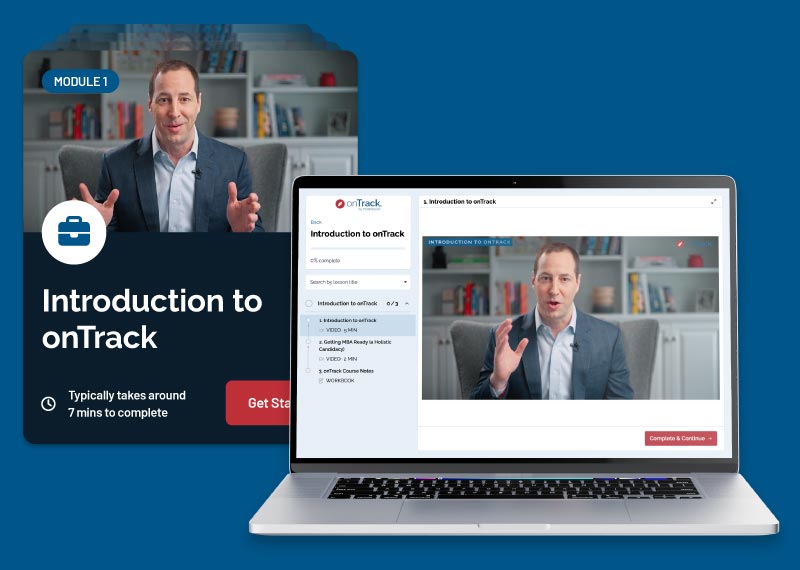
onTrack by mbaMission

A first-of-its-kind, on-demand MBA application experience that delivers a personalized curriculum for you and leverages interactive tools to guide you through the entire MBA application process.

Get Started!

2026–2027 MBA Essay Tips

Click here for the 2025–2026 MBA Essay Tips


MBA Program Updates

Explore onTrack — mbaMission’s newest offering allowing you to learn at your own pace through video. Learn more