Blog

INSEAD Essay Analysis, 2020–2021

INSEAD - mbaMissionOnce again, INSEAD appears to have made no significant changes to its MBA application essay prompts this season. Candidates must respond to four short career-focused queries (a fifth one is optional) and provide three motivation essays (with an optional fourth).  Applicants are also tasked with completing a video component for which they answer four questions as four separate video recordings. Given the total number of prompts, tasks, and questions involved, some candidates may find INSEAD’s essay gauntlet a bit intimidating and likely arduous as well. Read on for our full analysis, which we hope will make the process a little easier to manage.

Job Description 1: Briefly summarise your current (or most recent) job, including the nature of work, major responsibilities, and where relevant, employees under your supervision, size of budget, clients/products and results achieved. (200 words maximum) 

Job Description 2: What would be your next step in terms of position if you were to remain in the same company? (200 words maximum) 

Job Description 3: Please give a full description of your career since graduating from university. Describe your career path with the rationale behind your choices. (300 words maximum) 

Job Description 4: Discuss your short and long term career aspirations with an MBA from INSEAD. (100 words maximum) 

For the school’s job-related mini essays, we encourage you to start by very carefully parsing exactly what data the school requests for each. Together, these four prompts cover many of the elements seen in a traditional personal statement essay, including info about one’s career to date, interest in the school, and professional goals. However, the topics are clearly separated among individual submissions rather than covered in a cohesive single essay, and INSEAD also asks applicants to comment on their expected progression within their current firm were they to remain there rather than entering business school.

The first prompt requires that you outline roughly six different aspects of your current or most recent position. Be sure that you address each of the elements the school lists, and do not skip any just because you would rather write more about some than others. You may also want to consider providing a very brief description of your company or industry, if the nature of either might not be readily clear to an admissions reader. For the second question, your response should be fairly straightforward. If your firm has a clearly defined management hierarchy in which one position leads directly to a higher one—and you would be interested in adhering to that system—you simply need to explain this and perhaps offer a short description of the new responsibilities your next position would entail. If your company does not have such an arrangement or you would want to move in a different direction, simply explain what your preferred next role would be and the duties involved. 

The third prompt is rather self-explanatory with respect to detailing the various stages of your career to date, but do not be remiss in responding to the “rationale” and “choices” aspects of the query. The school wants to know that your progression has not been passive, with your simply accepting the next good thing to come along, but rather that you have made thoughtful decisions with clear motivations and intentions behind them. For the fourth question, you will need to present your professional goals within the context of an INSEAD MBA education. Do your research on the school to identify specific resources it offers that relate directly to the skills and experiences you need to be successful in your career, thereby illustrating how INSEAD would help you achieve your aims. Above all, be sure to show determination and direction—that you are focused firmly on your intended end points and will not be easily deterred. 

For all your job description responses, avoid using any acronyms or abbreviations that would not be easily recognizable to most people. Using shortcuts (in the form of abbreviations/acronyms) and skipping basic contextual information could make your answers less understandable and therefore less compelling and useful to an admissions reader, so do yourself a favor by depicting your situation as clearly as possible. 

Texas McCombs Essay Analysis, 2020–2021

Texas McCombs Essay Analysis - mbaMissionThe McCombs School of Business at the University of Texas at Austin has tweaked the wording of one its MBA application essay questions this season in what we believe is a subtle nod to the uncertainty caused by the (seemingly endless) coronavirus pandemic. Otherwise, the queries remain unchanged and still focus on eliciting the same fundamental information from candidates. The school’s required self-introduction essay (or video, for those who prefer that option) has been in play since at least 2013, and for its second essay, applicants are asked to imagine the end point of their MBA studies and to reflect on what they have gained and learned at McCombs within the context of their goals. Anyone with a potential problem area or unclear element in their profile can also submit an optional essay to address the issue(s). As a whole, the Texas McCombs essays give applicants ample opportunity to provide meaningful insight into their characters and strengths. Read on for our entire analysis of the program’s essay prompts for 2020–2021. 

Essay 1: We will learn a lot about your professional background through your resume and letter of recommendation, but we want to get to know you further. Please introduce yourself. Select only one communication method for your response. 

  • Write an essay (250 words) 
  • Share a video introduction (one minute in length)

The Texas McCombs admissions committee offers a little clarifying text before its straightforward request for an introduction, guiding applicants to steer away from aspects of their story that will already be covered in their resume and recommendations. Otherwise, candidates have an arguably blank slate from which to begin here. We imagine that the less guidance a program provides with its essay questions, the more panic is generated in the hearts of hopeful applicants, but let us reassure you that you do not need to be intimidated. Some patience, self-reflection, brainstorming, and authenticity—with a dash of creativity—and you should be on the road to a standout submission.  

First, determine the format that is more compatible with your personality. If you are the quiet, thoughtful type, an essay may be the better choice; if you are typically the life of the party or a better speaker than writer, you should probably select the video option. Next, start identifying the kind of information you might share by thinking about what you would like to know about a new person you are meeting and would find interesting, helpful, or intriguing. For example, would you consider someone’s age or undergraduate institution particularly important or compelling? Probably not, so you should skip mentioning such facts in your own introduction. (Remember, too, that your actual audience will be a member of the admissions committee, who will already know such basic information about you from the rest of your application.) You would likely be more curious about what someone does in their spare time, what interesting or exceptional skills they have, whether they are approachable/funny/hyperorganized/a risk taker/etc., whether they have extensive experience in a certain area or a more wide-ranging background, and so on.

So think about the aspects of your personality and profile that you believe truly define you as an individual—not just what you do and have done, but who you are—and fully explore your background, hobbies, talents, experiences, values, goals, and quirks. Brainstorm an extensive list and then eliminate any items that seem too common (e.g., a BA in finance) or basic (e.g., your hometown) until you have a collection of truly distinctive qualities you can weave into your response. Your goal is to provide a well-rounded picture of yourself that draws from multiple areas and shows that you possess characteristics and/or knowledge that would make you a positive addition to McCombs’ diverse community.

Remember to bring energy and enthusiasm to your submission. You are not filling out a job application—you are trying to connect with others, so charisma is welcome, and a less rigid and traditionally “professional” demeanor is okay. Forego any fancy essay-writing or dramatic tactics (e.g., starting with a quotation, launching into an anecdote), and just be as natural and authentic as possible. Do not pitch your candidacy, detail your career goals, or express your admiration for the program. As they say, you only have one chance to make a first impression, so dedicate the time and effort necessary to ensure that your introduction is engaging, substantive, and true to who you are.

If you choose to submit a video, think beyond what you will say and also consider the clothing you will wear, the setting or background, your tone of voice, your language style, whether you will include music, and other similar details. Brainstorm ways of nonverbally communicating some of your strongest attributes and key aspects of your life to help permeate your submission with as much information as possible. For example, if you are an avid biker, consider filming your video while you are actively riding. If you are a dedicated musician, perhaps incorporate your instrument into your message by playing it while you speak (if you are especially confident, you might even sing about yourself!). Think about what makes you who you are today, decide what you most want to share about yourself, and then let your creativity flow.

On a practical note, be sure to speak clearly in your video. You naturally do not want any part of your message to be lost or misunderstood, and the admissions committee may view your communication skills and style as indicators of how you might interact with your classmates and/or speak in the classroom. Spend some time practicing in front of a mirror or a friend, but do not overrehearse. And definitely do not try to read from an off-camera script or notes (trust us—they will be able to tell!). You want to come across as genuine and natural.

Haas School of Business at the University of California, Berkeley, Essay Analysis, 2020–2021

Haas School of Business at the University of California, Berkeley, Essay Analysis - mbaMissionThe Haas School of Business at the University of California, Berkeley, has made some slight adjustments to just one of its application essay questions this year, but the core of the query remains essentially the same—candidates are asked to explain how the school will help them become a successful leader. For its first required essay, Berkeley Haas wants applicants to dig deep on a personal level and discuss something about which they are passionate. The admissions committee then takes an interesting approach to the optional essay, offering both a short, multipart questionnaire (which is less complicated than it might seem at first glance) and a straightforward prompt that invites applicants, if needed, to address any unclear or problem areas in their profile. Together, the essays should allow you to offer insight into who you are as an individual and who you hope to be as a future business leader, to complement the information presented in your resume, recommendations, and basic stats. Our more detailed analysis follows…

Required Essay #1: What makes you feel alive when you are doing it, and why? (300 words maximum)

Perhaps you are familiar with the psychological concept of “flow,” which is a mental state people enter when they are completely immersed in and focused on something they enjoy and are enthusiastic about—it is also described as being “in the zone.” With this question, Berkeley Haas is basically asking you to discuss what puts you in the zone. If you are truly excited about something—and, we would assume, therefore engage in it on a regular basis—writing about it should not prove too challenging. Like all other application questions, this one has no “right” answer, so do not try to guess what you think the school wants to hear. Authenticity is key to your success here. Note that the prompt includes the words “when you are doing it,” so although you may feel strongly about certain causes or values, such as animal rights or environmental matters, for this essay, you will need to discuss an activity rather than an ideology.  

The school does not stipulate that your topic needs to come from a specific area of your life (e.g., professional life, community service, personal life). We appreciate that you are likely passionate about your career, but this is not automatically your best choice for a topic here, especially given that the school’s second required essay offers a better opportunity to discuss your professional side. What Berkeley Haas wants to learn from this essay is what gets your heart pumping and mind revving. Enthusiasm and intensity can be very inspiring and energizing and can lead to big ideas and actions. Sharing what incites such feelings in you gives the admissions committee an idea of where you might someday make an impression on the world, how you might leave your mark—especially once you are equipped with all you will gain and learn during your MBA experience.

That said, do not worry if the thing you feel so fervently about might initially seem commonplace to someone else. For example, perhaps you feel passionate about basketball. Because this is an interest anyone could share and enjoy, you might have concerns that it could sound pedestrian or unremarkable—and for many, this is a completely unremarkable pastime and one they should not write about. If, however, you can show that you have engaged with basketball in a way that takes the activity well beyond being a commonplace hobby and that it is something you connect with on a deep level and in various ways (perhaps having played for many years, you now coach youth teams from underprivileged neighborhoods in your community), then it most definitely becomes an acceptable discussion topic. In such a case, basketball could be used to reveal intensity, dedication, commitment to yourself and others, growth, longevity, and/or resilience. Of course, we are offering basketball here just for illustration purposes. We imagine you likely feel the flow when engaging in a completely different activity or even in disparate activities that are unified by a single behavior, such as when you are creating something or perhaps motivating others. The options are very much endless.

Once you have identified the passion you wish to discuss, avoid simply telling the admissions committee about it and instead illustrate how it manifests in your life. For example, rather than starting your essay by stating, “I have been watching and playing basketball since I was a child,” you need to create a more vivid impression of your dedication and involvement, such as “From playing with my brothers after school to varsity ball in college to now coaching a youth league in my community, I can hardly remember a time when basketball wasn’t an integral part of my life.” Or consider a more narrative approach, such as, “Dripping with sweat, I thrust my right arm up and knocked the basketball away, just as the buzzer sounded.” Once you have set the scene and presented the object of your fervor, you must then explain why you connect with it so strongly or so well. Perhaps it gives you a sense of peace or purpose, or it makes you feel connected with others in a meaningful way, or it allows you to challenge yourself mentally or physically. A successful essay response will not only paint a clear picture of your passion but also highlight the elements of your personality that make it significant to you.

University of Chicago (Booth) Essay Analysis, 2020–2021

Chicago BoothFor the 2020–2021 MBA application season, the University of Chicago Booth School of Business has introduced a new prompt that shines a spotlight on candidates’ lives outside the workplace and serves as a nice complement to its strictly professionally focused first essay. In addition, the admissions committee has made an interesting tweak to its note about the word count for both required essays. The stipulated minimums are still 250, but “no maximum” has now been added to this directive. Last year, the admissions committee said its prompts had produced essays that “disclosed amazing insights into our applicants’ professional aspirations as well as personal interests.” Our assumption, then, is that more than a few recent candidates might have misinterpreted the guidance on word limits—or did not trust that the admissions committee was truly open to longer submissions—and kept their essays on the briefer side, thereby potentially withholding some of these “amazing insights” the school had been so excited about learning. The new, if subtle, reassurance that longer essays are indeed acceptable indicates that Chicago Booth wants to hear as much of your story (that fits the question, of course) as you feel compelled to share. Our more in-depth essay advice follows.

Essay 1: How will the Booth MBA help you achieve your immediate and long-term post-MBA career goals? (Minimum 250 words, no maximum)

If this essay prompt seems rather simplistic and straightforward, that is because it is. Chicago Booth is requesting very fundamental—yet incredibly important—information and really just wants you to provide it so the school can understand your motivation for pursuing an MBA from its program and where you expect to go in your career afterward. Be as specific as possible in your description of where you see yourself after graduation and several years down the line, from the industry and role to any additional details about which you currently feel confident (perhaps specific companies or responsibilities that appeal to you in particular). Explain what has brought you to this point in your professional life, not only your career progression to date but also what has inspired you to earn an advanced degree as a vital tool in moving forward. And ideally, take the extra step of noting which of the program’s resources you believe will be most helpful to you in your pursuits. To be effective, this needs to be more than a passing mention, so do your research on the school and draw a clear picture for your admissions reader as to how and why the particular offerings you have identified relate directly to your needs and how you intend to apply them.

This essay includes many of the most elemental components of a traditional personal statement essay. We therefore encourage you to download your free copy of the mbaMission Personal Statement Guide, in which we provide much more in-depth guidance on how to consider and respond to these sorts of questions, along with numerous illustrative examples. Please feel free to download your complimentary copy today.

Essay 2: An MBA is as much about personal growth as it is about professional development. In addition to sharing your experience and goals in terms of career, we’d like to learn more about you outside of the office. Use this opportunity to tell us something about who you are… (Minimum 250 words, no maximum.)

As we have seen, Chicago Booth’s first essay question focuses specifically on candidates’ professional paths and aspirations, and the school’s previous second essay question left the door open for applicants to again discuss some aspect of their career. With this new prompt, however, the admissions committee is very explicitly directing candidates to discuss their personas and lives, separate from the workplace. Booth is essentially asking for whatever information or insight you believe it needs to understand you more fully as an individual and to be able to evaluate you thoroughly and fairly.

The admissions committee will already have a lot of information about you that it can and will use to get to know you better, including your resume, extracurricular activities, recommendations, short-answer question responses, academic transcripts, and GMAT/GRE score. You should therefore approach this essay by first thinking about what these portions of your application convey about who you are. Whatever you discuss should complement that information and help provide the school with a more well-rounded impression of you. Do not use this essay to pander to the school or make a general pitch for your candidacy or why you need an MBA. The focus needs to be on you and on giving the admissions committee a new window into your profile. Consider elements of your personality that you feel are particularly revelatory of who you are as an individual (e.g., values, hobbies, skills) as well as significant instances from your past that illustrate something about you or influenced the person you are today (e.g., accomplishments, excursions, milestones). The ideas about which you feel most enthusiastic are likely your best options and should also be the easiest to write about.

New York University (Stern) Essay Analysis, 2020–2021

NYU SternOnce again, the New York University (NYU) Stern School of Business has made no changes to its application essay prompts. The program’s first required essay covers applicants’ professional aspirations and Stern’s role in their attainment. For the second required essay, candidates must tackle the school’s challenging but very revelatory “Pick Six” submission, which might be less intimidating for today’s applicants than it was when it was first introduced in 2017, given the ubiquitousness of social media today. Together, Stern’s essay questions should allow you to present a good balance of your professional and personal sides for the admissions committee, though the optional essay is also on the table if you feel strongly that a vital part of your candidacy has not been covered by one or the other. Our full essay analysis follows…

Essay 1: Professional Aspirations
(500 word maximum, double-spaced, 12-point font)

  • What are your short and long-term career goals?
  • How will the MBA help you achieve them?

With this rather no-nonsense query about your motivation to earn an MBA and expectations as to where you will go with it after graduation, NYU Stern simply wants you to spell out what you have in mind as you approach this phase of your life and career. The school does not ask specifically about past experiences or what about its program in particular makes it the best one for you, though brief mentions of either would be acceptable if they are central to your main points. The three core components of this essay prompt are typical elements of a traditional personal statement, so we encourage you to download your free copy of the mbaMission Personal Statement Guide. This complimentary publication explains ways of approaching these topics effectively and offers several annotated sample essays as examples.

And for a thorough exploration of NYU Stern’s academic program, unique offerings, social life, and other key characteristics, download a copy of the mbaMission Insider’s Guide to New York University’s Leonard N. Stern School of Business, which is also available for free.

Essay 2: Personal Expression (a.k.a. “Pick Six”)

Describe yourself to the Admissions Committee and to your future classmates using six images and corresponding captions. Your uploaded PDF should contain all of the following elements:

  • A brief introduction or overview of your “Pick Six” (no more than 3 sentences).
  • Six images that help illustrate who you are.
  • A one-sentence caption for each of the six images that helps explain why they were selected and are significant to you.

Note: Your visuals may include photos, infographics, drawings, or any other images that best describe you. Your document must be uploaded as a single PDF. The essay cannot be sent in physical form or be linked to a website.

We imagine that the initial reaction most candidates have to pretty much any prompt that does not request a traditional essay is momentary panic (though, to be fair, that is likely many applicants’ reaction to traditional essays as well), but let us reassure you a bit before we delve more deeply into how best to approach this one. One could argue that in many ways, this essay prompt is merely asking you to do something we assume you are already doing every day and have possibly been doing for years—curate an impression of yourself for others by sharing certain images and other media that resonate with you. Is that not what people regularly do via Twitter, Facebook, Snapchat, Instagram, and any number of other social media venues by posting photos, memes, infographics, cartoons, and the like, typically along with a related comment? When you think of the task NYU Stern has presented you with this framework in mind, do you feel a little more confident about mastering it? We hope so.

In this case, rather than passing along just anything you think is funny or interesting or documenting your latest adventure or meal, you are communicating directly with a very singular audience, within a certain context, and with a very specific goal in mind. So start by carefully considering what you want the admissions committee to know about you—with the goal of sharing as many different aspects of your life and personality as possible—and what it will already be able to learn through your other essays and the rest of your application (resume, recommendations/EQ endorsement, transcript, etc.). You want the admissions “reader” to take away something new from each image they see.


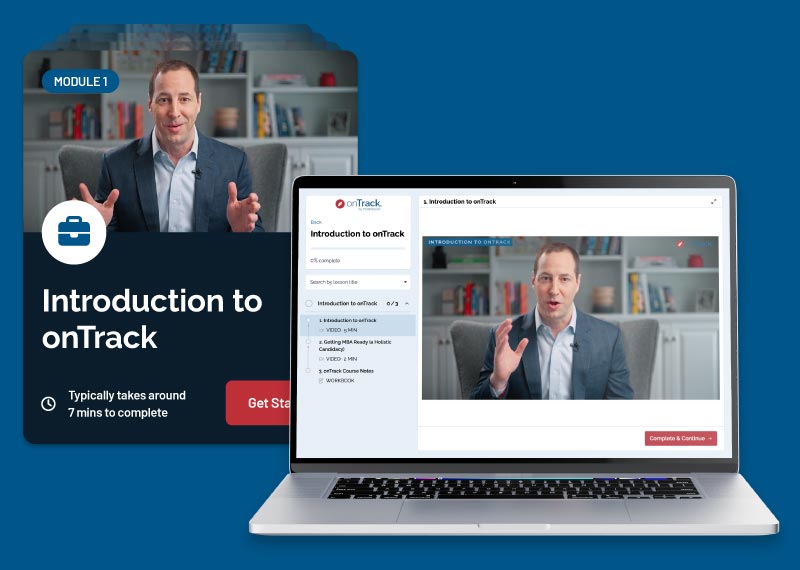
onTrack by mbaMission

A first-of-its-kind, on-demand MBA application experience that delivers a personalized curriculum for you and leverages interactive tools to guide you through the entire MBA application process.

Get Started!

2026–2027 MBA Essay Tips

Click here for the 2025–2026 MBA Essay Tips


MBA Program Updates

Explore onTrack — mbaMission’s newest offering allowing you to learn at your own pace through video. Learn more