Blog

Decoding the HBS Interview: A New Webinar for HBS Applicants

Decoding the HBS Interview: A New Webinar HBS ApplicantsYour Harvard Business School (HBS) application is in. Now, the waiting game for the interview invitation begins.  

Predicting exactly what questions you will be asked in your HBS interview is impossible, given the dynamic nature of the meeting and the school’s individualized approach, but this does not mean you cannot prepare to navigate the interaction effectively and increase your chances of leaving your desired impression.

On January 27, 2021, join us for “Decoding the HBS Interview,” a new webinar hosted by mbaMission Founder/President Jeremy Shinewald and mbaMission Managing Director/HBS Interviewer in Residence Devi Vallabhaneni (HBS Class of 1997, former HBS Admissions Board Candidate Interviewer).

In this 60-minute workshop, you will learn:

  • What makes the HBS interview so different from all the other business school interviews
  • The philosophy behind the HBS approach
  • How to prepare for the interview

Coming out of the session, you will have a much better sense of what to expect in your HBS interview and how to prepare for it so you can approach your interview with competence and confidence. Space is limited. Reserve your spot today.

Before you attend the webinar, what do you need to know? Drawing on her six years as an interviewer at HBS, Devi Vallabhaneni shares a few helpful tips:

Feeling Nervous

Feeling your nerves kick in is totally normal, but would you believe that every time I interviewed an HBS prospect, I was just as nervous? You might find that hard to imagine, but it is the truth! I felt like I owed each and every interviewee the courtesy of bringing my best to them, really getting to know them, and working just as hard as they had to arrive at the interview. So, first things first, know that the person on the other side of your HBS interview is eager and sincere in wanting to know the real you.

Know Your Story Cold

Your story should be within you, right? Well, maybe you wrote about your love of Chinese cookery in the personal section of your resume, but since then, you have not given another thought to the last cooking class you took—which, by the way, was a good story two years ago! Although I was never specifically trying to find weak spots in interviewees’ stories, I would sometimes start by asking about interests and hobbies they had listed that sounded interesting, so I just might have asked you about your Chinese cooking. Before your interview, refresh your familiarity with your entire application, even the parts you think are trivial.

Master the What & How

How you accomplished something is just as important, if not more than, what you actually accomplished. The how shows the real level of effort you had to expend to reach your end result. To me, the how also lets you share a deeper version of your story with your interviewer. I once interviewed an applicant who had worked on a seemingly common financial transaction. Because of the regulatory and political complexity of the transaction, she had to create more than 30 different potential scenarios to anticipate and quantify the client’s next steps. In this case, the how gave me better insight into the applicant’s depth of analysis, creativity, and experience. Without that information, this project, on its face, may not have stood out to me as something meaningful. Be sure to detail the how of your achievements for your HBS interviewer so that he or she can better understand the rigor and impact of your experience.

Professor Profiles: Bruce Greenwald, Columbia Business School

Professor Profiles: Bruce Greenwald, Columbia Business School - mbaMissionMany MBA applicants feel that they are purchasing a brand when they choose a business school. However, the educational experience you will have is what is crucial to your future, and no one will affect your education more than your professors. Today, we focus on Bruce Greenwald from Columbia Business School.

Bruce Greenwald has been a fixture at Columbia Business School (CBS) since the early 1990s, and until recent years, he taught the popular “Economics of Strategic Behavior” course in the full-time MBA program (he continues to teach this course in the school’s EMBA program, in addition to teaching the EMBA course “Globalization and Markets and the Changing Economic Landscape”). Greenwald has also taught the “Value Investing” and “Value Investing with Legends” courses in the MBA program for years. Students in CBS’s Value Investing Program, in which Greenwald has served as a faculty co-director, are primarily the ones who get to enjoy his classes.

Those with whom mbaMission spoke espoused enthusiasm for Greenwald’s intense depth of knowledge and his connections to top-notch guest speakers, whom he brings to campus to address his classes. On the CBS Peer Course Review site, a former student of Greenwald’s once summed up the instructor’s popularity by stating, “Greenwald has the ability to make something complex seem simple and easy to understand.” Greenwald has also served as the director of the school’s Heilbrunn Center for Graham & Dodd Investing. In addition to his efforts at CBS, Greenwald has served as a senior advisor at First Eagle Investment Management since 2011.

For more information about CBS and 16 other top-ranked business schools, check out our free mbaMission Insider’s Guides.

Georgia Tech Scheller College of Business Essay Analysis 2020–2021

 width=Applicants to the Georgia Tech Scheller College of Business (learn a little more about the program here) must submit two required essays, the first of which constitutes, in many ways, a traditional personal statement. The second, shorter essay takes a more creative and personal spin, inviting candidates to present a list of facts about themselves that they would like to share with their future Sheller classmates. Interestingly, unlike the other MBA programs we feature in our essay analyses, Scheller measures essay length in characters rather than words, with the maximum of 4,000 characters (including spaces) for its first essay equaling roughly four to five paragraphs, and 1,000 for the second representing just one or two. The program also offers applicants the opportunity to write an optional essay about either a potential issue in their profile that they would like to explain or a facet of their candidacy they believe the admissions committee should be aware of to be able to evaluate them fully. Together, Scheller’s suite of application essays appears to give candidates room to present a nicely rounded image of themselves for consideration. Read on for our full analyses of the school’s essay prompts for this season.

Required Essay: Why an MBA and why Georgia Tech?
Describe how your experiences, both professional and personal, have led you to the decision to pursue an MBA at Georgia Tech. Discuss your short- and long-term career goals and how Georgia Tech is best suited to help you achieve your goals.  4,000 character maximum (including spaces).

With this rather straightforward essay prompt, Scheller is requesting very fundamental—yet incredibly important—information that will help the school understand your motivation for pursuing an MBA from its program and where you expect to go in your career afterward. Be as specific as possible in your description of where you see yourself after graduation and several years down the line, from the industry and role to any additional details about which you currently feel confident (perhaps even specific companies or responsibilities that appeal to you in particular). Explain what has brought you to this point in your professional life, not only your career progression to date but also what has inspired you to earn an advanced degree as a vital tool in moving forward. 

In addition to outlining your career goals—including context for how you arrived at them and why they are realistic for you—you must illustrate how Scheller will help you pursue these goals by demonstrating a thorough understanding of what the school offers and a well-thought-out game plan for availing yourself of these offerings. To effectively do this and write a reasoned, nuanced essay, you must first familiarize yourself with Scheller’s various resources and pinpoint those that truly pertain to you and the direction in which you hope to head. Go the extra mile in learning about the school. This is where we would normally encourage you to visit campus and sit in on a class, and/or at least attend an admissions event in your area, but the ongoing pandemic precludes such options at this time. Instead, connect directly with students and alumni (online or via phone, Skype, Zoom, etc.), read student blogs and the program’s recent press releases, and peruse Scheller’s YouTube channel. This will provide the kind of in-depth insight that will show the admissions committee you are serious about the school and are confident you belong there. Simply presenting a list of classes and clubs you think sound interesting will not suffice, and absolutely avoid vague, pandering statements about how great the school is. You must reveal clear connections between your aspirations, what you need to achieve them (e.g., skills, experience[s], connections, exposure), and what Scheller in particular can provide that will enable you to fill those gaps.

This prompt covers several basic elements of a typical MBA personal statement. We therefore encourage you to download your free copy of the mbaMission Personal Statement Guide. This complimentary guide offers detailed advice on approaching and framing these subjects, along with multiple illustrative examples. 

Required Essay: Ten Facts
List 10 facts about yourself that will help your future classmates get to know you. 1,000 character maximum (including spaces).

The Scheller admissions committee offers basically no clarifying text before its straightforward request for ten introductory facts. As a result, you have a largely blank slate from which to begin here, but because the purported audience for your list is your “future classmates” (though the true audience is of course the admissions committee), you should likely steer away from basic aspects of your story covered in your resume, transcript, and recommendations. In our experience, the less guidance a program provides with its essay prompts, the more panic is generated in the hearts of hopeful applicants, but do not let yourself be intimidated. Some patience, self-reflection, brainstorming, and authenticity—with a dash of creativity—and you should be on the road to a standout submission.  

To start identifying the kind of information you could share in your list, think about what you would like to know about a person you are first meeting and that you would find interesting, helpful, or intriguing. For example, would you consider someone’s age or undergraduate institution particularly important or compelling? Probably not, so you should skip including such facts. (Remember, again, that your actual audience will be a member of the admissions committee, who will already know such basic information about you from the rest of your application.) You would likely be more curious about what someone does in their spare time, what interesting or exceptional skills they have, whether they are approachable/funny/hyperorganized/a risk taker/etc., whether they have extensive experience in a certain area or a more wide-ranging background, what unique or rare accomplishments they can claim, and so on.

The Ohio State University Fisher College of Business Essay Analysis 2020–2021

The Ohio State University Fisher College of Business Essay Analysis 2019–2020 - mbaMissionThe application essay questions for the Fisher College of Business at The Ohio State University give candidates an opportunity to add some detail and depth to their profiles beyond the statistics and other basic data conveyed in the rest of their application. The school’s first required essay is a rather traditional career goals statement, and for the second essay, applicants must share a significant achievement from their past and explain how the experience has equipped them to be an additive member of the Fisher MBA community. If needed, a 250-word supplemental essay is also available for candidates with unusual or unclear elements in their profiles. All aspiring Fisher MBAs must complete a video interview soon after submitting their application, and although this is not technically an essay, we offer tips on preparing for it as well in our complete essay analysis, which follows.

You will be required to complete two written essay responses. The essay questions give you the opportunity to present yourself more fully to our MBA Admissions Committee and to provide insight into your experiences, goals, and thought processes.

ESSAY TOPIC 1: What are your short-term and long-term goals? How/why will an MBA help you achieve those goals? (Maximum words: 500)

The Fisher admissions committee is hardly breaking any new ground with this essay prompt. Like all MBA programs, Fisher is interested in hearing where you see yourself going after you graduate and how you believe a business degree will equip you to fulfill your vision. Because this essay question covers several of the main components of a traditional personal statement, we encourage you to download a free copy of the mbaMission Personal Statement Guide, in which we offer detailed advice on approaching these topics, along with multiple illustrative examples.

ESSAY TOPIC 2: Please tell us about the accomplishment you are most proud of. How will this experience allow you to contribute a unique perspective to the Fisher community? (Maximum words: 400)

We imagine that at this point in your life, you have achieved a number of things both personal and professional that you could use as fodder for an application essay. However, your goal here is not simply to impress the admissions committee with the scale or impact of your accomplishment but to offer one that best fits the prompt. This means you will need to select one that was truly meaningful for you on a profound level and that also left with you with a belief, mind-set, or understanding that would make you a valuable member of the Fisher network. The school does not stipulate whether the achievement you discuss should be from your career or your personal life, so thoroughly consider all your possibilities to identify the one that is most appropriate for this submission. Although sharing a non-work-related accomplishment in this essay could serve as a nice complement to your discussion of your career goals in Essay 1, do not feel that this is strictly necessary. What is most important is that the story you present clearly conveys your values (why you feel most proud of this achievement in particular) and explains how your takeaways have molded you into the kind of person Fisher would want in its ranks.   

We would recommend using only the first 100–150 or so words of this essay to describe your chosen experience, so that you will have sufficient leeway in which to then clearly reveal what you learned from it and how it has equipped you to contribute to the Fisher community in a substantial way. Do your best in this limited space to “show,” or really spell out, how things unfolded—rather than just stating the accomplishment or flatly presenting the situation—to give the admissions reader some perspective on how you conduct yourself and achieve. 

You will then need to demonstrate both self-awareness and a thorough understanding of the Fisher MBA experience by outlining your takeaway(s) and drawing a connection between what you learned and what you can subsequently bring to the school as a member of its community. For example, you may have gained some useful insights you could share with your classmates in a related class or club, or maybe you now have an interesting viewpoint on commitment, determination, teamwork, or other such value. To effectively illustrate a connection between your takeaway from the experience and your expectation for applying it at Fisher, you will need to fully familiarize yourself with the program’s various resources and the characteristics of its community. Go the extra mile in learning about the school—connect with multiple students and alumni, read through recent school press releases and student blogs, peruse the OSU Fisher YouTube channel, and, if offered, consider attending admissions events in your area (safely!). This will provide the kind of in-depth insight that will show the admissions committee you are really serious about Fisher and understand how and why you belong there. 

Georgetown McDonough Essay Analysis, 2020–2021

Georgetown McDonough Essay Analysis - mbaMissionOf all the programs we feature in our annual essay analyses, Georgetown University’s McDonough School of Business is the one we typically expect to make at least some changes to its application essay questions from one season to the next. So even though applicants must still provide one 500-word written essay in response to their choice of three question options, we were not surprised to see that those options have been modified a bit. Candidates are now asked to write about a time when they led a team (versus being out of their comfort zone), a challenging situation they navigated (versus a failure), or their personal brand and someone they admire (focusing more pointedly now on the applicant than the role model). The school has also tweaked the wording of its video essay prompt; rather than requesting that applicants introduce themselves to their future classmates, the admissions committee wants them to share how they are “unique”—likely to encourage candidates to dig deeper with their response and provide more profound insight into their individuality and personality than before. The school’s optional essay still gives applicants the leeway to discuss anything they feel is necessary, so it should be sufficient to meet everyone’s needs. Read on for our full essay analysis of all the school’s essay prompts for 2020–2021.

We want to hear your story. When responding to our required essays, be authentic and take time to reflect on your goals and past experiences. Craft a response that explains how these experiences led you to pursue an MBA.

Our goal at Georgetown McDonough is to craft a diverse class with people who have had varying personal and professional life experiences. As such, we want to give our applicants the opportunity to select one essay (from a list of three) that allows them the ability to best highlight their experiences, characteristics, and values that showcase the value proposition that they can bring to the McDonough community. Please select one of the following three essays to complete in 500 words or less and include the essay prompt and your first/last name at the top of your submission.

Essay Option One: Principled Leadership: Georgetown McDonough places a strong emphasis on principled leadership, providing both curricular and co-curricular opportunities to strengthen your leadership skills. Describe a time when you’ve led a team in a professional environment to implement a new idea or process. What leadership characteristics did you utilize? What could you have done to be more effective? And most importantly, what skills will you be able to bring to the teams you lead at McDonough? 

Although this essay question retains some elements of the one the school posed last year and again focuses primarily on leadership skills, the admissions committee has made some meaningful adjustments in what it wants to know and how it frames its request. Rather than asking you to discuss an instance in which you led (and succeeded) outside your comfort zone, McDonough tasks you with sharing a time when you led a team specifically “to implement a new idea or process.” This means that the situation you share is one in which you had to apply your skills and thought processes in a novel way rather than simply repeating ones you had executed before in a similar context. You must thereby demonstrate that the abilities and knowledge you possess are broad and keen enough to apply to novel situations and—even more—that you know how and when to exercise certain ones to fit the demands of the task at hand. This essay is about revealing not only the leadership qualities you already possess but also your instincts in identifying the ones that are appropriate and helpful in a given situation and in using them effectively.

The addition of the specification “in a professional environment” requires that the experience you share be related to your career (a change from last year), and although the prompt no longer says the incident must be one in which “you were asked to lead” (emphasis ours), this will likely be the case, given the workplace context. The prompt also no longer specifies that you must have “succeeded,” but you will of course want to show yourself to be effective and that your leadership skills are such that they direct people to the desired result, so we would caution against sharing an instance in which you and your team failed to attain your goal. 

You want to focus on conveying the skills you engaged and steps you took to guide your team, as well as your thought processes along the way. The admissions committee will thereby gain both a clear picture of what you accomplished and the aspects of your character that inspired you and helped enable your success. Take time as you are planning your response to this prompt to carefully read the “About Principled Leadership” page on the McDonough website. Although you obviously want to be authentic in conveying which skills and qualities you in fact relied on in the situation (and therefore not claim to possess any you do not because you think the admissions committee is seeking a specific “right” answer here), if any you plan to discuss align with the school’s stated values, they might warrant a little extra emphasis in your essay. 

The addition of the query “What could you have done to be more effective?” constitutes an invitation to demonstrate to the admissions committee your capacity for self-assessment and both your motivation and ability to identify areas for improvement. This is also your opportunity to explain how the McDonough MBA experience will help you address and mitigate those shortcomings. Absolutely do not denigrate anyone else on your team or related to the project by saying or implying that you could have been more effective if others had acted differently. Also, note that the admissions committee does not ask what you learned from the experience, so we caution you against using valuable word count on this point.


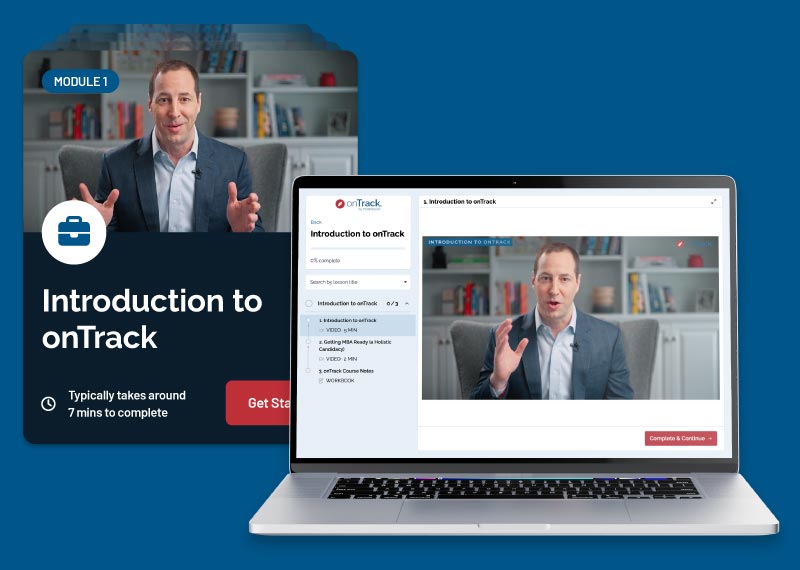
onTrack by mbaMission

A first-of-its-kind, on-demand MBA application experience that delivers a personalized curriculum for you and leverages interactive tools to guide you through the entire MBA application process.

Get Started!

2026–2027 MBA Essay Tips

Click here for the 2025–2026 MBA Essay Tips


MBA Program Updates

Explore onTrack — mbaMission’s newest offering allowing you to learn at your own pace through video. Learn more