Blog

Professor Profiles: Adam Grant, The Wharton School of the University of Pennsylvania

Professor Profiles: Adam Grant, The Wharton School of the University of Pennsylvania - mbaMissionMany MBA applicants feel that they are purchasing a brand when they choose a business school. However, the educational experience you will have is what is crucial to your future, and no one will affect your education more than your professors. Today, we focus on Adam Grant from the Wharton School of the University of Pennsylvania.

In addition to receiving multiple teaching awards at Wharton and having been named one of HR’s “Most Influential International Thinkers” in many biennial rankings, Adam Grant is also reportedly a student favorite. The author of New York Times bestsellers Option B: Facing Adversity, Building Resilience, and Finding Joy (Knopf, 2017; co-authored with Sheryl Sandberg), Originals: How Non-Conformists Move the World (Viking Press, 2016), and Give and Take: A Revolutionary Approach to Success (Viking Press, 2013; named one of the best books of the year by Amazon), and more than 60 articles, Grant has received numerous awards for his research on work motivation, including a Cummings Scholarly Achievement Award from the Academy of Management, the Distinguished Scientific Award for Early Career Contribution from the American Psychological Association, and a fellowship from the National Science Foundation. Grant’s books have been translated into 35 languages.

Grant was quoted in a past Bloomberg Businessweek profile of him as saying, “There is a long list of reasons that make me passionate about teaching, but every one revolves around the observation that we spend the majority of our waking hours at work, and there are many ways in which organizational psychology lets people lead more reward[ing] and productive work lives and makes the experience and organizations of others more productive, too.” In addition, Wharton students quoted by Poets&Quants once remarked of him, “I’m always struck by his humility (and humanity). It’s actually more like a bedside manner, almost like charisma, but more humble and personable” and “Adam is an amazing teacher and friend. In both my classes with him, he’s shown that in addition to being passionate about his subject matter, he really cares about his students. He also has an uncanny ability to remember the name of every student he teaches.”

For information on other defining characteristics of the MBA program at Wharton or any of 16 other top business schools, check out our free mbaMission Insider’s Guides.

What to Do When You Do Not Have Much Time to Prepare for the GMAT

What to Do When You Do Not Have Much Time - mbaMissionWith regard to the GMAT, raw intellectual horsepower helps, but it is not everything. Manhattan Prep’s Stacey Koprince teaches you how to perform at your best on test day by using some common sense.

Some time ago, I flew over to London to give an all-day workshop at London Business School. The audience comprised about 35 students who had already been admitted to a weekend master’s program, but that admission was contingent upon taking the GMAT and getting a “good enough” score (as defined by the school). The students had only about a month or two to fulfill this requirement.

What can you do in a six-hour crash course? Not much more than an introduction and orientation—but even that is incredibly valuable in helping people get started and know what to expect.

So what should someone do who is in the position of taking the test in four to eight weeks and has not studied a ton yet?

First, take a practice test under 100% official conditions. I always recommend this first step for anyone, but this is especially crucial for someone with limited time. You are going to have to prioritize heavily, and you have no effective way to do that without good practice test data.

Next, identify the practice materials you want to use. You are going to need at least one source for official practice questions (perhaps the Official Guide 2018 Edition). You are also going to need some materials that help you get better in your areas of greatest weakness—for example, if you are struggling with word problems and sentence correction, then you are going to need some test prep materials that teach those specific areas.

When determining which question types and content areas to prioritize, remember two important things:

(1) All areas are not created equal. Struggling with Combinatorics? Great. Those are infrequently tested, so you can get away with just dropping that topic entirely. Struggling with exponents and roots? Those are much more common, so you are going to need to dig in there. Frequently versus infrequently tested areas can change over time, so ask an expert on an online forum at whatever point you need to figure this out.

(2) Timing is an enormous factor on this exam. Everyone has timing problems, ranging from mild to severe. I cannot tell you how many students I have spoken with who study for months but do not get much better on their practice tests because they have not been practicing timing. Everyone needs to deal with timing right from the start—and this is especially true for someone who has only four to eight weeks to take the test.

Last step: Start working! Tons of resources are available on the Manhattan Prep blog to help you in your studies, but I will point you toward two particular article compilations that should be the most helpful. Both articles were written as comprehensive articles for people who have months to study, so you will once again have to prioritize and cut out things for which you just do not have time—but these will provide you with the best starting point from which to make those decisions.

The 2023 MBA Application Season Has Begun!

Happy New Year from mbaMission!As we turn the page on 2022, we at mbaMission are thankful to have been able to continue to help many who have been dislocated by the pandemic—as well as many others—to find acceptances and scholarships in what was certainly a competitive MBA application year. We are proud of the company we keep, maintaining our place as the best reviewed admissions consulting firm on GMAT Club and Poets&Quants and the exclusive partner of the world’s leading GMAT prep firm, Manhattan Prep. We never take for granted all of the hard work that has gotten us here. For almost two decades, we have put our clients first—and we will continue to lead in 2023! 

As we look toward the 2023–2024 admissions season, we remain committed to being the best MBA admissions consulting firm in the world by putting our clients first; providing relevant and insightful guidance through our free guides, webinars, and blog; and continuing to bring dedication, passion, and expertise to every MBA applicant who partners with us.

If you have your sights set on business school—and perhaps applying in 2023—we would love the opportunity to share our knowledge with you. Here are a few ways we can help:

We are eager to form productive partnerships and to make the coming year one of significant professional and personal advancement. All of us at mbaMission wish you a happy, prosperous, and (most importantly) healthy new year!

Tips for the MBA Diversity Essay

As an MBA student, you are guaranteed to work in student teams composed of individuals from different backgrounds (professions, nationalities, cultures, orientations, etc.). For this reason, business schools want to ensure that you are equipped to collaborate effectively with people who might hold perspectives different from your own. During the past few admissions cycles, several programs have evaluated applicants’ ability to work across backgrounds by posing an essay question that asks about the candidate’s experience with diversity and inclusion, how they have created or promoted an inclusive environment, and/or how they expect to be an inclusive leader at the MBA program and after graduation.

Here are our tips on how to approach responding to an MBA diversity essay question:

  1. First, to identify your essay topic, think about times when you have worked with a diverse group of people, whether on the job or as part of an extracurricular activity or personal pursuit. When some people hear the word “diversity,” they automatically associate it with race, gender, and ethnicity. Although those dimensions certainly are major aspects of diversity, you need to think about the definition of diversity—and about your experiences—more broadly. For example, maybe you worked on a team with members from across functions and/or with varying levels of seniority. Or perhaps you worked on recruiting new employees from a more comprehensive list of universities than you firm has considered in previous years.
  2. Next, consider your actions as they relate to diversity. In which of your experiences did you actively cultivate diversity, such as by encouraging more people to participate in an initiative and to share their viewpoints during discussions? Simply writing about a time when you worked within a diverse group is not enough; you have to show that in that situation, you purposefully harnessed the advantages of having different perspectives by inviting the members of that group to express themselves, genuinely listening to them, and taking their views and ideas into account. If you encountered any challenges along the way, acknowledge them. Showing how you worked effectively to reconcile different points of view will lead to a more meaningful narrative.
  3. Then, reflect on the result. Based on your actions—including fostering participation and dialogue—how did you and your team successfully accomplish the mission at hand? For example, maybe you won a sales pitch because you were able to tailor your message more closely to your audience. Or perhaps your company’s once-homogenous internship program now represents a blend of students from a range of backgrounds. In addition to explaining the outcome, address what you learned from the experience. Business school admissions committees like to see that applicants are capable of growing as the result of being exposed to different perspectives.
  4. Finally, look to the future. If the essay question asks how you will promote diversity and inclusion on campus and in your post-graduate career, describe in specific terms how you aspire to be a leader in this space. Identify a student organization at your target MBA program that you would want to join based on your interests, and explain how exactly you would encourage the cultivation of a diverse membership and the voicing of different perspectives as a way of enhancing the club’s activities and impact. As for your post-MBA ideas, think about diversity, equity, and inclusion efforts you would want to be involved in at work or as a leader in a community organization that aims to foster diversity. Keep in mind that less is more—you will come across as more genuine if you focus on one or two ways that you will be an inclusive leader rather than providing a laundry list of activities you want to be involved in.

For specific essay-writing tips for programs that are posing a diversity-related essay prompt this year, please see our essay analysis for the following schools:

And if you have an especially strong track record of promoting inclusion at school, in your job(s), and/or in your personal life, consider applying to business school via the Consortium for Graduate Study in Management. You can learn more about the Consortium in this blog post, and also refer to our Consortium Essay Tips.

Professor Profiles: Roberto Rigobon, MIT Sloan School of Management

 width=

Many MBA applicants feel that they are purchasing a brand when they choose a business school. However, the educational experience you will have is what is crucial to your future, and no one will affect your education more than your professors. Today, we focus on Roberto Rigobon from the MIT Sloan School of Management.

Roberto Rigobon, the Society of Sloan Fellows Professor of Management and a professor of applied economics, specializes in international economics, monetary economics, and development economics. At an awards ceremony in 2005, Sloan students described him as someone who “epitomized the fine line between madness and genius.” Other award-related descriptions of Rigobon refer to him as “serious but hilarious,” “crazy and brilliant,” and “high energy.”

Rigobon teaches the reportedly very popular “Applied Macro and International Economics” course, which is said to be often taken by up to 30% of Sloan students at a time. He has won numerous teaching awards during his time at Sloan (including the school’s Excellence in Teaching Award in 2000, 2003, and 2005, and Teacher of the Year in 1999, 2002, and 2004) and is primarily recognized for his accessibility. As one second-year student blogged, “The door to his office was always open.”

For more information about MIT Sloan and 16 other top-ranked business schools, check out our free mbaMission Insider’s Guides.


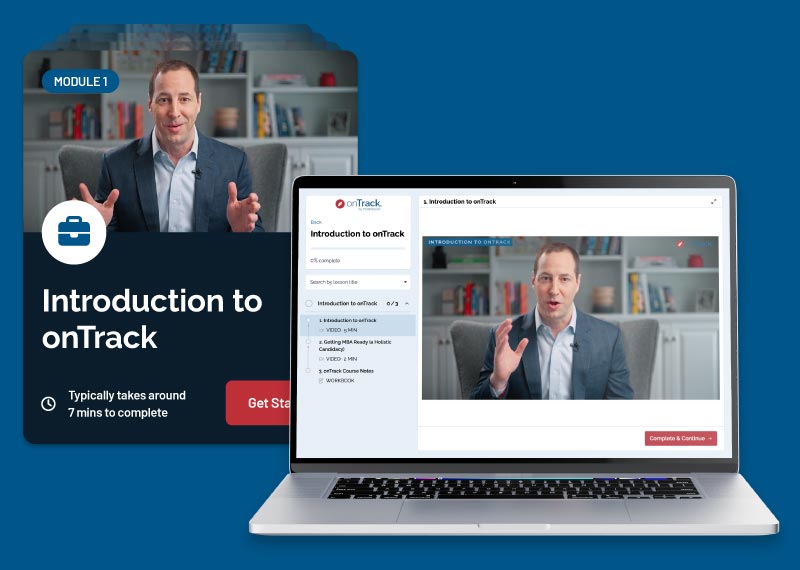
onTrack by mbaMission

A first-of-its-kind, on-demand MBA application experience that delivers a personalized curriculum for you and leverages interactive tools to guide you through the entire MBA application process.

Get Started!

2026–2027 MBA Essay Tips

Click here for the 2025–2026 MBA Essay Tips


MBA Program Updates

Explore onTrack — mbaMission’s newest offering allowing you to learn at your own pace through video. Learn more