Blog

July 14, 15, 17: Choosing the “Right” MBA program and Writing Effective Essays (London, England)

mbaMission Founder/President Jeremy Shinewald will be visiting Manhattan GMAT’s London center to conduct this free workshop. Join Jeremy as he helps students tackle two major issues facing all b-school applicants: choosing the right school and writing essays that grab the attention of admissions committees.

Jeremy will help prospective MBAs understand the differences that exist among top MBA programs and elaborate on areas that will profoundly affect students’ academic and social lives — including the flexibility of a program’s curriculum, breadth of core courses, unique methods of instruction, varying sizes of the cohorts and more. Jeremy will also guide attendees through a series of essay-writing exercises that challenge them to uncover their personal and nuanced stories, craft compelling opening statements, develop meaningful goal statements, connect their goals to their target school’s resources, and more.

There will be Q&A sessions after each presentation and, following that, Jeremy will remain on site to discuss specific candidate inquiries. Attendees will also be able to sign up for free in-person consultation sessions with Jeremy during his stay in London.

Join us for this valuable event that will be essential to your B-School planning!

July 14th: “Sold out”

July 15th: Sign up!

July 17th: Sign up!

All attendees at these exclusive events will receive:

  • $100 off any 9-session ManhattanGMAT course
  • Free access to a ManhattanGMAT computer adaptive practice exam
  • Free half hour consultation with Jeremy Shinewald (appointments can be scheduled after the workshop!)

July 11: Essay Writing Seminar (Live Online)

How can you write essays that grab the attention of MBA admissions committees?

mbaMission Founder/President, Jeremy Shinewald, will use this simple but often perplexing question as the starting point for a seminar for prospective business school applicants. Attendees will walk through a series of examples, challenging their understanding of the essays themselves.  The goal of this seminar is to help you uncover your stories, craft compelling opening statements, develop meaningful goal statements, connect your goals to your target school’s resources, and more.

There will be a Q&A session after the presentation and Jeremy will remain online to discuss your personal inquiries.

Join us for this valuable event that will be essential to your B-School planning!

  • All attendees of this exclusive event will receive:$100 off any 9-session ManhattanGMAT course
  • Free access to a ManhattanGMAT computer adaptive practice exam
  • Free half hour consultation with an mbaMission consultant


Sign up today!

University of Pennsylvania (Wharton) Essay Analysis, 2010–2011

The admissions committee is interested in getting to know you on both a professional and personal level. We encourage you to be introspective, candid, and succinct. Most importantly, we suggest you be yourself.

1. Required Question: What are your professional objectives? (300 words)

Just 300 words? Yes, 300. Once you get over the unusual structure of this essay, your assignment is fairly straightforward: state your goals. They do not need to be presented in the traditional short- and long-term sequence, however. Wharton gives you the opportunity to discuss the bigger picture (likely a nod to the fact that few people actually end up pursuing the narrow goals they offer in these statements). You are not required to rigidly define your professional objectives by naming a specific industry and job title, but instead you may discuss the type of organization you want to be a part of (a series of start-ups, for example) or the kind of responsibilities or effect you would like to have in your career. Whichever approach you choose, however, you must explain the reasoning behind your stated objectives (the “why”).

As you start to write, keep in mind that you need not offer a lengthy work history; the question does not ask for it and the word count does not allow it. Still, you may want to devote approximately 50–75 words to providing context for your goals before you state your professional objectives, especially if you are a career changer or plan to pursue a highly atypical, particular and/or competitive career path (managing a sports franchise, for example). Providing some basic context will lend credibility to your ambitions by establishing a purpose behind and a foundation for your goals.

Because Personal Statements are similar from one application to the next, we have produced the mbaMission Personal Statement Guide, which helps applicants write this style of essay for any school. We offer this guide to candidates free of charge, via our online store. Please feel free to download your copy today.

For a thorough exploration of Wharton’s academic program/merits, defining characteristics, crucial statistics, social life, academic environment and more, please check out the mbaMission Insider’s Guide to the Wharton School of the University of Pennsylvania.

2. Respond to 3 of the following 4 questions:

Student and alumni engagement has at times led to the creation of innovative classes. For example, through extraordinary efforts, a small group of current students partnered with faculty to create a timely course entitled, “Disaster Response: Haiti and Beyond,” empowering students to leverage the talented Wharton community to improve the lives of the Haiti earthquake victims. Similarly, Wharton students and alumni helped to create the “Innovation and the Indian Healthcare Industry” which took students to India where they studied the full range of healthcare issues in India. If you were able to create a Wharton course on any topic, what would it be? (700 words)

Given its long lead-in, some may find this essay question confusing or even daunting. You may be wondering, “How do I even start to conceive my response?” However, try not to be concerned and instead simply focus on the final sentence: “If you were able to create a Wharton course on any topic, what would it be?” This question is actually far more open ended than you might realize. You could, for example, envision a course based on an existing area of expertise of yours and then discuss what you would hope to learn from the class that would improve your capabilities in this area as well as what others might also gain from the offering. Or, you might consider an area in which you have no expertise but do have an intellectual interest and believe could be equally beneficial to your fellow Wharton MBA candidates. We want to stress and are underlining this point for emphasis: You do not need to conceive of a course in corporate social responsibility. One requirement for success in this essay is of course to thoroughly examine the school’s current and recent course offerings so that you do not conceive of a “new” class that in fact already exists!

As you explain what your proposed course will be about, consider taking some time to also explain the origins of your interest in the topic, why you think the course will be important to you and others and what the course might be like functionally (e.g., suggested guests speakers, field trips, projects). Take care not to delve into the world of fantasy—such as envisioning a class visit by Bill Gates on Monday, Warren Buffet on Tuesday, etc.—and do not pander to the admissions committee, but recognize that you can use this essay to reveal your knowledge of the Wharton experience by mentioning certain school resources and explaining how these offerings could be used in the class.

Reflect on a time when you turned down an opportunity. What was the thought process behind your decision? Would you make the same decision today? (600 words)

Many schools try to learn about you through your mistakes. Thoughtful descriptions of missed opportunities—errors of omission rather than commission—can provide the admissions committee with valuable information about candidates’ values, motivations and thought processes. Whether you declined to start a business, accept a project (big or small), take time off to travel or any other missed opportunity, the admissions committee wants to understand the manner in which you weighed your options and your perception of the risks inherent in either decision.

Of course, you may have made the right choice in turning down an opportunity and thus made no error of omission at all. In such a case—maybe you made a bold move and eschewed an offer from an investment banking firm to pursue a less lucrative path or chose to gain external experience rather than joining a family business—you will still need to show that you thoroughly considered your options and demonstrate that the decision you made, while difficult, was ultimately correct. Again, clarifying your thought process in weighing your options is key.

Describe a failure that you have experienced. What role did you play, and what did you learn about yourself? How did this experience help to create your definition of failure? (600 words)

When schools ask about a failure, they want honesty and expect you to take responsibility. You will certainly not impress the admissions committee if you elect to answer this question and then fail to own up to your role in whatever problem(s) existed. Let us be unequivocal: your essay will be an utter failure if you try to lay the blame solely on others.

As you construct this essay, start by showing positive momentum toward your goal—even if only your idea was promising and the process turned out to be a disaster from the start—and then reveal how things went off track. The sharper the contrast between expectations and reality, the more compelling your essay will likely be. After all, if you had nothing to lose in the situation, what kind of impact will your story have on the reader?

A curious aspect of this question is the request for a “definition of failure.” Many applicants will start their essays with a statement like, “My definition of failure is X, but as a result of this experience, it became Y.” We caution you against using such an opening line. Doing so shows a lack of creativity and will likely lead the admissions committee to lump you in with the mass of other candidates that take this bland approach. Instead, you could offer your definition implicitly via the conclusions you draw from the experience you describe. If you are able to avoid writing the phrase “My definition of failure is,” this will be refreshing for the reader.

Discuss a time when you navigated a challenging experience in either a personal or professional relationship. (600 words)

Clearly, the admissions committee wants to understand how you manage yourself vis-à-vis others and get a feel for your level of emotional intelligence. For this essay, you do not need to limit yourself to considering only loud and public conflicts; instead, give some thought to instances in which you experienced clashing styles or values. Maybe you struggled to motivate someone or had a different understanding of or view on an ethical issue. The emphasis here is not on the problem itself (though discussing a truly difficult situation is helpful) but on your navigation of that problem. You will need to demonstrate your level of emotional intelligence by describing how you attempted to resolve the issue, whether you were successful or not. Clearly conveying your thought processes and actions with regard to how they affected the desired and actual outcomes is crucial.

mbaMission Releases Fuqua, Haas and Darden Insider’s Guides – 14 Guide Series!

We are pleased to release our new mbaMission Insider’s Guides to Duke-Fuqua, Berkeley-Haas, and UVA-Darden.

Through our guides to these three MBA programs (and our eleven others!) you will gain a powerful understanding of each school’s unique attributes:

  • Defining characteristics of the school’s location, class size, curriculum, teaching methods, facilities, alumni base/involvement and rankings
  • Courses, experiential opportunities, faculty and clubs related to MBAs’ most common career areas, such as Consulting, Finance, Marketing, Entrepreneurship, Venture Capital/Private Equity, InternationalBusiness, Health Care, Nonprofit/Social Entrepreneurship and Real Estate (where applicable)
  • The admissions committee’s stance on such elements as GMAT/TOEFL scores, layoffs/unemployment, recommendations, the waitlist and other crucial topics 
  • Notable professors, classes and social and community events
  • Admission and employment statistics and more

The Insider’s Guide series has been hailed by a top-five program’s marketig director as “just nailing our school.” We are certain that you will gain a comprehensive understanding of your target program in our 50-75 page guides.

University of California Los Angeles (Anderson) Essay Analysis, 2010–2011

REQUIRED ESSAYS

Please be introspective and authentic in your responses. Content is more important than style of delivery. We value the opportunity to learn about your life experiences, aspirations, and goals.

1. What event or life experience has had the greatest influence in shaping your character and why? (750 words)

In offering you the opportunity to discuss an “event” that has shaped your character, UCLA Anderson seems to be leaving open the possibility that something external to you (a landmark political occurrence, for example) could have had “the greatest influence.” We suspect, however, that most candidates will choose to discuss a “life experience” that has affected them, because such experiences are more personal and exclusive. Still, the opportunity exists to follow either path.

Whether you decide to focus on a personal life experience or an external event, you must ensure that your reader understands the “before” and “after” aspects of your story. This does not mean that you have to structure your essay in a chronological manner, but rather that you need to convey the sense that because of this event/experience, you underwent a meaningful change that had an enduring impact, ideally in terms of your philosophy on life and/or your behavior toward others. This result is your “after,” and you will need to sufficiently describe your “before” philosophy and/or behavior to ensure the contrast is clear for your reader.

We often advise applicants to tell their stories narratively and to launch directly into the action; this approach would work particularly well for this essay. Starting this essay with a formal introduction, wherein you sum up for the reader what he/she is about to be told in the rest of the text, will prevent you from being able to create momentum or suspense in your story. Consider the following example:

Bad: “The most influential experience in my life occurred when I defied expectations and was elected student president of my 50,000 person college.”

With this kind of opening, where is the mystery? Where do you go from there? By contrast, consider the following:

Good: “I was rushing to class on a chilly fall morning, when suddenly a poster advertising the upcoming class elections stopped me in my tracks.”

By launching into the “action” of your story and maintaining the mystery within it, you will grab and hold your reader’s attention, and the story of your shaping event will have maximum impact.

2. Describe your short-term and long-term career goals. What is your motivation for pursuing an MBA now and how will UCLA Anderson help you to achieve your goals? (750 words)

Because Personal Statements are similar from one application to the next, we have produced the mbaMission Personal Statement Guide, which helps applicants write this style of essay for any school. We offer this guide to candidates free of charge, via our online store. Please feel free to download your copy today.

Do not use up precious word count here detailing your professional career and accomplishments to date, but do include some general reference to your past work experience to frame why you need an MBA education to attain your stated goals. You must then clearly explain what UCLA Anderson offers in particular that will help you. As always, avoid telling the school what it already knows about itself, and instead strive to demonstrate links between specific offerings at the school and your aspirations. You will need to do your research to best identify direct ties between what Anderson offers and your professional goals, personal beliefs, study style, etc. The deeper your knowledge of the school, the easier pinpointing specific resources will be in the context of your future success, and thus, the more effective your essay will be. Take time to go beyond the school’s view book and Web site and contact students and alumni—and, ideally, visit the school and attend a class.

An important element of personal statement essays that can sometimes get lost in the shuffle is the “why now” aspect. Be sure to not gloss over or sacrifice this information, believing it is not as important as the other elements of your candidacy that you wish to express. The school asked this question for a reason, so commit yourself to developing a clear, fitting answer.

For a thorough exploration of Anderson’s academic program/merits, defining characteristics, crucial statistics, social life, academic environment and more, please check out the mbaMission Insider’s Guide to the Anderson School of Management.

OPTIONAL ESSAYS

The following essays are strictly optional. These essays are for individuals who would like to provide additional information.  No preference is given in the evaluation process to applicants who submit optional essays.

1. You may respond to the following question via written essay, audio or video clip:

What is something people will find surprising about you?

You should certainly take note that this essay is indeed optional. That written, the opportunities to reveal depth of character and experience are somewhat minimal in the two mandatory essays, and many candidates will likely feel that they still have important stories to tell that will help round out their profiles. So, this option can be used to add “spice” to your profile and enable you to quickly differentiate yourself from others.

For this essay to be effective, you need to draw a stark contrast between the “surprising” aspect of your personality and what is expected of you—and of course, the greater the contrast, the better. If you are having difficulty measuring this contrast, you may want to try your ideas out on friends and coworkers to see what they find most unexpected. Once you have identified a possible topic, compare and contrast your obvious persona with your proposed “surprising revelation” for this essay. If you can list as many, or more, similarities as dissimilarities between the two, you should likely keep brainstorming.

As an example, for someone who works within a rigid structure for their job function, such as an accountant, having a hobby or other interest that is also highly structured, such as doing puzzles or assembling models, may not seem that surprising. On the other hand, an accountant who loves to participate in improvisational poetry jams—which involve almost no preparation or structure and instead rely heavily on creativity and spontaneity—would catch the admissions committee’s attention much more readily. If possible, going one step further and revealing an accomplishment or recognition in this surprising area would be ideal.

Anderson pioneered the audio/video “essay,” and they have preserved the option this year. Remember, however, that you do not have to use this approach when responding to this essay question, and if you do, you do not need to overproduce your response. The admissions committee is seeking to learn about you, not your directorial and editing skills.

2. Are there any extenuating circumstances in your profile about which the admissions committee should be aware? (250 words)

However tempted you might be, this is not the place to paste in a strong essay from another school or to offer a few anecdotes that you were unable to use in any of your other essays. Instead, this is your opportunity, if needed, to address any lingering questions that an admissions officer may have about your candidacy, such as a poor grade or overall GPA, a low GMAT score, a gap in your work experience, etc. In our mbaMission Optional Statement Guide, available through our online store, we offer detailed advice on when and how to take advantage of the optional essay, with multiple examples, to help you mitigate any problem areas in your profile.


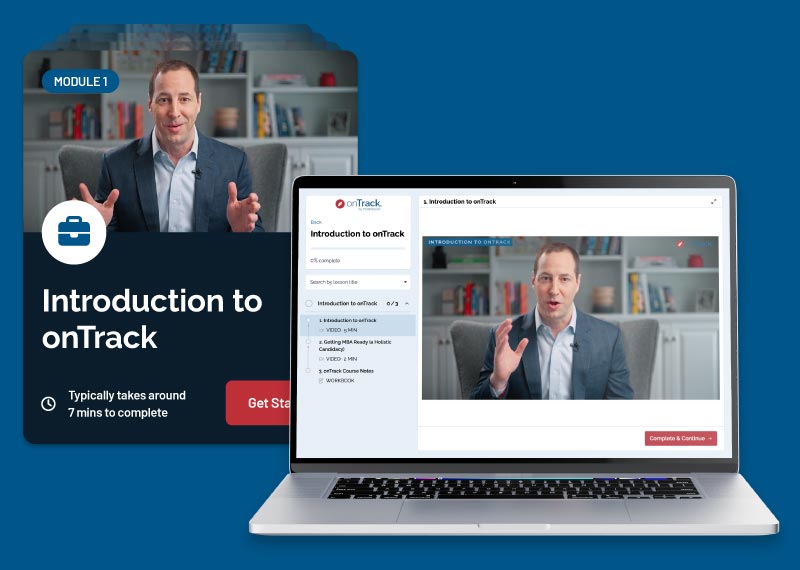
onTrack by mbaMission

A first-of-its-kind, on-demand MBA application experience that delivers a personalized curriculum for you and leverages interactive tools to guide you through the entire MBA application process.

Get Started!

2026–2027 MBA Essay Tips

Click here for the 2025–2026 MBA Essay Tips


MBA Program Updates

Explore onTrack — mbaMission’s newest offering allowing you to learn at your own pace through video. Learn more