The Wharton School of the University of Pennsylvania asks applicants to provide two short essays concerning their career goals, plus a longer essay, whose focus is on how the applicant’s background will enable them to contribute to the Wharton community. By discussing your professional aspirations as well as your experiences and values, you have the opportunity to provide the admissions committee with a well-rounded impression of yourself, in addition to illustrating your fit with the school.
In our analysis that follows, we provide more in-depth guidance on each of Wharton’s 2026–2027 essay questions. You should also note a major change to its general application that was made last year: Wharton now asks for only one recommendation and will send the form, which includes two standard recommendation questions, to the recommender whose name you enter. This will surely be good news for your recommenders, who no longer need to answer Wharton-specific questions!
Harvard Business School (HBS) offers an excellent MBA program. This is largely a given, and we are not questioning that. However, what we will call into question is whether HBS (or any other school, for that matter) is right for you. Every year, we get a few calls from confused MBA aspirants who say, “I visited HBS, and I am not sure if there is a fit,” as if that indicates some sort of problem. Indeed, and this may be shocking to some, HBS is not for everyone—particularly those who do not relate well to case-based learning, those who want a lot of flexibility in their first-year curriculum, and those who would prefer a small class size (HBS’s Class of 2026 has 930 students, while the same class at the University of California, Berkeley, Haas School of Business, for example, has just 295).
Applicants to the University of Washington (UW) Foster School of Business must provide two average-length essays but have the option of submitting two more, allowing candidates to cover more of what they feel are the most compelling parts of their candidacy. The school’s first required essay focuses on applicants’ desire to attend business school with respect to their career plans and professional needs, and the second asks candidates to explain how their attitude aligns with the program’s mission statement and then share an experience that illustrates the alignment. The first optional essay provides a rather open-ended opportunity to discuss anything else of significance in one’s candidacy, while the second deals exclusively with the importance of encouraging inclusion. Read on for our full analysis of UW Foster’s 2026–2027 application essay questions.
With MBA graduations right around the corner, many of you will be starting new jobs soon. Getting off on the right foot is critical for job satisfaction and long-term success within an organization (and beyond it). Whether your new employer offers substantial onboarding and training programs or whether you are expected to take the reins yourself as you forge ahead in your new role, these six tips can help set you up for success:
Many MBA applicants know they want to make a change professionally, but far fewer know how to clearly articulate what that change should look like. They might feel ready to take on more responsibility, pivot to a new industry, or enter a different function, but when asked to define their post-MBA goals, they draw a blank. Because career goals are such a central part of the MBA application, that uncertainty can quickly become a liability.
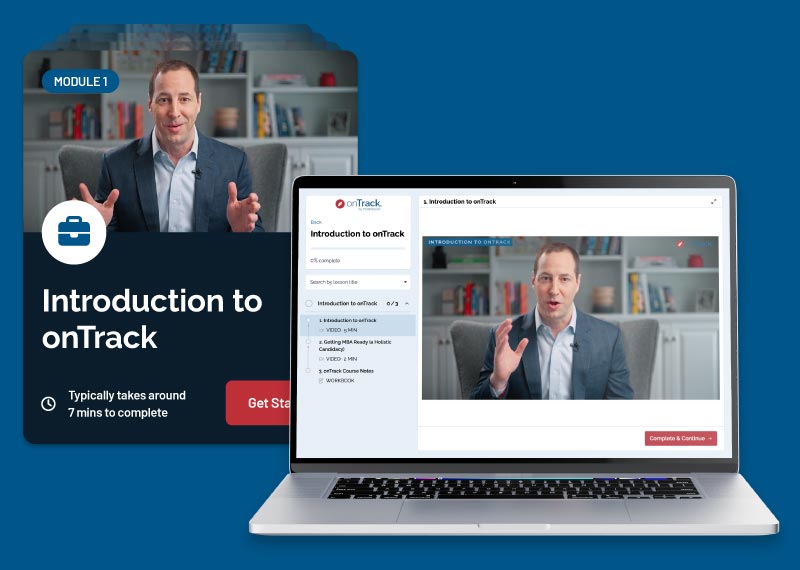
A first-of-its-kind, on-demand MBA application experience that delivers a personalized curriculum for you and leverages interactive tools to guide you through the entire MBA application process.