Blog

University of Virginia (Darden) Essay Analysis, 2013–2014

Darden initially announced that it would have only one essay prompt, but now that its application has been officially released, we see that the school actually requires three “traditional” essays and an optional essay, like most other programs this year. Darden can be said to be slightly more focused on fit than other schools, because it asks a narrow question about the learning team experience. Clearly, the school feels that an applicant’s fit with this structural element of Darden’s core curriculum and an understanding of how you can contribute to the experience of your peers is an important part of the selection process. So, think especially carefully about your responses with this in mind , as we explain further in our essay analysis, which follows…

Darden

1. Learning teams are an integral part of Darden’s academic experience. What personal qualities and expertise will you bring to your Darden learning team? (250 words)

To write this essay, you first need to understand how a Darden learning team operates. You might start by reading up on the learning team approach on the Darden Web site and watching a video the school produced on its learning teams. If you know anyone who is currently at Darden or has graduated from the program, you should definitely reach out to ask about the experience. Keep in mind that you will not be writing about the learning team itself, but you will need to understand how such teams work to be able to compellingly discuss how you would contribute to and participate in such a dynamic.

Even in a short essay of just 250 words, you should still tell a story about yourself. You cannot simply write something like “I am a patient teacher and would bring these skills to my learning team, where I will help others learn more effectively.” Instead, you might discuss how you are an experienced mentor and trainer and reveal how you have positively affected an individual or group. Then, you might relate that experience to how you would conduct yourself as part of a learning team. The specific personal quality or expertise you claim is not as important as proving that your skill(s)/experience will allow you to be a valuable, contributing member of that team.

2. What is your short-term goal and why? What makes this goal a good fit for you? (250 words).

In short, this essay prompt is basically asking you to write a personal statement—though a very brief one. Because such essays are similar from one application to the next, we have produced the mbaMission Personal Statement Guide, which helps applicants write this style of essay for any school. We offer this guide to candidates free of charge. Please feel free to download your copy today.

For a thorough exploration of Darden’s academic program/merits, defining characteristics, crucial statistics, social life, academic environment and more, please check out the mbaMission Insider’s Guide to the Darden School of Business Administration.

3. Share your thought process as you encountered a challenging work situation or complex problem. What did you learn about yourself? (500 words maximum)

Choosing a situation to discuss that required clear and measured consideration on your part is imperative, given that Darden asks explicitly for you to detail your thought process. Simply describing the nature of the situation and how it played out is not enough for this essay—you must reveal the process of contemplation that ultimately led you to action in your efforts to resolve the issue. Interestingly, you do not necessarily need to show that you achieved your desired results, and the type of challenge you describe is not of primary importance. The key to a successful essay here is not only showing that you invested an appropriate amount of thought for the problem or situation at hand, but also the progression and development of your thinking. The other crucial element of this essay is demonstrating that you learned from the experience—and specifically, learned something about yourself. So, claiming that you gained a new skill, for example, would not constitute an appropriate response. You will need to delve more deeply into how your understanding of yourself differed after the situation and clearly explain what the experience brought out in you that you had not known about yourself before.

4. Additional Comments: If there is further information you believe would be helpful to the Admission Committee, please provide it: (250 words)

However tempted you might be, this is not the place to paste in a strong essay from another school or to offer a few anecdotes that you were unable to use in any of your other essays. Instead, this is your opportunity—if needed—to address any lingering questions that an admissions officer might have about your candidacy, such as a poor grade or overall GPA, a low GMAT score, a gap in your work experience, etc. In our mbaMission Optional Statement Guide, available through our online store, we offer detailed advice on when and how to take advantage of the optional essay (including multiple sample essays) to help you mitigate any problem areas in your profile.

University of Pennsylvania (Wharton) Essay Analysis, 2013–2014

Wharton’s essay prompts for this application season may seem a bit perplexing. At first glance, the two questions seem rather similar. However, the first is basically a question about what you hope to get from your MBA experience at the school, and the second is mostly about what you can give to the Wharton program. With only 500 words for Essay 2 to give the school a sense of your personality and experiences, you will need to think especially carefully about what you want to say. At other schools, an interview will give you the opportunity to share these parts of your profile, but Wharton’s group interview will not be the place for you to talk about yourself, so this essay is your opportunity instead. Proceed thoughtfully…

Wharton

Essay 1: What do you aspire to achieve, personally and professionally, through the Wharton MBA? (500 words)

This essay prompt has the markings of the classic personal statement question, though it differs slightly in that it includes your personal aspirations in addition to your professional aspirations. With respect to your personal aspirations (note that the phrasing is “through” Wharton’s program), your goals can be anything from advancing your intellectual development while at the school to experiencing new cultures and personalities after graduating with your degree. The goal you claim is not as important as truly owning it and connecting it directly to what Wharton offers, revealing a very clear understanding of the school’s strengths and resources and of how you will use them. Avoid vague statements about how great the school is and focus on demonstrating a clear connection between your aspirations, what you need to achieve them and what Wharton in particular offers that will enable you to fulfill those needs.

Because personal statements are generally similar from one application to the next, we have produced the mbaMission Personal Statement Guide, which helps applicants write this style of essay for any school. We offer this guide to candidates free of charge. Please feel free to download your copy today.

For a thorough exploration of Wharton’s academic program/merits, defining characteristics, crucial statistics, social life, academic environment and more, please check out the mbaMission Insider’s Guide to the Wharton School of the University of Pennsylvania.

Essay 2: Academic engagement is an important element of the Wharton MBA experience. How do you see yourself contributing to our learning community? (500 words)

Here, Wharton gives you a chance to discuss how your past activities, professional experiences and, in some cases, even personal adventures could be harnessed for the benefit of others at the school. Consider identifying and exploring one or two specific instances in your life that were extraordinary or formative and allowed you to claim specific knowledge or expertise. Then connect them to specific elements of the school’s MBA program, revealing that you have a thorough understanding not only of the school itself but also of how your personal strengths could enhance the experience for your fellow students.

Your experiences need not be totally unique, but they must be conveyed in a way that paints them as specifically yours, and they need to be capable of being leveraged academically.  Note that the school’s question specifies a contribution to the “learning” community. However, this does not mean that you must have some sort of strictly academic knowledge. In fact, most essays written from that angle would end up being quite boring: “I worked on discounted cash flows modeling, so I can help others with such models” would be an almost sure loser. Unless you can claim a truly exceptional academic achievement that has direct application in class (“My PhD in nanotechnology would advance discussions on the topic of emerging technologies…”), you would be better off delving into how you developed particular skills or traits and then explaining how they could be applied. For example, if you have experience managing flexible teams, you would be well equipped to facilitate discussions on your learning team and thereby add value in that capacity.

As you approach this essay, be sure to not simply tell the admissions committee how great you are at something. Instead, use a narrative to illustrate that you have certain applicable experiences, skills and/or qualities and fully understand their value to others.

Monday Morning Essay Tip: Consider Adding a Personal Dimension

Candidates often fixate on using professional and community-based stories in their application essays. As a result, many forget (or neglect) to even consider personal stories as possible differentiators. Because so many candidates have similar professional experiences, personal dimensions should be highlighted whenever possible (considering that few examined lives can truly be said to be similar). Stories of commitment to oneself or others can have a strong emotional impact on an admissions committee and can help distinguish you from other applicants.

What types of experiences should you discuss? This question has no easy answer. For personal stories to work in your application essays, they need to be truly distinct. An example of a unique personal story might be that of an individual who helped his/her cousin, who was adopted at birth, relocate his/her birth mother; another might be one of an individual who took a six-month leave of absence to take his/her disabled grandmother on a tour of her home country. Clearly, not everyone has these exact experiences, but each of us has interesting anecdotes we can tell about ourselves. These are the kinds of stories that can be showcased in your essays with a little bit of thought and creativity.

New York University (Stern) Essay Analysis, 2013–2014

New York University’s (NYU’s) Stern School of Business jumps on the “less is more” bandwagon this application season by reducing its essay count from three to two. However, that is the only change—Stern’s essay questions are actually the same as last year’s, but for Essay 2, candidates can now choose between two prompts that were previously both mandatory.

For Essay 2, it will be interesting to see whether candidates favor Option A, taking the rather straightforward path and exploring their envisioned careers in greater depth, or the challenging creative essay in Option B, hoping to provide a far deeper personal picture for the admissions committee. Our guess is that most applicants will choose the latter—doing so will allow the candidates to differentiate themselves from many “careerists” in the applicant pool. We also suspect that some candidates will worry that if they choose Option A, they will be inadvertently revealing themselves to be “uncreative” and will therefore feel compelled to choose Option B. But do not try to guess what the admissions committee “wants”! If the school wanted everyone to respond to one option in particular, they would not have offered two! Let us reassure you that this is not some sort of test. Take the time to consider how you would respond to both questions, and then select the one that you believe would offer the admissions committee the more compelling picture of you.

NYU Stern Essay 1:  Professional Aspirations

(750 word maximum, double-spaced, 12-point font)

  • Why pursue an MBA (or dual degree) at this point in your life?
  • What actions have you taken to determine that Stern is the best fit for your MBA experience?
  • What do you see yourself doing professionally upon graduation?


The three points that make up Stern’s Essay 1 question this year basically constitute a Personal Statement, and because Personal Statements are similar from one application to the next, we have produced the mbaMission Personal Statement Guide, which helps applicants write this style of essay for any school. We offer this guide to candidates free of charge. Please feel free to download your copy today.

And for a thorough exploration of NYU Stern’s academic program/merits, defining characteristics, important statistics, social life, academic environment and more, please check out the mbaMission Insider’s Guide to New York University’s Leonard N. Stern School of Business.

Essay 2: Choose Option A or Option B

Option A: Your Two Paths

(500 word maximum, double-spaced, 12-point font)

The mission of the Stern School of Business is to develop people and ideas that transform the challenges of the 21st century into opportunities to create value for business and society. Given today’s ever-changing global landscape, Stern seeks and develops leaders who thrive in ambiguity, embrace a broad perspective and think creatively about the range of ways they can have impact.

  • Describe two different and distinct paths you could see your career taking long term. How do you see your two paths unfolding?
  • How do your paths tie to the mission of NYU Stern?
  • What factors will most determine which path you will take?


Given that the school is asking about two possible paths for your long-term career, you may be wondering whether you can be vague or uncertain about your goals in this essay. Quite simply, “No.” In fact, you will instead need to present two feasible career options and relate your skills and experiences to both of them very clearly to create an effective, coherent statement and to show not only that you are versatile but also that you know yourself well.

The key here is demonstrating that you have a full understanding of the career paths you propose for yourself and truly grasp how and why each one would be a good fit for you. If you write that you could see yourself as either a marketing manager or a hedge fund manager, for example, you will reveal that you actually do not know much about these positions, because the personalities and skills necessary to succeed in the roles are quite different. Although identifying and showing a connection between these options is not impossible (both can require a very intense focus on data mining, for example), your essay will really only be successful if you can effectively show that you know yourself and the two diverse paths well. A more plausible—and likely convincing—option is to choose two positions that are more relatable to each other, such as entrepreneur and politician. There is no “right” combination for this essay, but whatever you propose has to be credible. Basically, Stern is saying that it wants to know that you are able to make the most of opportunities, even if life (or the economy!) throws you a curveball. By thoughtfully discussing two feasible alternatives, you will prove that you are multitalented and prepared to knock any curveball out of the park.

To best answer the question that relates to Stern’s mission, you should first understand—you guessed it!—the school’s mission. Here it is in Stern’s words:

The mission of the Stern School of Business is to develop people and ideas that transform the challenges of the 21st century into opportunities to create value for business and society. Given today’s ever-changing global landscape, Stern seeks and develops leaders who thrive in ambiguity, embrace a broad perspective and think creatively about the range of ways they can have impact.

The school’s mission is clearly quite broad. You need not address every aspect of it in your essay, but make sure that you connect your proposed paths to at least one element of Stern’s statement. Further, you should definitely not trot out clichés about “doing good,” just because Stern has the word “society” in its mission. In short, avoid approaching this part of the essay with a “What do they want to hear?” perspective and truly consider how your stated career trajectories relate to the school’s objectives—think deeply about who you are, where you want to be and how your ambitions and values connect with Stern’s own mission.

Option B: Personal Expression

Please describe yourself to your MBA classmates. You may use almost any method to convey your message (e.g. words, illustrations). Feel free to be creative. (See Stern’s essay write-up in more depth via this link.)

In NYU Stern’s famed “personal expression” essay, you have a phenomenal opportunity to differentiate yourself from the rest of the applicant pool in two distinct ways. The first is the vehicle through which you choose to reveal your persona. By using a creative and captivating format, you can grab the admissions committee’s interest and compel your “reader” to pay close attention to your content. However, be sure to consider the possible limitations of certain clever options, not just their uniqueness. For example, although a baseball card may be aesthetically pleasing, this format severely limits the amount of information you can convey because of its size and anticipated style. Instead, if you were to submit a eulogy theoretically written by your best friend (and you CAN submit something that is written, but do not use this idea; it is now public), the format would be sufficiently broad to allow you to touch on all that is unique about you. The second way this essay question allows you to differentiate yourself is through your content. Ideally, you will use this opportunity to showcase a diversity of professional, personal, academic and community accomplishments that you were not able to share in essay one. The personal expression allows you to reveal your true personality and “likeability” beyond your professional/academic competencies.

One important note: NYU Stern is accepting multimedia presentations, but do not feel compelled to use this option if this is not something with which you are comfortable, and if you do choose this method, do not worry about the level of your Web design or video production skills relative to others’. For this essay, content trumps style. In fact, at an mbaMission event, we interviewed various admissions officers, students and alumni from NYU Stern who spoke of some incredibly simple “personal expression” submissions that had captivated the admissions committee—and many of these were straightforward essays!

Professor Profiles: Andrew Metrick, Yale School of Management

Many MBA applicants feel that they are purchasing a brand when they choose a business school to attend, but the educational experience itself is what is crucial to your future, and no one will affect your education more than your professors. Each Wednesday, we profile a standout professor as identified by students. Today, we profile Andrew Metrick from the Yale School of Management.
Andrew Metrick, Yale SOM
Twice distinguished with Excellence in Teaching awards during his time at the University of Pennsylvania’s Wharton School, Yale undergrad alumnus Andrew Metrick (’89) (“The Financial System”) first joined the Yale School of Management (SOM) faculty in 2008 as a professor of finance. In 2009, he was named the Theodore Nierenberg Professor of Corporate Governance and made faculty director of the Millstein Center for Corporate Governance. Then, in 2010, he became deputy dean for faculty development and the Michael H. Jordan Professor of Finance and Management.

Metrick’s interest in venture capital reportedly began when he volunteered to take over a course in the study area while at Wharton and led to the eventual publication of his textbook Venture Capital and the Finance of Innovation (with Ayako Yasuda; Wiley, 2010). His work now focuses on financial stability.

In his biography on the Yale SOM Web site, Metrick states, “Watching what happened to Bear [Stearns] in March 2008—seeing how fast a large and powerful financial institution can collapse—had a profound effect on my research interests. Since then, I have been spending much of my time trying to understand financial crises. I don’t expect to finish this project anytime soon.” Moreover, Metrick notes in his faculty biography that the financial crisis also triggered something of a career shift for him, which “led to a complete change in my teaching, with all my courses now relating in some way to the functions and regulation of the financial system, especially when that system goes awry.”

Metrick stepped away from the Yale SOM briefly in 2009–2010 to serve as an economist on President Obama’s Council of Economic Advisors, then returned to the school in the fall of 2010. A recent SOM graduate described her experience with Metrick in a “Learning From the Experts” video on the school’s site, saying, “It was great to get to be exposed to him and the work that he’s been doing.”

For more information about the Yale SOM and 15 other top-ranked business schools, check out the mbaMission Insider’s Guides.


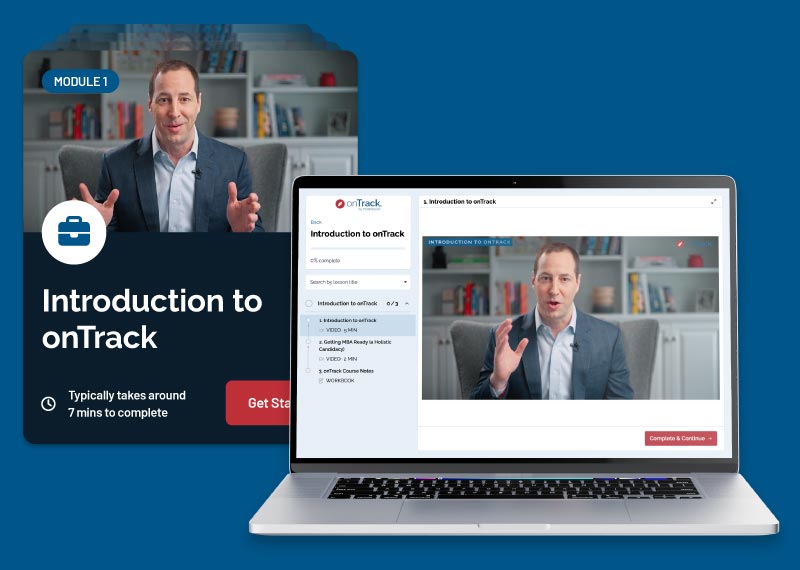
onTrack by mbaMission

A first-of-its-kind, on-demand MBA application experience that delivers a personalized curriculum for you and leverages interactive tools to guide you through the entire MBA application process.

Get Started!

2026–2027 MBA Essay Tips

Click here for the 2025–2026 MBA Essay Tips


MBA Program Updates

Explore onTrack — mbaMission’s newest offering allowing you to learn at your own pace through video. Learn more