

Blog

What I Learned at… London Business School, Part 4

In our “What I Learned at…” series, MBAs discuss the tools and skills their business schools provided as they launched their careers.

Nitzan Yudan is the CEO and co-founder of FlatClub, a United Kingdom–based online marketplace for short-term rentals that connects verified members of exclusive alumni, employment and organizational networks. In the final part of this four-part series, Nitzan reflects on the influence London Business School (LBS) has had on his career. 

My journey from banker to entrepreneur has been a complete roller coaster, with many ups and downs. Entrepreneurial problem solving is now something that I never stop thinking about. My son was born around the same time that the business was born, and when he and I play with LEGOs, the first thing I think about is how I would “publish” the house we built on the FlatClub site. My advice is that if you like problem solving, become a consultant. If you like problem solving with no resources, become an entrepreneur.

When I think about how LBS has influenced my career, specific entrepreneurial skills come to mind. In particular, my education gave me important insights into thinking about how venture capitalists make decisions to invest. The course “Financing the Entrepreneurial Business,” for example, really helped me understand how to pitch ideas. Conversely, the prospect of pitching an actual business idea made class much more interesting and engaging.

Beyond imparting these very powerful tools, the LBS network provided the necessary connections and opportunities for starting a business. Many alumni in the United States that we spoke to were eager to help, and one even reached out to invest. FlatClub would not exist without LBS—that I know for sure.

What I Learned at… London Business School, Part 3

In our “What I Learned at…” series, MBAs discuss the tools and skills their business schools provided as they launched their careers.

Nitzan Yudan is the CEO and co-founder of FlatClub, a United Kingdom–based online marketplace for short-term rentals that connects verified members of exclusive alumni, employment and organizational networks. In Part 3 of this four-part series, Nitzan explains how the London Business School (LBS) community helped him find traction for his start-up idea and discusses the preliminary phases of building his company.

The first step in creating a business around the idea of renting flats through exclusive networks was to perform some basic market research. I spoke to approximately 300 of my fellow students on an individual basis, with the goal of learning how trust works across different demographics and cultures. The LBS community proved invaluable in this regard. I also asked people in marketing and branding for input and received help from a friend with the modeling that I would later use to pitch to investors. I learned from my research that trust is a very personal and individual decision. It seemed that what people most valued was the ability to control their privacy settings.

Another important moment in the creation of FlatClub occurred while taking “Entrepreneurship.” I decided to pitch my idea to Professor Gary Dushnitsky [LBS Associate Professor of Strategy and Entrepreneurship]. Dushnitsky liked the idea and said, “Why don’t you just go for it? What can go wrong?” This was exactly what I needed to hear. Shortly thereafter, I began testing a very basic prototype of the site. Although I did not have the money to hire employees or invest up front, I had free access to a huge network of students and faculty. To drive traffic to the new site, I sent an email to the entire LBS community. Within two weeks, 70 flats had been listed, and we had our first sale.

After graduating in 2010 and gaining the confidence to get FlatClub off the ground, I joined the LBS Incubator Programme for one year. One of the greatest advantages was being able to call people and introduce myself with the affiliation of the program. In addition, the incubator provided my company with free office space, access to school resources, advice on accounting, public relations support (we were mentioned in Forbes and the Financial Times) and access to investors.

My partner, whose background is in real estate, came on board in 2011. In April 2012, two professors invested in the business, and just six months after launching, we hired our first employee. We are now a team of 13 people from ten nationalities and recently closed a significant round of financing. We are still based in London, which is where most of our team is located, and FlatClub has grown to include more than 10,000 listings representing 30 business school communities globally.


What I Learned at… London Business School, Part 2

In our “What I Learned at…” series, MBAs discuss the tools and skills their business schools provided as they launched their careers.

Nitzan Yudan is the CEO and co-founder of FlatClub, a United Kingdom–based online marketplace for short-term rentals that connects verified members of exclusive alumni, employment and organizational networks. In Part 2 of this four-part series, Nitzan describes the inspiration he found for starting his business while at London Business School (LBS).

The idea for FlatClub came together through a number of experiences I had while attending LBS. My first exposure to the opportunities afforded by the school’s alumni network occurred during an event hosted by the Entrepreneurship Club, at which Tony Wheeler (’72)—the founder of Lonely Planet [Publications] and an LBS alumnus—gave a talk. Wheeler was a kind of role model for me, as I frequently read Lonely Planet guides during my extensive travels.

A year after hearing Wheeler speak, I reached out to him via email. In his reply, he said that although he could not meet right away, since he was living in Australia, he would reach out whenever he was next in London. Three months later, he followed up, and we got together for a cup of coffee. This encounter helped me realize that attending LBS had significantly bolstered my reputation and enhanced my networking possibilities. I knew from this experience that there was something different about this MBA network.

Another significant moment in the inception of FlatClub came during a weekend trip to Bruges. My wife and I had hoped to rent out our London flat while we were gone to recoup some of the cost of our travel. Trust was an important factor in finding a renter. We didn’t want to rent out our place just to anyone online, so we ended up renting to the family of an LBS alum whom I did not know but had by chance found through the internal portal. The rent paid was generous, and I knew that this alum would not trash my apartment, because he had a reputation to uphold. We also wanted to create a positive impression, so we left all sorts of suggestions and directions to help accommodate him and his family during their stay. They were so happy that they left us a gift!

A light bulb went on. I realized that business school networks can fill the apparent need—especially common among MBA students and professionals who travel often—for a trusted source of short-term rentals. In addition, the same network that inspired this idea would equip me with the necessary tools and support to launch my entrepreneurial debut. Nine months later, I had a business.

What I Learned at… London Business School, Part 1

In our “What I Learned at…” series, MBAs discuss the tools and skills their business schools provided as they launched their careers.

Nitzan Yudan is the CEO and co-founder of FlatClub, a United Kingdom–based online marketplace for short-term rentals that connects verified members of exclusive alumni, employment and organizational networks. In Part 1 of this four-part series, Nitzan details his reasons for choosing London Business School for his MBA and why he decided to leave the finance industry for a career in entrepreneurship.

My path to co-founding FlatClub came about after forgoing a more traditional career path in favor of the freedom—and risks—that come with creating a start-up company. Although I am an avid traveler, the idea of building a business focused on short-term accommodations and peer-to-peer flat sharing was not initially among my pre-MBA career goals or part of my educational background. I am originally from Israel, and I studied industrial engineering and management at Ben-Gurion University of the Negev, served in a special forces unit of the Israeli military and have 12 years of professional experience, primarily in financial services. After working at Israel’s Bank Hapoalim for two years, I decided to pursue business school as a means to advancing my career in finance.

When I was shopping around for MBA programs, my top choices were INSEAD and London Business School (LBS). Ultimately, I chose the latter on the basis of location and the potential to accelerate my career: I wanted to live in London, and the city seemed an ideal place to focus on my goal of moving up in the world of banking. I did not know it at the time, but LBS would also serve a crucial role in providing the financial support, entrepreneurial resources and confidence I needed to launch my own business.

By the end of my first year of the two-year program at LBS, I received attractive post-MBA offers from both American Express and Deutsche Bank for full-time positions upon graduation, but I decided to reassess my career trajectory. I had secured desirable opportunities in my target industry but nonetheless found myself asking, “Why not try something else?” I felt that I had a risk-free second year of education to explore a different field and decided to leverage my business school resources and get a start-up off the ground. LBS equipped me with an amazing space in which to take risks that I would never have access to again in my life. When I made that choice, I had no idea that FlatClub would emerge.

Monday Morning Essay Tip: Use Only One Famous Quote per Application

Sometimes, incorporating a famous quote (or perhaps a lesser-known quote by a well-known person) into one of your application essays can add a little something special to the story you are trying to tell. If the quotation truly enhances your message in a significant way, it can serve as an effective tool, making your submission that much more compelling. Consider the following examples:

Example 1:

“The best executive is the one who has sense enough to pick good men to do what he wants done, and self-restraint enough to keep from meddling with them while they do it.”
– Theodore Roosevelt

Roosevelt’s words are as true today as when he spoke them. The essence of a manager is…

Example 2:

As Peter F. Drucker said, “Management is doing things right; leadership is doing the right things.” I have found the distinction between management and leadership especially important…

However, some candidates may be tempted to use a quotation as a kind of crutch, essentially relying on someone else’s clever or poignant wordsmanship to take the place of their own. Think of this option as a way of enriching an already interesting narrative, rather than as an easy shortcut to a more impressive essay.

Before using a quotation in your writing, ask yourself these three questions:

• Does the quotation fit the essay’s main theme?
• Does the quotation reflect who you are or what you believe?
• Does the quotation truly enhance the essay?

If you can answer “yes” to all three questions, making the quotation a part of your essay might be a good idea. But first make sure that your story is sufficiently strong to stand on its own, even without the quote, and limit yourself to just one quotation per application (not per essay).


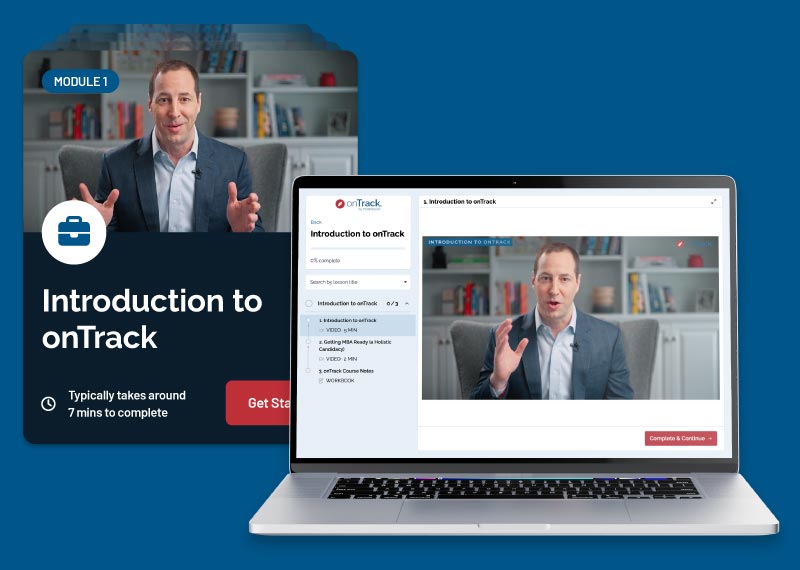
onTrack by mbaMission

A first-of-its-kind, on-demand MBA application experience that delivers a personalized curriculum for you and leverages interactive tools to guide you through the entire MBA application process.

Get Started!

2026–2027 MBA Essay Tips

Click here for the 2025–2026 MBA Essay Tips


MBA Program Updates

Explore onTrack — mbaMission’s newest offering allowing you to learn at your own pace through video. Learn more