
Blog

What I Learned at…Stanford Graduate School of Business, Part 2

In our “What I Learned at…” series, MBAs discuss the tools and skills their business schools provided as they launched their careers.

Sandi Lin is the CEO and founder of Skilljar, which provides businesses with online course software. Before founding Skilljar, Sandi was a senior manager at Amazon.com in Seattle. She earned her MBA from the Stanford Graduate School of Business. In Part 2 of this three-part series, Sandi discusses some ways in which the school’s notable “Touchy Feely” course prepared her for the real-world challenges associated with founding a start-up. (Click here to read Part 1.)

Most Stanford Graduate School of Business (GSB) alumni will tell you that the most impactful class they took at Stanford was “Interpersonal Dynamics,” also known as “Touchy Feely.” Five years out from graduation, I can certainly tell you that “Touchy Feely” is something I use every day. I can look up the details of Porter’s five forces analysis or of the generally accepted accounting principles when I need to, but the lessons of communication are universal.

There are already several great posts on the impact of “Touchy Feely,” including a Quora thread and a facilitator’s blog post. What happens inside a T-Group [training group] is confidential, but at a high level, the groups are intense learning labs for active listening, communication and influence. It is easy to read about these topics in the abstract, but it is another matter to deeply understand how I am perceived by others, how I communicate and what my biases are.

I use “Touchy Feely” lessons in multiple ways at work. Here are three tactical examples:

“I feel [feeling word].In “Touchy Feely,” I learned that I can only know my own feelings and my interpretation of other people’s actions (for more information, see the Johari window). But I cannot know other people’s feelings or their motivations for why they took those actions. So instead of assuming, “Joe Smith is so inconsiderate. He’s always interrupting me when I’m working,” I should talk to Joe directly and say, “I feel frustrated when you drop by to ask me questions. I want to give you my full attention, but I also lose track of what I am doing. Can we figure out a strategy that will work for both of us?” The key technique I remember to use is to say, “I feel [feeling word].” Try it—it is harder than it sounds.

“Tell me more.” I learned that the word “why” is inherently challenging and puts a burden (no matter how slight) on the other person to explain themselves. Using phrases such as “tell me more” are more inviting and produce the same result.

“What I’m hearing is…” One of my biggest weaknesses in terms of communication is cutting people off and immediately jumping to solutions. I learned firsthand in “Touchy Feely” that often the most valuable part of a conversation is first acknowledging that I do hear what the other person is saying.

Most of entrepreneurship comes down to communication. As a founder, I am constantly asking investors to believe in my company, asking customers to trust our product and asking potential hires to join the team for long hours and little pay. Understanding the potential impact of my words and actions, experienced firsthand through “Touchy Feely,” has made a profound difference in both my professional and personal interactions.

What I Learned at…Stanford Graduate School of Business, Part 1

In our “What I Learned at…” series, MBAs discuss the tools and skills their business schools provided as they launched their careers.

Sandi Lin is the CEO and founder of Skilljar, which provides businesses with online course software. Before founding Skilljar, Sandi was a senior manager at Amazon.com in Seattle. She earned her MBA from the Stanford Graduate School of Business. In Part 1 of this three-part series, Sandi reflects on the advantages of having gained experience at a “real job” before starting her own company.

Entrepreneurship is in the air at the Stanford Graduate School of Business (GSB). In 2011, 16% of the GSB class started their own companies after graduation, and many more chose to join start-ups as nonfounders. Stanford’s location in the heart of Silicon Valley, the extremely high caliber of engineering and business students on campus, and the university’s active support of start-up accelerator programs like StartX all fuel the school’s awesome entrepreneurial engine. Even the GSB’s tagline, “Change Lives, Change Organizations, Change the World,” leads students to dream big.

I arrived at Stanford knowing that I wanted to start (or work at) a tech start-up after business school. My background was in transportation consulting, so this would be a significant career change for me. Unfortunately, in 2008, the global economy collapsed—Lehman Brothers declared bankruptcy in September, just as I was just starting my second year at Stanford. It is hard to imagine now, but virtually all big companies declared a hiring freeze that fall and even began laying off seasoned employees.

My goal had been to join a start-up, but I also had a product management job offer from Amazon.com in Seattle, where I had interned the previous summer. Although Amazon is a very well respected company today, in 2008, most people believed that Amazon was “just a retailer” and that its era of innovation was long over. I knew differently, having just witnessed the early days of the Kindle, Amazon Web Services and Fulfillment by Amazon (all of which were very small teams with MBA interns back in the summer of 2008). Not sure what to do, I looked to the Stanford network for advice.

I first talked to an alumna at a Bay Area start-up that I had my eye on. She had worked at several big companies before founding her company. Her advice was gentle but blunt—her company was always looking for talented people, but I had very little experience. In addition, well-known tech giants were laying off hundreds of experienced product managers. That was the reality of the job market I would be competing in. At the same time, she told me that work experience at Amazon was very well respected in the industry and that I could not go wrong by taking a position there.

At Stanford, I was lucky enough to take a supply chain class with Michael Marks, an amazing leader I admired both personally and professionally. When I asked him for advice, he told me, “No matter when you decide to start a company, you will need to know how a well-run company operates. And there is no better-run company in the world than Amazon.com right now.”

With their advice, I decided to put my start-up dreams on pause and take the job at Amazon, where I spent the next four years in various product management roles. Looking back now, I cannot imagine taking the entrepreneurial leap without the experience I developed during those years. Thanks to Amazon, I met my co-founders, most of my early employees and several of my future investors. I learned how to build and launch a tech product, how to hire and manage a team and how to run a business. While it may be true that nothing prepares you for a start-up like launching a start-up, I now know that my decision to work at an established company after graduation has given me the best chance of success with Skilljar.

Click here to read Part 2.

Webinar Series: Five Steps to Business School Acceptance

Are you ready for the 2014–2015 MBA application season?

Join mbaMission, Manhattan Prep and Poets & Quants for a free, five-part webinar series to help you prepare!

Five-Steps-Email

Three leaders in the MBA admissions space—Poets & Quants, mbaMission and Manhattan Prep—are banding together to ensure that you will be ready for the 2014–2015 MBA admissions season. Together, we are launching a free, five-part webinar series entitled “Five Steps to Business School Acceptance”! In each of the first four sessions, a senior consultant from mbaMission will address and explain a different significant admissions issue, while Poets & Quants’ John Byrne serves as host, moderating any questions and answers. Then, an expert from Manhattan Prep will present a challenging GMAT issue, offering insight, advice and more. The fifth and final session consists of a discussion panel with current admissions officers, sharing their thoughts and answering questions about the upcoming admissions season.

We hope you will join us for this special series. Please sign up for each session separately via the links below—space is limited.

Session 1: March 19, 2014 – Assessing Your MBA Profile and GMAT vs. GRE

Session 2: April 2, 2014 – Choosing the Right B-School and Advanced Quant

Session 3: April 16, 2014 – What Can I Do with My MBA? and Getting the Most Out of Your Practice GMAT Exams

Session 4: April 30, 2014 – Essay Writing Workshop and Advanced Sentence Correction

Session 5: May 14, 2014 – Questions and Answers with MBA Admissions Officers

Do you have questions for our GMAT and MBA admissions experts? Ask them in the comments below, and we will do our best to answer them in the Q&A sessions following each presentation!

Mission Admission: What About European B-Schools?

Mission Admission is a series of MBA admission tips; a new one is posted each Tuesday.

This week, we consider another option for MBA candidates looking to broaden their business school choices: European MBA programs.

Although many candidates who are competing for places at the top U.S. business schools are well aware of the strengths of the MBA programs at INSEAD and London Business School, even more options are available beyond these two, including IESE, ESADE, Oxford (Said) and Cambridge (Judge). These four schools in particular have been aggressively playing “catch up” with their better-known brethren by raising funds and dedicating them to scholarships and to enhancing their global brands. Those who know their business schools also know that IMD offers a boutique MBA program with remarkable international diversity, very highly regarded academics and a stellar reputation with international employers.

So, numerous options are available, and each can be explored on its own academic merit, but is earning your MBA in Europe, in itself, a good choice for you? For many, the key issue in determining this centers on where they would like to be after completing their education. If you are seeking to work in Europe, then clearly, these schools offer an advantage over all but the top five or six schools in the United States. (Harvard Business School, for example, can probably open as many doors in Europe as INSEAD can.) However, if you are seeking to work in the States, then the European schools will not provide the pipeline of opportunities that a top-15 American school will provide, particularly for those who hope to work in a niche industry or with a company that is not a well-known international brand.

Still, beyond the employment picture, studying abroad offers intrinsic value. Two years in London, Fountainbleu or Lausanne could certainly be its own reward…

Professor Profiles: Richard Honack, Northwestern’s Kellogg School of Management

Many MBA applicants feel that they are purchasing a brand when they choose a business school to attend, but the educational experience is what is crucial to your future, and no one will affect your education more than your professors. Each Wednesday, we profile a standout professor as identified by students. Today, we focus on Richard Honack from the Kellogg School of Management at Northwestern University.

 src=Richard Honack (“Service Marketing and Management” and “Sports Marketing and Management”) is known for integrating alumni and speakers into his popular “Service Marketing and Management” class, which focuses on how to deliver excellent customer service. Students we interviewed raved about the class’s practicality and about the way Honack unifies theory and real-world application. Further, students reported that they appreciate Honack’s warm personality. One second year told us that Honack is “interested in each student’s life,” adding, “He wanted to know what your goals were and what students wanted to get out of his class. He made connections for students and wanted to enrich their overall experience at Kellogg.” Students chose Honack as one of five recipients of the school’s Faculty Impact Award in June 2010.

For more information about Kellogg and 15 other top-ranked business schools, check out the mbaMission Insider’s Guides.


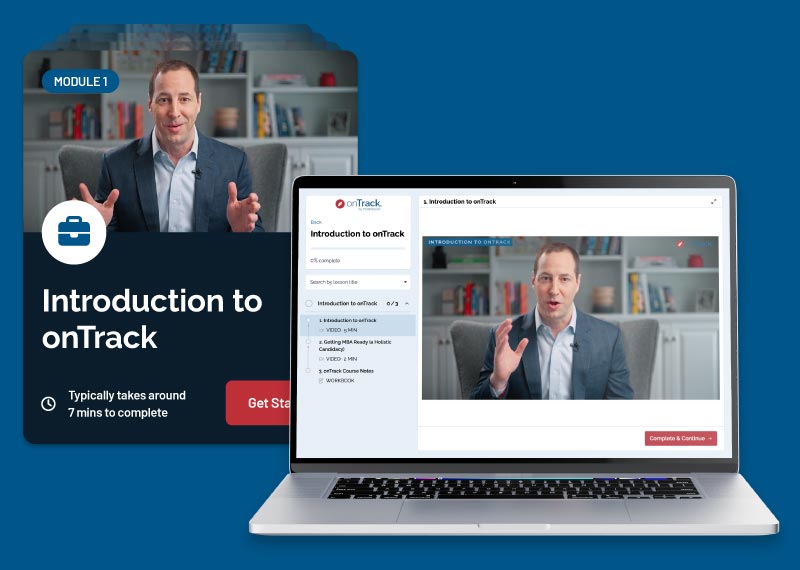
onTrack by mbaMission

A first-of-its-kind, on-demand MBA application experience that delivers a personalized curriculum for you and leverages interactive tools to guide you through the entire MBA application process.

Get Started!

2026–2027 MBA Essay Tips

Click here for the 2025–2026 MBA Essay Tips


MBA Program Updates

Explore onTrack — mbaMission’s newest offering allowing you to learn at your own pace through video. Learn more