Blog

Mission Admission: The B-School Interview Is Not a Quiz Show

Mission Admission is a series of MBA admission tips; a new one is posted each Tuesday.

This time of year, business school candidates are starting to interview with their target MBA programs. Many of these applicants inevitably fret and ask themselves, “What if I don’t know the answers to my interviewer’s questions?” The good news is that, as the title for this blog post states, a business school interview bears no resemblance to a TV quiz show. The admissions officer, alumnus/alumna, or student interviewing you will not ask you about esoteric topics and will not expect you to answer questions pertaining to business management. The vast majority of the questions you will encounter in your interview will pertain to your life and experiences—in other words, the interviewer will be asking you about you—so you will already have all the answers in hand from the beginning.

As a first step in preparing for your interviews, take time to reacquaint yourself with your own story, especially as you have thus far presented it to the school in your application. Go back and reread your essays, contemplate pivotal moments in your life, and consider your major accomplishments and failures. By doing so, you will be sure to have the basic knowledge necessary to perform at your very best during your interview.

For more guidance with your business school interviews, sign up for an mbaMission mock interview session!

GMAT Impact: How to Solve Any Sentence Correction Problem, Part 1

With respect to the GMAT, raw intellectual horsepower helps, but it is not everything. In this blog series, Manhattan GMAT’s Stacey Koprince teaches you how to perform at your best on test day by using some common sense.

Manhattan GMAT has been developing a new process for Sentence Correction (SC). Read on and let us know what you think!

The Five Steps for Sentence Correction

The full article on the MGMAT blog goes into more detail on each step.

1. Take a First Glance
2. Read the Sentence
3. Find a Starting Point
4. Eliminate Answers
5. Repeat Steps 3 and 4

As with any process, you will sometimes decide to deviate for some good reason. For most questions, though, you will follow this basic process.

In this post, I briefly introduce each step, but the full article goes into more detail, so make sure to follow up by reading that.

1. First Glance

The idea here is to take a “holistic” glance at the entire screen: let your eyes go slightly out of focus (do NOT read!), look at about the middle of whatever text is on the screen, and take in three things:

– the problem type (in this case, SC)
– the length of the whole sentence
– the length of the underline (or the length of the answers)

This first glance will help you formulate a plan of attack.

2. Read the Sentence

Next, read the sentence as a complete sentence, not just a collection of potential grammar issues. Pay attention to the overall meaning that the sentence is trying to convey.

3. Find a Starting Point

4. Eliminate Answers

When you spot something you know is wrong, immediately cross off answer (A) on your scrap paper. Check that same issue (and only that issue!) in the remaining answer choices; eliminate any answers that repeat the error.

5. Repeat Steps 3 and 4

SC is a bit annoying in that your initial starting point often will not allow you to cross off all four wrong answers. You usually have to find multiple starting points.

Once you have dealt with one issue, return either to the original sentence or to a comparison of the answer choices, wherever you left off.

What to Do When You Are Stuck

In general, once you get stuck, give yourself one shot to “unstick” yourself. Try comparing different answers to see whether anything new pops out at you. If not, guess and move on.

Half of the battle on the GMAT is knowing when to stop trying. Set explicit “cutoffs” for yourself—rules for when to let go—and stick to them!

Next Steps

Got all of that? Good!

In the second and third parts of this series, I will give you some drills that you can use to build the different skills needed to get through a sentence correction problem. Until then, go ahead and practice the overall process until you internalize the different steps. Good luck!

Our Favorite Advice from MBA Admissions Directors, Part 2

At mbaMission, we constantly strive to learn more about what makes a successful application and what the leading schools want—and do not want—from prospective students. To accomplish this, we communicate regularly with admissions directors at the top MBA programs, and in this two-part blog series, we want to share with you some of our favorite advice we have collected from these experts over the past few application seasons.

Liz Riley Hargrove, Former Associate Dean for Admissions at Duke University’s Fuqua School of Business

“It’s incredibly important to be authentic in this process. The worst thing an applicant can do in the business school application process is to misrepresent who they are and what they’ve done. You don’t have to be anyone other than who you are, but you do have to be able to articulate your story. You are more than your GMAT score or the sum of your years of work experience. We may admit students who have lower GMAT scores because they are amazing in all other aspects of their candidacy. We may also deny candidates with very high GMAT scores because they are one-dimensional and are not as competitive on those other important dimensions. Applicants really have to take the time to understand what our program is about and then make the connections throughout their application. Be who you are.”

Hima Bindu, Associate Director of Admissions and Financial Aid at the Indian School of Business

“Inconsistencies in performance, immaturity, and lack of focus as to why they want to do an MBA are a few pointers that spell trouble. Chance is that many applicants see an MBA more as a natural progression than as a conscious choice which adds value to their career and business. If essays and recommendations of the student are things that speak volumes about the skills he or she is going to bring to the table, a history of no achievements, awards or credentials holds up the red flag.”

Amanda Carlson, Assistant Dean of Admissions at Columbia Business School

“One thing that raises not a red flag but more like a yellow flag is when somebody’s really interested in making a career change—and I know that a lot of people come to business school to make a career change—but there needs to be some consistency in their story. So if … somebody wants to go from working in marketing at a financial services company to working in real estate development, what can they claim that shows demonstrated commitment to this interest in real estate development? I mean, is there volunteer work? Is there academic background? Are there continuing education classes? Is there a membership in some type of professional organization that would show that this is actually coming from some place genuine and it’s not just a pie-in-the-sky idea of what they think they might want to do with their MBA?”

Dustin Cornwell, Former Director of MBA Admissions at the Cox School of Business at Southern Methodist University

“If you look at any of the schools in the top ten, for example, or even the top 30, you’re going to get a great education at just about any of them. In terms of the faculty there, in terms of the resources the schools can provide, you’re very likely to get a good education and learn a lot at any of those programs. What you have to kind of drill down and look at, though, is what experience do you want? Some people thrive in a large environment. They want to meet a lot of people. They want to have hundreds of companies recruiting on campus. They really want that type of an experience, and there are a number of schools that have anywhere from 300 to upward of 800 students per class. That might be a great fit for that type of student. We hear a lot of our candidates say, ‘I want that personal attention. I want to have a small class size. I want to know my classmates. I want to know my professors personally, and I want to make sure that I’m not lost in the crowd.’ And so a [smaller] program … fits that person well. They’re able to know their classmates very well and to really have an impact on campus, maybe be a club leader, maybe get involved in student government and leave their mark on the school. So I think you can use rankings as a starting point, but you really have to look a lot more closely at other factors when you’re making a decision.”

Isser Gallogly, Assistant Dean of MBA Admissions at the Stern School of Business at New York University

“You should really have a super clear goal when you’re applying to … business school. I don’t know why anyone would make a $100,000 or so investment in anything without carefully reading the prospectus and doing a lot of investigation. There are those who haven’t researched themselves, their future careers, and also haven’t researched the schools. You can tell people who are just throwing applications out there to everybody versus those who have taken the time to do it right. All the great schools are going to give you a great education and opportunities, but there are schools where you’re going to excel, where you are going to thrive and become the best you can be, and there are other places where it’s going to be a bad fit. People really need to investigate a lot more than they think they do. There is nothing like going and visiting the school, even if it has to be virtually.”

Rodrigo Malta, Director of MBA Admissions at the McCombs School of Business at the University of Texas, Austin

“I always advise applicants to take a close look at the letter of recommendation process and make sure that they’re selecting the right people to be their recommenders, making sure that their recommenders are able to really talk about why they want an MBA and what their differentiators are. Probably the biggest flag that we see is whenever we open those letters of recommendation, and they’re either very skimpy or negative. Letters of recommendation are outside of the applicant’s control from a writing perspective, but the applicants do have a say in who they select and what they’re able to share about their candidacy with those folks that write them.”

Niki da Silva, Former Director of MBA Recruitment and Admissions at the University of Toronto’s Rotman School of Management

“I think the worst thing people can do is not be authentic. I’m not sure why [applicants do this]. I know candidates continue to do it, but you just think, you’re going to be in this program for two years of your life, and it’s going to be exhausting to have to be someone that you’re not. So just embrace who you are and have fun with it.”

Soojin Kwon, Director of Admissions at the Ross School of Business at the University of Michigan

“There are two main things [applicant mistakes] that come to mind. On their resumes: applicants often give us a job description or a list of responsibilities rather than highlighting results and impact. The second common mistake I see is that applicants use the essays to tell us about us rather than themselves. They cite a laundry list of classes, clubs, and faculty in their essays—sometimes from the wrong school—and use that as evidence of school research without really understanding what they’re about. We already know what we’re about. What we want to know is what the applicant is about and why he or she will benefit from and contribute to our community.”

Sara Neher, Former Assistant Dean of MBA Admissions at the Darden School of Business at the University of Virginia

“Never be afraid to interview because you think it’s going to be competitive. Don’t try to differentiate yourself from others; try to be your best self. These are sort of cliché, but people get caught up in ‘There are so many consultants applying’ or ‘There are so many bankers applying.’ I still want the best and most interesting bankers or the best and most interesting consultants, so don’t let that dissuade you.”

Bruce DelMonico, Assistant Dean and Director of Admissions at the Yale School of Management

“One thing I frequently tell people when asked is, we’re good at reading applications and we know that everybody has weaknesses. Very few candidates are strong across the board in every respect, and I think there’s a tendency for applicants to run away from the weaknesses to try to avoid them and hide from them, which is a natural tendency. But actually, what I find so very refreshing, and actually can be a net positive, is for applicants to actually address their weaknesses. Not dwell on them. You don’t want to lead with the weakness necessarily, but try to explain it and contextualize it, and I think applicants who do that in a good way and can do that successfully—actually, they stand out in a number of regards. It shows self-awareness, it shows interest in self-improvement, and it really can put someone in a much better position in terms of their application. One of the things I tell people is a lot of the time, if we see a weakness, if we see a gap—for example, you don’t have a recommendation from your current supervisor even though we ask for one—and you don’t explain that, we’ll likely draw a negative interpretation based on that. But if you explain it for us and contextualize it and make us understand why that’s the case, we’ll be much more forgiving.”

Our Favorite Advice from MBA Admissions Directors, Part 1

At mbaMission, we constantly strive to learn more about what makes a successful application and what the leading schools want—and do not want—from prospective students. To accomplish this, we communicate regularly with admissions directors at the top MBA programs, and in this two-part blog series, we want to share with you some of our favorite advice we have collected from these experts over the past few application seasons.

Kurt Ahlm, Associate Dean for Student Recruitment and Admissions at the University of Chicago Booth School of Business

“Take time to thoroughly think through your objectives for business school. Why do you want an MBA? What skills or experiences do you hope to gain? How do you prefer to learn? How do all of these things put you in a better position to accomplish your short- and long-term goals? These are just some of the questions I push people to consider as they begin their application preparation. The more focused and on point an applicant is, the more compelling their application will be and the more prepared they will be to successfully start an MBA program. A two-year MBA program moves quickly, regardless where you go, and if you have not fully vetted your reasons for being at that school, you can fall behind pretty quickly. The more thinking and planning you do on the front end, the greater overall success you will have throughout the entire MBA experience.”

Amanda Carlson, Assistant Dean of Admissions at Columbia Business School

“You should still prepare [for your admissions interview] as you would for a professional interview. Reread your application. The admissions committee is of course going to look for consistency in your story. It should not come as a surprise to anybody that if a person who’s interviewing says, ‘Well, I’d like to go into health care’ to the interviewer but said, ‘I want to go into real estate development’ in their application, that’s clearly going to be something that gets our minds percolating.”

Dawna Clarke, Former Director of MBA Admissions at the Tuck School of Business at Dartmouth

“A successful interview, I find …, is when people don’t just make broad sweeping statements, but they have some really good, tangible examples of things that they’ve done. So if they say they have strong leadership potential, then they tell a story to illustrate that, or if they identify themselves as being a strong team player, then they would tell us a story, an anecdote, or a vignette that illustrates that they are a team player. It’s very hard if you interview a lot of people, you’re not going to remember that so-and-so said that they were a strong team player, but I very well might remember a very compelling story that somebody told me. So I would tell people to really identify what are the three things that you’re most proud of that you think are relevant to business school, and how am I going to convey those in the interview, and what kind of specific examples do I have to tell that would be memorable and compelling?”

Dustin Cornwell, Former Director of MBA Admissions at the Cox School of Business at Southern Methodist University

“What we like to see is applicants who are focused on why they’re pursuing an MBA. They have a career goal in mind, and they’ve done their research enough about our program to know that we’re able to help them in achieving that goal. Many candidates don’t know exactly what they want to do. They know they need to get an MBA to gain more experience, perhaps, or if they’re switching careers from marketing into finance or vice versa, for example, that’s a good reason to get an MBA. And I always encourage candidates, when I’m talking to them on the road and at recruiting events, to take that next step further. Okay, now you’ve identified why you need an MBA, what do you want to do with that? How are you going to make that transition? If you are making a rather dramatic career switch from one industry to another, think about the skill set that you have, be ready to talk to recruiters about how you can transfer what you’ve done to that new position…. There are all these different areas, and students may not have had exposure to all of them yet, so the MBA program certainly can open their eyes to opportunities. But I think you have to come in with some direction. You have to have some idea of where it is you want to go, because we can’t start from square one. You need to have at least walked down that path a little and meet us halfway so we can help you get where you’re going.”

Isser Gallogly, Assistant Dean of MBA Admissions at the Stern School of Business at New York University

“When you look at the three areas—the academic, the professional, and the personal—you don’t want to give an admissions officer a reason to say no. You want them to look at everything and say, ‘Wow, this looks great across the board.’ … Obviously for undergraduate [GPA], there is only so much you can do, and it’s usually too late, but with the GMAT, we only look at someone’s best scores. So if your score is not reflective of your ability, then retake it. Retake it several times. Put yourself in the best position to demonstrate academic ability. In the application itself, when you’re talking about résumés and things like that, again, people should really try to highlight what they have achieved and quantify those results. Answer questions that may be out there, and if you have been unemployed, take the time to explain what happened and what you were doing in that time. Don’t just leave us guessing. … Help us understand.”

Rodrigo Malta, Director of MBA Admissions at the McCombs School of Business at the University of Texas, Austin

“Treat the interview professionally, no matter if it is done by a student, an admissions officer, or an alumnus of the program. I think it’s really important to prepare questions for the end, because after all, the interview is a two-way street. We’re getting to know the applicant a little bit better, but we also expect that this is an opportunity for the applicant to get to know us as well. So, I would advise them to prepare some good questions that can’t usually be found on the Web site.”

Soojin Kwon, Director of Admissions at the Ross School of Business at the University of Michigan

“We highly encourage prospective students to visit and sit in on a class, get a feel for the class dynamics—with the professor, with each other—walk around the campus and get a feel for the culture. Visits can help applicants make informed decisions about which school to apply to and ultimately attend, because they’ll get better sense of fit. Some schools are going to be a better fit based on someone’s personality and goals, and you can’t really make that determination based on view books or Web sites or rankings. You really need to experience it firsthand. That said, we understand that applicants’ budgets and schedules are tight, and it may be tough for prospective students to visit all the schools they’re considering. At a minimum, prospective students should talk to current students and alumni at each school.”

Niki da Silva, Former Director of MBA Recruitment and Admissions at the University of Toronto’s Rotman School of Management

“If they do [not know what they want to do after graduating], they should not be investing a hundred thousand dollars in an MBA program until they figure it out a little bit. But … lots of people, even the ones who think 100%, ‘I know exactly what I want to do’ will come in, and they’ll have an experience that changes their mind. They’ll shift. So what we really look for is, do they have an understanding of what they’re great at, what they want to do, what they’re passionate about doing? Can they articulate that? Do they seem flexible? Are they coachable? Are they resilient? Because even if you know that you want to be a strategy consultant at McKinsey [& Company],  … you might not land there for your first job out of the MBA program. And we want to ensure we’re admitting people who are still going to feel like they had a good experience and are open to coaching, to other options, to working really hard. If they don’t get that summer internship, are they going to come back and try again, or are they just going to kind of give up and feel like they’re entitled to a specific role …?”

Sara Neher, Former Assistant Dean of MBA Admissions at the Darden School of Business at the University of Virginia

“One of the mistakes people make is regurgitating the Web site back to us. You telling me that you want to take so-and-so’s class or the case method is important because of what we put on our Web site is just a waste of your word count. It shows me that you can read our Web site, but it doesn’t show me anything about who you are. Really spend that time with personal examples, incidents, specific stories that you think tell me something about yourself that would make you a fit for the case method. For example, something about presenting at a board meeting and the questions you were asked and how you had to manage that on your feet and what kind of preparation you had to do beforehand—that would completely tell me that you could accomplish the case method, right? But it doesn’t tell me exactly what I already know about the case method that I’ve told you on the Web site. Really personal examples from the workplace or from an activity, that’s how you can convey that the best. The best essays are always about a moment in time and not a laundry list or a chronology of everything you’ve ever done.”

Bruce DelMonico, Assistant Dean and Director of Admissions at the Yale School of Management

“We ask applicants to tell us what they want to do after they get their MBA, and a lot of times we get applicants who want to do something different than what they’re doing now, and that’s perfectly understandable. A lot of people use an MBA to make a career shift. But one thing, one red flag that will often raise, is if we see someone who wants to make a career shift to an area that they don’t really have any experience in or any exposure to. If you’re making a career shift, you’re necessarily not in that area now, so we don’t expect that someone will have work experience in a certain area—but they should at least have some exposure, whether it’s an activity or some volunteer work, to that area so that they can have some sense of what they’re getting into and have a bit of an idea to get from where they are now to where they want to go.”


mbaMission Exclusive Interview with Christopher Storer, Former Executive Director of Graduate Programs and Admissions at the George Washington University School of Business

Update: Christopher Storer left George Washington University School of Business in May 2016. 

Having joined George Washington University approximately two years ago, Christopher Storer oversees all the school’s MBA programs, working with students from when they are prospectives through the day they graduate. Chris took some time to speak with mbaMission at length about the university’s full-time MBA program and offer details about some of its standout features, including the following:

  • broad international scope
  • small class size
  • robust roster of concentrations
  • advantageous Washington, DC, location
  • unique consulting abroad program

Read on for the full transcript.

mbaMission: Thanks for joining us, Chris.

Christopher Storer: Not a problem. My pleasure!

mbaMission: We generally like to start by asking this key question: what do you think your program should be known for? What would you say are the strengths of the George Washington (GW) MBA program?

CS: I would say by and large, the program is known for its global focus, particularly the full-time program. The full-time program is called the Global MBA, and through it we have some distinct features, including international business course work that’s in the core, which is a bit different from many MBA programs out there, to the international consulting abroad project, which is definitely a strong feature of the program. And then all the opportunities in addition to those requirements that are part of the core—there’s a ton of optional activities where students can go even more global. Some of those optional activities include short-term study abroad projects. Last year, we ran more than 20 different short-term study abroad programs, where students go overseas and complete course work. One example is “Marketing in the Arab World,” a course that we offer in Dubai over two weeks. We’ve run [courses on] sustainability in the Amazon in Brazil, public-private partnerships in London. This wide variety of short-term, intensive courses that are done over either winter break or spring break are great options to round out your international experience a bit more and get some hands-on experience.

mbaMission:  Is there a limit to the number of classes like that someone can take? Could a student take one at Christmas and one at spring break both years and do four classes that way? Is that possible?

CS: There isn’t a limit. In the new tuition structure, the tuition itself would be included, but there’s also additional travel costs associated with these options. But is it feasible? Yes. There are definitely students that do at least two in addition to CAP [consulting abroad program]. So if you choose to do something really international, you can certainly round it out. There’s a sports management program as well, and those students went to Sochi for the Olympics this past winter.

Some students were just at the World Cup in Brazil, meeting with FIFA executives there, and there are students that went on both of those. And they don’t necessarily even want careers in sports—it’s just a really unique opportunity. It’s a cool international experience they can get. There’s also semester-length exchanges. We have nearly 20 partnerships with leading business schools around the world where people can spend a semester abroad in locations such as Paris, Taipei, or Singapore. So, the global aspect is definitely key. And one final global aspect I would mention is the opportunity for electives or dual degrees with the Elliott School [of International Affairs], which is a very highly regarded international affairs school housed here at GW.

mbaMission: Right. Does GW intend to always stay a comparatively small program? Do you have any plans to expand, or do you feel like there are advantages to being small?

CS: I think there are definitely advantages. It was a strategic decision when I came here two years ago to focus on making sure we were bringing in the highest caliber students we could, from the perspective of quality of student life experience and academic experience, but also with respect to career placement and outcomes. So, we were at about 115 and consciously decreased the size of the program to focus on those issues. And we’ve seen some good results from doing that, anecdotally from feedback from faculty and current students as well as what we’re seeing in terms of internship placements and the outcome of many of our graduates. I have a feeling we will grow, but right now, we’re focused on maintaining that quality. So it depends—if we can grow the pipeline, which is our goal, we certainly will take some more, but it will be incremental. It’s not going to be all of a sudden, we’re at 200 students like some of our peers.

Our focus in terms of growth actually has been in the specialized master’s area.  We’ve launched a new government contracts specialized master’s. There’s a new specialized master’s in business analytics that we’ve launched. We launched our online MBA. So those other programs are filling market demand and are extremely popular at the moment in management education.


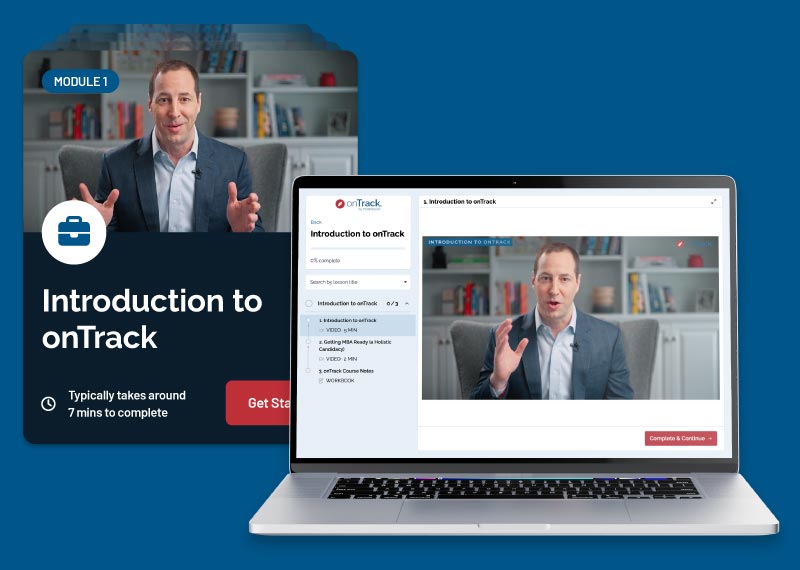
onTrack by mbaMission

A first-of-its-kind, on-demand MBA application experience that delivers a personalized curriculum for you and leverages interactive tools to guide you through the entire MBA application process.

Get Started!

2026–2027 MBA Essay Tips

Click here for the 2025–2026 MBA Essay Tips


MBA Program Updates

Explore onTrack — mbaMission’s newest offering allowing you to learn at your own pace through video. Learn more