With regard to the GMAT, raw intellectual horsepower helps, but it is not everything. In this blog series,Manhattan Prep’s Stacey Koprince teaches you how to perform at your best on test day by using some common sense.
Has this happened to you? You have ambitious plans to study a ton of things this weekend. You get tired, but you are determined to push through, so you keep studying. You begin to get a bit anxious because you feel you are not learning well (and you are not!), so you study even more. You get even more tired, and that makes it even harder to learn. By the end of the weekend, you are exhausted, frustrated, and demoralized.
In a nutshell: your brain makes better memories when it is not tired.
The Time article quotes Michaela Dewar, the lead author of a research study on this topic. She notes that we are “at a very early stage of memory formation” when we first start to study new information, and “further neural processes have to occur after this stage for us to be able to remember this information at a later point in time.”
With regard to the GMAT, raw intellectual horsepower helps, but it is not everything. In this blog series, Manhattan Prep’s Stacey Koprince teaches you how to perform at your best on test day by using some common sense.
As we have discussed in the past, the importance of the Integrated Reasoning (IR) section mirrors that of the essay: we want to get a “good enough” score, but our main focus is on the Quant and Verbal. (Note: this will likely change in the future as the schools figure out how to use IR scores.)
One important aspect of that is, as always, timing. We have 30 minutes total for IR, and there are a total of 12 questions. We do actually have to discuss what a “question” is; this is a little bit confusing on IR, because many of the questions have multiple parts.
One question equals everything that appears on one screen. A question might have one, two, or three parts to it, and all parts need to be answered to gain credit for that one question. Once you have submitted your answer(s) for that question, a new question screen will pop up.
MBA students at the University of Virginia’s Darden School of Business are known to work quite hard amid the rigors of the case method. Each day, they are expected to read a business case and perform their own analysis of the situation presented. Then, they must compare and reason through their analysis with a small, diverse group of fellow students—their Learning Team. Students can often spend two to four hours prepping on their own and then two to three more with their teammates to arrive at ananswer (as opposed to theanswer). And what might be the reward for all this work? The student may be selected for a “cold call” to start off the class.
At Darden, most first-year and some second-year classes begin with a professor randomly selecting a student to lead the day’s discussion by presenting his/her case analysis. This student can be subjected to anywhere from five to 20 minutes of questioning, as the professor teases out key points of discussion for the broader class to explore. Many a student has sweated through a cold call, only to gain the applause of his/her peers at the end. (Others, of course, may not do as well.) These cold calls can be daunting, but they force students to prepare thoroughly and think on their feet—a key feature of the Darden learning experience.
For more information on Darden and any of 15 other leading MBA programs, check out the mbaMission Insider’s Guides.
mbaMission is proud to announce an addition to our MBA admissions consulting services: pre- and post-MBA career coaching! Whether you work with us to Strengthen Your Pre-MBA Career, Get a Job You Love after earning your degree, or Become a Star Performer in your current role, our career coaching experts will empower you to take charge of your professional life.
mbaMission Career Coaches can help you achieve mastery and fulfillment at work and assist you with any aspect of your career at any stage. We offer comprehensive packages to help you realize your greatest potential, whether you are…
A pre-MBA who is ready to start positioning yourself for your post-MBA career and wants to make the most of your personal, professional, and community life before you begin the admissions process
A pre-MBA who is trying to figure out how to define your short-term or long-term goals before embarking on the road to business school
A current or post-MBA who is searching for not just a job, but a fulfilling and lasting career in a field you love
A current or post-MBA who is hoping to maximize your potential in a current role, define your strengths and weaknesses, and build key relationships so you can hit the ground running and establish yourself as a top performer
Mission Admission is a series of MBA admission tips; a new one is posted each Tuesday.
We at mbaMission have tried repeatedly to persuade business school candidates who are evaluating MBA programs to downplay the various schools’ rankings, which can fluctuate wildly, and instead focus on fit, which is enduring. Now, as a new admissions season is about to begin, we recommend that you accelerate and broaden your evaluation process.
One way to look beyond rankings is to speak with MBA students. Even if you do not have direct access to students, reaching out to them in a targeted way—via email, club Web sites, and social media—can be quite easy. Do not feel as though you are being “pushy” when contacting students this way, because most take pride in their school and are open to speaking with candidates. They are a de facto part of the school’s marketing arm. For example, if you are interested in a certain program for its entrepreneurship offerings, you can get in touch with the individual(s) leading the entrepreneurship club to learn more about the program (and the club!). Of course, you should be respectful of each individual’s time and be well prepared for your conversation. If you are conscientious, you will be able to gain some great insight into the school’s academic environment and then have time to learn more about the atmosphere on campus. Networking now should enable you to begin narrowing your search and more effectively focus your limited “free” time over the next few months.
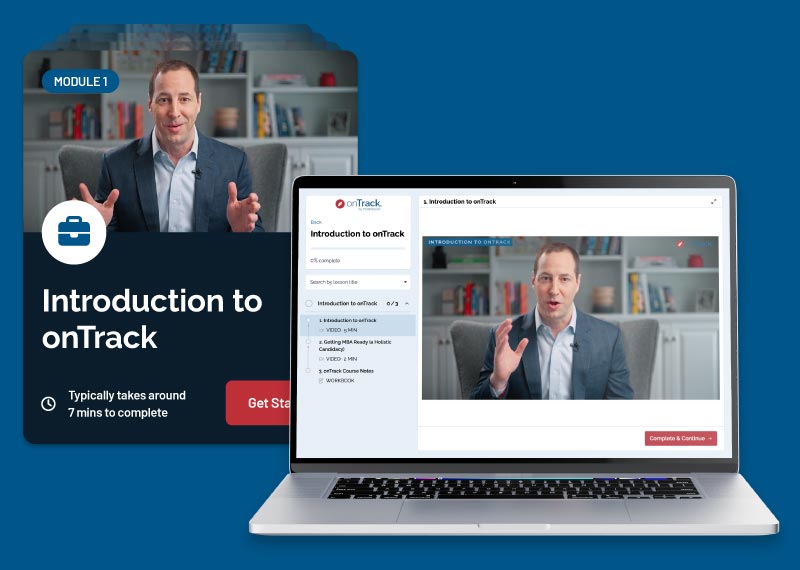
A first-of-its-kind, on-demand MBA application experience that delivers a personalized curriculum for you and leverages interactive tools to guide you through the entire MBA application process.