Blog

MBA Admissions Myths Destroyed: You Need a 750 to Get In!

We often hear MBA applicants ask some form of the following question: “Do I need a 750 to get into a top MBA program?” Although a 750 on the GMAT can only help, it is definitely not a prerequisite. We wanted to dispel this myth and put some who believe it at ease. Here are a few simple reasons why this is just not the case:

  1. The average is lower. Average GMAT scores at the top 15 MBA programs range from approximately 700 to 730. Clearly, if the high end of the GMAT average range is 730, the schools cannot expect applicants to have a 750. That would mean that everyapplicant would be above average, which is not possible. Still, if a candidate’s score falls below the average, this generally places a greater burden on the other components of the individual’s application—so, for example, maybe his/her work experience would need to be stronger than that of other applicants, or maybe his/her extracurriculars would need to stand out even more. Or maybe we are straying from our main point! The bottom line is that mathematically speaking, many people have a GMAT score below 750.
  2. Too few applicants have a 750 or higher. The top 15 MBA programs accept around 7,000 applicants each application season. Only approximately 3,700–4,600 GMAT test takers earn scores of 750 or higher each year (depending on whether GMAC counts the number of tests taken or individual test takers), and some are earned by people who do not ultimately apply to business school at all, do not apply to any of the leading schools, take the test only to become GMAT instructors, pursue an EMBA or part-time MBA instead, are rejected because other aspects of their profile render them uncompetitive… and the list goes on. Basically, the top 15 MBA programs do not receive applications from enough applicants with 750s to entirely populate their incoming class, as evidenced by the schools’ mid-80% GMAT ranges, which are typically 660–760.
  3. All schools accept the GRE. Applicants do not really even needto take the GMAT anymore. Of course, if you do take the GMAT, you should strive to achieve the highest score possible. However, if the GMAT is not even required, you obviously would not need to score a 750 to be accepted. (Note: The GMAT is “preferred” at some schools, but the GRE is still accepted.)

We want to be unequivocal: 750 is a great GMAT score, and anyone who earns that score should be delighted. However, if you do not fare as well on the exam, you should still be quite hopeful and keep a positive mind-set because the admissions process is holistic.

MBA Admissions Myths Destroyed: At Least I Don’t Have to Rework My Resume

Many MBA candidates do not thoroughly consider and revise their resumes for their applications, often dismissing this element because an existing version may already be saved on their computer. We strongly caution you not to underestimate the value of this document—the admissions committees, in fact, review applicants’ resumes carefully, because they serve as a road map of each candidate’s career.
In the past, we have highlighted that your resume is not the place to “stuff” all of your life experiences. Somewhere between the two extremes—cramming your resume with information and ignoring it altogether—lies the ideal: a clear, easily scannable, action-/results-oriented resume, one that tells a story that will capture the attention of an admissions officer who has reviewed hundreds of similar files.

One of the most common errors that candidates make is leaving their resume in an industry-specific format, filled with jargon and acronyms recognizable only to an expert in their field. Remember, the admissions committee is not hiring you for a task, but is trying to understand your progress, your accomplishments, and even your character. Each bullet point in your resume needs to highlight achievement more than positional expertise.

As you prepare your resume to be included in your application, think about your audience and recognize that your resume can be a strategic tool to reinforce certain characteristics that are important to you—characteristics that may complement information provided in other parts of your application. For example, if you aspire to a career that is international in nature, you may place more emphasis on your international experience in your resume. Or, if you come from a field that is not known for its management orientation—you were a teacher who administered a school’s $50,000 student activities budget, for example—you may use your resume to emphasize disciplines that are important to an MBA admissions audience.

Some candidates are surprised to realize that one page can communicate so much and thus deserves a significant level of attention, but investing some time in this short but crucial document is definitely worth the effort.

Harvard Business School Essay Analysis, 2017–2018

Harvard Business School

*Please note: You are viewing an essay analysis from the 2017-2018 admissions cycle. Click here to view our collection of essay analyses for the current admissions season. 

Last year (after just one season), Harvard Business School (HBS) did away with its incredibly broad “introduce yourself” essay prompt in favor of one that at first glance seemed to have almost no parameters at all—and, interestingly, was more or less the same as the one from 2013–2014, when Dee Leopold was running the show. Now with a full year under his belt as HBS’s director of admissions, Chad Losee must feel that the essay question was effective in eliciting the kind of information the admissions committee finds valuable in evaluating the program’s potential students, because it remains exactly the same this year. Our analysis of the prompt and advice on the best way to approach it therefore also remain constant…

“As we review your application, what more would you like us to know as we consider your candidacy for the Harvard Business School MBA Program?” (no word limit)

Take special note of the word “more” in this straightforward question. With it, the admissions committee is subtly acknowledging that it already has a lot of information about you that it can and will use to get to know you better, including your resume, extracurricular activities, recommendations, short-answer question responses, academic transcripts, and GMAT/GRE score. You should therefore think first about what these portions of your application convey about who you are as an individual and candidate, so you can determine which parts of your profile still need presenting or could benefit from more detail. Now, some applicants may fret that this means they absolutely cannot touch on anything mentioned elsewhere in their application, for fear that the admissions committee will become annoyed and reject them. However, HBS is not asking only for fresh information—it is asking for more, and specifically, whatever “more” you believe the committee needs to evaluate you thoroughly and fairly. So, even though a bullet on your resume may inform the school of a certain fact, if a profoundly important story lurks behind that fact that you feel effectively expresses a key part of your personality or skill set, you should not feel hesitant to share that story. That said, we are not advocating for you to explore your resume in depth, just trying to convey that “more” here does not mean strictly “thus far unmentioned.”

Before we discuss a few approaches you might take in framing this essay, we must note that your goal in writing it is sincerity. The admissions committee is not staffed by robots, seeking to detect a certain “type” of applicant. These are human beings who are trying to get to know you and really want to end up liking you! With this essay, you essentially want to forge a meaningful connection with a complete stranger, and if you try to present yourself as something or someone you are not, you will fail.

You, like many other applicants, may worry that your sincere stories will sound clichéd. For example, if you want to write about making a difference, you may wince simply thinking those words: “making a difference.” But the power of your story does not lie in the theme you choose (if you choose to write thematically, that is), but in the manner in which you reveal your actions. If you have truly made a significant difference in the lives of others and can own that angle by offering powerful anecdotes and demonstrating a deep emotional connection to others and profound purpose in your acts, you can write on this topic. Although more than a few candidates will undoubtedly submit clichéd pieces on making a difference, if you can capture your admissions reader’s attention fully and make a strong enough impression, the cliché aspect will disappear, and he or she will be impressed by your actions and character.

So, what approach might you take to this essay? The prompt is so open-ended that we cannot possibly capture all possible options, but here are a few:

Experiential Learning at the University of Minnesota’s Carlson School of Management

Experiential Learning at the Carlson School of Management - mbaMissionWith approximately 20 Fortune 500 companies located nearby—including UnitedHealth Group, Target, and U.S. Bancorp—the University of Minnesota’s Carlson School of Management boasts a robust network of corporate ties and high-profile recruiting opportunities. In fact, the Twin Cities placed first in Forbes’s 2011 rankings of the best U.S. cities for finding employment. Carlson also prepares its students with a pronounced hands-on approach to building leadership, management, and problem-solving skills.

Among the school’s more distinctive offerings, Carlson’s four Enterprise programs expose students to the areas of brand, consulting, funds, and ventures. The Enterprise learning experience is rather unique insofar as it operates as a full professional services firm, serving multiple clients and allowing students to work through real-world business challenges with senior management at major companies. In the Brand Enterprise program, for example, Carlson students have developed key marketing strategies for such brands as Cargill, Boston Scientific, Target, 3M, General Mills, and Land O’Lakes. Students in the Consulting Enterprise program have offered services to such companies as Best Buy, Northwest Airlines Cargo, Medtronic CRM Division, and Polaris. With approximately $35M in managed assets, the Carlson Funds Enterprise program ranks among the three largest student-managed funds in the world. Finally, the Carlson Ventures Enterprise program puts aspiring entrepreneurs in contact with experts, professionals, and investors.

Columbia Business School Essay Analysis, 2017–2018

Columbia Business School

*Please note: You are viewing an essay analysis from the 2017-2018 admissions cycle. Click here to view our collection of essay analyses for the current admissions season. 

For years, Columbia Business School (CBS) has been at the front of the pack of MBA programs that have been gradually shortening their application essays and requiring candidates to be direct and concise in their submissions. It was even the first school to incorporate a micro essay into its application. Last season, CBS gave applicants a bit more wiggle room with the essays, increasing the word count for each by a pretty significant margin (up to 100% in one case), but it has tightened the reins back down for this year’s applicants. Still, with a goal statement, three required essays, and an optional essay, you should have plenty of opportunity to convey a well-rounded impression of yourself for the admissions committee. Read on for our insight into the program’s 2017–2018 prompts…

Goal: What is your immediate post-MBA professional goal? (50 characters)

Including spaces, CBS’s career goal question is exactly 50 characters itself, showing candidates just how much (or how little, in this case) space they have to work with and just how succinct they are therefore expected to be with their response. At just 50 characters, this can hardly be considered a true essay, but you will need to approach this with the same level of thought and focus as any of your other written responses for the school. The prompt is clearly a no-nonsense request for information, with no room allowed for exposition, flowery words, background, or pandering. This is all about getting to the point and telling the admissions committee what it wants to know.

In the past, the school has provided a few sample responses, including “Work in business development for a media company” and “Join a strategy consulting firm,” illustrating that conveying the requested information in such a tight space is definitely doable and that you do not need to worry too much about grammatical issues (in other words, you do not need to start your statement with “I want to” or something similar). We like to offer the statement “Reveal true goals, not what you think CBS wants” as both our own example of keeping things concise and our advice on how to approach and fulfill this request. Think about what you truly want to do with your career in the short term and state this aspiration directly. Keep in mind that the rest of your application will need to provide evidence that your stated goal aligns with your existing skills and profound interests, especially once they have been augmented by an MBA education. This will show that your professed goal is achievable and lend credibility to your statement. If you can do this in 50 characters (not words!), you will have done what you need to answer the school’s question quite well.

Essay #1: Through your resume and recommendations, we have a clear sense of your professional path to date. What are your career goals over the next 3 – 5 years and what, in your imagination, would be your long-term dream job? (500 words)

CBS starts this essay question by more or less telling you not to recap your career to date, so we strongly recommend that you do so (and briefly, at that) only if context is absolutely needed for your stated goals to be understood and/or believable—perhaps if you are making a fairly remarkable career change. Pay particular attention to the phrases “dream job” and “in your imagination” with respect to the long-term portion of the question. The school is prompting you to be creative and perhaps even to challenge or push yourself to think big. CBS wants individuals who do not just follow prescribed paths according to someone else’s blueprint but who are aspirational and more inclined to forge their own way. This is not to suggest that if you have a more traditional plan in mind that you are in trouble or at risk of losing the admissions committee’s attention, but you may need to take a little extra time to consider your ambitions from the perspective of “what if?” and delve more deeply into what you hope to achieve to find the more personal and inspiring elements of your goals. Showing creativity and individualism here can only be helpful.

Although this is not a request for a textbook personal statement essay, your response will certainly involve some elements of the topics covered in such a submission, such as short- and long-term goals. The mbaMission Personal Statement Guide offers advice on brainstorming and crafting such essays along with multiple illustrative examples and so may be helpful in preparing your CBS response to this prompt. You can download your free copy here.


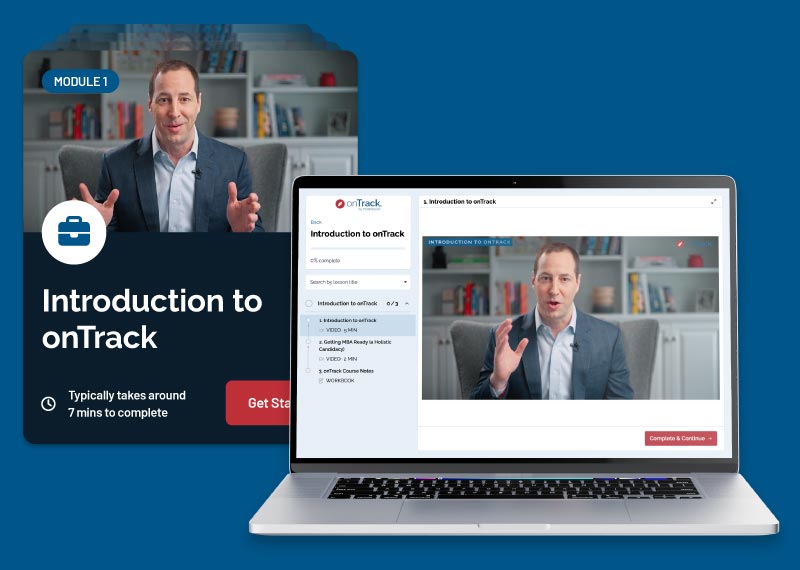
onTrack by mbaMission

A first-of-its-kind, on-demand MBA application experience that delivers a personalized curriculum for you and leverages interactive tools to guide you through the entire MBA application process.

Get Started!

2026–2027 MBA Essay Tips

Click here for the 2025–2026 MBA Essay Tips


MBA Program Updates

Explore onTrack — mbaMission’s newest offering allowing you to learn at your own pace through video. Learn more