

The Stanford Graduate School of Business (GSB) interview is widely regarded as one of the most personal, and most challenging, interviews in the MBA admissions process. Unlike more traditional forms of admissions interviews, Stanford’s is deeply behavioral, highly introspective, and designed to assess not just what you have done but also how you think, reflect, and connect.
In the 89th episode of The mbaMission Podcast, host Harold Simansky is joined by Senior MBA Admissions Consultants Christine Patel and Julie-Anne Heafey for an in-depth breakdown of what makes the Stanford GSB interview so distinctive. Drawing on years of firsthand experience guiding and advising successful Stanford candidates, they unpack how the program’s interview is structured, what parts interviewers actually see of candidates’ applications, and how applicants can prepare so that their answers feel authentic rather than overly rehearsed.

 Apple Podcasts and Spotify), with full video episodes available on mbaMission’s YouTube channel. Sign up for a free consultation with Harold, Julie-Anne, Christine, or any other member of the mbaMission admissions team.
Table of Contents
Harold Simansky: So I’ll have clients do the Stanford application. Six or seven essays, really overwhelming, requires a lot of work. At the end of the day, though, when someone gets a Stanford interview, suddenly, panic sets in. So, first of all—high stakes, certainly—but what is it that’s unique about a Stanford interview rather than [that of] some other school? So let me start off with Christine, who herself is a Stanford graduate.
Why the Stanford GSB Interview Feels So High Stakes
Christine Patel: So interestingly enough, Stanford takes a look at your resume. Not all the interviewers will be looking at your whole application. That’s slightly different from other schools like HBS [Harvard Business School]. Also, it’s a behavioral interview. So focusing on your past history, obviously your career. Really, I think, maybe having interviewers being alumni as well is a little bit different. It’s not always from the adcom. Julie-Anne, do you have anything else to add?
Julie-Anne Heafey: I would say it’s behavioral but amped up. A lot of schools will ask behavioral interview questions, but you might get two or three in the course of it, and the rest of the questions will be pretty motivational or basic. Whereas Stanford really interrogates the behavioral interview. They call it a structured behavioral interview. So they are really examining multiple angles.
The Structured Behavioral Interview Explained
Harold Simansky: Right. So let’s take a step back here. Frequently, we’ll hear about behavioral interviews. What are they actually? What are they trying to find out? How are they different from just “tell me about yourself”?
Julie-Anne Heafey: So, I would say you’ll recognize a behavioral interview when they say, “Tell me about a time” or “Describe a time when.” It’s storytelling, right? And so I think what it’s trying to get at is probing beneath the accomplishments to the why and how you did something. And so you need to have a plan of attack for that kind of question that’s a little bit less off the cuff and a little bit more organized than you would for other answers. You know, “Tell me about yourself.” You usually have time to guide you, chronology. You start back in college, and you move your way forward in your career. “Tell me about a time when you had to make a difficult decision.” You’ve got to come up with a way to wrap and explain that situation and to really take them through a story.
Harold Simansky: Okay, sounds very intimidating. And you really spoke to this need for maybe some sort of structure already there, already built in. So, what does that structure even look like?
Christine Patel: One common one we recommend is the STAR framework. So tell me about a challenge, for example, you might have had. And so you describe what the challenge could be with the ST: “situation” and “task.” Then you describe in depth what the “action” you took was with that challenge. Maybe you missed a sales forecast that you realized there was an error that you had in your forecasting. Go into details of the action that you took and the challenge that it created for the rest of the financial team. And then the R is the “result.” Like, what did you do to mitigate and fix that problem and the challenge that you incurred? But I think the key here is not just having a STAR framework but really going into depth, a little more depth than just an overview, high level of “I did this, I did that, and then as a result, this happened.” I don’t think that’s enough for this interview question. You want to go into a little more detail.
Harold Simansky: Okay, so with the STAR method: Situation, the kitchen needed to be painted; Task, paint the kitchen; Action, you bought some paint brushes and got a friend; and the Result is you have a great-looking kitchen. Julie-Anne, do you think that would be too superficial an answer?

Julie-Anne Heafey: Yes, I think that would probably be the first step of your practice. You really need to get deeper than that, as Christine suggested, into the whys and hows. You know, why did you take that particular approach? What were your other options at the time? What were you thinking? Did things work out the way you planned? Were there obstacles? How did you overcome them? And then in terms of results, you don’t want to just say, I used X gallons of paint, and the kitchen is now yellow. You want to get into the impact of it or what you learned through that process.
Harold Simansky: In fact, sometimes people are told to use the STAR-L method, where the L is the “learning.”
Christine Patel: Exactly. I think having that growth mindset to figure out a vulnerability or something that you learned on that challenge and actually admit that you were at fault, but then what did you do differently the next time around? I think that’s really the key. Or how did it change your mindset when you viewed some new business opportunity or challenge that you have?
Harold Simansky: And are these the greatest experiences of your life? Must they be home runs when compared to what somebody else is saying? Or is it something that’s far more like Stanford itself, far more introspective, far more thinking about “Okay, how were you changed?”
Christine Patel: I mean, honestly, I think it’s being authentic. It doesn’t have to be like a major home run per se but something that’s true to you, that you believe in, that you can explain in depth. But it doesn’t have to be like the biggest deal you’ve ever had. I think just being yourself is really key.
Julie-Anne Heafey: I think it can depend a little bit, though. I think you don’t want to go into a Stanford business school interview only armed with personal stories from your extracurriculars and not talk about work at all. I think that would probably be the wrong way to go. So I do think you have to go into a plan with thinking about what you really do bring to the table, what you’re excited about making an impact on, what are the times that you’ve really been tested at work. But, agreed, it can’t just all be work. And it doesn’t all have to be the most amazing thing you’ve done. You can have some stumbles. But you want to make sure they get to know all of you, including the business you.
How Stanford Interviewers Prepare (and What They See)
Christine Patel: I think a good point that Julie-Anne made is actually going back to your application and seeing what you think stood out for you. Because these interviewers may not have read your whole application; they’ll only see your resume. So going back through everything, maybe your brainstorming document you’ve put together for the school. I think personal and career accomplishments are both important to highlight.
Harold Simansky: That makes sense. And going to a Stanford interview, when you think about preparation, how many of these examples do you need to really feel comfortable? Loaded question there. I know there’s no one answer, but at the end of the day, I would suspect more than one, less than ten.
Julie-Anne Heafey: I mean, I would do a minimum of eight, but [it] might be higher, might be ten. I think you don’t know how long the interview is going to go. With an alum, it’s always a wild card. When you’re getting an admissions committee interview, like at Harvard, you know it’s a tight 30 minutes; they’re not going to vary from that at all. When it’s a student on campus, they also have to do a number of slots. They’re not really free to ramble on a ton. But anytime you’re talking to an alum, all bets are off in terms of length.
Harold Simansky: Listen, the reality is that with “tell me about yourself” behavioral questions, how much of the interview will be focused on that rather than something else?
Christine Patel: It’s probably a good number of the questions; probably the majority of the questions will be behavioral. And then there’ll be time for questions like maybe “Why Stanford?” later on, or if there is time, open questions for the interviewee, too. But I think a lot of it will be behavioral.
Julie-Anne Heafey: I think the only big difference that I see with my clients who get Stanford interviews is not just that they’re getting only a few behavioral interview questions, it’s just that some may get a lot of angles on different types of leadership. And then others will just go more in-depth, really long, drawn-out explorations of situations in a McKinsey PEI [Personal Experience Interview] style of interview, where they’re really just tunneling deep on maybe two experiences. So those are the two types that I usually hear. But at the end of the day, it’s all behavioral.
Harold Simansky: And listen, we know again, there’s behavioral questions and there’s behavioral questions in the sense of “Okay, behavioral question, tell me about a time when.” At that point, you respond, and that’s sort of the end of it, and you never revisit that issue. But I know that is where Stanford is different in the sense of they will drill down, and they’ll drill, and they’ll keep on drilling. And at some point, they are drilling so deep, you’re sort of out of story at that point. What happens then?
Julie-Anne Heafey: Well, I think they’re trying to get you off script a little bit and really understand what makes you tick and how you approach situations and what your awareness is of other people that you’re working with. I mean, I think a lot of the degree is so introspective and about building your own self-awareness and also your awareness of others and how they operate. It’s a big part of influence and other skills that you’re looking to build with the Stanford MBA, I would think. Wouldn’t that be your experience? [gestures toward Christine]
 interview guides. If you click there, you’ll find a Stanford GSB interview guide with some sample questions. But just to give you a taste, a couple of those might be “When is a time when you identified an opportunity that others didn’t or a threat that others didn’t see?” And you want to dig into what that whole process was about. Another one might be “When were people heading in one direction, the ship was going in one direction, and you steered it in a new one?” So how you got to turn things around to another point of view or result. And I think these things speak to not having just always top-down formal leadership roles, right? It’s about how you were a leader within another position on the team. You don’t always have to be the one in charge, the one with the big title to make a difference in what’s going on in your world.
Harold Simansky: What we do at mbaMission is a lot of mock interviewing, particularly in the context of Stanford, but really every school. So how do you conduct a mock interview? You know, quite candidly, I’ve had a number of clients over the years who did not do great at a Stanford interview, and they had really prepped, and at the end of the day, they were almost robotic. And maybe that’s the point that you said, Julie-Anne. They want to get to the person. That’s the reason they keep on drilling down. So how do you really navigate the fact that STAR-L lends itself to a lot of preparation, but at the same point, you can’t do too much preparation, otherwise you start sounding robotic?
![/></a></figure>
<p><!-- /wp:image -->
<!-- wp:paragraph --></p>
<p><b>Julie-Anne Heafey</b>: That’s a really great question. I mean, I think it’s just don’t write it out and memorize it, you know? Just really try to think about the main points and what that was like for you. I mean, it depends on the person, right? Sometimes I work with people, and they do need that practice. And other times, I work with people who have got it down [to the point] that I’m worried [that] if they keep going, they’re going to lose all emotion and connection with the interviewer. And a big part of the interview is this connection with the interviewer, especially at Stanford, because they’re making a match when they match you [with an interviewer]. They’re getting somebody that they’re hoping that you’re going to have this connection with. So you don’t want to be so rehearsed that you are just telling planned stories. I get people to practice honestly by talking about their day and things around them in that same way, like where they went to dinner and why they did that. </p>
<p><!-- /wp:paragraph -->
<!-- wp:paragraph --></p>
<p><b>Harold Simansky</b>: Oh, that’s interesting!</p>
<p><!-- /wp:paragraph -->
<!-- wp:paragraph --></p>
<p><b>Julie-Anne Heafey</b>: Family experiences, you know? How they interacted with their mother-in-law and why they took that approach. I mean, I think that’s a good way to sort of practice the method of storytelling without getting so canned on your exact story.</p>
<p><!-- /wp:paragraph -->
<!-- wp:paragraph --></p>
<p><b>Christine Patel</b>: Sometimes you’ll see the interviewer name in advance. And if that’s the case, I definitely recommend researching who that person is. Sometimes, if you know that person in advance, if they have the same industry knowledge or same geographical location as you, that helps bring a bond. And so you can start off with building a connection that way. Then also just reading the body language of your interviewer. So if you’re speaking for more than three or four minutes and suddenly you see the eyes glazing, I think you want to adjust. Maybe it’s time to close out your answer just because you can tell it’s not going the way you’d want it to be. Maybe the answer is just too long and rambling and not really directed enough. So just I think reading the cues from your interviewers is key.</p>
<p><!-- /wp:paragraph -->
<!-- wp:heading --></p>
<h2 class=](https://www.mbamission.com/blog/wp-content/uploads/2026/02/sm-Julie-Anne-blog-button.jpg) How to Prepare for a Stanford GSB Interview Authentically
How to Prepare for a Stanford GSB Interview Authentically
Harold Simansky: Listen, what I always think about with the Stanford application overall, it is very much on brand and aligned with Stanford in terms of being an introspective place, thinking about the big picture, not being afraid to be very aspirational. And again, you’re going to really be preparing for your interview, I think, when you do those—and it depends on you how you count them—four, five, or six essays.
Christine Patel: Definitely. I mean, I actually just went to my GSB centennial reunion a few weeks ago. Some of my classmates are interviewers as alumni. And their goal is to get in as many people as possible who are amazing. And they’re really excited to meet people. One of my classmates focuses on biotech and gets a lot of nontraditional candidates like MD, PhD folks, and she’s excited to vouch for these people. I think in general, I would view them as on your side. They’re really trying to engage with you. So use this as an opportunity to put your best foot forward.
Julie-Anne Heafey: Oh, 100%. I mean, one of the things people get so scared about with these interviews is that it’s high stakes. They know that not everybody’s going to get in, right? The odds are, they say, one in two or one in three. Not everybody’s going to be accepted. But what I’m telling people is, “Hey, these people are in your general arena a lot of the time, and they are super cool.” It’s like an opportunity for you to get to know somebody new who’s like a leader in this industry. Obviously you want to have a connection with them and get along and have a great interview. Like this is a great opportunity to meet a mover and shaker in your world. So even if it doesn’t work out or you don’t convert off of the waitlist or whatever, you have just built a new person in your network. And so treat it as that opportunity, and ironically, most of the time when people are treating it that way, they do get in.
Harold Simansky: That certainly makes sense. Let me ask you, sort of touching on HBS, how does an interview with HBS compare to an interview with GSB? And which is more important? Which one should you be more concerned about? Which one is really the one that you should really swallow hard when you get that interview?
 give us a call, speak to Christine, me, Julie-Anne, any one of our 25 or so consultants—we can really talk you through it, at least in a very preliminary way, to help you understand just what goes into a great GSB application. Because the reality is the acceptance rate is just so low. It really is quite amazing to me as far as how low it is. So just to wrap up a little bit here, if a client calls you and says, “Hey, I’ve got a Stanford interview,” what’s the first thing they do?
Christine Patel: Usually, we celebrate, actually. Just getting the interview alone is a big deal. And so I usually give a high five virtually, and it’s great. So I start with the positive there, and then I get into the nitty-gritty. We just start preparing for it.
Harold Simansky: Right, right. And just very quickly here, Stanford is also, I think, a little strange in terms of how it rolls out its interviews.
Julie-Anne Heafey: It seems to be creeping earlier and earlier. I mean, it used to always be, Harvard would do it four weeks after the deadline, and Stanford would start the night before. And now I find it creeping earlier and earlier. Now this year is a couple weeks earlier. So the applications have been submitted for two or three weeks, and already they’re starting to trickle out some invitations. But I think that the trickling is the hardest part of the process.
Harold Simansky: Absolutely. I once had a client, a great client, who found out he got a Stanford interview days before he was supposed to receive his final word or acceptance or rejection. And he was waitlisted and then accepted. So absolutely, it was a happy story there. And what was also interesting, he was a guy who came from the forestry industry. And yes, there’s some innovative pieces to it, but one does not think “innovation” when one thinks “forestry.”
Julie-Anne Heafey: But that’s rubbing up of different types of people. I mean, you don’t want everybody just to be working in VC [venture capital]. Like, 100% of the class working in VC would not be very useful at all. You need to have people who are transforming even old industries or bringing in good ideas that nobody pays attention to because they’re not the hot topic in 2020-whatever.
Christine Patel: I usually prepare each client with actual interviews from the past. So we have a database of questions from every school from our clients. And I give them these examples so they know what’s coming. I also recommend that if they’re a package client, they can go to or even if they have onTrack on their own. onTrack is a video module that we have. We can do on-demand learning. And there’s a whole section on interviewing, which is great, maybe three hours’ worth. And there’s also specific school sections where you can record yourself and do a mock interview on your own, which I find very helpful, by school. And these modules are specific for each school, which is nice because every school has different questions.

After going through that, going through the preparation, giving you all this information, then we’ll start doing a mock interview. Depending on the school, maybe it’s 30 minutes, 45 minutes. I also make sure that each interviewee has a list of questions ready to tell the interviewer what they might be, depending [on] if they’re alumni, students, faculty, that’s actually really important. Some schools don’t have time for extra questions at the end, but some do. So you want to be ready for that, have at least three questions ready for the interviewer. And then after the mock interview is done, I’ll give feedback in real time afterwards. I record the mock interview so they can actually see it afterwards. After I give feedback, maybe we’ll do another mock interview, depending on how they feel, if they want more.
Harold Simansky: What are some of your favorite mock interview questions for Stanford?
Christine Patel: For me, because you know, I actually graduated from Stanford, I actually love the question “Why Stanford?” And the reason is because sometimes I feel like if you haven’t done enough homework, it really shines through. And I think if you can substitute the Stanford name with any other school name with your answer, you haven’t done enough yet to prepare. So in this situation, I say at least visit or do some admissions events, do a few one-on-one conversations with alumni, students, or faculty. Go beyond what’s expected, basically. I think that you can tell when someone’s really figured out the fit and the reason why they want to go to a certain school.
Final Advice for Stanford GSB Interview Candidates
Harold Simansky: Right. And [that’s true] really for every school. It’s like you don’t have to go to a particular school to learn accounting, for example. And most schools are going to have some sort of entrepreneurial curriculum. So you always think to yourself, “Okay, how is the Stanford innovation curriculum going to be different from [that of] some other school?” Or “What is Stanford doing that other schools are actually not doing?” What are sort of those margin or edge courses or focuses that Stanford has? And by all means, if you’re applying to Stanford—and I say this as a non-Stanford graduate who nevertheless does a lot of Stanford mock interviews—don’t tell me about the “touchy-feely” class. At the end of the day, if I ask the mock question “Why Stanford?,” 90% of the people say the “touchy-feely” class. And at this point, I think it speaks to the fact you didn’t quite do your homework. You really have to push down much deeper than that.
Julie-Anne Heafey: You know, I think it’s just not naming a class that you’re just going to sit in, you know? Like, connect it to why you need that introspection for your goals. What are you missing? What are you trying to accomplish or do that’s going to help? So the analogy I always use is a swimming pool. Don’t just describe Stanford’s beautiful swimming pool. It might be the perfect temperature or whatever, but how are you going to use it? What are you going to do with that? Are you going to test your swimsuit designs for your new line of eco-friendly swimwear? What are you going to do with it? So I agree we can get tired of hearing the same kinds of answers, and so can they. But if you’re telling me really thoughtfully how you’re going to use something, then that can win me over.
Christine Patel: I think especially, we know these interviewers don’t read your essays. So go back to your essay number two that you’d written for the application and review what you said: Why Stanford, and how will Stanford achieve your goals, short term, long term. And I think once you go back to that, this question becomes very easy to answer.
Harold Simansky: Well, thank you very much, Julie-Anne. Thank you very much, Christine, telling us about not just interviewing at Stanford but really how to approach Stanford, what the application looks like. And by all means, if you want to spend more time with Christine, Julie-Anne, me, or one of our, like I said before, 25 or so different consultants, give us a call, spend 30 minutes on the phone with us. We’d love to help you; we’d love to talk to you.

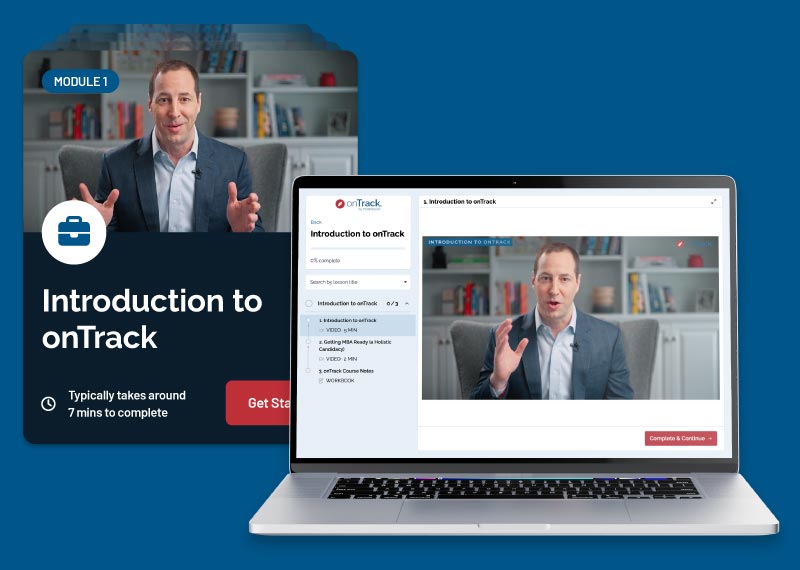

A first-of-its-kind, on-demand MBA application experience that delivers a personalized curriculum for you and leverages interactive tools to guide you through the entire MBA application process.
2026–2027 MBA Essay Tips
- Berkeley Haas School of Business Essay Tips 2026–2027
- Cambridge Judge Business School
- Carnegie Mellon Tepper School of Business
- Chicago Booth School of Business Essay Tips 2026–2027
- Columbia Business School
- Cornell Johnson Graduate School of Management Essay Tips 2026–2027
- Dartmouth Tuck School of Business
- Duke Fuqua School of Business Essay Tips 2026–2027
- Georgetown McDonough School of Business Essay Tips 2026–2027
- Harvard Business School (HBS) Essay Tips, 2026–2027
- INSEAD Essay Tips, 2026–2027
- International Institute for Management Development (IMD)
- London Business School
- Michigan Ross School of Business Essay Tips 2026–2027
- MIT Sloan School of Management Essay Tips 2026–2027
- Northwestern Kellogg School of Management
- Notre Dame Mendoza College of Business
- NYU Stern School of Business
- Ohio State Fisher College of Business
- Oxford Saïd Business School
- Stanford Graduate School of Business Application Essay Tips, 2026–2027
- Texas McCombs School of Business Essay Tips 2026–2027
- The Consortium for Graduate Study in Management Essay Tips 2026–2027
- The Wharton School
- UCLA Anderson School of Management Essay Tips 2026–2027
- UNC Kenan-Flagler Business School
- USC Marshall School of Business
- UVA Darden School of Business Essay Tips 2026–2027
- UW Foster School of Business
- Vanderbilt University Owen Graduate School of Management
- Villanova School of Business Essay Tips 2026–2027
- Yale School of Management Essay Tips 2026–2027
Click here for the 2025–2026 MBA Essay Tips
MBA Program Updates
- Berkeley-Haas
- Boston University (Questrom)
- Cambridge Judge Business School
- Carnegie Mellon University (Tepper)
- Columbia University (Columbia Business School)
- Consortium for Graduate Study in Management
- Cornell University (Johnson)
- Dartmouth College (Tuck)
- Duke University (Fuqua)
- Emory University (Goizueta)
- ESADE
- George Washington University (GWSB)
- Georgetown University (McDonough)
- Harvard University (Harvard Business School)
- HEC Paris
- HKUST
- IE Business School
- IESE Business School
- IMD
- Indian School of Business
- Indiana University (Kelley)
- INSEAD
- Ivey Business School
- London Business School
- Massachusetts Institute of Technology (Sloan)
- New York University (Stern)
- Northwestern University (Kellogg)
- Notre Dame (Mendoza)
- Ohio State University (Fisher College)
- Oxford University (Saïd Business School)
- Penn State Smeal College of Business
- Rotman School of Management
- Saïd Business School
- Southern Methodist University (Cox School of Business)
- Stanford University (Stanford Graduate School of Business)
- University of California Los Angeles (Anderson)
- University of Cambridge (Judge)
- University of Chicago (Booth)
- University of London (London Business School)
- University of Michigan (Ross)
- University of North Carolina (Kenan-Flagler)
- University of Pennsylvania (Wharton)
- University of Southern California (Marshall)
- University of Texas at Austin (McCombs)
- University of Virginia (Darden)
- Vanderbilt University (Owen)
- Villanova School of Business
- Yale University (School of Management)