What exactly is business school, and how does one successfully navigate the application process? Whether you are just beginning to consider pursuing an MBA or are already deep into drafting your essays, this episode of The mbaMission Podcast offers valuable guidance. Senior Consultant Harold Simansky and mbaMission Founder and President Jeremy Shinewald begin by examining the fundamentals: what an MBA entails, who benefits most from the degree, and the transformative impact it can have on one’s career. From there, the duo walk through each stage of the application journey, including school research, standardized testing, personal storytelling, securing strong recommendations, and preparing for interviews.
If you have ever wondered what gaining admission to business school truly demands—and why the experience is worth the effort—this episode provides clear insights, practical strategies, and encouragement to help you move forward confidently.
New episodes of The mbaMission Podcast are released every Tuesday on all major streaming platforms (including Apple Podcasts and Spotify), with full video episodes available on mbaMission’s YouTube channel. Sign up for a free consultation with a member of mbaMission’s admissions team at MBAmission.com/consult.
Harold Simansky: Jeremy, let’s do MBA 101. Taking a huge step back. What’s an MBA? How do you get one? Where do you get one? What are some of the steps?
Jeremy Shinewald: Obviously, it’s a Master’s in Business Administration, really a concept that developed in the last 100 years but gained momentum in the last 40. The idea is that management isn’t whimsical, it’s a science. You can study it. These days, we take analytics for granted because it’s such a huge part of everything we do. But the idea that things can be measured, that you can quantify and have data to drive your successes in management, that’s foundational.
Not everything is quantitative, of course. There are still aspects of leadership and organizational behavior you can learn to improve your organization. So it’s the study of a variety of practices that fall under management: operations, marketing, finance, strategy, organizational behavior—perspectives you can learn traditionally through two‑year programs, sometimes one‑year programs, sometimes part‑time programs that last longer.
It gives you the full suite of tools to be effective as a businessperson. I mentioned some disciplines individually, but you can also go beyond just marketing or operations. Some programs include international business or entrepreneurship—perspectives on business as layers.
Is that fair? Am I doing okay?
Harold Simansky: That’s fair. And then you have this horizontal overlay, learning about individual industries as well. You could go to business school and study healthcare, data analytics, tech, product management. Whatever you’re interested in.
Jeremy Shinewald: And then the approaches to that study can be quite different from program to program. Some programs, especially two‑year programs, prescribe the entire first year—a strict core curriculum covering the disciplines I mentioned. Others will have a strong core plus electives you can choose early on. And still others might allow you to take electives from day one.
Harold Simansky: Harvard Business School and Darden will tell you exactly what they want you to study that first year. MIT [Sloan] requires a core only for the first semester.
Jeremy Shinewald: has no set semester-long core but still requires you to fulfill certain “buckets”—for example, choosing two of nine courses in operations or strategy. MIT [Sloan] actually has the fewest core courses of all.
Harold Simansky: And even in that first semester, you have some flexibility.
Jeremy Shinewald: Exactly. Even in the first semester at MIT [Sloan], you can choose some electives. Other schools fall somewhere in between.
There are also differences in pedagogy. Some schools use “raw cases”—messy cases with imperfect data, as Yale [School of Management] does.
Harold Simansky: As a businessperson, you’re given a huge amount of information and your job is to sort through it and figure out what’s important and what’s not—as opposed to the more traditional cases at Darden or Harvard, which are more narrative and organized.
Jeremy Shinewald: Right. Then there are programs with conventional lectures, others with simulations or projects as part of their learning.
Harold Simansky: Columbia does a great job getting you out of the classroom and into actual companies one day a week.

Jeremy Shinewald: Michigan Ross prides itself on this, too, with its Multidisciplinary Action Projects. Dartmouth Tuck has similar first‑year projects—cases brought to life. You’re making decisions in real time with imperfect information.
Harold Simansky: Most schools use a combination of these methods.
Jeremy Shinewald: You’ll find some case method at almost every school, and most schools layer in lectures as well. Harvard, Darden, and IESE in Spain are exceptions—they rely almost exclusively on the case method.
Jeremy Shinewald: Traditionally, when we think of the MBA, at least for our clients, they’re overwhelmingly looking at two‑year MBA programs in the United States. A subset is looking at programs in Europe, often one‑year programs, but the conventional model is two years with a core curriculum and teaching structures delivered most often with a summer internship.
Harold Simansky: Exactly.
Jeremy Shinewald: Halfway through, you put your education into practice. Where did you do your summer internship?
Harold Simansky: I did mine at IBM in North Carolina, at the time, their largest site in the world. It gave me a sense of working at a big company, a great experience, but it also made me realize I didn’t want to work in a big company long term. That’s part of the purpose of the summer internship.
How about yourself when you were at Darden?
Jeremy Shinewald: I spent the summer at JP Morgan, during the depths of the tech fallout. There were no jobs on offer. A pretty quiet time. No one was wining and dining us. We were resigned to graduating with no job offers. It wasn’t ideal, but I’m glad I had the experience. It paid well and helped me pay for my second year, but I knew it wasn’t for me.
Harold Simansky: Worked both ways. So listen, this whole MBA thing sounds really interesting. I’m interested, I really want to do one. So what do I do now?
Jeremy Shinewald: If we’re going with real MBA 101, ideally, you’ll take a standardized test, the GMAT or GRE. Most schools still require one, though some accept the Executive Assessment, which is like a shorter GMAT/GRE. The GMAT itself has been scaled back and now looks fairly similar to the EA.
You can technically take the test later in the process, but it’s better to have the score early. It gives you context for where you can apply. So the first step is testing.
The second step is research. Figure out which schools are right for you based on what we’ve been talking about: curriculum, industry focus, culture, location.
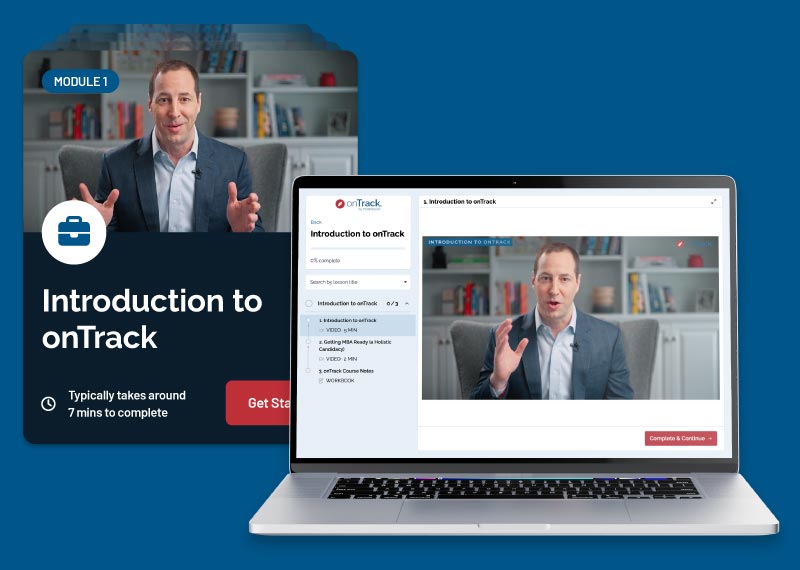
Harold Simansky: Absolutely. And a quick plug for our OnTrack platform. It’s excellent for helping people research schools and get an inside look at programs. It’s organized more clearly than most school websites.
Jeremy Shinewald: One applicant told me he picked everything up in 45 minutes using our site.
OnTrack covers who thrives at a given school, how the curriculum works, job outcomes, and unique features like niche programs. It helps people get smart on schools quickly. Once you’ve researched, you can transition to applying, with modules on essays, recommendations, and more.
Even with that foundation, there’s still value in “kicking the tires” yourself—visiting campuses or attending online info sessions, which are widely available now. You can also connect with students through ambassador programs or LinkedIn. Even if you don’t have a network, you can reach out to schools directly and ask to speak to someone.
Harold Simansky: It’s worth doing some research first so you make the most of those calls.
Jeremy Shinewald: Exactly. So ideally, you’re getting your research done [and] taking diagnostics of both the GMAT and GRE to see which fits your strengths. Once you have your test and research, you move into applications.
People often start working with us as early as December or January, even though Round 1 deadlines aren’t until September. Essay [questions] are usually released in May or June, so that’s when the season really kicks off.
Harvard Business School’s Round 1 deadline, for example, is early September—right before or after Labor Day. Round 2 is in January. We always encourage clients to submit at least a week early to avoid last‑minute scrambling.
Harold Simansky: And essays come first, then the full application forms?
Jeremy Shinewald: Correct. The essays are released first. The full applications—which include detailed questions about your work history, salary progression, community engagement, academics, and awards—come out about a month later. These short answers take a long time, so don’t leave them until the last day.
Harold Simansky: Recommendation forms are also critical. Schools vary: some require one recommender, some two. Identifying and preparing recommenders early is crucial. Never ask someone two days before the deadline.
Jeremy Shinewald: Once you’ve submitted your application in September, two types of interviews can follow. Some schools require an online recorded interview immediately after submission—short, timed questions where you speak to a camera. They can feel intimidating because you can’t redo them and don’t know how you’re being evaluated.
Most schools do a first cut before offering live interviews. By October, Round 1 applicants may start receiving interview invitations. Decisions usually follow in November or December.
Harold Simansky: And then the tables turn. Now the schools want you to come. It’s an exciting but stressful time.
Jeremy Shinewald: If you’re choosing between multiple offers. Some applicants apply to a few schools in Round 1 and save others for Round 2 in January. Round 2 interviews happen in February, with decisions in March or April.
Harold Simansky: The whole process can span 18 months from test prep to final decisions. Some applicants are even waitlisted into the summer, occasionally up until classes start in August. It’s rare, but it happens.
Jeremy Shinewald: There’s also a Round 3 at many schools, but we generally advise against it. It’s harder to get admitted because most seats are filled. It does happen (we’ve seen clients get into Wharton in Round 3), but it’s the exception.
After acceptances, most schools host welcome weekends. You can compare programs, negotiate scholarships, and, for international students, begin the visa process. By late spring or early summer, most applicants know where they’re headed.
That’s a great crash course.
Harold Simansky: Right, I think we covered everything required in an MBA 101 course.
Jeremy Shinewald: Awesome. Great job. Thanks for having me on your podcast.
Harold Simansky: Thank you for allowing me to allow you onto my podcast.
Jeremy Shinewald: If you want to be one of our success stories, sign up for a free consultation with a member of our full‑time MBA admissions team. We’ve worked with tens of thousands of applicants over the past two decades. We can give you an honest opinion on your chances and help you put together your very best application. This is not a sales call — it’s your first session with us, free. We can evaluate your profile, answer process questions, review your resume, talk about school choices, and more. Sign up here. We look forward to working with you.